


Cloud Computing for Business: The Ultimate Beginner’s Guide
The business world has fundamentally changed, and cloud computing stands at the center of this transformation. From small startups to Fortune 500 giants, organizations across America are discovering that cloud computing isn’t just a technology trend, it’s a business imperative that can determine competitive success or failure. The statistics speak volumes: 94% of enterprises now use cloud services, a dramatic increase from just 80% in 2020. This shift represents more than technological adoption; it signals a fundamental reimagining of how businesses operate, scale, and compete in the digital economy.
What is Cloud Computing: The Foundation of Modern Business
Cloud computing represents a paradigm shift from traditional IT infrastructure to on-demand, internet-based computing services. Rather than owning and maintaining physical servers, businesses access computing power, storage, and applications through remote data centers managed by specialized providers. This model transforms IT from a capital expense requiring substantial upfront investment into an operational expense that scales with business needs.
The concept revolves around three essential characteristics: on-demand self-service, broad network access, and resource pooling. Users can provision computing capabilities automatically without requiring human interaction with service providers. Services are available over networks through standard mechanisms that promote access across heterogeneous platforms. Provider resources are pooled to serve multiple consumers using a multi-tenant model, with different physical and virtual resources dynamically assigned according to consumer demand.
American businesses have embraced this model at unprecedented rates. Research from the National Center for Science and Engineering Statistics reveals that 54% of firms have digitalized at least one business function while purchasing cloud computing services. This adoption spans across industries, with information services leading at over 80% digitalization and cloud computing usage exceeding 60%. Even traditionally conservative sectors like manufacturing and agriculture show adoption rates between 30-50%.
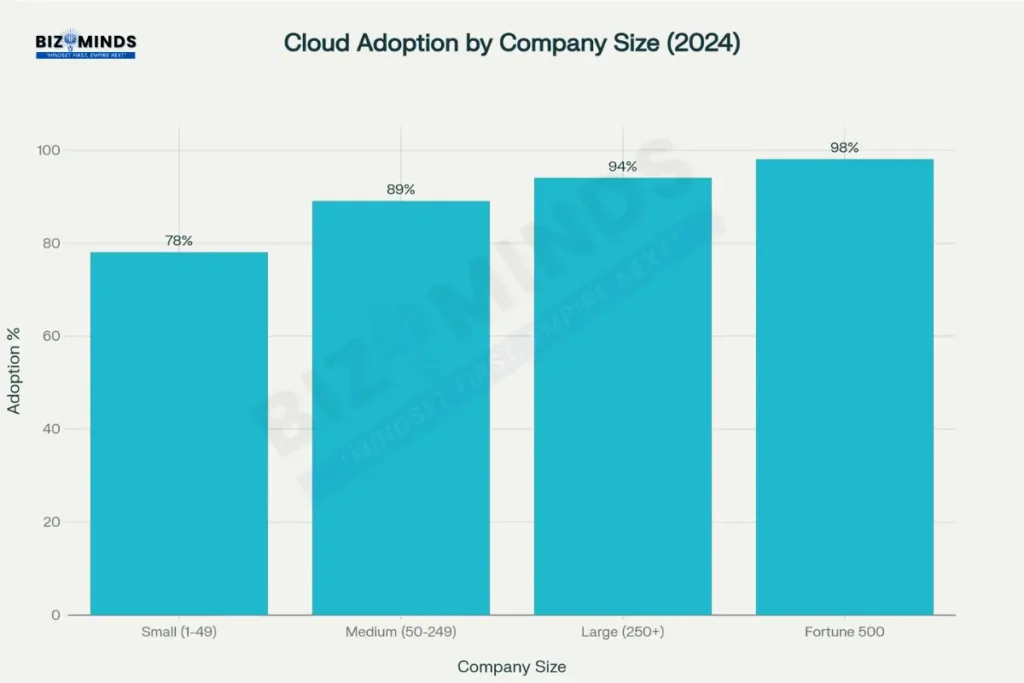
Cloud computing adoption increases significantly with company size, with Fortune 500 companies leading at 98% adoption
The Business Impact of Cloud Computing Adoption
The financial implications of cloud computing extend far beyond simple cost comparisons. Organizations utilizing cloud platforms report up to 15% growth in revenue and 4% gains in profitability, highlighting cloud’s positive financial impact. Small and medium-sized businesses using cloud computing demonstrate particularly impressive results, generating 21% more profit and experiencing 26% faster growth compared to their non-cloud counterparts.
These improvements stem from cloud computing’s ability to transform business operations fundamentally. Companies achieve 37% faster time to market for new products and services, enabling them to respond more quickly to market opportunities. Application development productivity increases by 38%, allowing businesses to innovate more rapidly and efficiently. Perhaps most significantly, 71% of mature cloud adopters report faster adoption of new technologies, creating compounding advantages in competitive markets.
The cost benefits are equally compelling. Research indicates businesses can reduce IT expenditures by approximately 20% through cloud adoption. Organizations moving to public cloud platforms experience Total Cost of Ownership (TCO) savings between 30-40% compared to traditional on-premises infrastructure. These savings result from eliminated capital expenditures for hardware, reduced maintenance costs, and improved resource utilization efficiency.
Cloud Computing Service Models: Choosing the Right Foundation
Understanding cloud computing service models is crucial for making informed business decisions. The three primary models—Infrastructure as a Service (IaaS), Platform as a Service (PaaS), and Software as a Service (SaaS)—offer different levels of control, responsibility, and functionality.

Comprehensive comparison of cloud service models showing control levels, responsibilities, and use cases
Infrastructure as a Service (IaaS):
Providing the core building blocks of cloud computing, it allows businesses to utilize virtualized computing assets including servers, storage, and networking remotely through the internet. This model offers maximum flexibility and control, making it ideal for businesses requiring custom configurations or migrating existing applications with minimal changes. Amazon Web Services EC2, Microsoft Azure Virtual Machines, and Google Compute Engine represent leading IaaS solutions.
IaaS customers retain responsibility for operating systems, runtime environments, middleware, and applications while the provider manages underlying infrastructure including servers, virtualization, storage, and networking. This model particularly benefits organizations with skilled IT teams seeking infrastructure flexibility without capital expenditure commitments. The pay-as-you-go pricing allows businesses to scale resources dynamically, avoiding over-provisioning while ensuring adequate capacity during demand spikes.
Platform as a Service (PaaS):
It delivers a complete development and deployment environment in the cloud. This model enables developers to build, test, and deploy applications without managing underlying infrastructure complexities. PaaS providers handle servers, storage, networking, middleware, development tools, and database management systems. Popular examples include AWS Lambda, Google App Engine, and Microsoft Azure Functions.
PaaS proves particularly valuable for organizations focusing on application development and innovation rather than infrastructure management. Development teams can deploy applications faster, collaborate more effectively, and experiment with new technologies without infrastructure constraints. The model accelerates development cycles while reducing costs associated with software licenses, development tools, and hardware maintenance.
Software as a Service (SaaS):
It delivers fully functional applications over the internet. Software is accessible via web browsers or mobile applications, eliminating the requirement for local installation or maintenance. The provider handles all infrastructure, platform, and application management, leaving customers responsible only for data and user management. Microsoft 365, Salesforce, and Slack exemplify successful SaaS offerings.
SaaS offers the lowest barrier to entry and minimal technical requirements, making it ideal for end-users focused on business outcomes rather than technical implementation. Organizations benefit from automatic updates, simplified deployment, and predictable subscription costs. The model enables rapid adoption of enterprise-grade capabilities previously accessible only to large organizations with substantial IT resources.
Deployment Models: Public, Private, and Hybrid Strategies
Cloud deployment models determine where and how cloud services are implemented, each offering distinct advantages aligned with specific business requirements.
Public Cloud:
As the leading deployment model, it delivers services via third-party providers on the internet, making resources readily accessible to users. Resources are shared among multiple organizations, enabling providers to achieve economies of scale that translate into lower costs for customers. Major public cloud platforms include Amazon Web Services, Microsoft Azure, and Google Cloud Platform.
Public cloud:
Public Cloud excels in cost-effectiveness through its pay-as-you-go model, requiring no upfront capital investment. Organizations access enterprise-grade infrastructure and services immediately, scaling resources up or down based on demand. The model provides global reach through provider networks spanning multiple regions, enabling businesses to serve customers worldwide with minimal latency. However, organizations sacrifice some control and customization capabilities in exchange for lower costs and simplified management.
Private Cloud:
Cloud computing delivered on private, dedicated infrastructure that serves only one organization, maximizing control and compliance. This model provides maximum control, customization, and security while maintaining cloud benefits like scalability and automation. Private clouds can be hosted on-premises, by third-party providers, or in dedicated sections of provider data centers.
Organizations choose private cloud for heightened security requirements, regulatory compliance needs, or specific performance demands. The model enables complete customization of hardware, software, and policies while providing predictable performance through dedicated resources. However, private cloud requires higher capital investment and internal expertise for management, potentially offsetting some cloud economics.
Hybrid Cloud:
Hybrid Cloud combines public and private cloud environments, enabling organizations to leverage benefits of both models while addressing specific requirements. Sensitive workloads remain in private environments while less critical applications utilize public cloud resources for cost efficiency and scalability.
Hybrid approaches provide optimal flexibility, allowing workload placement based on security, performance, and cost considerations. Organizations can maintain control over critical systems while accessing public cloud capabilities for burst capacity, development environments, or new initiatives. The model enables gradual cloud migration, reducing risk while building organizational cloud expertise.
Cloud Computing Migration Strategy: Step-by-Step Roadmap
Successful cloud migration requires systematic planning and execution following proven methodologies. The widely adopted “6 Rs” framework provides structured approaches for different migration scenarios.
Rehosting is a cloud migration strategy where existing applications are transferred to cloud platforms without significant redesign or alteration. This approach offers quick migration timelines and reduced risk but may not fully capitalize on cloud-native capabilities. Rehosting works well for organizations seeking immediate infrastructure benefits while planning future optimization.
Replatforming makes tactical optimizations to leverage cloud capabilities without fundamental architecture changes. Examples include migrating databases to managed services or updating operating systems to cloud-optimized versions. This approach balances migration speed with cloud benefit realization.
Refactoring transforms applications to harness cloud-native features, enabling improved scalability, resilience, and operational efficiency. While requiring more time and investment, refactoring delivers maximum cloud benefits including improved scalability, resilience, and cost efficiency. Organizations typically pursue this approach for strategic applications requiring long-term optimization.
Retiring involves decommissioning applications no longer providing business value. Migration projects often reveal redundant or obsolete systems that can be eliminated, reducing complexity and costs. This approach requires careful analysis to ensure no critical capabilities are lost.
Retaining keeps certain applications on-premises due to regulatory, technical, or business constraints. Some applications are unsuitable for cloud migration because of stringent latency requirements, licensing constraints, or intricate integration challenges. Organizations should regularly reassess retained systems as cloud capabilities evolve.
Repurchasing replaces existing applications with cloud-native alternatives, typically SaaS solutions. This approach can accelerate capability adoption while reducing custom application maintenance burden. Organizations must evaluate functional fit and data migration requirements when considering repurchasing options.
Cloud Migration Checklist
| Phase | Task | Priority | Estimated Time Days | Key Stakeholders |
| Planning | Define business objectives and goals | High | 5 | C-Suite, IT Leadership |
| Planning | Establish budget and timeline | High | 3 | Finance, IT Leadership |
| Planning | Identify key stakeholders | High | 2 | All Departments |
| Planning | Create project team and assign roles | Medium | 3 | IT Team, HR |
| Planning | Develop communication plan | Medium | 2 | Marketing, IT |
| Assessment | Inventory current IT infrastructure | High | 7 | IT Team, Operations |
| Assessment | Assess application dependencies | High | 5 | IT Team, Development |
| Assessment | Evaluate security requirements | Critical | 4 | Security Team, Compliance |
| Assessment | Analyze compliance needs | Critical | 3 | Legal, Compliance |
| Assessment | Calculate current operational costs | High | 4 | Finance, IT |
| Strategy | Select cloud service model (IaaS/PaaS/SaaS) | Critical | 4 | IT Architecture, Business |
| Strategy | Choose cloud deployment model | Critical | 3 | IT Architecture |
| Strategy | Select cloud service provider | Critical | 5 | IT Leadership, Procurement |
| Strategy | Design target architecture | High | 8 | IT Architecture, Security |
| Strategy | Create migration strategy (6 Rs) | High | 6 | IT Leadership, Business |
| Migration | Set up cloud environment | Critical | 10 | IT Operations, Cloud Team |
| Migration | Migrate data and applications | Critical | 15 | IT Operations, Development |
| Migration | Configure security settings | Critical | 7 | Security Team, IT Ops |
| Migration | Test functionality and performance | High | 10 | QA Team, End Users |
| Migration | Train staff on new systems | Medium | 5 | HR, IT Training |
| Post-Migration | Monitor performance and costs | High | 30 | IT Operations, Finance |
| Post-Migration | Optimize resource allocation | High | 14 | IT Operations, Finance |
| Post-Migration | Implement governance policies | Critical | 7 | IT Leadership, Legal |
| Post-Migration | Conduct security audits | Critical | 5 | Security Team, Auditors |
| Post-Migration | Plan for continuous improvement | Medium | 30 | IT Leadership, Business |
Implementation Best Practices
Successful cloud migration follows structured phases ensuring minimal business disruption while maximizing benefits. The preparation phase involves comprehensive assessment of current infrastructure, applications, and business requirements. Organizations must inventory existing systems, identify dependencies, and evaluate technical constraints affecting migration approaches.
Planning develops detailed migration roadmaps including timelines, resource requirements, and success metrics. Effective plans address risk mitigation, communication strategies, and contingency procedures for addressing unexpected challenges. Organizations should establish clear governance models defining roles, responsibilities, and decision-making authority throughout migration projects.
Migration execution implements planned transitions while maintaining operational continuity. Best practices include phased approaches starting with non-critical systems, extensive testing at each stage, and maintaining rollback capabilities until migrations are validated. Organizations should implement comprehensive monitoring to detect issues quickly and ensure performance meets expectations.
Post-migration optimization focuses on realizing full cloud benefits through ongoing refinement. Activities include cost optimization through right-sizing resources, security hardening, and process automation. Organizations should establish continuous improvement processes ensuring cloud investments deliver sustained value.
Security and Compliance: Protecting Your Cloud Investment
Cloud security represents a shared responsibility between providers and customers, requiring clear understanding of respective obligations. The shared responsibility model defines provider responsibilities for securing underlying infrastructure while customers maintain responsibility for applications, data, and access management.
Provider responsibilities typically include physical security of data centers, host operating system patching, network infrastructure protection, and hypervisor security. Major cloud providers invest billions in security capabilities, often exceeding what individual organizations can achieve independently. These investments include advanced threat detection, security monitoring, and compliance certification maintenance.
Customer responsibilities encompass identity and access management, data encryption, network traffic protection, and application-level security. Organizations must implement robust authentication mechanisms, configure security groups properly, and maintain current security patches for customer-managed components. Regular security assessments and vulnerability testing remain critical customer obligations.
Compliance Framework Implementation
American businesses must navigate complex regulatory requirements including HIPAA for healthcare data, SOX for financial reporting, and various industry-specific standards. Cloud adoption requires careful alignment of provider capabilities with regulatory obligations.
HIPAA compliance in cloud environments demands comprehensive controls protecting patient health information. Cloud providers serving healthcare organizations must sign Business Associate Agreements (BAAs) committing to HIPAA compliance standards. Required controls include data encryption during transmission and storage, access logging, and audit trail maintenance.
Regardless of cloud provider features, healthcare organizations remain ultimately accountable for maintaining HIPAA compliance. Implementation requires risk assessments identifying vulnerabilities, access control policies limiting PHI access to authorized personnel, and disaster recovery procedures ensuring data availability. Regular compliance audits and staff training programs ensure ongoing adherence to regulatory requirements.
SOX regulations require publicly traded firms to ensure their cloud computing strategies align with compliance mandates. The Sarbanes-Oxley Act mandates controls ensuring financial data integrity and accuracy. Cloud implementations must provide adequate audit trails, access controls, and data protection mechanisms supporting SOX requirements.
SOX compliance in cloud environments requires collaboration between organizations and providers. While providers ensure infrastructure reliability and security, customers must implement proper data governance, access management, and financial reporting controls. Ongoing evaluation and detailed documentation of internal controls remain fundamental for ensuring regulatory compliance.
Cloud Computing Cost Optimization and ROI Measurement
Cloud computing financial benefits extend beyond simple infrastructure cost comparisons. Comprehensive ROI calculations must consider total cost of ownership, operational efficiency gains, and business value creation.
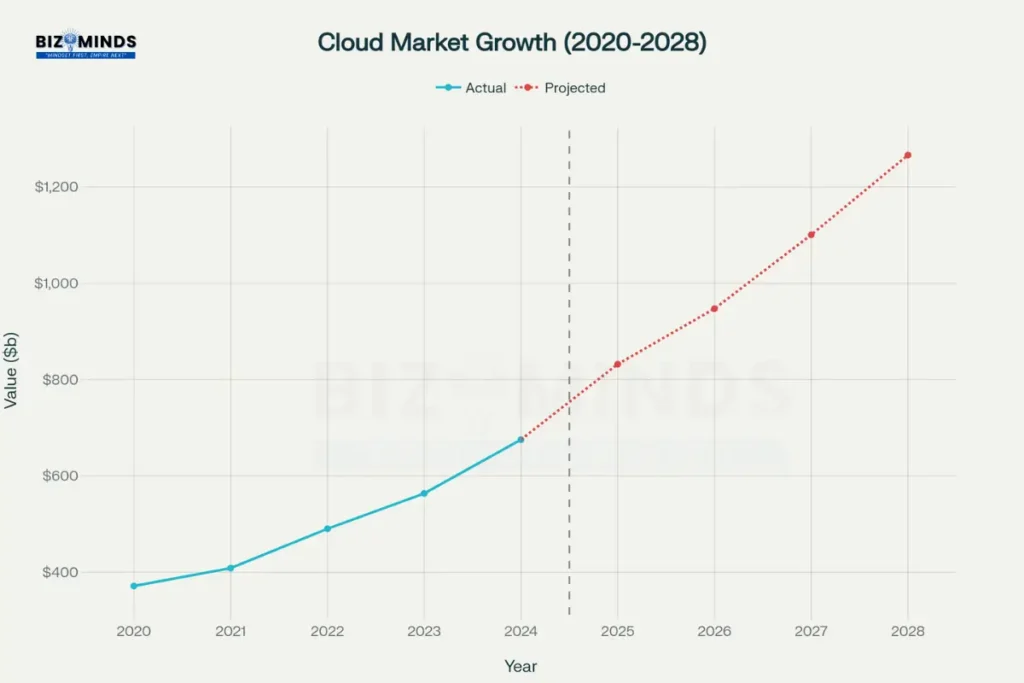
Cloud computing market shows consistent growth from $371B in 2020 to projected $1.27T by 2028
Cost reduction mechanisms in cloud computing operate through multiple channels. Organizations eliminate capital expenditures for hardware purchases, maintenance contracts, and facility costs. The pay-as-you-go model aligns costs with actual usage, avoiding over-provisioning while ensuring adequate capacity. Automated scaling capabilities reduce operational overhead while improving resource utilization efficiency.
Studies demonstrate cloud computing can reduce IT spending by 20-30% through effective optimization practices. Organizations migrating to public cloud platforms achieve TCO savings between 30-40% compared to traditional infrastructure. These savings result from shared infrastructure economics, reduced administrative overhead, and improved operational efficiency.
Performance metrics for cloud ROI measurement should encompass multiple dimensions beyond direct cost comparisons. Time-to-market improvements of up to 37% enable organizations to capitalize on opportunities faster, generating revenue that may exceed cost savings. Operational efficiency gains through automation and improved processes often produce productivity improvements justifying cloud investments independent of infrastructure costs.
Revenue impact measurements demonstrate cloud computing’s value creation potential. Organizations report revenue increases up to 15% following cloud adoption, attributed to improved customer experiences, new service capabilities, and enhanced operational responsiveness. Small and medium businesses show particularly strong results, with 21% higher profits and 26% faster growth compared to non-cloud competitors.
Financial Planning and Budgeting
Successful cloud financial management requires understanding pricing models and implementing cost control mechanisms. Reserved Instances offer 50-70% savings compared to on-demand pricing for predictable workloads through one-year or three-year commitments. Spot Instances provide up to 90% discounts for fault-tolerant workloads by utilizing unused provider capacity.
Implementing cost monitoring and optimization processes helps avoid exceeding budgets and enhances resource efficiency. Organizations should implement automated cost tracking, establish budget alerts, and regularly review resource utilization patterns. Right-sizing instances based on actual usage patterns, implementing automated shutdown for development environments, and leveraging reserved capacity for stable workloads optimize spending efficiency.
Effective cloud financial management requires ongoing attention and optimization. 66% of organizations experience higher-than-expected cloud costs due to insufficient management practices. Successful organizations implement dedicated cost management processes, provide cost visibility to development teams, and establish governance policies preventing cost proliferation.
Cloud Computing Success Stories: Netflix, Airbnb & SMBs
American companies across industries demonstrate cloud computing’s transformative potential through successful implementations delivering substantial business value.
Netflix represents perhaps the most celebrated cloud transformation story. The streaming giant migrated its entire infrastructure to Amazon Web Services, enabling global scaling to over 190 countries while serving millions of concurrent users. Netflix’s cloud-first architecture supports massive content delivery, personalized recommendations, and seamless user experiences across devices.
The migration enabled Netflix to handle unpredictable demand spikes during popular content releases without infrastructure constraints. Cloud-based microservices architecture allows independent scaling of different application components, optimizing performance while controlling costs. Advanced analytics capabilities powered by cloud services enable sophisticated content recommendation algorithms driving user engagement.
Netflix achieves 99.99% uptime across global markets through multi-region AWS deployments providing redundancy and disaster recovery capabilities. The company processes hundreds of millions of streaming hours daily while maintaining consistent performance through cloud-based content delivery networks. This achievement would require prohibitive infrastructure investment using traditional approaches.
Airbnb transformed from a simple lodging marketplace to a global platform serving millions of users through strategic cloud adoption. Initial on-premises infrastructure proved inadequate for handling traffic spikes during peak booking seasons, leading to performance bottlenecks and customer dissatisfaction. Cloud migration enabled dynamic scaling capabilities supporting rapid business growth and global expansion.
The platform now handles massive transaction volumes during peak periods while maintaining response times and availability standards. Cloud-based analytics enable sophisticated pricing algorithms, fraud detection, and personalized recommendations enhancing user experiences. Global expansion accelerated through cloud infrastructure providing local presence in multiple markets without substantial capital investment.
Small and Medium Cloud Computing Business Success
American SMBs demonstrate cloud computing’s accessibility and impact across diverse industries. A typical e-commerce startup reduced infrastructure costs by 60% while improving website performance through cloud-based hosting and content delivery. The pay-as-you-go model enabled growth from serving hundreds to thousands of customers without upfront infrastructure investment.
Manufacturing companies implement cloud-based ERP systems improving inventory management, production planning, and customer service. These implementations often reduce software licensing costs while providing enhanced functionality previously available only to larger competitors. Cloud-based collaboration tools enable remote work capabilities supporting business continuity during disruptions.
Professional services firms leverage cloud computing for client communication, project management, and data analytics. Implementations typically reduce IT management overhead while improving service delivery capabilities. The scalability enables serving larger clients or handling project spikes without infrastructure constraints.
Business Benefits of Cloud Computing: Beyond Infrastructure
Cloud computing’s influence goes well beyond mere upgrades to technical infrastructure, driving profound transformations in business operations, enhancing agility, and reshaping competitive advantage in the market. By enabling rapid innovation, flexible scaling, and improved collaboration, cloud adoption empowers organizations to respond swiftly to changing market demands and unlock new growth opportunities. This paradigm shift facilitates cost efficiency, streamlined processes, and accelerated time-to-market, ultimately positioning businesses to thrive in a fast-paced digital landscape.
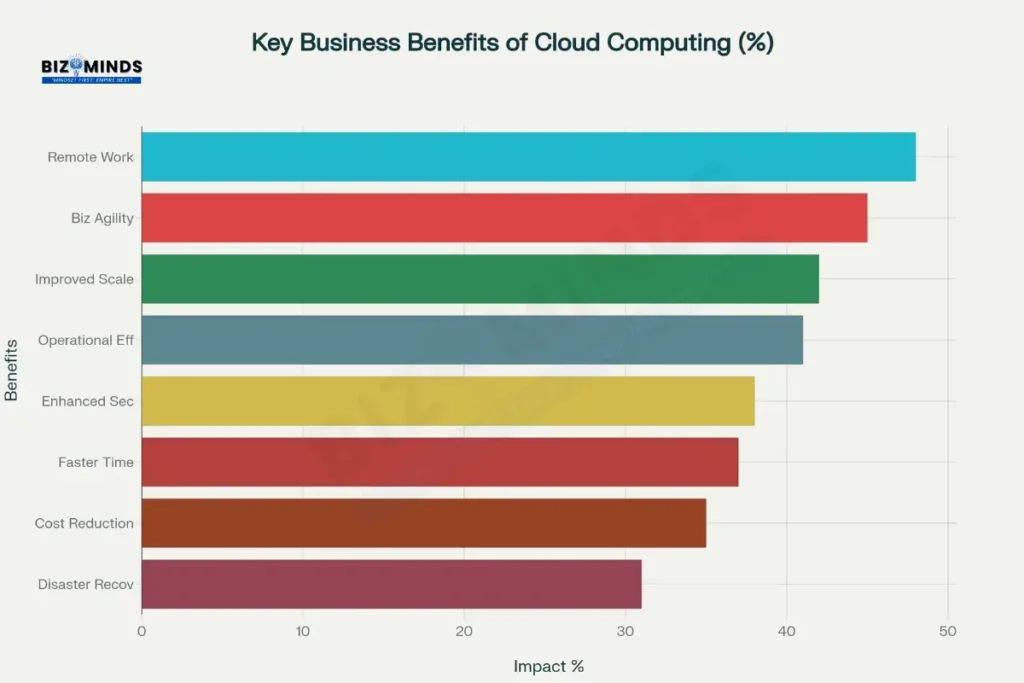
Remote work support leads cloud computing benefits at 48%, followed by business agility and improved scalability
Operational agility emerges as cloud computing’s most significant business benefit. Organizations can launch new initiatives, enter markets, or respond to competitive threats more rapidly through cloud capabilities. Traditional infrastructure procurement and deployment cycles measured in months compress to minutes or hours in cloud environments. This responsiveness enables businesses to capitalize on opportunities and adapt to market changes more effectively.
Innovation acceleration results from reduced infrastructure management overhead and improved development capabilities. Development teams focus on creating business value rather than managing servers, databases, and networking infrastructure. Cloud-based development tools and services significantly accelerate application development by simplifying workflows and reducing technical complexity. Leveraging scalable cloud resources, these tools enable development teams to build, test, and deploy software faster and more efficiently compared to traditional methods. Additionally, cloud platforms offer enhanced collaboration, flexibility, and cost savings, allowing organizations to focus on innovation without being hindered by infrastructure limitations. Organizations report 38% improvements in development productivity following cloud adoption.
Remote work enablement has become increasingly crucial for business continuity and talent acquisition. Cloud-based applications and infrastructure support distributed teams effectively, providing secure access to business systems from any location. 82% of companies report enhanced cooperation and communication through cloud applications. This capability proved essential during the COVID-19 pandemic and remains valuable for ongoing operations.
Disaster recovery and business continuity capabilities improve dramatically through cloud implementation. Traditional disaster recovery requires substantial investment in secondary infrastructure often remaining unused for years. Cloud-based disaster recovery provides cost-effective redundancy through geographically distributed infrastructure. Organizations achieve recovery times of 2.1 hours compared to 8 hours for non-cloud environments.
Competitive Advantage Creation
Cloud adoption creates sustainable competitive advantages through multiple mechanisms. Faster time-to-market for products and services enables organizations to capture market opportunities ahead of competitors. Enhanced customer experiences through improved application performance, availability, and functionality drive customer satisfaction and retention.
Data-driven decision making improves through cloud-based analytics capabilities providing insights previously requiring substantial investment in specialized infrastructure and expertise. Organizations can analyze customer behavior, operational performance, and market trends more effectively, enabling better strategic decisions.
Scalability without constraints enables businesses to pursue growth opportunities without infrastructure limitations. Organizations can expand into new markets, serve larger customers, or handle demand spikes without lengthy infrastructure planning cycles. This capability proves particularly valuable for seasonal businesses or those experiencing rapid growth.
Implementation Roadmap: Your Path to Cloud Success
Successful cloud implementation requires systematic approaches balancing business objectives with technical constraints and risk management.
Phase 1:
A thorough assessment and detailed planning process form the essential groundwork for effective cloud adoption, ensuring that organizations are well-prepared for migration challenges and aligned with their strategic goals. Organizations must inventory current infrastructure, applications, and processes while identifying business drivers for cloud adoption. Comprehensive assessments include technical dependencies, security requirements, and compliance obligations affecting implementation approaches.
Business case development quantifies expected benefits including cost savings, productivity improvements, and risk reduction. Financial projections should consider total cost of ownership changes, operational efficiency gains, and revenue impact potential. Realistic timelines account for organizational readiness, technical complexity, and change management requirements.
Phase 2:
Strategy Development defines specific cloud computing approaches aligned with business objectives. Service model selection (IaaS, PaaS, SaaS) depends on organizational capabilities, control requirements, and integration needs. Deployment model decisions balance cost, security, and compliance considerations.
Provider evaluation encompasses technical capabilities, security posture, compliance certifications, and total cost of ownership. Multi-cloud strategies may provide benefits through risk diversification and capability optimization, but increase management complexity. Organizations should prioritize simplicity during initial implementations while maintaining flexibility for future expansion.
Phase 3:
Pilot Implementation validates cloud approaches through limited-scope deployments. Pilot projects should represent realistic workloads while minimizing business risk through careful selection. Success criteria must be measurable and aligned with broader business objectives.
Pilot implementations provide learning opportunities for technical teams while demonstrating cloud benefits to organizational stakeholders. Feedback from pilot projects informs broader deployment strategies and identifies potential challenges requiring mitigation. Performance monitoring during pilots establishes baselines for evaluating ongoing cloud operations.
Phase 4:
Full-Scale Deployment expands cloud adoption based on pilot learnings and organizational readiness. Adopting a phased approach reduces risk by executing changes incrementally, which also helps build organizational knowledge and confidence step by step. Change management programs ensure staff understand new processes and tools while addressing resistance to change.
Training programs develop organizational cloud computing capabilities essential for long-term success. Technical teams require hands-on experience with cloud platforms and tools. Business users need training on new applications and processes enabled by cloud adoption. Ongoing education ensures organizations maximize cloud investment value.
Future of Cloud Computing: Trends & Predictions for 2025+
The cloud computing landscape continues evolving rapidly, driven by technological innovations and changing business requirements. Edge computing brings cloud capabilities closer to data sources and users, reducing latency while enabling new applications like autonomous vehicles and IoT implementations. American businesses increasingly adopt edge strategies for performance-sensitive applications requiring real-time processing.
Artificial intelligence and machine learning integration with cloud platforms democratizes advanced analytics capabilities previously accessible only to technology giants. Cloud-based AI services enable small businesses to implement sophisticated customer analytics, predictive maintenance, and automated decision-making without substantial technical expertise. These capabilities are becoming essential competitive differentiators across industries.
Sustainability considerations drive cloud adoption as organizations seek to reduce carbon footprints. Cloud infrastructure typically operates more efficiently than on-premises data centers, reducing energy consumption by up to 84% when moving workloads to Infrastructure as a Service. Major cloud providers commit to renewable energy usage, enabling customers to achieve sustainability objectives through cloud adoption.
Regulatory evolution continues shaping cloud computing adoption strategies. New privacy regulations and data sovereignty requirements influence deployment model selection and provider choice. Organizations must maintain flexibility to adapt cloud strategies as regulatory landscapes evolve.
The trajectory toward cloud-native business models appears irreversible. Organizations achieving cloud maturity gain compounding advantages through improved agility, innovation capabilities, and operational efficiency. Those delaying adoption risk falling behind competitors leveraging cloud capabilities for market advantages.
Conclusion
The widespread adoption of cloud computing highlights its role as a strategic necessity rather than a mere technology upgrade. With over 90% of enterprises and nearly 80% of small businesses leveraging cloud platforms, organizations that postpone migration risk falling behind their competitors. Beyond cost savings, cloud computing enables faster product rollouts, improved operational efficiency, and enhanced customer experiences—advantages that define market leadership in today’s digital economy.
Achieving success with cloud computing demands more than lifting existing systems into the cloud; it requires a holistic transformation of business processes and culture. Only a minority of digital initiatives fully realize their objectives, often due to insufficient planning or stakeholder alignment. By investing in comprehensive migration strategies, change management, and staff training, organizations can unlock the full potential of cloud services and avoid common pitfalls.
Looking forward, the evolution of cloud computing will be shaped by innovations like edge computing, advanced AI services, and tighter integration with emerging technologies such as IoT and 5G. The market’s projected growth to over $700 billion by 2025 underscores the urgency for businesses to adopt cloud solutions now. Early adopters will benefit from real-time analytics, personalized customer interactions, and unrivaled scalability—capabilities that promise to redefine competitive advantage.
For American businesses, the message is clear: embracing cloud computing is not a one-time project but an ongoing journey of optimization and innovation. Success hinges on setting clear objectives, selecting appropriate service and deployment models, and fostering a culture that values agility and continuous improvement. Organizations that master this approach will be well-equipped to navigate future challenges and sustain long-term growth.
Frequently Asked Questions
Q1: How much does it cost to implement cloud computing for a small business?
Cloud computing costs for small businesses vary significantly based on requirements and usage patterns. Most small businesses can start with basic cloud services for $50-200 per month, scaling costs with business growth. The pay-as-you-go model eliminates large upfront investments while providing enterprise-grade capabilities. Many businesses reduce overall IT costs by 20-30% through cloud adoption, as operational expenses replace capital expenditures for hardware and software licenses.
Q2: Is cloud computing secure enough for sensitive business data?
Properly implemented cloud computing can surpass traditional on-premises infrastructure security through robust encryption, centralized controls, and real-time threat detection. Major cloud providers invest billions in security capabilities including advanced threat detection, encryption, and compliance certifications. However, security remains a shared responsibility requiring organizations to implement proper access controls, data encryption, and monitoring practices. Many cloud environments exceed security capabilities available to individual organizations through dedicated security teams and automated threat response systems.
Q3: How long does cloud migration typically take for a business?
Cloud migration timelines vary from weeks to years depending on complexity, organizational readiness, and migration scope. Simple migrations involving SaaS adoption can be completed in days or weeks. Comprehensive infrastructure migrations typically require 6-18 months including planning, testing, and gradual transition phases. Organizations should prioritize business-critical applications and plan phased approaches minimizing operational disruption while building cloud expertise progressively.
Q4: What happens to my data and services if my cloud provider goes out of business or faces downtime?
Reputable cloud providers maintain robust business continuity and disaster recovery capabilities, with major providers offering 99.9%+ uptime guarantees backed by service level agreements. Organizations can mitigate provider risks through multi-cloud strategies, data backup procedures, and exit planning. Cloud providers typically offer higher availability than individual organizations can achieve independently through redundant infrastructure, automated failover, and geographic distribution.
Q5: Can I move back to on-premises infrastructure if cloud computing doesn’t work for my business?
Cloud migration reversibility depends on implementation approaches and data management practices. Organizations maintaining proper data portability and avoiding vendor lock-in can return to on-premises infrastructure, though this requires careful planning. However, most organizations find cloud benefits compelling once proper implementation and optimization occur. Only 5% of organizations plan to switch from cloud to on-premises infrastructure, indicating high satisfaction with cloud capabilities.
Q6: Do I need technical expertise to implement cloud computing successfully?
While technical expertise enhances cloud implementation success, many cloud services are designed for non-technical users. SaaS applications like Microsoft 365 or Salesforce require minimal technical knowledge for basic usage. More complex implementations benefit from technical expertise or professional services support. Many organizations combine internal training with external expertise during initial implementations, gradually building internal capabilities for ongoing management and optimization.
Citations
- https://www.cloudzero.com/blog/cloud-computing-statistics/
- https://www.hostingadvice.com/how-to/cloud-adoption-statistics/
- https://www.ibm.com/think/topics/iaas-paas-saas
- https://cloud.google.com/learn/paas-vs-iaas-vs-saas
- https://ncses.nsf.gov/pubs/ncses22213/assets/ncses22213.pdf
- https://n2ws.com/blog/cloud-computing-statistics
- https://www.cloudzero.com/blog/cloud-savings/
- https://vaporvm.com/top-benefits-of-cloud-services-for-businesses-why-cloud-computing-is-essential-in-2024/
- https://www.cloudkeeper.com/insights/blog/cloud-cost-savings-definitive-guide-proven-strategies-best-practices-hacks
- https://www.esparkinfo.com/blog/cloud-computing-statistics
- https://www.cohesity.com/glossary/iaas-paas-saas/
- https://www.techbrain.com.au/cloud-computing-models-explained-iaas-paas-saas/
- https://www.geeksforgeeks.org/software-engineering/difference-between-iaas-paas-and-saas/
- https://aws.amazon.com/types-of-cloud-computing/
- https://www.geeksforgeeks.org/devops/public-cloud-vs-private-cloud-vs-hybrid-cloud/
- https://testgrid.io/blog/public-vs-private-vs-hybrid-cloud/
- https://www.bmc.com/blogs/public-private-hybrid-cloud/
- https://azure.microsoft.com/en-us/resources/cloud-computing-dictionary/what-are-private-public-hybrid-clouds
- https://www.cantech.in/blog/public-cloud-vs-private-cloud-vs-hybrid-cloud/
- https://www.akamai.com/blog/cloud/cloud-migration-strategy
- https://www.lucidchart.com/blog/cloud-migration-strategies-the-6-rs-of-cloud-migration
- https://www.netapp.com/learn/cloud-migration-strategy-challenges-and-steps/
- https://www.geeksforgeeks.org/cloud-computing/cloud-migration/
- https://www.exabeam.com/explainers/cloud-security/cloud-security-principles-solutions-and-architectures/
- https://www.crowdstrike.com/en-us/cybersecurity-101/cloud-security/cloud-security-best-practices/
- https://www.wiz.io/academy/cloud-security-best-practices
- https://www.checkpoint.com/cyber-hub/cloud-security/what-is-cloud-security/
- https://www.ahead.com/resources/regulatory-compliance-in-the-cloud/
- https://www.aquasec.com/cloud-native-academy/cloud-compliance/cloud-compliance/
- https://www.veeam.com/blog/guide-to-cloud-compliance.html
- https://www.wiz.io/academy/cloud-compliance-fast-track-guide
- https://www.hyperglance.com/blog/cloud-compliance-standards/
- http://www.opengroup.org/cloud/wp_cloud_roi/p5.htm
- https://ahanait.com/blog/how-to-best-predict-and-maximize-rol-on-cloud/
- https://ergos.com/8-ways-to-measure-cloud-roi/
- https://www.economize.cloud/blog/small-businesses-cloud-computing-cost/
- https://cloudsphere.com/cloud-computing-cost-drivers-and-savings/
- https://www.cloudzero.com/blog/cloud-roi/
- https://www.scribd.com/document/807528221/Case-Study-1
- https://aws.amazon.com/solutions/case-studies/netflix-case-study/
- https://www.qsstechnosoft.com/blog/aws-63/scaling-the-cloud-how-netflix-leveraged-aws-for-seamless-global-streaming-698
- https://netflixtechblog.com/cloud-efficiency-at-netflix-f2a142955f83
- https://www.park.edu/blog/leveraging-cloud-computing-for-business-efficiency-and-growth/
- https://www.techaheadcorp.com/blog/cloud-computing-for-small-medium-size-businesses/
- https://www.workast.com/blog/cloud-computing-tips-for-growing-your-small-business/
- https://www.newweborder.co/blogs/Cloud-Computing-for-Small-Business-Guide-2025
- https://www.mckinsey.com/featured-insights/mckinsey-explainers/what-is-cloud-computing
- https://www.geeksforgeeks.org/cloud-computing/differences-between-disaster-recovery-and-business-continuity-in-cloud-computing/
- https://www.cloudthat.com/resources/blog/cloud-disaster-recovery-and-business-continuity
- https://www.oracle.com/in/business-continuity/business-continuity-disaster-recovery/
- https://faddom.com/business-continuity-in-the-cloud-pros-cons-and-key-considerations/
- https://www.future-processing.com/blog/how-to-implement-cloud-computing/
- https://www.lenovo.com/in/en/glossary/cloud-computing-for-small-business/
- https://aws.amazon.com/blogs/smb/how-to-measure-the-roi-of-your-small-businesss-cloud-workflows/
- https://spacelift.io/blog/cloud-computing-statistics
- https://www.dsolutionsgroup.com/a-simple-guide-to-cloud-computing-for-a-small-business/
- https://www.statista.com/topics/11124/industry-cloud-in-the-us/
- https://zoetalentsolutions.com/cloud-computing-adoption-statistics-across-industries/
- https://turcomat.org/index.php/turkbilmat/article/download/5172/4327
- https://www.nextwork.org/blog/cloud-computing-stats-2025
- https://technologyadvice.com/blog/information-technology/4-ways-cloud-computing-can-save-money/
- https://edgedelta.com/company/blog/how-many-companies-use-cloud-computing
- https://99firms.com/research/cloud-computing-statistics/
- https://cloud.google.com/security/best-practices
- https://sam-solutions.us/insights/cloud-migration-strategy-guide-5-steps/
- https://cloudsecurityalliance.org/blog/2024/10/25/unpacking-the-cloud-security-best-practices-from-cisa-and-the-nsa
- https://www.analytics8.com/blog/cloud-migration-strategy-guide/
- https://www.youtube.com/watch?v=36zducUX16w
- https://www.esecurityplanet.com/cloud/cloud-security-best-practices/
- https://pubs.opengroup.org/onlinepubs/7698999599/toc.pdf
- https://aws.amazon.com/solutions/case-studies/innovators/netflix/
- https://www.intel.com/content/www/us/en/content-details/823269/case-study-netflix-chooses-amazon-ec2-instances-with-intel-xeon-processors-to-provide-fast-and-seamless-streaming-experiences.html
- https://www.alphaus.cloud/en/blog/roi-in-cloud-computing
- https://www.ibm.com/think/topics/public-cloud-vs-private-cloud-vs-hybrid-cloud
- https://www.bacancytechnology.com/blog/netflix-aws-migration
- https://cloudsecurityalliance.org/blog/2021/10/31/business-continuity-and-disaster-recovery-in-the-cloud
- https://www.ceiamerica.com/blog/compliance-requirements-guide/
- https://docs.aws.amazon.com/whitepapers/latest/disaster-recovery-workloads-on-aws/business-continuity-plan-bcp.html
- https://youdigital.com/cloud-computing-for-small-businesses-the-ultimate-guide-to-getting-started/
- https://www.exabeam.com/explainers/cloud-security/cloud-security-standards-iso-pci-gdpr-and-your-cloud/