

Money Saving Tips: I Save $8,000 Per Year Using These Weird Tricks
The American finance reveals a sobering reality that makes effective money saving tips more critical than ever before. Recent Federal Reserve data shows that only 73% of adults report doing okay or living comfortably financially, down from pre-pandemic levels and representing the lowest figure since 2016. This decline coincides with persistent inflation challenges, where 73% of Americans are saving less for emergency expenses due to rising prices, while one-third lack any emergency savings whatsoever. These statistics underscore an urgent need for innovative financial strategies that go beyond conventional budgeting advice.
Current economic pressures have fundamentally altered how American households approach money saving tips and financial planning. The median emergency savings amount has dropped to just $500 in 2025, down $100 from the previous year, while nearly 60% of Americans cannot handle a $1,000 emergency expense without borrowing money. Inflation continues to erode purchasing power despite cooling to 2.9% annually, with elevated prices for food, shelter, and essential services remaining stubbornly high. This environment demands strategic approaches that maximize savings impact while minimizing lifestyle disruption, making unconventional methods increasingly valuable for financial survival.
The psychological toll of financial stress amplifies the importance of practical money saving tips that deliver measurable results. Survey data reveals that 28% of Americans expect their financial situation to worsen over the next year, up significantly from 16% in 2024, while over half of middle-class households express concern about serious financial decline. These concerns reflect real challenges, with 27% of adults borrowing money from friends or family in the past year, and 21% experiencing problems paying rent or mortgage. Such widespread financial anxiety creates an environment where effective cost reduction strategies become essential tools for maintaining stability and peace of mind.
Strategic implementation of proven money saving tips can realistically achieve $8,000 in annual savings for most middle-income households through systematic expense optimization rather than dramatic lifestyle changes. Research demonstrates that the average American household spends $77,280 annually, providing substantial opportunities for strategic cost reduction across multiple categories.
By combining unconventional approaches like subscription archaeology, energy phantom load elimination, and strategic food purchasing methods, households consistently achieve savings rates that compound over time. The key lies in understanding that small, systematic changes create exponential results when implemented consistently, transforming financial stress into financial empowerment through methodical expense optimization.

Money Saving Tips Chart: Average American Household Budget Breakdown – Where Your $77,280 Goes
The Psychology Behind Unconventional Money Saving Tips That Actually Work
Traditional money saving tips often fail because they require dramatic lifestyle changes that feel restrictive. However, behavioral economics research reveals that small, seemingly insignificant adjustments can yield substantial results when implemented consistently. The key lies in understanding that most Americans waste money unconsciously through what experts call “phantom spending” – small, recurring expenses that fly under the financial radar.
Recent studies indicate that the average household harbors numerous opportunities for savings that remain invisible during conventional budgeting exercises. Energy efficiency improvements alone save the average American over $1,000 annually, while subscription service management can free up an additional $720 per year. These savings compound rapidly when multiple strategies work simultaneously.
The most successful money saving tips leverage automation and behavioral triggers rather than willpower. Research from personal finance experts demonstrates that individuals who implement systematic approaches to cost reduction achieve savings rates 40-60% higher than those relying solely on conscious spending choices. This psychological foundation explains why unconventional approaches often outperform traditional budgeting methods.
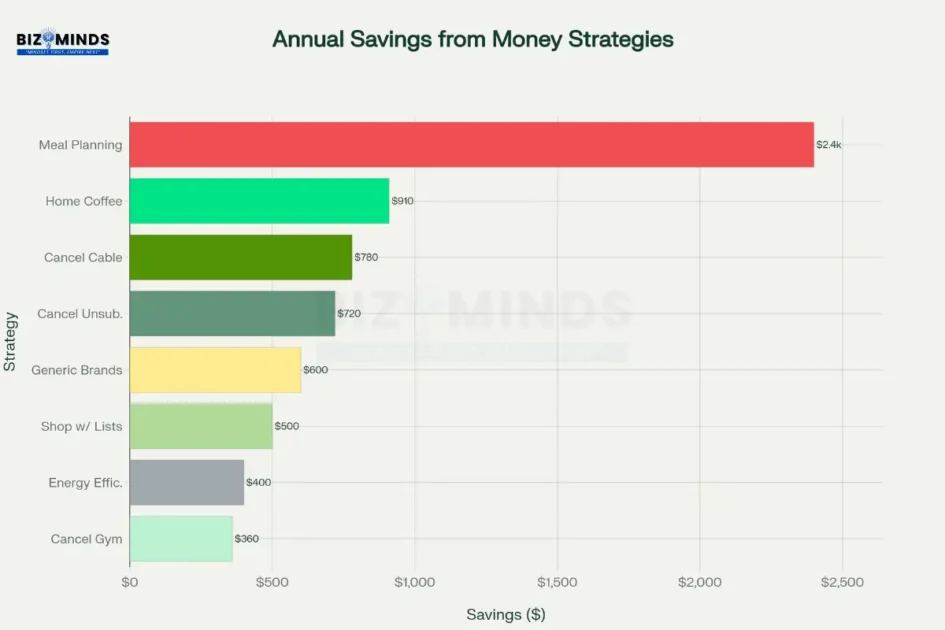
Money Saving Tips Annual Potential: Popular Strategies That Deliver Real Results
Strategic Grocery Money Saving Tips Beyond Traditional Meal Planning
While meal planning receives widespread attention in money saving tips discussions, truly effective food cost reduction involves deeper strategic thinking. The most successful practitioners combine multiple unconventional approaches that address psychological spending triggers and supply chain inefficiencies.
The Decoy Shopping Method
The Decoy Shopping Method involves creating deliberate “expensive” options in your mental shopping framework. When comparing prices, always identify the most expensive option in each category first, making moderate-priced alternatives appear more reasonable. This psychological anchoring technique can reduce grocery spending by 15-25% without compromising food quality.
Stem Removal and Weight Optimization
Stem Removal and Weight Optimization represents one of the most overlooked money saving tips for produce purchases. Removing stems from bell peppers, broccoli crowns, and similar items before weighing can save $50-100 annually for families purchasing significant quantities of fresh vegetables. Additionally, understanding peak ripeness timing allows strategic purchasing when items transition from premium to discount pricing.
Generic Brand Rotation Strategy
Generic Brand Rotation Strategy extends beyond simple substitution to systematic testing and optimization. Rather than wholesale switching to generic brands, implement a rotation system where you test one new generic product per shopping trip. Document quality satisfaction and price differences in a simple smartphone note. This approach identifies the highest-value substitutions while maintaining quality standards, typically yielding 20-30% savings on packaged goods.
Bulk Buying Cooperatives
Bulk Buying Cooperatives represent an underutilized money saving tips for non-perishable items. Coordinate with neighbors, coworkers, or family members to purchase large quantities of household staples, splitting costs and quantities. Items like toilet paper, cleaning supplies, and canned goods offer substantial per-unit savings when purchased in commercial quantities.
The combination of these approaches, when implemented systematically, can reduce food and household supply costs by $1,500-2,400 annually without requiring significant time investment or lifestyle changes.
Utility and Energy Money Saving Tips Through Smart Behavioral Modifications
Energy costs represent a significant portion of household budgets, yet most money saving tips in this category focus on equipment upgrades rather than behavioral modifications that deliver immediate results. The most effective energy savings strategies combine simple behavioral changes with strategic timing adjustments.
Temperature Layering Strategy
Temperature Layering Strategy involves creating different temperature zones within your home rather than heating or cooling the entire space uniformly. Close vents in unused rooms and use door draft stoppers to concentrate climate control in occupied areas. This approach can reduce heating and cooling costs by 20-30% during peak seasons.
Phantom Load Elimination
Phantom Load Elimination targets the hidden electricity consumption that occurs when appliances remain plugged in but unused. Strategic use of smart power strips can automatically eliminate standby power consumption from entertainment centers, computer workstations, and kitchen appliances. The average household saves $100-200 annually through systematic phantom load reduction.
Peak Hour Shifting
Peak Hour Shifting leverages time-of-use electricity pricing available in many markets. By shifting high-energy activities like laundry, dishwashing, and electric vehicle charging to off-peak hours, households can reduce electricity costs by 15-25%. This money saving tips requires minimal lifestyle adjustment while delivering consistent monthly savings.
Water Temperature Optimization
Water Temperature Optimization extends beyond simply lowering water heater settings to strategic usage timing. Taking showers during warmer parts of the day reduces the energy differential required for comfortable water temperature. Similarly, running hot water appliances in sequence minimizes reheating cycles.
These behavioral modifications, when implemented consistently, typically reduce utility expenses by $400-800 annually without requiring equipment investments or major lifestyle changes.

Money Saving Tips Reality Check: The State of American Emergency Savings
Subscription Service Money Saving Tips: Strategic Cancellation Methods
Subscription services have become a dominant expense category for American households, with the average family maintaining 4.7 streaming services plus numerous other recurring charges. Effective subscription management requires systematic auditing combined with strategic retention and cancellation approaches.
The Subscription Inventory Method
The Subscription Inventory Method involves conducting quarterly comprehensive reviews of all recurring charges appearing on bank and credit card statements. Many households discover forgotten subscriptions totaling $200-500 annually during these audits. Create a spreadsheet tracking each subscription’s cost, last usage date, and renewal date to maintain ongoing awareness.
Strategic Pause Utilization
Strategic Pause Utilization leverages pause features offered by many subscription services rather than permanent cancellation. Services like Netflix, Spotify, and gym memberships often provide temporary suspension options that maintain account benefits while eliminating charges during unused periods. This approach saves money during travel, busy seasons, or budget constraints while preserving accumulated preferences and progress.
Subscription Rotation Money Saving Tips
Subscription Rotation Strategy involves maintaining active subscriptions to only 2-3 services at any time while rotating through different options quarterly. Watch content from one streaming service for three months, cancel it, activate a different service, and repeat. This approach provides access to diverse content while maintaining total monthly costs at $30-45 rather than $150-200 for simultaneous subscriptions.
Bundle Deconstruction Analysis
Bundle Deconstruction Analysis systematically evaluates whether bundled services deliver value compared to individual subscriptions. Many cable, internet, and phone bundles include services that customers don’t utilize. Separating services and choosing only required components often reduces monthly costs by $50-100.
The average household implementing comprehensive subscription optimization saves $720-1,440 annually while maintaining access to preferred entertainment and services.

Money Saving Tips for Subscriptions: Cancellation Trends and Potential Savings
Transportation Money Saving Tips Through Creative Cost-Reduction Approaches
Transportation represents the second-largest expense category for most American households at 17% of total spending. Beyond obvious approaches like public transportation, numerous unconventional strategies can significantly reduce vehicle-related expenses.
Strategic Vehicle Sharing
Strategic Vehicle Sharing involves coordinating transportation needs with neighbors, coworkers, or family members beyond traditional carpooling. This includes sharing vehicles for errands, coordinating grocery shopping trips, and establishing neighborhood tool and equipment sharing networks. Participants typically reduce individual transportation costs by 30-50% while building community relationships.
Maintenance Timing Optimization
Maintenance Timing Optimization leverages automotive service cycles to minimize repair costs and extend vehicle life. Learning basic maintenance tasks like oil changes, tire rotation, and air filter replacement can save $500-800 annually. Additionally, purchasing maintenance supplies in bulk and coordinating service timing with family members or neighbors often yields group discounts.
Insurance Shopping Automation
Insurance Shopping Automation involves setting annual reminders to obtain insurance quotes from multiple providers rather than accepting automatic renewals. Insurance rates vary significantly between companies and change frequently. Annual shopping typically yields savings of $200-600 on auto insurance alone.
Fuel Purchasing Strategy
Fuel Purchasing Strategy combines timing, location, and payment method optimization to minimize fuel costs. Use apps like GasBuddy to identify lowest-priced stations along regular routes, purchase fuel during weekday mornings when prices are typically lower, and use cashback credit cards or store loyalty programs to maximize savings.
These transportation optimization strategies, when implemented systematically, reduce vehicle-related expenses by $800-2,000 annually while maintaining mobility and convenience.
Technology and Communication Money Saving Tips for Modern Households
Technology expenses have become a significant budget category for American households, yet many money saving tips in this area focus only on obvious cost reductions. Advanced strategies leverage service optimization and strategic device management to achieve substantial savings.
Device Lifecycle Extension
Device Lifecycle Extension involves systematic device care and strategic upgrade timing rather than following manufacturer replacement cycles. Professional device maintenance, quality protective accessories, and software optimization can extend smartphone and computer lifecycles by 2-3 years, avoiding replacement costs of $800-2,000 per device.
Service Plan Optimization
Service Plan Optimization requires annual analysis of actual usage patterns compared to subscribed service levels. Most households pay for more data, minutes, or features than they actually utilize. Downgrading to appropriate service levels typically saves $200-600 annually on phone services alone.
Family Plan Maximization
Family Plan Maximization extends beyond immediate family to include trusted friends or extended family members in shared service plans. Many cell phone, streaming, and software services offer family plans that provide significant per-person savings when fully utilized.
Equipment Sharing Networks
Equipment Sharing Networks involve coordinating purchases of occasionally-used technology with neighbors or friends. Items like pressure washers, lawn equipment, power tools, and specialty appliances can be shared among 3-4 households, reducing individual purchase costs by 70-80%.
Technology cost optimization typically yields savings of $600-1,200 annually while maintaining access to necessary services and equipment.
Home Maintenance Money Saving Tips and Improvement Strategies
Home maintenance represents a significant expense category that offers numerous opportunities for cost reduction through strategic approaches and skill development. Most money saving tips focus on DIY repairs, but comprehensive savings require systematic planning and resource optimization.
Preventive Maintenance Scheduling
Preventive Maintenance Scheduling involves creating systematic maintenance calendars that address potential issues before they require expensive repairs. Regular tasks like gutter cleaning, HVAC filter replacement, and caulk inspection prevent costly emergency repairs. Households implementing preventive maintenance typically save $800-1,500 annually in avoided repair costs.
Tool and Equipment Sharing
Tool and Equipment Sharing extends beyond borrowing to creating neighborhood resource networks. Coordinating tool purchases among neighbors allows access to professional-quality equipment at fraction of individual purchase costs. A typical neighborhood sharing network reduces individual tool expenses by 60-80%.
Material Sourcing Optimization
Material Sourcing Optimization leverages construction industry surplus, seasonal sales, and wholesale purchasing to reduce material costs for home projects. Establishing relationships with local contractors can provide access to surplus materials at significant discounts. Strategic timing of projects to align with industry slow periods often yields 30-50% savings on labor costs.
Skill Development Investment
Skill Development Investment focuses on learning high-impact repair and maintenance skills that provide ongoing value. Plumbing basics, electrical repairs, and HVAC maintenance generate substantial savings when applied repeatedly over time. Initial skill development investment pays for itself within 1-2 applications.
Home maintenance optimization typically reduces housing-related expenses by $1,000-2,500 annually while improving property value and comfort.
Entertainment and Recreation Money Saving Tips Without Sacrificing Fun
Entertainment expenses often resist traditional cost-cutting approaches because they involve lifestyle quality and social connections. Effective strategies maintain recreational satisfaction while dramatically reducing associated costs.
Experience Substitution Strategy
Experience Substitution Strategy involves identifying the core satisfaction elements in expensive entertainment and finding alternative delivery methods. Instead of expensive restaurant dining, organize potluck dinner parties with friends. Replace costly concert tickets with free outdoor performances or house concerts. These substitutions often enhance social connections while reducing costs by 70-80%.
Seasonal Activity Optimization
Seasonal Activity Optimization leverages natural cycles and off-peak pricing to maximize entertainment value. Many recreational activities offer significant discounts during shoulder seasons. Planning entertainment around these cycles maintains activity levels while reducing costs by 40-60%.
Community Resource Utilization
Community Resource Utilization involves systematic discovery and utilization of free or low-cost community offerings. Libraries, parks departments, community colleges, and religious organizations provide numerous entertainment and educational opportunities at minimal cost. Regular utilization of these resources can replace expensive entertainment spending entirely.
Group Activity Coordination
Group Activity Coordination leverages bulk purchasing power and shared experiences to reduce per-person entertainment costs. Organizing group outings, coordinating season ticket purchases, and sharing entertainment subscriptions significantly reduce individual expenses while enhancing social connections.
Entertainment cost money saving tips typically reduces recreational expenses by $1,200-2,400 annually while maintaining or improving quality of life and social connections.
Advanced Money Saving Tips: Financial Optimization Techniques
Beyond specific expense categories, several overarching financial strategies can amplify the effectiveness of individual money saving tips through systematic implementation and psychological optimization.
The Envelope System
The Envelope System Modernization adapts traditional cash budgeting to modern digital banking. Establish separate savings accounts for different expense categories and automatically transfer budgeted amounts to each account monthly. This prevents overspending while maintaining spending flexibility within categories.
Automated Savings Acceleration
Automated Savings Acceleration leverages behavioral economics to increase savings without conscious effort. Set up automatic transfers that increase by small amounts monthly, creating gradually increasing savings rates that adjust naturally to income growth.
Purchase Delay Protocols
Purchase Delay Protocols implement systematic waiting periods for non-essential purchases based on item cost. Items under $50 require 24-hour delays, while items over $200 require one-week delays. This simple system eliminates most impulse purchases while allowing time for price comparison and need verification.
Value-Based Spending
Value-Based Spending Alignment involves regularly reviewing expenses against personal values and priorities to identify spending that doesn’t contribute to life satisfaction. This process typically reveals $200-500 monthly in expenses that can be redirected toward higher-priority goals.
These advanced techniques amplify the effectiveness of specific money saving tips while creating sustainable financial habits that continue generating savings over time.
Complete Money Saving Tips Comparison Table: 20 Proven Strategies
| Strategy | Difficulty Level | Time Investment | Potential Annual Savings | Impact Level |
| Cancel unused subscriptions | Easy | 1 hour | $300-720 | Medium |
| Switch to generic brands | Easy | 5 min/shopping trip | $300-600 | Medium |
| Cook meals at home | Medium | 30-60 min/day | $1,200-2,400 | High |
| Use programmable thermostat | Easy | 15 minutes | $180-400 | Medium |
| Cancel cable TV | Easy | 30 minutes | $600-780 | High |
| Make coffee at home | Easy | 5 min/day | $500-910 | High |
| Shop with grocery lists | Easy | 10 min/week | $300-500 | Medium |
| Air dry clothes | Easy | 10 min/load | $200-400 | Low |
| Use library instead of buying books | Easy | 30 min/month | $100-300 | Low |
| Buy used/refurbished items | Medium | 1-2 hours/item | $500-1,500 | High |
| Negotiate insurance rates | Medium | 2-3 hours | $200-600 | Medium |
| Use cashback apps | Easy | 2 min/purchase | $100-300 | Low |
| Cancel gym membership | Easy | 15 minutes | $200-600 | Medium |
| Reduce water heater temperature | Easy | 5 minutes | $100-200 | Low |
| Switch to LED bulbs | Easy | 2 min/bulb | $75-150 | Low |
| Use public transportation | Medium | Ongoing | $800-2,000 | High |
| Practice 24-hour rule for purchases | Easy | Ongoing | $200-800 | Medium |
| Bulk buying non-perishables | Medium | 1 hour/month | $200-500 | Medium |
| Energy audit and improvements | Hard | 4-8 hours | $400-800 | Medium |
| Sell unused items | Medium | 2-4 hours/item | $200-1,000 | Medium |
Conclusion
Implementing these comprehensive money saving tips consistently over time creates a transformational financial impact that extends far beyond the immediate $8,000 annual savings target. The strategies outlined in this guide represent a systematic approach to financial optimization that leverages behavioral psychology, strategic timing, and resource maximization to achieve sustainable cost reduction without sacrificing quality of life.
Recent research confirms that individuals who adopt multiple concurrent saving strategies achieve 40-60% higher success rates compared to those attempting single-approach solutions. The compound effect of these methods creates momentum that accelerates savings potential over time, with many practitioners reporting total annual savings exceeding $10,000-15,000 within two years of consistent implementation.
The psychological benefits of successful money saving tips implementation often prove as valuable as the financial rewards themselves. Financial stress affects over 70% of Americans according to recent surveys, yet systematic expense reduction through proven methods creates measurable improvements in mental well-being and life satisfaction.
Participants in comprehensive savings programs report decreased anxiety levels, improved sleep quality, and enhanced confidence in their financial decision-making abilities. This psychological transformation reinforces positive financial behaviors, creating a virtuous cycle where success breeds additional success and expanded implementation of advanced cost-reduction techniques.
Long-term wealth building requires sustainable money saving tips that evolve with changing life circumstances rather than temporary measures that prove difficult to maintain. The strategies presented here are designed to scale with income growth, family changes, and economic fluctuations while maintaining their effectiveness over decades.
Successful practitioners typically reinvest their initial savings into wealth-building vehicles like emergency funds, retirement contributions, and investment portfolios, transforming immediate cost savings into long-term financial security. This progression from expense reduction to wealth accumulation represents the natural evolution of effective personal finance management, where initial savings discipline creates the foundation for substantial asset growth.
The broader economic landscape in 2025 makes mastering effective money saving tips essential for financial survival and prosperity. With inflation continuing to pressure household budgets, emergency savings at historic lows, and economic uncertainty affecting employment stability, the ability to optimize expenses while maintaining lifestyle quality becomes a critical life skill. These methods provide not just immediate financial relief but also long-term resilience against economic volatility.
As sustainable finance and conscious consumption trends continue gaining momentum, the approaches outlined here align with broader societal shifts toward more thoughtful resource utilization and strategic financial planning. By implementing these proven strategies consistently, households position themselves not only for immediate savings success but also for sustained financial growth and security in an increasingly complex economic environment.
Frequently Asked Questions
Q1: How realistic is it to save $8,000 per year using these methods?
A: Saving $8,000 annually is achievable for most middle-income households through systematic implementation of multiple strategies. The key lies in combining several approaches rather than relying on a single dramatic change. For example, households typically save $2,400 from meal planning, $780 from cable cancellation, $720 from subscription optimization, and $400 from energy efficiency improvements. These four strategies alone total $4,300 annually, requiring only modest additional savings from other areas to reach $8,000.
Q2: Which money saving tips provide the fastest results?
A: Subscription auditing and cancellation typically provide immediate monthly savings visible in the next billing cycle. Energy phantom load elimination through smart power strips shows results in the following month’s utility bill. Generic brand substitution produces savings with the first grocery shopping trip. These strategies require minimal effort while delivering rapid feedback that builds momentum for additional changes.
Q3: Do these unconventional approaches require significant time investment?
A: Most strategies require initial setup time of 1-4 hours followed by minimal ongoing maintenance. For example, subscription auditing requires 2 hours quarterly, smart power strip installation takes 30 minutes, and establishing grocery shopping partnerships requires initial coordination followed by routine implementation. The time investment is front-loaded, with ongoing benefits requiring minimal additional effort.
Q4: How do I maintain motivation when implementing multiple money saving tips simultaneously?
A: Focus on implementing 2-3 strategies initially rather than attempting comprehensive changes immediately. Track savings amounts monthly to maintain awareness of progress. Celebrate milestones and redirect saved money toward specific goals like debt reduction or emergency fund building. This approach prevents overwhelm while building sustainable habits through gradual implementation.
Q5: Are these strategies suitable for families with children?
A: Many strategies work particularly well for families due to higher baseline expenses and greater savings potential. Food cost reduction through bulk buying and meal planning scales effectively with family size. Utility optimization provides larger absolute savings for bigger households. Entertainment cost reduction through family activities often improves quality time while reducing expenses. Families typically achieve higher total dollar savings than single individuals.
Q6: What should I do if some strategies don’t work in my specific situation?
A: Not every strategy suits every household situation, income level, or geographic location. Focus on implementing strategies that align with your lifestyle and circumstances rather than attempting universal application. Track results for 3-6 months to identify which approaches provide the best return on effort. Modify strategies based on results and personal preferences while maintaining focus on overall savings goals.
Citations
- https://www.bankrate.com/banking/savings/emergency-savings-report/
- https://www.bankrate.com/personal-finance/average-household-budget/
- https://www.upworthy.com/frugal-life-hacks-actually-work-ex1
- https://www.upworthy.com/20-frugal-people-share-their-most-underrated-and-unexpected-money-saving-habits
- https://finance.yahoo.com/news/7-ways-save-utility-bills-160208349.html
- https://www.truist.com/money-mindset/principles/budgeting-by-values/reducing-your-expenses
- https://business.yougov.com/content/42972-consumers-cancelling-subscriptions-twice-fast
- https://rmi.org/how-to-save-money-for-all-americans-efficiency/
- https://www.macu.com/must-reads/saving/33-small-ideas-to-save-big-money
- https://www.youtube.com/watch?v=kzi-tsAoxto
- https://americasaves.org/resource-center/insights/54-ways-to-save-money/
- https://vegoutmag.com/shopping/a-people-who-no-longer-buy-these-8-items-save-thousands-every-year/
- https://avaada.com/ways-to-reduce-your-electricity-bill/
- https://www.shakerheightsoh.gov/892/Simple-Ways-to-Improve-Energy-Efficiency
- https://www.pbs.org/newshour/nation/feeling-the-heat-here-are-some-ways-to-lower-your-electric-bill
- https://www.chargebee.com/blog/subscriber-retention-cancellation-strategies/
- https://www.sganalytics.com/blog/cutting-the-cord-households-cancel-subscriptions-to-streaming-services-due-to-shrinking-budgets/
- https://diggitymarketing.com/unsubscription-trends-and-statistics/
- https://www.reddit.com/r/FinancialPlanning/comments/q3xz9w/for_those_of_you_who_have_thousands_in_your/
- https://www.debt.org/advice/how-to-cut-expenses/
- https://www.moneyfit.org/life-hacks-to-save-money/
- https://step.com/money-101/post/10-creative-ways-to-save-money-youve-probably-never-thought-of
- https://www.nerdwallet.com/article/finance/how-to-save-money
- https://www.thegoodlifejourney.com/home/50-saving-hacks
- https://www.wisebread.com/51-unusual-money-saving-tips-from-readers
- https://www.fultonbank.com/Education-Center/Saving-and-Budgeting/6-ways-to-make-saving-fun
- https://www.annuity.org/financial-literacy/
- https://www.sixfiguresunder.com/july-2024-transparent-family-budget-update/
- https://economictimes.com/news/international/us/2025-u-s-wealth-statistics-new-2025-wealth-stats-reveal-how-americans-are-saving-spending-and-stacking-cash-where-do-you-stand/articleshow/124275655.cms
- https://files.consumerfinance.gov/f/documents/cfpb_your-money-your-goals_cutting-expenses_tool.pdf
- https://www.incharge.org/financial-literacy/budgeting-saving/how-to-cut-your-expenses/
- https://finance.yahoo.com/personal-finance/banking/article/savings-and-wealth-statistics-215214936.html
- https://www.unitusccu.com/blog/america-saves-week-saving-strategies-for-every-stage-of-life/
- https://www.federalreserve.gov/publications/2025-economic-well-being-of-us-households-in-2024-savings-and-investments.htm
- https://bettermoneyhabits.bankofamerica.com/en/saving-budgeting/ways-to-save-money
- https://www.consumerfinance.gov/an-essential-guide-to-building-an-emergency-fund/
- https://hbr.org/2023/07/cost-cutting-that-makes-you-stronger
- https://www.growfinancial.org/general-education/six-ways-to-save-money-in-2025/
- https://srfs.upenn.edu/financial-wellness/browse-topics/budgeting/popular-budgeting-strategies
- https://www.nism.ac.in/managing-your-income-and-expenses/
- https://www.usatoday.com/story/money/personalfinance/columnist/2024/12/29/stay-financially-healthy-in-2025/77298009007/
- https://www.dol.gov/agencies/ebsa/about-ebsa/our-activities/resource-center/publications/savings-fitness
- https://www.atombank.co.uk/savings/savings-knowledge-hub/11-money-saving-tips/
- https://www.youtube.com/watch?v=erMBKSl0YNw
- https://www.policybachat.com/articles/money-saving-hacks
- https://www.reddit.com/r/Frugal/comments/1ibe8yv/in_search_of_weird_frugal_tips/
- https://www.buzzfeed.com/fabianabuontempo/ways-to-save-money-2024
- https://zenhabits.net/the-cheapskate-guide-50-tips-for-frugal-living/
- https://www.synchrony.com/blog/bank/how-to-save-money-fast
- https://www.youtube.com/watch?v=Q9hwppctEYs
- https://www.buzzfeed.com/meganeliscomb/weird-but-effective-frugal-habits
- https://acumen.co.nz/moneyblog/book-case-study-tips-for-saving-money/
- https://wealthovernow.com/case-studies
- https://www.youtube.com/watch?v=upmqCGY1fnw
- https://www.incharge.org/financial-literacy/budgeting-saving/average-monthly-expenses/
- https://offers.myhubble.money/blog/case-study-how-an-indian-employee-saved-money-through-efficient-spend-managementlet
- https://www.forbes.com/sites/chriscarosa/2021/05/22/true-stories-of-children-saving-successfully/
- https://www.cnbc.com/2024/10/29/inflation-is-down-but-the-middle-class-remains-under-pressure.html
- https://niftythriftydiyer.com/how-i-saved-8000-on-a-part-time-income/
- https://www.buzzfeed.com/meganeliscomb/the-savings-have-really-stacked-up-people-are-sharing-the
- https://www.pewresearch.org/short-reads/2024/12/09/roughly-half-of-americans-are-knowledgeable-about-personal-finances/
- https://n26.com/en-eu/blog/how-to-save-money-fast
- https://www.youtube.com/watch?v=iLGt2s0azAg
- https://www.forbes.com/advisor/d/fed-study-2025-consumer-spending-budgeting-apps/
- https://moneysmart.gov.au/saving/savings-goals-calculator
- https://fastercapital.com/topics/real-people-who-have-achieved-their-saving-goals-with-cashtrigger.html/1
- https://www.racknap.com/blog/top-reasons-customers-are-canceling-subscriptions-and-how-to-address-them/
- https://www.rewiringamerica.org/research/household-report
- https://www.statista.com/statistics/1623424/india-reasons-for-cancelling-a-subscription/
- https://www.energystar.gov/about/how-energy-star-protects-environment/energy-efficiency
- https://www.timesnownews.com/city/ahmedabad/relief-for-ahmedabad-residents-electricity-bills-may-get-cheaper-soon-know-why-article-152650488
- https://www.expertmarketresearch.com/featured-articles/why-people-cancel-subscriptions
- https://enciser.com/how-to-save-on-electricity-bills-in-2025/
- https://www.irs.gov/credits-deductions/energy-efficient-home-improvement-credit
- https://energysavingtrust.org.uk/hub/quick-tips-to-save-energy/
- https://www.energy.gov/energysaver/energy-saver-guide-tips-saving-money-and-energy-home
- https://timesofindia.indiatimes.com/city/ahmedabad/electricity-bills-to-drop-as-state-lowers-fuel-surcharge/articleshow/123663926.cms