


How to Master Zero Based Budgeting: Complete Step-by-Step Tutorial for Beginners
In today’s economic climate, where the average American household carries $6,194 in credit card debt and 64% of families live paycheck to paycheck, traditional budgeting methods often fall short of delivering real financial transformation. While most budgeting approaches focus on minor adjustments to existing spending patterns, they fail to address the fundamental question: Is every dollar you spend truly necessary and aligned with your priorities? This critical gap has led millions of American families to discover Zero Based Budgeting, a revolutionary approach that challenges every expense and maximizes every dollar’s potential.
Zero Based Budgeting represents one of the most transformative financial management approaches available to American households today. Unlike traditional budgeting methods that build upon previous spending patterns, This budgeting requires you to justify every dollar from the ground up, creating a comprehensive financial framework that eliminates wasteful spending while ensuring your money directly supports your most important goals. This methodology transforms budgeting from a reactive exercise into a proactive strategy that puts you in complete control of your financial destiny.
What makes Zero Based Budgeting particularly powerful for American families is its ability to adapt to today’s complex financial landscape. With housing costs consuming 30-35% of household budgets, inflation affecting everyday expenses, and economic uncertainty requiring greater financial resilience, this approach provides the structure and flexibility needed to thrive rather than merely survive. Research consistently shows that households implementing this budgeting achieve 10-25% cost reduction within their first year while building stronger emergency funds and accelerating debt elimination.
Understanding Zero Based Budgeting Fundamentals
Zero Based Budgeting emerged from corporate finance practices in the 1970s when Texas Instruments manager Peter Pyhrr developed this methodology to combat inefficient spending patterns. The approach gained national attention when President Jimmy Carter attempted to implement Zero Based Budgeting across federal government operations, though the concept has evolved significantly since those early applications.
The core principle centers on starting each budgeting period with a clean slate. Rather than adjusting last month’s budget by adding or subtracting small amounts, Zero Based Budgeting demands that you allocate every dollar of income to specific categories, leaving no money unaccounted for. This approach transforms budgeting from a reactive process into a proactive strategy that aligns spending with current priorities and financial goals.
American households implementing Zero Based Budgeting typically experience improved financial awareness within the first month. The method works particularly well for individuals with stable incomes, though those with variable earnings can adapt the approach by establishing conservative baseline budgets and allocating additional income as it materializes.
The Psychology behind Zero Based Budgeting
Zero Based Budgeting fundamentally changes your relationship with money by requiring conscious decision-making for every expense. Traditional budgeting often operates on autopilot, allowing spending habits to continue unchallenged. This budgeting interrupts this pattern by forcing evaluation of each financial commitment.
This psychological shift proves especially valuable for American consumers facing inflation pressures and rising living costs. When housing costs consume 30-35% of the average household budget and transportation expenses account for another 15%, every remaining dollar requires strategic allocation. Zero-Based Budgeting ensures these decisions happen intentionally rather than by default.
Research indicates that individuals using Zero Based Budgeting report 92% increased spending awareness compared to traditional budgeting methods.
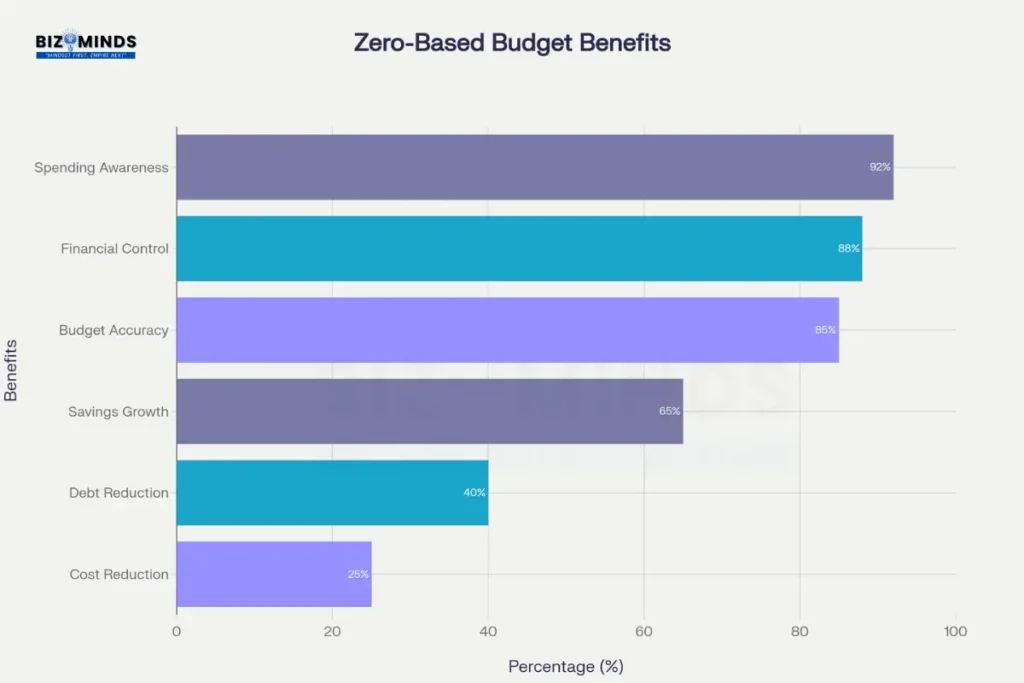
Zero Based Budgeting: Measured Benefits and Improvements
This heightened consciousness translates into more deliberate financial choices and reduced impulse spending patterns that often derail conventional budgets.
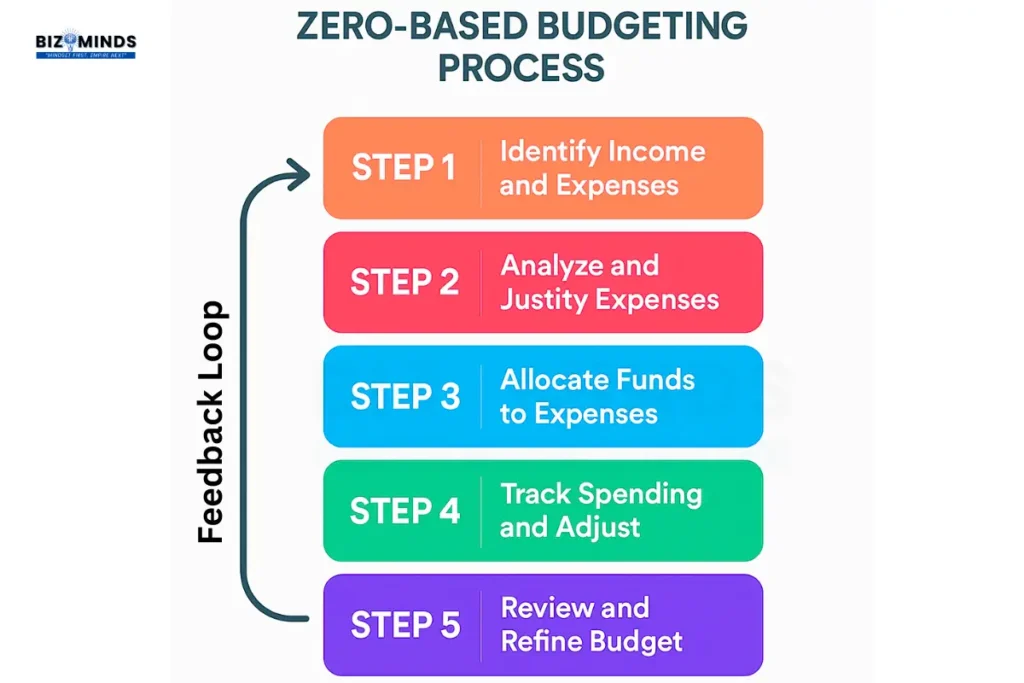
Zero Based Budgeting Implementation Process: 5-Step Framework
Traditional Budgeting vs Zero Based Budgeting
The fundamental difference between traditional budgeting and Zero-Based Budgeting lies in their starting assumptions. Traditional budgeting operates under the premise that last month’s spending provides a reasonable foundation for this month’s budget. If you spent $500 on groceries last month, traditional budgeting starts with that figure and makes minor adjustments based on anticipated changes.
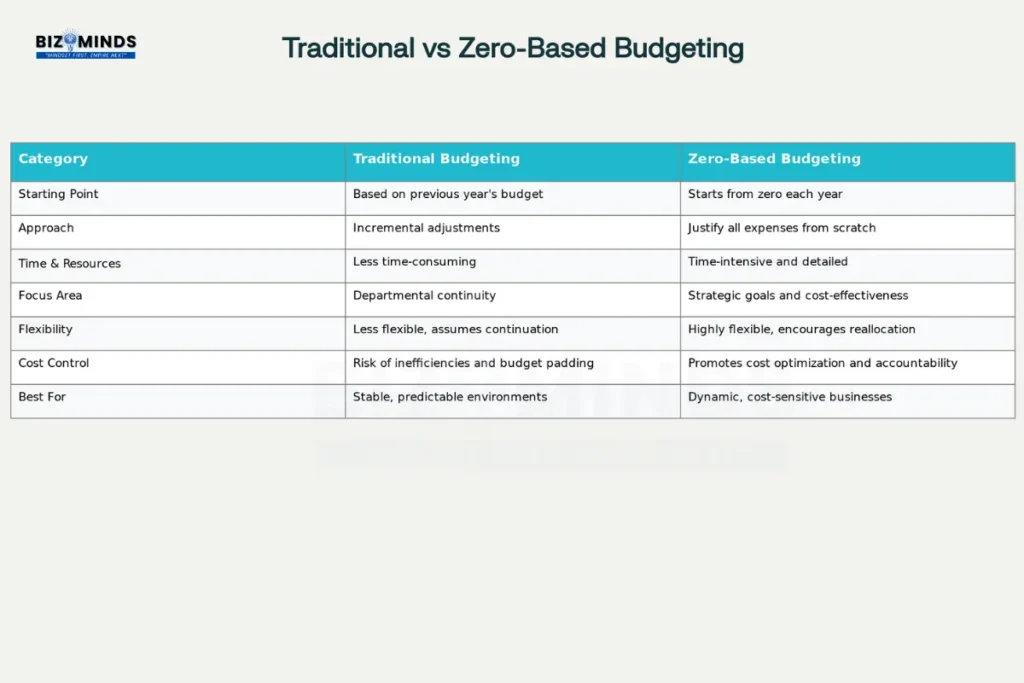
Traditional Budgeting vs Zero Based Budgeting: Key Differences
Zero-Based Budgeting rejects this assumption entirely. Instead of using historical spending as a baseline, you must justify every expense category from scratch. This process requires examining whether each expenditure aligns with your current financial priorities and life circumstances.
Implementation Complexity and Time Investment
Traditional budgeting typically requires 30-60 minutes monthly for most American households. You review last month’s spending, make minor adjustments, and carry forward most categories unchanged. This simplicity makes traditional budgeting accessible to busy families juggling work, childcare, and other commitments.
This budgeting demands significantly more time investment, particularly during initial implementation. New practitioners often spend 2-4 hours creating their first zero-based budget as they categorize expenses, research costs, and allocate funds across all categories. However, this time investment decreases substantially once the framework is established.
Monthly maintenance of this budgeting typically requires 90-120 minutes, as you must review and justify all categories rather than making incremental adjustments. Many American families find this additional time investment worthwhile given the improved financial outcomes, but it represents a genuine commitment that must be considered.
Flexibility and Adaptability
Traditional budgeting often struggles with unexpected expenses or changing circumstances. When your car requires a $1,200 repair, traditional budgets may lack the flexibility to accommodate this expense without borrowing or depleting savings.
Zero Based Budgeting builds flexibility into its foundation by regularly reassessing all categories. If car repairs require additional funds, you can reduce allocations to dining out, entertainment, or other discretionary categories to accommodate the unexpected expense. This adaptability makes Zero Based Budgeting particularly valuable for American households navigating economic uncertainty.
The 2020 pandemic demonstrated this flexibility advantage clearly. Companies implementing Zero Based Budgeting, such as Guess, rapidly reduced operating costs by $60 million quarterly while maintaining essential operations. Households using Zero Based Budgeting similarly adapted more quickly to reduced incomes and changing expense patterns.
Implementing Zero Based Budgeting: A Step-by-Step Guide
Successfully implementing this type of budgeting requires systematic execution across five distinct phases. American households that follow this structured approach consistently achieve better financial outcomes than those attempting informal implementation.
Phase 1: Calculate Your True Income
Begin by documenting all income sources for the upcoming month. Include your primary salary after taxes and deductions, but don’t stop there. Add income from side hustles, freelance work, investment dividends, rental properties, and any other regular earnings.
For example, a typical American household might have: primary salary ($4,200 after taxes), spouse’s part-time income ($800), freelance writing income ($300), and dividend payments ($75), totaling $5,375 monthly income.
Variable income presents additional complexity. If your freelance income fluctuates between $200-600 monthly, use the conservative estimate of $200 for your Zero Based Budgeting calculations. When additional income materializes, you can allocate it to savings, debt reduction, or other priorities through your established framework.
Phase 2: Comprehensive Expense Documentation
Document every expense category starting from absolute zero. This process requires examining bank statements, credit card records, and cash transactions from the previous 2-3 months to ensure nothing gets overlooked.
Create detailed categories rather than broad generalizations. Instead of a single “food” category, separate groceries ($450), dining out ($200), work lunches ($120), and coffee purchases ($80). This granularity provides better spending control and more accurate future planning.
Fixed expenses form your budget foundation: mortgage or rent, insurance premiums, loan minimums, and utilities. Variable necessities like groceries, gasoline, and phone bills require historical analysis to establish realistic allocations.
Don’t forget periodic expenses that don’t occur monthly. Car insurance might cost $600 semi-annually, requiring $100 monthly allocation. Property taxes, annual subscriptions, and holiday spending all need monthly provisions to avoid budget disruptions.
Phase 3: Strategic Category Prioritization
Zero Based Budgeting success depends on systematic prioritization that reflects your values and financial goals. American households typically organize priorities into four tiers: survival needs, security building, quality of life, and discretionary spending.
Survival needs include housing, basic utilities, minimum food requirements, essential transportation, and minimum debt payments. These categories receive funding first, as they maintain your basic living standard and creditworthiness.
Security building encompasses emergency fund contributions, additional debt payments above minimums, and retirement savings. Many financial experts recommend allocating 10-20% of income to this tier, though percentages vary based on individual circumstances.
Quality of life improvements include better food choices, reliable transportation, adequate clothing, and basic entertainment. These categories enhance daily living without constituting luxuries.
Discretionary spending covers hobbies, travel, premium streaming services, and other non-essential purchases. These categories receive funding only after higher priorities are satisfied.
Phase 4: Dollar-by-Dollar Allocation
Allocate every dollar of income to specific categories until you reach exactly zero remaining balance. This process often requires multiple iterations as you balance competing priorities within your income constraints.
Start with survival needs, then systematically work through each priority tier. If you reach zero before funding all desired categories, reduce allocations in lower-priority areas or increase income through side hustles or overtime work.
For instance, with $5,375 monthly income, you might allocate: housing ($1,600), transportation ($650), groceries ($450), utilities ($250), minimum debt payments ($400), emergency fund ($200), retirement ($300), dining out ($150), entertainment ($200), clothing ($125), and miscellaneous expenses ($50).
Phase 5: Ongoing Monitoring and Adjustment
Zero Based Budgeting requires continuous tracking and monthly recalibration. Unlike traditional budgeting where categories remain static, This budget adapts to changing circumstances and priorities.
Track actual spending against budgeted amounts throughout the month. Many American families use smartphone apps like YNAB, EveryDollar, or Goodbudget to monitor real-time progress. When actual spending deviates from planned allocations, make immediate adjustments rather than waiting until month-end.
Monthly budget reviews provide opportunities to reassess priorities and improve allocations. If you consistently overspend on groceries while underspending on entertainment, adjust future budgets to reflect your actual priorities and spending patterns.
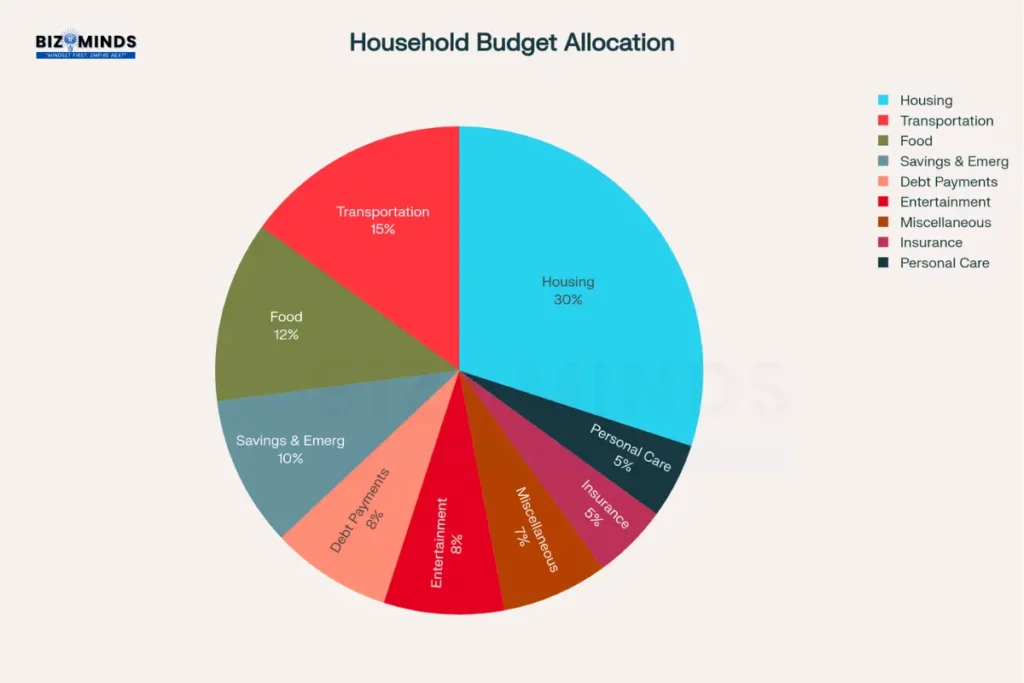
Typical Household Budget Categories for Zero Based Budgeting
Essential Budget Categories for American Households
Successful Zero Based Budgeting requires comprehensive category systems that capture all household expenses while maintaining manageable complexity. American families typically organize expenses into 8-12 major categories with multiple subcategories under each.
Housing and Home-Related Expenses
Housing typically consumes 25-35% of American household budgets, making it the largest expense category for most families. This category encompasses rent or mortgage payments, property taxes, homeowners or renters insurance, and homeowners association fees.
Utility expenses include electricity, natural gas, water, sewer, trash collection, and internet services. While these costs vary seasonally, establishing monthly averages helps maintain budget stability. A family spending $180 on electricity in summer and $120 in winter might budget $150 monthly, building reserves during lower-usage months.
Home maintenance and improvements require regular allocation even for renters. Homeowners need funds for routine maintenance, emergency repairs, and planned improvements. Even apartment dwellers benefit from allocating funds for minor repairs, decorative updates, and potential moving expenses.
Transportation and Vehicle Costs
Transportation expenses encompass vehicle payments, insurance premiums, fuel costs, routine maintenance, and emergency repairs. American households spend an average of 10-15% of income on transportation, though this varies significantly based on location and commuting requirements.
Vehicle maintenance deserves special attention in Zero Based Budgeting. Rather than treating oil changes, tire replacements, and major repairs as unexpected expenses, allocate monthly funds for these inevitable costs. A vehicle requiring $1,200 annually in maintenance needs $100 monthly allocation to avoid budget disruptions.
Public transportation, rideshare services, and parking fees require separate tracking for urban households. These costs can fluctuate significantly based on work schedules, weather conditions, and social activities.
Food and Nutrition Planning
Food expenses typically represent 10-15% of American household budgets, but this category offers significant optimization opportunities through Zero Based Budgeting. Separate grocery shopping from dining out to better understand spending patterns and make strategic adjustments.
Grocery budgets vary dramatically based on family size, dietary preferences, and shopping habits. A single professional might allocate $250-400 monthly for groceries, while a family of four typically requires $600-800. Meal planning and strategic shopping can reduce these costs by 15-25% without compromising nutrition.
Dining out, coffee purchases, work lunches, and social eating require separate tracking. Many American households spend $200-500 monthly on food consumed outside the home without realizing the cumulative impact on their budgets.
Debt Management and Credit Obligations
Debt payments receive high priority in this budgeting, but the approach extends beyond minimum payments. List all debt obligations including credit cards, student loans, auto loans, personal loans, and mortgages with their minimum required payments.
Zero Based Budgeting enables strategic debt reduction by allocating additional funds above minimum payments. Rather than spreading extra payments across multiple debts, focus additional payments on high-interest obligations first while maintaining minimums on other debts.
For example, if you have $500 available for debt payments beyond minimums, apply the full amount to your highest-interest credit card rather than distributing $100 each across five different obligations. This approach reduces total interest costs and accelerates debt elimination.
Insurance and Risk Protection
Insurance premiums protect against financial catastrophes but require careful evaluation within Zero Based Budgeting frameworks. Essential coverage includes health insurance, auto insurance (required by law in most states), and renters or homeowners insurance.
Life insurance needs vary based on family circumstances. Young singles may require minimal coverage, while parents with young children need substantial protection. Term life insurance typically provides adequate protection at reasonable costs for most American families.
Disability insurance often gets overlooked but provides crucial income protection. Many employers offer basic disability coverage, but additional protection may be warranted for high earners or those with limited savings.
Technology Tools and Resources for Zero Based Budgeting
Modern technology significantly simplifies Zero Based Budgeting implementation and maintenance. American consumers have access to numerous apps, software platforms, and digital tools designed specifically for zero-based financial management.
Dedicated Zero Based Budgeting Applications
YNAB (You Need a Budget) represents the gold standard for Zero Based Budgeting apps among American users. The platform requires users to assign every dollar of income to specific categories before spending occurs, enforcing Zero Based Budgeting principles through its interface design. YNAB costs $14.99 monthly or $99 annually, but users often report savings that exceed the subscription cost.
EveryDollar, developed by financial expert Dave Ramsey’s team, provides another popular Zero Based Budgeting platform. The free version offers basic functionality, while the premium version ($129 annually) includes bank connectivity and automated transaction categorization.
Goodbudget applies envelope budgeting principles to digital Zero Based Budgeting. Users allocate income to virtual envelopes representing different expense categories. When an envelope is empty, no additional spending can occur in that category until the next budget cycle.
Spreadsheet-Based Solutions
Excel and Google Sheets provide powerful platforms for customized this budgeting systems. Pre-built templates are available from Microsoft, Smartsheet, and numerous financial websites, offering starting points that you can customize for your specific needs.
Vertex42 offers comprehensive Zero Based Budgeting templates that include automated calculations and variance tracking. These templates work in Excel, Google Sheets, or can be printed for manual use.
The advantage of spreadsheet-based systems lies in their infinite customizability. You can create category structures that precisely match your spending patterns and financial goals without being constrained by app developers’ assumptions.
Bank and Credit Union Tools
Many American banks now offer budgeting tools integrated with checking and savings accounts. Bank of America’s Life Plan, Chase’s Budget Builder, and Wells Fargo’s My Money Map provide basic Zero Based Budgeting functionality using your actual transaction data.
Credit unions often provide more personalized budgeting support, including one-on-one consultations to help establish Zero Based Budgeting systems. These services typically cost less than private financial advisors while providing specialized local knowledge.
Real-World Case Studies and Applications
Zero Based Budgeting’s effectiveness becomes clear through examination of actual implementation experiences across diverse American household types. These case studies demonstrate both the potential benefits and common challenges encountered during real-world application.
Case Study 1: Young Professional in Chicago
Sarah, a 28-year-old marketing professional earning $65,000 annually in Chicago, implemented Zero Based Budgeting after accumulating $12,000 in credit card debt. Traditional budgeting failed because she consistently overspent on dining out and entertainment without tracking the cumulative impact.
Her Zero Based Budgeting allocation prioritized debt elimination while maintaining quality of life: take-home income ($4,200), rent ($1,400), groceries ($350), utilities ($150), transportation ($280), minimum debt payments ($240), accelerated debt payments ($600), emergency fund ($300), entertainment ($200), personal care ($150), clothing ($100), and miscellaneous ($430).
Within 18 months, Sarah eliminated her credit card debt and established a $5,400 emergency fund. The key breakthrough occurred when Zero Based Budgeting revealed that her seemingly modest daily coffee and lunch purchases totaled $380 monthly—money she redirected toward debt payments without significantly impacting her lifestyle.
Case Study 2: Family of Four in Suburban Dallas
The Johnson family (two adults, two children) with combined annual income of $85,000 struggled with constant financial stress despite earning above the median household income. Traditional budgeting failed because unexpected expenses regularly disrupted their plans.
Their Zero Based Budgeting system allocated $5,800 monthly income across comprehensive categories: housing ($1,800), groceries ($650), childcare ($800), transportation ($550), utilities ($220), insurance ($380), minimum debt payments ($350), emergency fund ($200), children’s activities ($150), family entertainment ($200), clothing ($150), personal care ($120), gifts/charity ($100), and miscellaneous expenses ($220).
The Zero Based Budgeting process revealed that their “unexpected” expenses weren’t truly unexpected—car repairs, medical copays, and seasonal clothing purchases occurred predictably. By allocating monthly funds for these categories, they eliminated the financial stress caused by seemingly random budget disruptions.
Case Study 3: Pre-Retirement Couple in Phoenix
Mark and Linda, both 58, needed to maximize retirement savings during their final working years while supporting college expenses for their youngest child. Their combined income of $120,000 provided opportunities for substantial savings if managed strategically.
Zero Based Budgeting enabled them to optimize their $8,200 monthly income: housing ($2,100), food ($600), transportation ($450), utilities ($280), insurance ($420), college expenses ($800), minimum debt payments ($200), accelerated mortgage payments ($400), retirement savings ($1,200), emergency fund ($300), travel fund ($250), entertainment ($300), personal care ($200), gifts/charity ($150), and miscellaneous expenses ($540).
Their Zero Based Budgeting success stemmed from questioning every expense category. They discovered that reducing dining out from $400 to $200 monthly, combined with strategic mortgage prepayments, would save $47,000 in interest costs while freeing additional retirement funding.
Benefits and Potential Challenges
Zero Based Budgeting delivers measurable improvements in financial management, but success requires understanding both advantages and limitations. American households report varying experiences based on their commitment level and implementation consistency.
Quantifiable Financial Benefits
Research demonstrates that users achieve 10-25% cost reduction within the first year of implementation. These savings result from eliminating unnecessary expenses and optimizing spending across all categories rather than from dramatic lifestyle changes.
Budget accuracy improves by an average of 85% compared to traditional budgeting methods. This enhanced accuracy stems from the detailed planning process that anticipates expenses rather than reacting to them after they occur.
Debt reduction accelerates by approximately 40% for households implementing Zero Based Budgeting consistently. The combination of increased spending awareness and strategic fund allocation enables faster debt elimination without requiring additional income.
Emergency fund building improves dramatically under this budgeting system. Households report 65% increased savings rates as they prioritize emergency fund contributions and eliminate wasteful spending.
Implementation Challenges and Solutions
Time investment represents the most common obstacle for American families considering Zero Based Budgeting. Initial setup requires 2-4 hours monthly during the first quarter, though maintenance time decreases to 60-90 minutes monthly once systems are established.
Family resistance often emerges when one spouse embraces Zero Based Budgeting while the other prefers less restrictive approaches. Success requires family-wide commitment and clear communication about financial goals and priorities.
Category complexity can overwhelm newcomers who create excessively detailed systems. Starting with 8-10 major categories and adding detail gradually produces better results than attempting comprehensive systems immediately.
Technology learning curves affect households unfamiliar with budgeting apps or spreadsheet software. Beginning with simple tools and advancing to more sophisticated platforms as comfort levels increase prevents abandonment during early implementation phases.
Psychological and Behavioral Impacts
Zero Based Budgeting fundamentally changes spending psychology by requiring conscious decision-making for every purchase. This heightened awareness reduces impulse buying and increases satisfaction with planned purchases.
Financial stress decreases significantly among consistent Zero Based Budgeting users. The combination of comprehensive planning and emergency fund building provides psychological security that traditional budgeting often fails to achieve.
Family financial communication improves as Zero Based Budgeting requires regular discussions about priorities and trade-offs. Children in households often develop better financial awareness and decision-making skills.
Advanced Strategies and Optimization Techniques
Experienced Zero Based Budgeting practitioners develop sophisticated strategies that maximize the approach’s effectiveness while minimizing time investment. These advanced techniques emerge from months or years of consistent implementation.
Seasonal Budget Adjustments
American households experience predictable seasonal expense variations that smart Zero Based Budgeting systems anticipate. Winter heating costs, summer cooling expenses, holiday gift spending, and back-to-school purchases all require proactive planning.
Create separate budget versions for different seasons rather than trying to average costs across the year. A family spending $200 monthly on utilities in spring/fall, $150 in winter, and $280 in summer should budget accordingly rather than using a $210 average that creates monthly surpluses and deficits.
Holiday spending requires year-round allocation to avoid debt accumulation. A family spending $1,800 on holiday gifts and activities should allocate $150 monthly to a dedicated holiday fund rather than scrambling to find money in December.
Income Volatility Management
Freelancers, commissioned sales professionals, and seasonal workers face unique challenges in implementing this budgeting with irregular income. Successful strategies focus on creating baseline budgets using conservative income estimates while developing systematic approaches for surplus allocation.
Establish your Zero Based Budgeting foundation using your minimum expected monthly income. When actual income exceeds projections, allocate surplus funds according to predetermined priorities: emergency fund growth, debt acceleration, long-term savings, or planned purchases.
Create separate “opportunity budgets” that activate when additional income materializes. These budgets might include home improvements, travel funds, or investment contributions that enhance long-term financial security without compromising basic budget stability.
Multi-Account Money Management
Advanced Zero Based Budgeting practitioners often use multiple bank accounts to physically separate budget categories. This approach reduces the mental effort required to track category balances while preventing accidental overspending.
Consider establishing separate accounts for irregular expenses like car maintenance, medical costs, and home repairs. Monthly transfers from your primary account fund these categories, creating dedicated reserves that prevent budget disruptions when expenses occur.
Savings goals benefit from dedicated accounts that remove temptation to spend allocated funds on other categories. Vacation funds, down payment savings, and emergency reserves grow more consistently when physically separated from daily spending money.
Building Long-Term Financial Success
This budgeting serves as a foundation for comprehensive financial planning that extends far beyond monthly expense management. American households using this approach often develop sophisticated financial strategies that build lasting wealth and security.
Investment Integration
As Zero Based Budgeting eliminates wasteful spending and builds emergency funds, surplus cash becomes available for investment. Systematic investment allocation through Zero Based Budgeting creates consistent wealth-building habits that compound over time.
Treat investment contributions as non-negotiable expenses similar to rent or insurance payments. A household allocating $400 monthly to index fund investments will accumulate approximately $200,000 over 20 years assuming 7% annual returns.
Tax-advantaged accounts receive priority in investment allocation strategies. Maximize 401(k) employer matching before considering taxable investments, then prioritize Roth IRA contributions for tax-free growth.
Estate Planning Considerations
Zero-Based Budgeting’s comprehensive financial awareness makes estate planning more effective. Detailed understanding of income, expenses, and asset accumulation enables more accurate life insurance calculations and beneficiary planning.
Regular budget reviews provide opportunities to update estate planning documents as circumstances change. Marriage, children, divorce, and career changes all require corresponding adjustments to wills, trusts, and beneficiary designations.
Teaching Financial Literacy
Zero-Based Budgeting households often produce financially literate children who understand money management principles from early ages. Age-appropriate involvement in budgeting discussions builds mathematical skills and decision-making abilities.
Teenagers benefit from managing their own Zero Based Budgeting systems for allowances, part-time job income, and discretionary spending. These experiences build practical financial skills that traditional education often neglects.
Conclusion
Zero Based Budgeting transforms financial management from a reactive process into a proactive strategy that maximizes every dollar’s potential. This comprehensive approach requires initial time investment and ongoing commitment, but delivers measurable improvements in spending awareness, debt reduction, and savings growth that compound over years.
American households implementing Zero Based Budgeting consistently report improved financial control, reduced money-related stress, and accelerated progress toward long-term goals. The method’s flexibility adapts to changing circumstances while maintaining strict accountability for financial decisions.
Success depends on starting with realistic expectations, using appropriate tools, and maintaining consistency over time. Begin with simplified category structures, gradually adding complexity as your experience grows. Focus on progress rather than perfection, adjusting your approach based on real-world results and changing circumstances.
Zero Based Budgeting represents more than a budgeting technique—it’s a comprehensive financial philosophy that builds lasting wealth and security through intentional decision-making and strategic resource allocation. For American families serious about achieving financial independence and building generational wealth, Zero Based Budgeting provides the foundation for sustainable long-term success.
Frequently Asked Questions About Zero Based Budgeting
1. How long does it take to see results from Zero Based Budgeting?
Most American households notice improved spending awareness within the first month of implementation, though significant financial improvements typically require 3-6 months of consistent practice. Debt reduction and savings growth become apparent after 6-12 months, while long-term wealth building benefits emerge over several years. The key is maintaining consistency rather than expecting immediate dramatic changes.
2. What should I do if my expenses exceed my income in Zero Based Budgeting?
When expenses exceed income, Zero Based Budgeting forces difficult but necessary decisions that traditional budgeting might avoid. First, eliminate or reduce discretionary spending categories like entertainment, dining out, and non-essential purchases. If cuts aren’t sufficient, consider reducing fixed expenses through downsizing housing, refinancing loans, or selling vehicles. Simultaneously explore income increases through side hustles, overtime work, or career advancement.
3. How do I handle irregular expenses like car repairs or medical bills?
Zero Based Budgeting excels at managing irregular expenses by allocating monthly funds for predictable categories. Create sinking funds for car maintenance ($75-100 monthly), medical expenses ($50-100 monthly), and home repairs ($50-150 monthly) based on historical patterns. When expenses occur, funds are already available without disrupting other budget categories or requiring emergency borrowing.
4. Can Zero Based Budgeting work for families with variable incomes?
Variable income families can successfully use Zero Based Budgeting by creating baseline budgets using conservative income estimates. Base essential expenses on your minimum expected monthly income, then develop systematic approaches for allocating surplus earnings. Priority-based surplus allocation ensures financial stability while maximizing opportunities during high-income periods.
5. What’s the biggest mistake beginners make with Zero Based Budgeting?
The most common mistake involves creating overly complex systems with too many detailed categories, leading to abandonment within 2-3 months. Start with 8-10 broad categories and gradually add detail as you gain experience. Another frequent error is setting unrealistically low allocations for variable expenses like groceries or entertainment, causing consistent budget failures that discourage continued use.
6. How does Zero Based Budgeting compare to other popular budgeting methods?
Zero Based Budgeting requires more time and mental energy than methods like the 50/30/20 rule but provides superior control and awareness. Unlike envelope budgeting, Zero Based Budgeting easily adapts to modern electronic payments and credit card usage. Compared to traditional budgeting, Zero Based Budgeting produces better long-term results but demands greater initial commitment and ongoing maintenance.
Citations
- https://www.investopedia.com/terms/z/zbb.asp
- https://chisellabs.com/glossary/what-is-zero-based-budgeting/
- https://www.huronconsultinggroup.com/insights/zero-based-budgeting
- https://www.intuit.com/blog/budgeting/zero-based-budgeting/
- https://www.indeed.com/career-advice/career-development/zero-based-budget
- https://swikblog.com/top-personal-finance-and-budgeting-apps-to-save-money-in-2025/
- https://www.accaglobal.com/in/en/student/exam-support-resources/fundamentals-exams-study-resources/f5/technical-articles/comparing-budgeting-techniques.html
- https://www.energybot.com/blog/home-budget-categories.html
- https://www.centier.com/resources/articles/article-details/money-101–traditional-budgeting-vs-zero-based-budgeting
- https://www.workday.com/en-ca/topics/fpa/what-is-zero-based-budgeting.html
- https://ondemandint.com/blog/traditional-budgeting-vs-zero-based-budgeting/
- https://planergy.com/blog/advantages-and-disadvantages-of-zero-based-budgeting/
- https://www.prophix.com/blog/advantages-and-disadvantages-of-zero-based-budgeting/
- https://www.citizensbank.com/learning/what-is-zero-based-budgeting.aspx
- https://criterionglobal.com/3-zero-based-budgeting-examples-that-define-success-and-failure/
- https://taggd.in/hr-glossary/zero-based-budgeting/
- https://www.nerdwallet.com/article/finance/zero-based-budgeting-explained
- https://familybudgetexpert.com/budget-categories/
- https://monefy.com/article/implementing-zero-based-budgeting-approach
- https://www.smartsheet.com/top-excel-budget-templates
- https://in.indeed.com/career-advice/career-development/what-is-zero-based-budgeting
- https://www.us-analytics.com/hyperionblog/zero-based-budgeting
- https://netzeroindia.org/top-budgeting-apps-for-gen-z/
- https://www.moneypatrol.com/moneytalk/budgeting/zero-budget-software/
- https://www.forbes.com/advisor/banking/best-budgeting-apps/
- https://www.vertex42.com/ExcelTemplates/zero-based-budget-worksheet.html
- https://excelmatic.ai/blog/6-best-free-budget-templates-in-2025/
- https://www.pcmag.com/picks/the-best-personal-finance-services
- https://thecfoclub.com/tools/best-zero-based-budgeting-software/
- https://www.zycus.com/blog/budget-management/zero-based-budgeting-procurement-transform-your-spend
- https://www.bain.com/insights/the-new-case-for-zero-based-cost-management/
- https://www.deloitte.com/an/en/services/consulting/perspectives/gx-zero-based-budgeting.html
- https://lumel.com/blog/budgeting/zero-based-budgeting-fpa-transformation/
- https://www.patriotsoftware.com/blog/accounting/what-is-zero-based-budgeting-example-process/
- https://www.rocketmoney.com/learn/personal-finance/zero-based-budgeting
- https://8020consulting.com/blog/zero-based-budgeting-bottoms-up
- https://www.datarails.com/zbb-guide-with-examples/
- https://www.oracle.com/in/performance-management/planning/zero-based-budgeting/
- https://www.anaplan.com/blog/zbb-zero-based-budgeting-guide/
- https://www.golimelight.com/blog/zero-based-budgeting
- https://rajras.in/ras/mains/paper-1/accounting-auditing/basic-knowledge-of-performance-budgeting-zero-base-budgeting/
- https://www.youtube.com/watch?v=hJtSOmuhbXQ
- https://www.thehackettgroup.com/zero-based-budgeting-hackett/
- https://testbook.com/ugc-net-management/zero-based-budgeting
- https://efinancemanagement.com/budgeting/zero-based/zero-based-budgeting-steps
- https://tallysolutions.com/accounting/what-is-zero-based-budgeting/
- https://paro.ai/blog/advantages-disadvantages-zero-based-budgeting/
- https://mrsc.org/getmedia/c52f539c-adad-41c1-8421-6584ed3ba8d9/gfoazero.pdf
- https://www.reddit.com/r/personalfinance/comments/1hykvfe/what_is_the_best_budget_app_that_is_not_zerobased/
- https://spreadsheetdaddy.com/templates/budget
- https://www.sheetgo.com/blog/finance-processes/free-budget-templates-in-excel/
- https://tiller.com/free-google-sheets-budget-templates/
- https://finance.yahoo.com/personal-finance/banking/article/zero-based-budgeting-205337534.html