

7 Essential Artificial Intelligence Applications Transforming Businesses in 2025
Business has reached a pivotal inflection point as artificial intelligence applications fundamentally reshape enterprise operations across every sector of the American economy. With market valuation reaching $638.23 billion globally in 2025 and projected to expand to $3,680.47 billion by 2034 at a remarkable compound annual growth rate of 19.20%, the technology has transcended experimental status to become essential infrastructure. Leading organizations recognize that AI applications represent the most significant operational advancement since the advent of the internet, driving unprecedented efficiency gains and competitive differentiation. The transformation is no longer optional but imperative for enterprises seeking sustainable market leadership in an increasingly digital economy.
Enterprise adoption of artificial intelligence applications has accelerated dramatically, with 78% of global organizations now implementing AI technologies across at least one business function, representing a substantial increase from 55% in the previous year. This widespread integration demonstrates that businesses have moved decisively beyond pilot programs to scale AI applications throughout their operations. In the United States alone, 40% of employees actively utilize AI tools in their daily work routines, doubling from just 20% two years ago. The surge in adoption reflects not merely technological curiosity but measurable business value, as organizations report average productivity improvements of 20-30% and cost reductions exceeding 35% through strategic implementation of AI applications.

AI will create 170 million new jobs by 2030 while displacing 92 million, resulting in a net gain of 78 million positions
Financial commitment to artificial intelligence applications has reached unprecedented levels, with 92% of executives planning to increase AI investments over the next three years and enterprise spending growing at 75% annually. The strategic rationale becomes clear when examining performance metrics, as companies successfully implementing AI applications report 1.5 times higher revenue growth and 1.6 times greater shareholder returns compared to organizations with limited AI adoption. PwC research projects that AI will contribute $15.7 trillion to the global economy by 2030, with North America positioned to capture $4.6 trillion of this value through strategic deployment of AI applications. These extraordinary projections underscore why leading organizations treat AI implementation as mission-critical infrastructure rather than experimental technology.
The most successful enterprises leverage artificial intelligence applications to achieve operational excellence across seven fundamental business functions that define competitive advantage in 2025. Customer service automation, predictive analytics, supply chain optimization, fraud detection, process automation, personalized marketing, and quality control represent the core applications delivering immediate return on investment while establishing foundations for long-term strategic advantage. Organizations implementing these AI applications report measurable improvements including 40-65% efficiency gains, 35-50% cost reductions, and return on investment timelines ranging from 3-18 months depending on implementation complexity. This comprehensive analysis examines how American enterprises successfully deploy these transformative technologies to drive sustainable growth and market leadership in an increasingly competitive global economy.
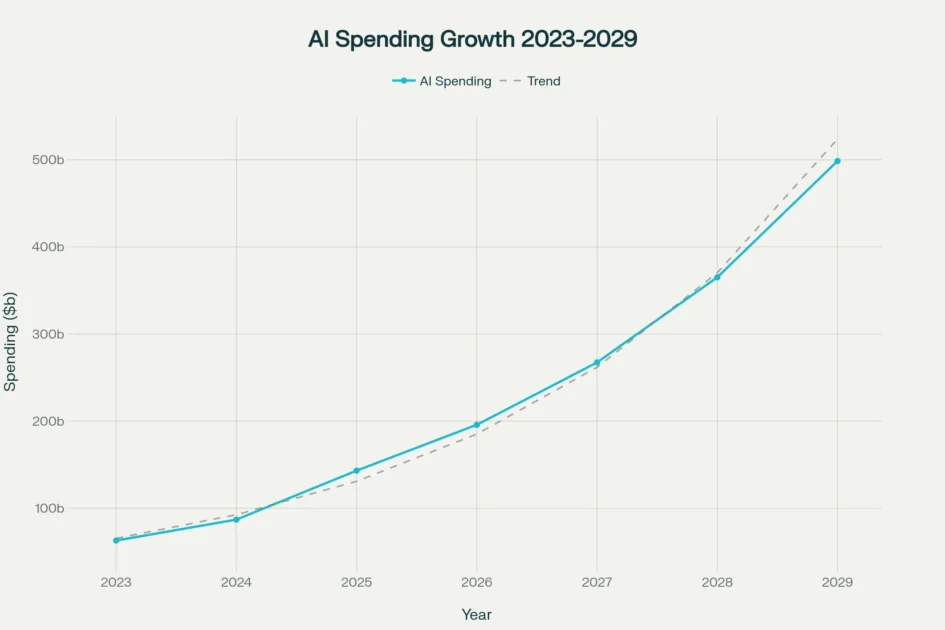
Global enterprise Artificial Intelligence Applications spending shows exponential growth, projected to reach nearly $500 billion by 2029
Customer Service Automation and Artificial Intelligence Applications Support Systems
Customer service automation represents one of the most immediately impactful artificial intelligence applications transforming business operations across sectors. Modern enterprises leverage sophisticated natural language processing and machine learning algorithms to create responsive, personalized customer experiences that operate continuously without human intervention. The technology processes customer inquiries through multiple channels simultaneously, providing instant resolution for routine queries while escalating complex issues to human agents equipped with AI-generated context and suggested solutions.
Measurable Impact of Customer service automation
The measurable impact of customer service automation AI applications demonstrates compelling business value. Leading implementations report 43% of customer tickets deflected through AI agents, while achieving 50% reduction in overall ticket volume through enhanced self-service capabilities. Companies implementing advanced customer service automation experience 9.44% increases in customer satisfaction scores, primarily attributed to reduced response times and improved issue resolution accuracy. Organizations like Telstra report 84% of agents confirm that AI applications positively impact customer interactions, while 90% of support staff demonstrate increased effectiveness when augmented by intelligent systems.
Artificial intelligence applications in customer service extend beyond basic chatbot functionality to encompass predictive customer needs analysis and proactive issue resolution. Machine learning algorithms analyze historical interaction patterns to anticipate customer requirements, enabling businesses to address concerns before they escalate into formal complaints. Financial institutions utilize these AI applications to reduce fraud investigation times while improving customer communication during security incidents. The technology’s ability to maintain consistent brand voice across thousands of simultaneous conversations ensures uniform service quality regardless of interaction volume or complexity.
The implementation complexity of customer service automation artificial intelligence applications varies significantly based on organizational requirements and existing technology infrastructure. Medium-complexity deployments typically achieve return on investment within 6-12 months, while more sophisticated systems integrating multiple data sources may require extended timelines. However, the efficiency gains consistently justify the investment, with organizations reporting 40-65% improvements in support team productivity and 35-50% reductions in operational costs associated with customer service operations.
Artificial Intelligence Applications Impact Table
| AI Application | Primary Industry | Cost Reduction (%) | Efficiency Gain (%) | ROI Timeline | Implementation Complexity |
| Customer Service Automation | Retail/Finance | 35-50% | 40-65% | 6-12 months | Medium |
| Predictive Analytics | Healthcare/Finance | 25-40% | 30-55% | 12-18 months | High |
| Supply Chain Optimization | Manufacturing/Retail | 15-30% | 25-45% | 9-15 months | High |
| Fraud Detection | Finance/Insurance | 60-75% | 70-85% | 3-6 months | Medium |
| Process Automation | All Industries | 40-65% | 50-75% | 6-12 months | Low-Medium |
| Personalized Marketing | E-commerce/Media | 20-35% | 35-60% | 9-18 months | Medium |
| Quality Control | Manufacturing | 30-45% | 45-70% | 12-24 months | Medium-High |
Predictive Analytics and Data-Driven Decision Making
Predictive analytics represents a transformative category of artificial intelligence applications that convert vast datasets into actionable business intelligence. These systems analyze historical patterns, current market conditions, and external variables to forecast future outcomes with remarkable accuracy. Healthcare organizations utilize predictive AI applications to identify patients at risk of complications, while financial institutions deploy similar technologies to assess credit risk and detect fraudulent transactions before they impact operations.
The sophistication of modern predictive analytics AI applications enables real-time decision support across multiple business functions simultaneously. Manufacturing companies leverage these systems to predict equipment failures, optimize production schedules, and manage supply chain disruptions before they affect delivery commitments. Retail organizations implement predictive AI applications to forecast demand with unprecedented precision, reducing inventory carrying costs while minimizing stockouts that impact customer satisfaction. The technology’s ability to process diverse data sources, including social media sentiment, economic indicators, and weather patterns, provides comprehensive insights that traditional analytical methods cannot achieve.
Financial services organizations demonstrate particularly impressive results from predictive analytics artificial intelligence applications. JPMorgan Chase reports significant improvements in fraud detection capabilities, with AI systems processing millions of transactions in real-time to identify suspicious patterns that human analysts would miss. These AI applications analyze transaction velocity, geographic patterns, and behavioral anomalies to prevent fraudulent activities while reducing false positive rates that inconvenience legitimate customers. The technology’s continuous learning capabilities ensure that detection algorithms adapt to evolving fraud techniques without requiring manual updates or rule modifications.
The return on investment timeline for predictive analytics artificial intelligence applications typically extends 12-18 months due to the complexity of data integration and model training requirements. However, organizations implementing these systems report 25-40% cost reductions and 30-55% efficiency gains once fully operational. The high implementation complexity requires significant expertise in data science and machine learning, but the strategic advantages justify the investment for organizations seeking competitive differentiation through superior decision-making capabilities.

Artificial Intelligence Applications Return on Investment varies significantly across industries, with healthcare leading at 124% ROI
Supply Chain Optimization and Artificial Intelligence Applications Logistics
Supply chain optimization represents one of the most complex and impactful artificial intelligence applications transforming modern business operations. These systems integrate multiple data streams, including supplier performance metrics, transportation logistics, inventory levels, and market demand forecasts, to optimize end-to-end supply chain performance. Manufacturing giants like Siemens report saving $750 million annually through AI-powered predictive maintenance systems that prevent costly production disruptions. The technology’s ability to process real-time data from Internet of Things sensors, logistics providers, and supplier networks enables dynamic optimization that responds immediately to changing conditions.
The implementation of supply chain
The implementation of supply chain AI applications delivers measurable improvements across multiple operational dimensions. Early adopters report 15% reductions in logistics costs and 35% improvements in inventory management efficiency. These systems optimize delivery routes in real-time, reducing fuel consumption and improving on-time delivery performance while minimizing environmental impact. Walmart leverages machine learning algorithms for demand forecasting across its global supply chain, achieving significant waste reduction and improved product availability through more accurate inventory planning.
Advanced supply chain artificial intelligence applications incorporate predictive analytics to anticipate disruptions before they impact operations. These systems analyze weather patterns, geopolitical events, and supplier financial health to recommend alternative sourcing strategies and inventory adjustments. The technology’s ability to simulate thousands of supply chain scenarios enables organizations to develop robust contingency plans and optimize their operations for both efficiency and resilience. Manufacturing companies report that AI-driven supply chain optimization reduces unplanned downtime by 25% while extending equipment lifespan through intelligent maintenance scheduling.
The complexity of implementing supply chain AI applications requires significant organizational commitment and technical expertise. Organizations typically invest 9-15 months in deployment and optimization before achieving full operational benefits. However, the long-term advantages include 15-30% cost reductions and 25-45% efficiency improvements that compound annually as the systems continue learning and optimizing. The strategic importance of supply chain resilience ensures that these artificial intelligence applications remain high-priority investments for organizations seeking competitive advantage through operational excellence.
Fraud Detection and Risk Management Systems
Fraud detection represents a critical category of artificial intelligence applications where the technology’s pattern recognition capabilities deliver exceptional value. Financial institutions report that 90% now utilize AI-powered fraud detection systems, with two-thirds implementing these AI applications within the past two years. These systems analyze transaction patterns, user behavior, and device characteristics in real-time to identify suspicious activities with accuracy rates that far exceed traditional rule-based approaches. PayPal’s AI-based fraud detection system maintains fraud losses at just 0.32% of revenue, significantly below industry averages.
The sophistication of modern fraud detection artificial intelligence applications extends beyond transaction monitoring to encompass behavioral analytics and predictive risk assessment. These systems learn normal user patterns and immediately flag deviations that suggest fraudulent activity. Financial institutions implementing advanced fraud detection report 40-60% reductions in fraud losses while achieving 34% decreases in false positive rates that previously inconvenienced legitimate customers. The technology’s ability to adapt continuously ensures that detection algorithms remain effective against evolving fraud techniques, including AI-generated deepfakes and synthetic identity attacks.
Artificial intelligence applications in fraud detection demonstrate remarkable efficiency improvements that translate directly to operational cost savings. Organizations report 43% improvements in operational efficiency as AI systems handle routine fraud investigations automatically, allowing human analysts to focus on complex cases requiring nuanced judgment. The technology processes millions of transactions simultaneously, providing instant risk assessments that enable real-time decision-making for payment approvals and account security measures. Banks utilizing these systems report processing times reduced from days to hours for fraud investigations while maintaining higher accuracy rates than manual review processes.
The rapid deployment potential of fraud detection AI applications makes them attractive investments for financial institutions facing increasing cyber threats. Organizations typically achieve return on investment within 3-6 months due to immediate fraud loss reductions and operational efficiency gains. The technology’s medium implementation complexity allows banks to deploy effective systems without extensive data science infrastructure, while the 60-75% cost reductions and 70-85% efficiency improvements provide compelling business justification for continued investment and expansion.

Enterprise AI budget allocation shows public cloud platforms receiving the largest share at 11% of total AI spending
Artificial Intelligence Applications Process Automation and Workflow Optimization
Process automation represents the most widely adopted category of artificial intelligence applications across industries, fundamentally changing how organizations handle repetitive tasks and complex workflows. These systems utilize robotic process automation enhanced by machine learning to execute multi-step business processes with minimal human intervention. Organizations implementing comprehensive process automation report that employees save an average of 2.5 hours daily, enabling focus on strategic initiatives rather than routine administrative tasks. The technology’s ability to learn from human actions and optimize workflows continuously ensures that automation systems become more efficient over time.
The scope of process automation
The scope of process automation AI applications encompasses everything from document processing and data entry to complex decision-making workflows requiring multiple approvals and validations. Insurance companies leverage these systems to automate claims processing, reducing assessment times from weeks to hours while improving accuracy and consistency. Healthcare organizations implement artificial intelligence applications to streamline patient onboarding, appointment scheduling, and insurance verification processes, achieving 75% reductions in administrative processing time. The technology integrates seamlessly with existing enterprise systems, enabling organizations to automate workflows without disrupting established operational procedures.
Financial institutions demonstrate particularly impressive results from process automation AI applications. Bank of America’s implementation reduced customer support costs while handling over 250 million client interactions through automated systems. These artificial intelligence applications process loan applications, conduct compliance checks, and manage account maintenance tasks with accuracy rates exceeding human performance while operating continuously without breaks or scheduling constraints. The technology’s ability to maintain detailed audit trails and ensure consistent policy compliance addresses regulatory requirements while improving operational transparency.
The low-to-medium implementation complexity of process automation AI applications makes them accessible to organizations across all sectors. Companies typically achieve return on investment within 6-12 months while realizing 40-65% cost reductions and 50-75% efficiency improvements. The technology’s scalability enables organizations to expand automation gradually, starting with high-volume, routine processes before progressing to more complex workflows requiring sophisticated decision-making capabilities. This phased approach minimizes implementation risk while maximizing organizational learning and adoption success.
Personalized Marketing and Customer Engagement
Personalized marketing represents a sophisticated category of artificial intelligence applications that transforms how organizations understand and engage with their customers. These systems analyze customer behavior, purchase history, and interaction patterns to create highly targeted marketing campaigns that resonate with individual preferences and needs. Amazon’s AI-powered recommendation engine generates 35% of the company’s total sales by presenting customers with products aligned to their demonstrated interests and browsing patterns. The technology’s ability to process vast amounts of customer data in real-time enables dynamic personalization that adapts to changing customer preferences and market conditions.
The implementation of personalized marketing AI applications extends beyond product recommendations to encompass content creation, campaign optimization, and customer journey orchestration. Streaming services like Netflix report that their recommendation technology generates $1 billion in annual revenue by keeping subscribers engaged with personalized content suggestions. These systems analyze viewing patterns, genre preferences, and temporal behaviors to predict content that individual users will find compelling. The technology’s continuous learning capabilities ensure that recommendations improve over time, increasing customer satisfaction and reducing churn rates across subscriber bases.
Artificial intelligence applications in personalized marketing demonstrate measurable impact on customer engagement and revenue generation. Coca-Cola implemented AI-powered social media analytics and machine learning to create targeted campaigns that reach specific audience segments at optimal times. The company’s AI applications analyze customer interaction patterns on platforms like Instagram and Facebook to determine when teenage followers are most active, enabling precisely timed advertisements that maximize engagement while minimizing advertising spend. Organizations implementing similar strategies report significant improvements in campaign effectiveness and customer acquisition costs.
The medium implementation complexity of personalized marketing artificial intelligence applications requires organizations to invest in customer data infrastructure and analytical capabilities. Companies typically realize return on investment within 9-18 months as the systems optimize campaign performance and improve customer lifetime value. The technology delivers 20-35% cost reductions in marketing spend while achieving 35-60% improvements in customer engagement metrics. Organizations that successfully implement these AI applications gain competitive advantages through superior customer understanding and the ability to deliver relevant experiences that build long-term customer loyalty.
Quality Control and Predictive Maintenance
Quality control artificial intelligence applications represent a critical transformation in manufacturing and production environments, where precision and consistency directly impact product quality and operational efficiency. These systems utilize computer vision, machine learning, and sensor data to detect defects, monitor production parameters, and predict equipment failures before they impact operations. HCLTech launched manufacturing quality AI agents that predict and eliminate various types of defects using advanced analytics and real-time monitoring capabilities. The technology’s ability to identify subtle quality variations that human inspectors might miss ensures consistent product standards while reducing waste and rework costs.
The sophistication of modern quality control AI applications extends beyond defect detection to encompass predictive maintenance and operational optimization. Manufacturing companies implement these systems to monitor equipment performance continuously, analyzing vibration patterns, temperature fluctuations, and performance metrics to predict maintenance requirements before failures occur. Siemens’ implementation of AI-powered predictive maintenance achieved a 25% reduction in power outages at production facilities while saving millions annually through prevented downtime. The technology’s ability to optimize maintenance schedules based on actual equipment condition rather than predetermined intervals maximizes operational availability while minimizing maintenance costs.
Quality control artificial intelligence applications demonstrate remarkable impact on production efficiency and product consistency. These systems process thousands of product inspections per hour with accuracy rates exceeding human capabilities while maintaining detailed quality records for compliance and improvement initiatives. Manufacturing organizations report that AI-driven quality control systems identify defects earlier in production processes, reducing waste and rework costs while improving overall product reliability. The technology’s continuous learning capabilities ensure that detection algorithms improve over time, adapting to new product variations and quality requirements without manual recalibration.
The medium-to-high implementation complexity of quality control AI applications reflects the need for specialized sensors, computer vision systems, and integration with existing manufacturing equipment. Organizations typically invest 12-24 months in deployment and optimization before achieving full operational benefits. However, the long-term advantages include 30-45% cost reductions and 45-70% efficiency improvements that justify the investment through improved product quality, reduced warranty claims, and enhanced customer satisfaction. The strategic importance of quality control ensures that these artificial intelligence applications remain essential investments for manufacturers seeking competitive advantage through operational excellence.
Future Outlook and Strategic Implementation Considerations of Artificial Intelligence Applications
The successful deployment of artificial intelligence applications requires careful consideration of organizational readiness, technical infrastructure, and change management strategies. Leading organizations recognize that AI transformation extends beyond technology implementation to encompass workforce development, process redesign, and cultural adaptation. McKinsey research indicates that 78% of enterprises now utilize AI applications in at least one business function, with successful implementations characterized by strong executive sponsorship and cross-functional collaboration. Organizations achieving superior results from AI applications invest significantly in employee training and change management initiatives that ensure technology adoption aligns with business objectives.
The financial implications of artificial intelligence applications implementation demand strategic planning and realistic expectations regarding return on investment timelines. Enterprise AI spending is projected to grow 75% year-over-year, with organizations allocating an average of $85,521 monthly to AI initiatives in 2025. Successful implementations balance immediate operational improvements with long-term strategic capabilities, ensuring that artificial intelligence applications deliver both short-term efficiency gains and sustained competitive advantage. Organizations report that AI projects with clear business objectives and measurable success metrics achieve return on investment 1.5 times faster than experimental implementations without defined outcomes.
The evolution of Artificial Intelligence applications
The evolution of AI applications continues accelerating as new technologies mature and become accessible to mainstream enterprises. Generative AI budgets are expected to grow 60% over the next two years, with total spending projected to reach $644 billion globally. Organizations positioning themselves for future success invest in foundational capabilities, including data infrastructure, analytical expertise, and organizational learning systems that support continuous AI innovation. The most successful implementations create feedback loops that enable AI applications to improve continuously while generating insights that inform strategic decision-making.
The competitive landscape increasingly favors organizations that successfully integrate AI applications into their core operations. Companies with mature AI strategies report 1.5 times higher revenue growth and 1.6 times greater shareholder returns compared to organizations with limited AI adoption. This performance differential will likely expand as AI applications become more sophisticated and integrated into business operations. Organizations that delay AI adoption risk falling behind competitors who leverage these technologies to optimize operations, enhance customer experiences, and develop innovative products and services that define market leadership in the digital economy.
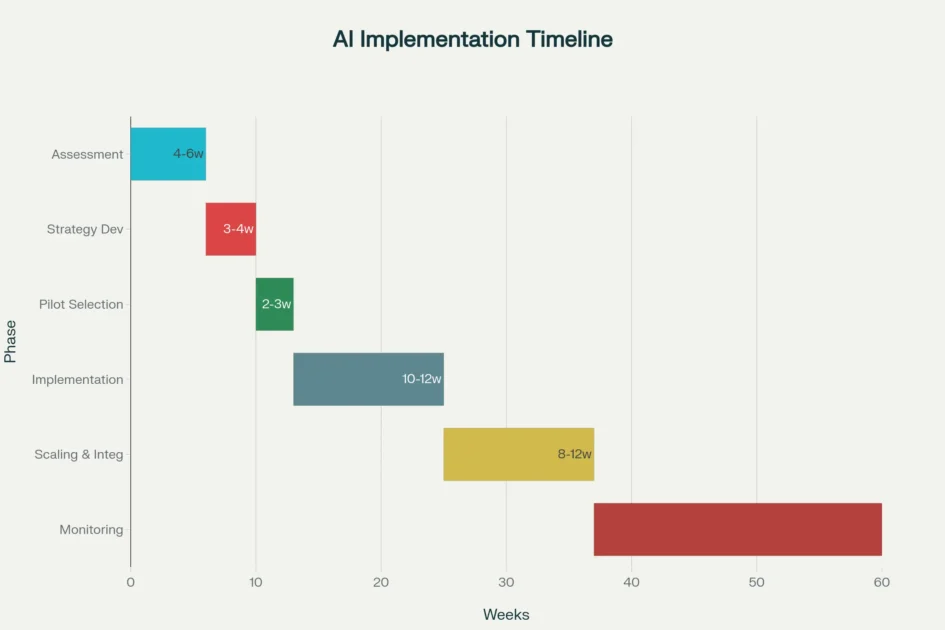
Artificial Intelligence applications implementation follows six distinct phases, with total timeline ranging from 6 months to 18 months for enterprise deployment
Conclusion
The transformation of business operations through artificial intelligence applications represents more than technological advancement—it signifies a fundamental shift in how organizations create value, serve customers, and compete in global markets. The seven essential AI applications examined in this analysis demonstrate that AI has evolved from experimental technology to mission-critical infrastructure delivering measurable business impact across industries. Organizations successfully implementing these systems report average returns of 3.7 times their investment, with leading sectors achieving returns exceeding 124% through strategic application of AI capabilities. The evidence overwhelmingly supports the conclusion that AI applications are no longer optional enhancements but essential components of competitive business strategy.
The strategic imperative for AI adoption becomes increasingly urgent as market leaders establish significant performance advantages over competitors who delay implementation. Companies with mature AI applications report 1.5 times higher revenue growth and substantially improved operational efficiency across multiple business functions. The compounding nature of AI benefits ensures that early adopters continue expanding their competitive advantages as systems learn, optimize, and generate insights that inform strategic decision-making. Organizations that recognize artificial intelligence applications as foundational investments rather than experimental projects position themselves for sustained success in an increasingly digital economy.
The future landscape of business competition will be defined by organizations’ ability to leverage AI applications for continuous innovation and operational excellence. With global AI spending projected to reach $644 billion and enterprise adoption growing 75% annually, the technology’s impact on business operations will only intensify. Organizations that develop comprehensive AI strategies, invest in organizational capabilities, and maintain commitment to continuous learning will lead their industries. The transformation enabled by AI applications represents the most significant business opportunity of the digital age, rewarding organizations that embrace these technologies with sustainable competitive advantage and unprecedented operational capabilities.
Citations
- https://www.mckinsey.com/capabilities/quantumblack/our-insights/the-state-of-ai
- https://www.precedenceresearch.com/artificial-intelligence-market
- https://www.tredence.com/blog/ai-roi
- https://www.marketsandmarkets.com/Market-Reports/artificial-intelligence-market-74851580.html
- https://smartdev.com/ai-return-on-investment-roi-unlocking-the-true-value-of-artificial-intelligence-for-your-business/
- https://www.vktr.com/ai-disruption/5-ai-case-studies-in-customer-service-and-support/
- https://blog.lumen.com/ai-powered-customer-service-success-stories-and-best-practices/
- https://www.netguru.com/blog/ai-business-applications
- https://tezeract.ai/how-fortune-500-companies-using-ai/
- https://www.growthjockey.com/blogs/ai-case-study
- https://www.forefront-technology.com/post/ai-in-the-enterprise-7-use-cases-that-actually-deliver-roi
- https://gjia.georgetown.edu/2024/02/05/the-role-of-ai-in-developing-resilient-supply-chains/
- https://talentsprint.com/blog/ai-transforming-industries-2025
- https://orbograph.com/feedzai-report-90-of-fis-use-ai-to-fight-fraud-and-financial-crime/
- https://www.microsoft.com/en-us/microsoft-cloud/blog/2025/07/24/ai-powered-success-with-1000-stories-of-customer-transformation-and-innovation/
- https://www.synthesia.io/post/ai-statistics
- https://cloud.google.com/transform/101-real-world-generative-ai-use-cases-from-industry-leaders
- https://www.cloudzero.com/state-of-ai-costs/
- https://www.saastr.com/a16z-enterprise-ai-spending-is-growing-75-a-year/
- https://www.superannotate.com/blog/enterprise-ai-overview
- https://www.bcg.com/press/24october2024-ai-adoption-in-2024-74-of-companies-struggle-to-achieve-and-scale-value
- https://www.geeksforgeeks.org/blogs/applications-of-ai/
- https://www.esparkinfo.com/software-development/digital-transformation/statistics
- https://a16z.com/ai-enterprise-2025/
- https://www.scalacode.com/blog/top-ai-business-ideas/
- https://explodingtopics.com/blog/ai-statistics
- https://www.weforum.org/stories/2025/07/enterprise-ai-tipping-point-what-comes-next/
- https://www.pwc.com/us/en/tech-effect/ai-analytics/ai-predictions.html
- https://www.venasolutions.com/blog/ai-statistics
- https://www.anthropic.com/research/anthropic-economic-index-september-2025-report
- https://www.simplilearn.com/tutorials/artificial-intelligence-tutorial/artificial-intelligence-applications
- https://www.deloitte.com/us/en/services/consulting/blogs/ai-adoption-challenges-ai-trends.html
- https://codewave.com/insights/artificial-intelligence-applications-enterprises/
- https://www.integrate.io/blog/data-transformation-challenge-statistics/
- https://nasscom.in/knowledge-center/publications/enterprise-experiments-ai-agents-2025-global-trends
- https://www.mckinsey.com/capabilities/mckinsey-digital/our-insights/superagency-in-the-workplace-empowering-people-to-unlock-ais-full-potential-at-work
- https://mlq.ai/media/quarterly_decks/v0.1_State_of_AI_in_Business_2025_Report.pdf
- https://digitaldefynd.com/IQ/artificial-intelligence-case-studies/
- https://www.bitcot.com/top-ai-automation-tools-for-fortune-500-companies/
- https://barnraisersllc.com/2019/05/19/artificial-intelligence-success-stories-brands/
- https://www.zycus.com/blog/generative-ai/genai-deployment-within-fortune-500-companies
- https://www.omdena.com/blog/examples-of-ai-in-business-2025
- https://www.bluemantis.com/blog/unlock-real-roi-with-ai-insights-from-microsoft-webinar/
- https://www.forbes.com/lists/ai50/
- https://www.aicerts.ai/news/us-ai-insights-key-trends-and-case-studies-in-2025/
- https://sada.com/blog/real-world-ai-use-cases-delivering-roi-across-industries/
- https://brand-studio.fortune.com/accenture/reinventing-the-fortune-500-with-generative-ai/?prx_t=-RsJAAAAAAoQARA
- https://www.forbes.com/sites/cio/2025/01/30/why-75-of-businesses-arent-seeing-roi-from-ai-yet/
- https://www.netguru.com/blog/ai-in-the-workplace
- https://ir.isg-one.com/news-market-information/press-releases/news-details/2024/Enterprise-AI-Spending-to-Rise-5.7-Percent-in-2025-Despite-Overall-IT-Budget-Increase-of-Less-than-2-Percent-ISG-Study/default.aspx
- https://kyp.ai/roi-of-artificial-intelligence-and-automation-metrics-that-matter/
- https://kanerika.com/blogs/ai-market-analysis/
- https://www.cprime.com/resources/blog/maximizing-ai-roi-business-success/
- https://www.grandviewresearch.com/industry-analysis/artificial-intelligence-ai-market
- https://my.idc.com/getdoc.jsp?containerId=prUS53765225
- https://papers.ssrn.com/sol3/papers.cfm?abstract_id=5225996
- https://hai.stanford.edu/ai-index/2025-ai-index-report
- https://www.ibm.com/think/insights/ai-roi
- https://www.statista.com/outlook/tmo/artificial-intelligence/worldwide
- https://www.sap.com/resources/ai-in-supply-chain-management
- https://www.feedzai.com/pressrelease/ai-fraud-trends-2025/
- https://throughput.world/blog/ai-in-supply-chain-and-logistics/
- https://sift.com/blog/how-ai-is-fueling-online-fraud-in-2025-and-what-businesses-can-do-about-it/
- https://www.tidio.com/blog/companies-that-use-ai-generated-customer-support/
- https://ebsedu.org/blog/ai-in-supply-chain-management
- https://forethought.ai/blog/customer-success-stories-with-ai
- https://www.ibm.com/think/topics/ai-supply-chain
- https://datadome.co/learning-center/ai-fraud-detection/
- https://www.oracle.com/in/scm/ai-supply-chain/
- https://www.mishcon.com/news/fraud-trends-in-2025-the-ai-paradox
- https://www.flowforma.com/blog/ai-customer-service-automation
- https://www.ibm.com/think/topics/ai-fraud-detection-in-banking
- https://www.salesforce.com/news/stories/agentforce-customer-success-stories/
- https://www.eazystock.com/blog/artificial-intelligence-and-machine-learning-in-supply-chain-management/