
7 High-Impact Social Media Advertising Campaigns to Copy
The modern marketing environment demands more than traditional advertising approaches. Businesses investing in social media advertising campaigns are witnessing transformative returns, with the US market projected to reach $103.07 billion in 2025 alone. This explosive growth reflects a fundamental shift in how brands connect with consumers, moving beyond interruption-based advertising toward community-driven engagement. These campaigns have evolved into sophisticated ecosystems where storytelling, data analytics, and authentic human connection converge to create measurable business outcomes.
The most successful brands recognize that effective advertising campaigns balance creative boldness with strategic precision, leveraging platform-specific features while maintaining consistent brand narratives across channels. Understanding the mechanics behind high-performing social media advertising campaigns provides marketers with actionable frameworks for building their own breakthrough initiatives, transforming modest budgets into viral phenomena that drive both brand awareness and bottom-line growth.

US Social Media Advertising Campaigns Spending Growth demonstrating the exponential increase from $23.5 billion in 2017 to $103.07 billion in 2025
Recent data reveals that social media advertising campaigns generate an average return of $5.78 for every dollar spent, nearly doubling the performance of traditional digital advertising methods. Companies executing strategic advertising campaigns report engagement rates up to 400% higher than conventional marketing approaches, while user-generated content campaigns demonstrate 240% greater authenticity perception among target audiences.
The seven social media advertising campaigns examined in this comprehensive analysis share common characteristics: emotional resonance, platform optimization, community participation, and measurable business impact. These campaigns span industries from personal care to fast food, technology to travel, yet each demonstrates universal principles applicable across sectors and budgets. By studying these exemplary advertising campaigns, marketers gain insights into campaign architecture, creative execution, audience psychology, and performance optimization that can be adapted to their unique business contexts.
Understanding the Social Media Advertising Campaigns Revolution
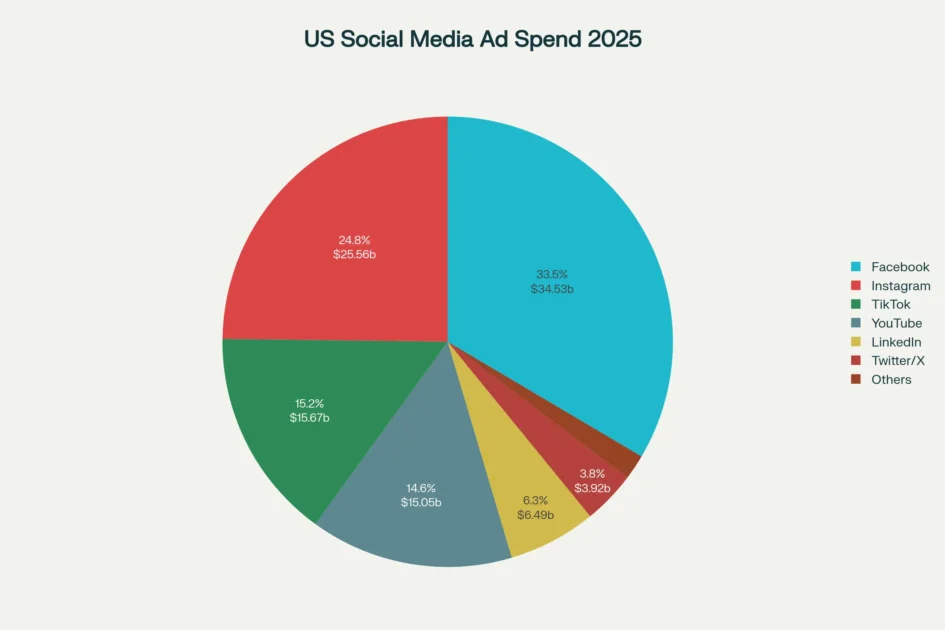
US Ad Spend Distribution (2025) showing Facebook commanding 33.5% market share ($34.53B), followed by Instagram at 24.8% ($25.56B) of total social media advertising investments
Meta platforms dominate Social Media Advertising Campaigns spending in 2025, with Facebook capturing 33.5% ($34.53B) and Instagram 24.8% ($25.56B) of the $103 billion US market, while TikTok emerges as third with 15.2% share.
The transformation of social media advertising campaigns from simple promoted posts to sophisticated multi-platform experiences represents one of marketing’s most significant evolutions. Traditional advertising operated on a broadcast model where brands transmitted messages to passive audiences, but modern advertising campaigns function as two-way conversations where consumers actively participate in brand narratives.
This fundamental shift requires marketers to reconceptualize their approach, viewing these campaigns not as isolated promotional activities but as ongoing relationships with dynamic communities. The most effective social media advertising campaigns leverage platform-specific features while maintaining cohesive brand identities across channels, creating seamless experiences that feel native to each environment while reinforcing central messaging.
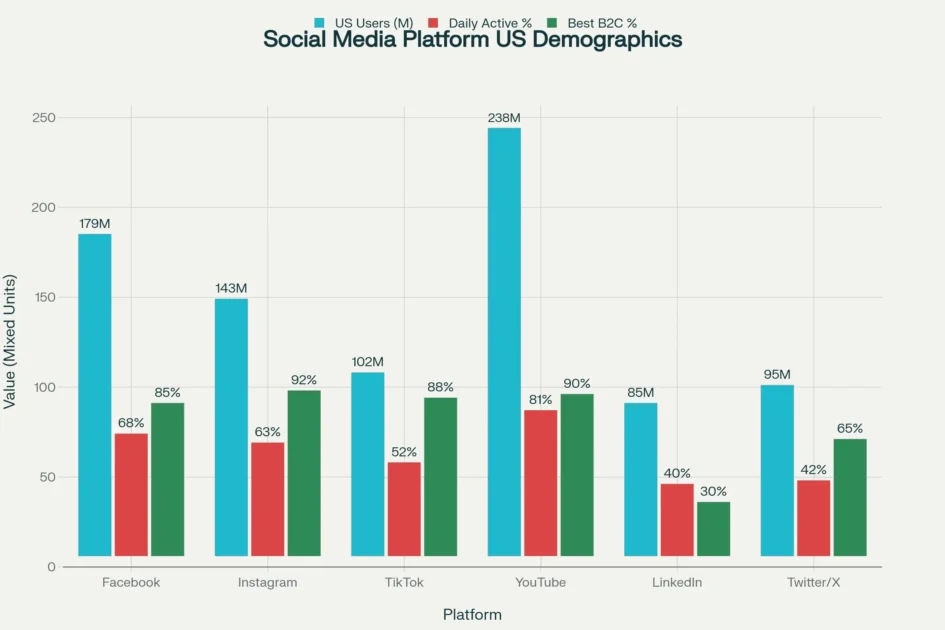
Platform Demographics and Usage showing YouTube leading with 238M US users and 81% daily active rate, while Instagram excels for B2C campaigns with 92% suitability rating
Platform selection
Platform selection profoundly impacts the advertising campaigns performance, with research indicating YouTube delivers the highest ROI at $6 per dollar spent, followed by influencer marketing at $5.78 and Facebook at $4.50. However, these aggregate statistics mask important nuances, as campaign effectiveness depends heavily on audience demographics, content format, and strategic objectives. TikTok advertising campaigns, while showing lower overall ROI metrics at $2.40, demonstrate exceptional performance with Gen Z audiences and achieve 56.8% year-over-year growth in retail sector spending.
LinkedIn advertising campaigns command premium pricing but deliver unmatched precision for B2B targeting, with 70% of marketers expressing confidence in positive returns. Instagram advertising campaigns excel in visual storytelling and influencer partnerships, generating 1.92% engagement rates on carousel formats that outperform single-image alternatives.
Platform-Specific Features and Best Use Cases
| Platform | Primary Ad Format | Targeting Precision | Best Campaign Type | Average CPC ($) | Average CPM ($) | Conversion Rate (%) |
| News Feed Ads | Excellent | Community building, events | 1.72 | 14.9 | 9.21 | |
| Stories & Reels | Excellent | Visual products, lifestyle | 3.56 | 8.96 | 1.08 | |
| TikTok | In-Feed Videos | Good | Viral challenges, Gen Z | 1 | 10 | 3.37 |
| YouTube | Pre-roll & Mid-roll | Very Good | Education, tutorials | 2.5 | 6.5 | 2.58 |
| Sponsored Content | Exceptional | B2B, thought leadership | 5.26 | 6.59 | 2.74 | |
| Twitter/X | Promoted Tweets | Good | Real-time, trending topics | 0.38 | 6.46 | 0.77 |

Platform ROI Comparison showing YouTube leading with $6 return per dollar spent, followed by LinkedIn at $5.78, demonstrating varying performance across social media advertising channels
Essential Success Factors for Social Media Advertising Campaigns
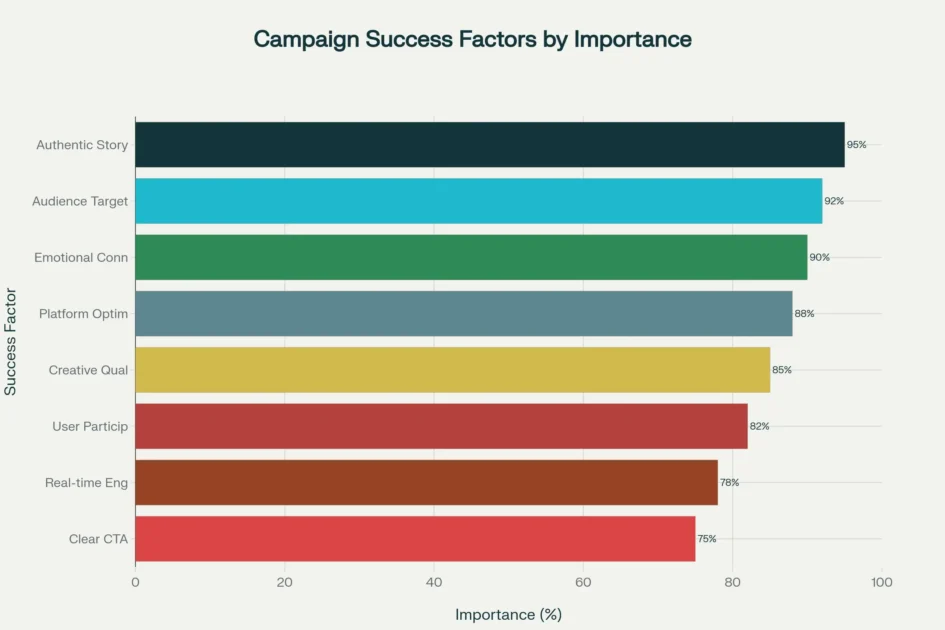
Campaign Success Factors revealing Authentic Storytelling (95%) and Audience Targeting (92%) as the most critical elements for high-impact social media advertising campaigns
Research reveals authentic storytelling (95% importance) and audience targeting (92%) as the most critical success factors for Social Media Advertising Campaigns, while clear calls-to-action (75%) rank lowest among essential elements.
The Evolution of Social Media Advertising Campaigns Strategies
Social media advertising campaigns have undergone remarkable transformation since Facebook introduced its advertising platform in 2007. Early social media advertising consisted primarily of banner ads and sponsored posts that mimicked traditional display advertising, achieving modest results and generating skepticism about social platforms’ commercial viability.
The introduction of sophisticated targeting capabilities, native ad formats, and algorithmic optimization fundamentally altered the social media advertising equation, enabling brands to reach precisely defined audiences with relevant messages at optimal moments. Modern social media advertising incorporate artificial intelligence, predictive analytics, and real-time bidding systems that continuously optimize performance based on thousands of data signals, creating self-improving campaigns that become more effective over time.
Mobile-First Consumption Patterns
The shift toward mobile-first consumption patterns revolutionized social media advertising campaigns design and execution. Mobile devices now account for 86.4% of social media advertising spending, driving format innovations like vertical video, swipeable carousels, and immersive Stories experiences that leverage smartphones’ unique capabilities.
Successful advertising campaigns recognize that mobile users exhibit distinct behavioral patterns, including shorter attention spans, thumb-based navigation, and context-switching behaviors that require tailored creative approaches. Video content dominates mobile social media advertising, with short-form videos delivering 71% higher ROI than other formats and vertical videos generating seven times more engagement than horizontal alternatives on platforms like TikTok and Instagram.
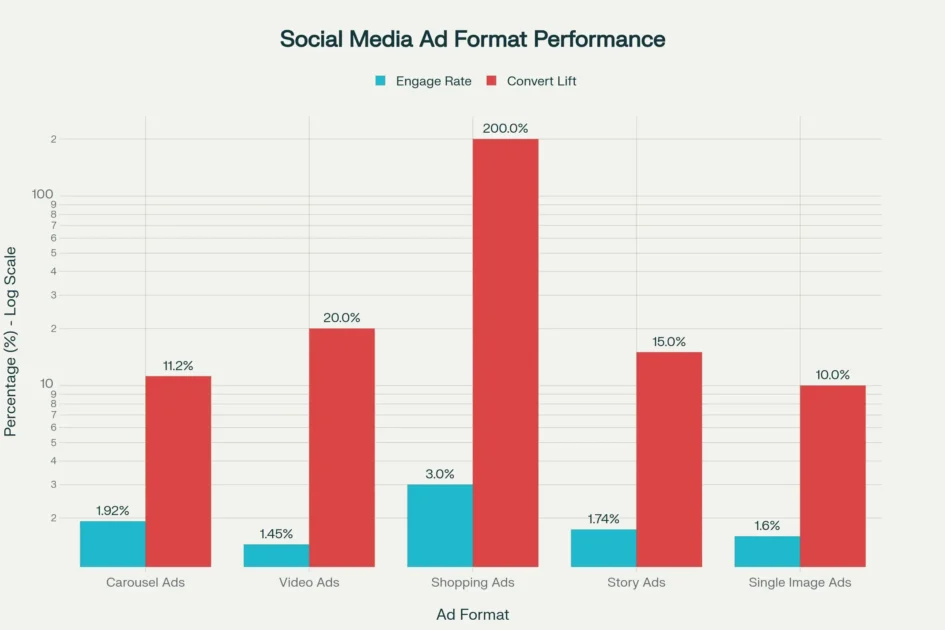
Social Media Advertising Formats Performance showing Shopping Ads delivering 200% conversion lift while maintaining 3% engagement rate, significantly outperforming other formats
Key Performance Indicators for Social Media Advertising Campaigns
Measuring social media advertising campaigns effectiveness requires sophisticated understanding of multiple performance dimensions beyond simple vanity metrics like follower counts or impressions. Comprehensive advertising campaigns evaluation encompasses engagement metrics (likes, shares, comments, saves), conversion metrics (click-through rates, lead generation, purchase completions), brand metrics (awareness, sentiment, recall), and economic metrics (return on ad spend, customer acquisition cost, lifetime value). The most successful social media advertising campaigns establish clear key performance indicators aligned with specific business objectives before launch, enabling objective assessment of campaign impact and informed optimization decisions throughout execution.
Engagement metrics
Engagement metrics provide crucial insights into social media advertising resonance with target audiences. Average engagement rates vary significantly across platforms and content types, with TikTok advertising campaigns averaging 0.72%, Instagram carousels achieving 1.92%, and YouTube content generating 0.91% engagement. However, raw engagement numbers require contextual interpretation, as engagement quality matters as much as quantity.
These campaigns that generate meaningful conversations, extended viewing time, and audience-to-audience interactions create more valuable outcomes than campaigns producing superficial engagement through sensational content or artificial manipulation. Advanced social media advertising campaigns analysis examines engagement patterns over time, identifying content themes, formats, and messaging approaches that consistently resonate with specific audience segments.
Conversion tracking
Conversion tracking represents the ultimate measure of the impact of these campaigns on business. While awareness and engagement metrics indicate campaign visibility and audience interest, conversion metrics demonstrate actual behavioral change and revenue generation. The advertising campaigns conversion rates vary dramatically based on industry, product category, funnel stage, and targeting precision, with shopping ads delivering 200% conversion lift compared to single-image alternatives.
User-generated content incorporated into social media advertising campaigns increases conversion rates by 29%, while campaigns featuring authentic customer testimonials generate 93% higher purchase intent than brand-created content. The most sophisticated advertising campaigns implement multi-touch attribution models that account for the complex customer journeys spanning multiple platforms and touchpoints before final conversion.
Campaign One: Dove’s Real Beauty Sketches
Dove’s Real Beauty Sketches campaign exemplifies how social media advertising campaigns can transcend product promotion to spark meaningful cultural conversations. Launched in 2013 as part of Dove’s broader Self-Esteem Project, this campaign featured an FBI-trained forensic artist sketching women based on their self-descriptions and stranger descriptions, revealing the stark disconnect between self-perception and external reality.
The emotional narrative resonated globally, generating 30 million views within ten days and achieving 97.6% positive sentiment on YouTube. This campaign demonstrated how social media advertising grounded in authentic human experiences create deeper connections than traditional product-focused messaging, transforming Dove from a soap brand into a champion for female self-esteem.
The strategic architecture
The strategic architecture of Dove’s social media advertising centered on emotional storytelling rather than product features, recognizing that meaningful narratives create lasting brand associations. The Real Beauty Sketches video employed documentary-style filming that felt genuine and unscripted, contrasting sharply with polished commercial aesthetics typical of beauty industry advertising.
This authenticity proved crucial to the campaign’s viral spread, as viewers shared content that felt meaningful rather than promotional. Dove amplified the campaign through carefully orchestrated social media advertising on Facebook and YouTube, encouraging audience participation through the #DoveSelfEsteemProject hashtag and facilitating conversations about beauty standards, self-worth, and societal pressures facing women.
The business impact
The business impact of Dove’s advertising campaigns extended far beyond immediate metrics, fundamentally repositioning the brand in consumers’ minds and creating sustainable competitive advantage. Within twelve days, the Real Beauty Sketches video became the most-watched online video advertisement ever, reaching nearly 180 million cumulative views and generating extensive earned media coverage across traditional and digital channels.
More significantly, the campaign strengthened Dove’s brand equity and customer loyalty, with onsumers increasingly viewing Dove as an authentic advocate for women’s empowerment rather than merely another personal care product. The campaign’s success validated social media advertising approaches prioritizing social impact and emotional connection over direct product promotion, establishing a template that numerous brands subsequently attempted to replicate.
Strategic Lessons from Dove’s Social Media Advertising Campaigns Approach
Dove’s Real Beauty Sketches campaign offers multiple strategic insights applicable to various social media advertising campaigns contexts. First, the campaign demonstrates the power of addressing genuine consumer pain points rather than manufactured needs. Women’s struggles with self-perception and beauty standards represented a real, widespread concern that Dove acknowledged and addressed, creating relevance far beyond product attributes.
Second, the campaign exemplified restraint in brand messaging, allowing the human story to dominate rather than overtly promoting products. The Dove logo appeared minimally in the video, yet brand association remained strong because the campaign’s values aligned perfectly with Dove’s established positioning around real beauty.
Third, Dove’s social media advertising succeeded through multi-platform integration that extended reach while maintaining narrative coherence. The campaign launched across YouTube, Facebook, Twitter, and traditional media simultaneously, creating unavoidable visibility while encouraging cross-platform conversation.
Each platform served distinct strategic purposes within the overall social media advertising architecture, with YouTube hosting the long-form video, Facebook facilitating community discussion, and Twitter enabling real-time reactions and broader cultural commentary. This integrated approach maximized campaign penetration while creating multiple entry points for diverse audience segments.
Campaign Two: Old Spice’s “The Man Your Man Could Smell Like”
Old Spice revolutionized men’s grooming social media advertising campaigns with “The Man Your Man Could Smell Like,” transforming a dated brand into a cultural phenomenon through humor, surrealism, and unprecedented real-time engagement. The 2010 campaign starred former NFL player Isaiah Mustafa delivering rapid-fire monologues while seamlessly transitioning through fantastical scenarios, creating visually stunning one-take advertisements that demanded repeated viewing.
The campaign’s brilliance lay in its counterintuitive target audience selection, addressing women who purchase men’s grooming products rather than men themselves, demonstrating sophisticated understanding of purchase decision dynamics. This strategic insight, combined with breakthrough creative execution, generated 40 million views in the first week and increased body wash sales by 125% within six months.
The real-time response phase elevated Old Spice’s social media advertising campaigns from memorable advertisement to interactive phenomenon. Following the initial commercial’s viral success, Old Spice’s team produced 186 personalized video responses to fan questions and celebrity comments within 48 hours, with Mustafa remaining in character throughout. This unprecedented social media advertising approach transformed passive viewers into active participants, creating genuine two-way conversation at massive scale.
Fans eagerly awaited their chance for personal interaction with the Old Spice Man, generating sustained buzz and keeping the campaign trending across social platforms for weeks. The response videos accumulated over 80 million additional views, demonstrating how extending advertising campaigns beyond initial launch can compound impact and extend campaign lifespan.
Old Spice’s social media advertising success stemmed from multiple innovative elements working in concert. The creative execution combined practical effects and seamless transitions that looked impossible yet were achieved in-camera, generating viewer curiosity about production techniques and encouraging repeated viewing. The humorous, confident tone struck perfect balance between parody and sincerity, appealing to men who wanted to be in on the joke while appealing to women who appreciated the absurdist comedy.
The campaign’s cultural impact extended beyond commercial success, with the Old Spice Man becoming a meme, the subject of countless parodies, and a permanent fixture in advertising history. The campaign won numerous awards including the Cannes Grand Prix and a Primetime Emmy, validating its creative excellence while demonstrating that entertaining social media advertising campaigns can achieve both cultural relevance and business results.
Tactical Innovations in Old Spice’s Social Media Advertising Campaigns
Old Spice’s campaign introduced tactical innovations that subsequently influenced countless social media advertising campaigns across industries. The real-time response strategy demonstrated that brands could participate in social conversations with agility and personality previously reserved for individual creators.
By responding to questions from regular fans and celebrities like Alyssa Milano and Kevin Rose within hours, Old Spice humanized the brand and created perception of accessibility despite being a major corporation. This approach required significant operational coordination, with writers, production crew, and approval chains operating at unprecedented speed, but the resulting engagement justified the resource investment.
The campaign’s success
The campaign’s success also validated humor as a legitimate strategy for social media advertising in traditionally serious categories. Men’s grooming products had typically employed aspirational masculinity or functional benefit messaging, but Old Spice proved that self-aware comedy could effectively differentiate brands while maintaining credibility. The surrealist elements, from transitioning from shower to boat to horse, created memorable distinctiveness that ensured the campaign stood out in crowded social media environments. Subsequent social media advertising across industries adopted similar humorous, slightly absurd approaches, recognizing that entertainment value drives sharing behavior and extends organic reach.
Campaign Three: Wendy’s Twitter Roast Campaign
Wendy’s transformed fast food social media advertising campaigns through its bold, sassy Twitter presence that roasted competitors and fans with razor-sharp wit. Beginning in 2017, Wendy’s Twitter account adopted a distinctive voice characterized by playful antagonism, clever wordplay, and fearless engagement with followers and rival brands.
This approach culminated in National Roast Day, an annual event where Wendy’s invited followers to request roasts, generating over 130 million impressions and increasing the brand’s following by 153,900 users in a single campaign. The strategy proved that social media advertising built on authentic personality and humor could drive massive engagement while reinforcing brand positioning around quality and freshness.
The strategic foundation of Wendy’s social media advertising campaigns rested on several key principles that enabled consistent execution of bold content. First, the brand established clear guidelines defining its social voice while granting the social media team significant autonomy to respond quickly to opportunities without bureaucratic approval processes.
This operational structure proved crucial for real-time engagement, allowing Wendy’s to participate in trending conversations and respond to competitor actions within minutes rather than days. Second, Wendy’s roasts maintained strategic consistency by always returning to core brand messages about fresh beef and quality ingredients, ensuring humorous content reinforced rather than distracted from fundamental positioning.
The campaign’s business impact extended across multiple dimensions, demonstrating how distinctive social media advertising campaigns personality can drive measurable outcomes. Wendy’s achieved 37.4% lift in ad recall and 28.1% increase in brand awareness according to platform analytics, while foot traffic data showed 4.5% increase in store visits during peak campaign periods. More significantly, Wendy’s established itself as the most entertaining fast food brand on social media, creating competitive differentiation that transcended product attributes.
The Twitter roast approach generated enormous earned media coverage, with major publications regularly featuring Wendy’s best burns and analyzing the strategy behind the campaign’s success. This free publicity amplified the campaign’s reach far beyond the brand’s organic social following, demonstrating how creative social media advertising campaigns can generate media coverage that would cost millions through traditional advertising.
Replicating Wendy’s Social Media Advertising Campaigns Strategy
Brands seeking to emulate Wendy’s social media advertising campaigns’ success must recognize that effective execution requires more than simply adopting a snarky tone. The campaign’s foundation rested on thorough understanding of Twitter’s cultural dynamics, meme formats, and conversation patterns that change rapidly. Wendy’s social team demonstrated deep platform literacy, referencing current trends, using appropriate hashtags, and understanding when to engage versus observe. This contextual awareness enabled content that felt native to the platform rather than corporate messaging awkwardly forced into social spaces.
Organizations implementing similar social media advertising campaigns must also establish appropriate guardrails while empowering teams with execution autonomy. Wendy’s chief marketing officer confirmed that their social team requires zero approvals before tweeting, trusting team members to exercise judgment while maintaining brand standards.
This empowerment model stands in stark contrast to typical corporate social media operations requiring multiple approval layers, which inherently prevents the real-time engagement necessary for successful social media advertising on Twitter. However, this autonomy requires hiring social media professionals who thoroughly understand the brand, possess excellent judgment, and can anticipate how content might be perceived across diverse audiences.
Campaign Four: Nike’s #JustDoIt Social Movement
Nike’s social media advertising transcends traditional product promotion, positioning the brand as a champion of athletic achievement, social justice, and human potential. The #JustDoIt campaign, initially launched in 1988 but continuously evolved through social media, creates emotional connections by featuring athletes overcoming adversity and challenging conventions. Nike’s advertising campaigns leverage the brand’s massive following—302 million on Instagram alone—to spark conversations about sports, culture, and societal issues. The brand’s willingness to take controversial stances, including the Colin Kaepernick campaign protesting racial injustice, demonstrates how social media advertising campaigns can reflect brand values even when risking short-term backlash.
Nike’s social media advertising architecture relies on multi-platform presence optimized for each channel’s unique characteristics and audience demographics. The brand operates numerous specialized accounts including Nike Running, Nike Basketball, Nike Women, and regional pages, enabling targeted content for specific interest communities rather than one-size-fits-all messaging. Instagram serves as Nike’s visual storytelling hub, featuring stunning athlete photography and short motivational videos that align with the platform’s aesthetic sensibilities. TikTok enables Nike to reach younger audiences through trend participation and behind-the-scenes content with emerging athletes. YouTube hosts longer documentary-style content exploring athlete journeys and product innovation, creating deeper engagement with highly interested audiences.
The effectiveness of Nike’s social media advertising campaigns stems from sophisticated understanding of emotional drivers and aspirational psychology. Rather than focusing on technical product specifications, Nike’s content emphasizes feelings associated with athletic achievement—determination, triumph, resilience, belonging. This emotional approach creates powerful associations between Nike products and transformative life experiences, positioning purchases as investments in personal potential rather than mere commodity transactions.
Nike’s social media advertising frequently feature user-generated content through hashtags like #mercurial, transforming customers into brand ambassadors while generating authentic content at massive scale. This strategy simultaneously reduces content production costs while increasing credibility through social proof.
Building Community Through Nike’s Social Media Advertising Campaigns
Nike’s social media advertising campaigns success demonstrates the power of community-building approaches that create lasting engagement beyond individual campaigns. The Nike Run Club and Nike Training Club apps integrate with social platforms, enabling users to share workouts, celebrate milestones, and encourage each other while wearing Nike gear. This approach transforms social media advertising from discrete initiatives into ongoing ecosystems where Nike facilitates connections between like-minded athletes. The community dimension increases customer lifetime value by creating emotional investments in Nike’s ecosystem that extend beyond product satisfaction.
Nike’s athlete partnerships
Nike’s athlete partnerships represent another crucial component of their social media advertising campaigns strategy, leveraging influencer relationships to amplify reach while maintaining authenticity. By partnering with athletes across skill levels and sports, from global superstars like LeBron James to emerging talents and amateur athletes, Nike creates diverse entry points for various audience segments. These partnerships feel genuine because Nike selects athletes who authentically embody brand values and use products even without sponsorship deals. Recent collaborations with cultural figures like Kim Kardashian expand Nike’s reach into fashion and lifestyle spaces, demonstrating how strategic social media advertising partnerships can access new audiences while maintaining core brand identity.
Campaign Five: GoPro’s Million Dollar Challenge
GoPro revolutionized user-generated content in social media advertising campaigns through its Million Dollar Challenge, which invited customers to submit footage captured on GoPro cameras for a chance to share a $1 million prize. The campaign generated 43,000 submissions globally, transforming customers into brand ambassadors while producing a massive content library showcasing product capabilities in diverse real-world scenarios. This approach demonstrated how social media advertising can simultaneously drive engagement, generate authentic content, build community, and demonstrate product value through actual customer experiences rather than brand claims.
The strategic brilliance of GoPro’s social media advertising campaigns lies in perfect alignment between campaign mechanics and brand positioning. GoPro cameras enable adventurers to capture extraordinary experiences, and the Million Dollar Challenge created incentive for customers to share their most spectacular footage. Submissions ranged from extreme sports and underwater exploration to family adventures and wildlife encounters, collectively demonstrating the camera’s versatility across use cases. This user-generated content proved far more compelling than traditional advertising because it showcased real experiences from actual customers, providing social proof of product capabilities while inspiring potential customers to imagine their own adventures.
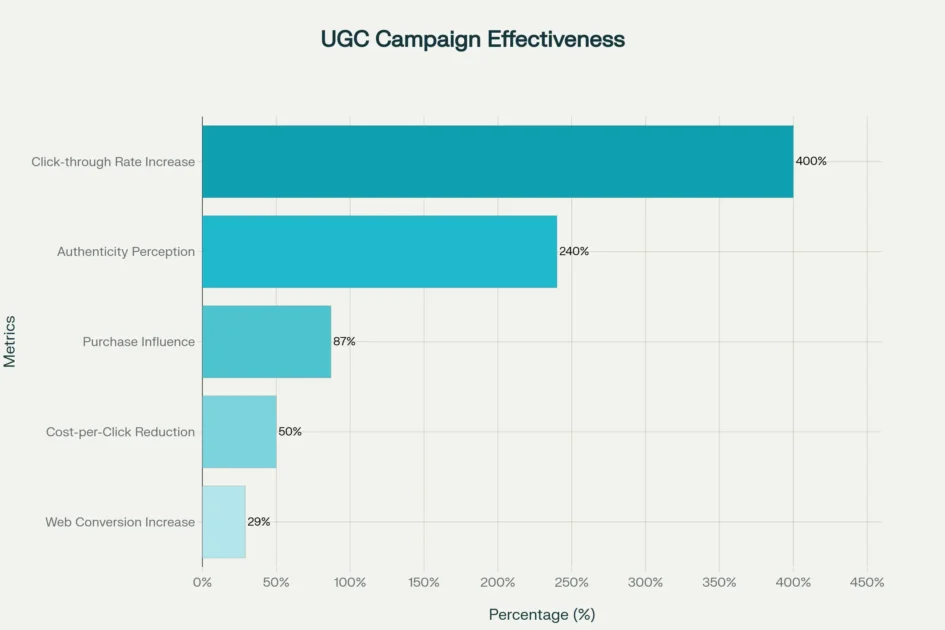
User-Generated Content Campaign Effectiveness revealing 400% increase in click-through rates and 240% boost in authenticity perception compared to traditional brand content
GoPro’s social media advertising campaigns leverage platform-specific features to maximize content distribution and engagement. Instagram serves as primary showcase for stunning still images and short video clips optimized for mobile viewing, while YouTube hosts longer-form content including customer highlights and professional athlete partnerships. The brand actively features user-generated content on official channels, providing recognition that incentivizes continued participation while curating best examples that maintain quality standards. This virtuous cycle—where customers create content, GoPro amplifies best submissions, recognition encourages more submissions—sustains ongoing engagement without requiring constant new campaign launches.
Implementing User-Generated Content Social Media Advertising Campaigns
Brands seeking to replicate GoPro’s user-generated content success in their social media advertising campaigns must recognize that effective execution requires products or services that naturally generate shareable moments. GoPro benefits from inherent shareability of adventure footage, but similar approaches can work across categories by identifying what aspects of customer experience people naturally want to share. Beauty brands showcase makeup transformations, fitness brands highlight workout achievements, food brands feature culinary creations—each finding the shareworthy element within their customer experience.
Successful user-generated content
Successful user-generated content social media advertising campaigns also require clear value propositions that motivate participation beyond altruistic brand support. GoPro’s monetary prize provided obvious incentive, but recognition, community belonging, and personal expression can equally drive participation depending on audience motivations. The advertising campaigns must make participation easy through simple submission processes, clear guidelines, and accessible platforms. The most effective approaches provide multiple participation options accommodating different customer comfort levels, from simple hashtag usage to formal contest entries, ensuring campaigns reach broad audiences rather than just most engaged segments.
Campaign Six: Amazon Fashion’s #PajamaJam Challenge
Amazon Fashion’s #PajamaJam campaign exemplified how hashtag challenges can drive explosive engagement in social media advertising campaigns through entertainment and accessibility. Partnering with creative agency Movers+Shakers, Amazon launched a TikTok challenge encouraging users to strut in pajamas ordered from Amazon Fashion to an original song, using the #PajamaJam hashtag. The campaign generated over 13,000 user videos and reached 1 billion views within 24 hours, demonstrating how well-designed advertising campaigns can achieve viral velocity on platforms favoring participatory content.
The strategic design of Amazon’s social media advertising incorporated several elements maximizing participation likelihood. The challenge’s simplicity—wearing pajamas and walking—required minimal skill or resources, enabling mass participation rather than limiting involvement to talented dancers or content creators. The custom song provided a memorable soundtrack that unified submissions while establishing campaign identity. Amazon’s selection of pajamas as a focus product proved strategic, as most people own pajamas and feel comfortable filming themselves in this attire, removing barriers that might prevent participation in campaigns requiring product purchases or uncomfortable attire.
Platform selection proved crucial to Amazon’s social media advertising campaigns success, as TikTok’s algorithm favors trend participation and challenge content. The app’s collaborative features enabling easy duets and stitches amplified campaign reach as users created reaction videos, tutorials, and variations on the original challenge format.
Amazon’s partnership with TikTok secured prominent placement through timeline takeovers ensuring maximum visibility during launch period, demonstrating how paid amplification combined with organic participation creates multiplicative effects in social media advertising. The campaign’s success on TikTok subsequently generated coverage across other platforms as users shared TikTok videos to Instagram, Twitter, and Facebook, extending reach beyond the origin platform.
Designing Effective Hashtag Challenge Social Media Advertising Campaigns
Creating successful hashtag challenges within social media advertising campaigns requires careful attention to participation friction and reward mechanisms. The most effective challenges balance accessibility with engagement value—simple enough that many people participate but interesting enough that participation feels worthwhile. Amazon’s #PajamaJam achieved this balance through the fun song, simple choreography, and humorous tone that made participation feel entertaining rather than commercial. These campaigns must also consider reward structures, whether through contest prizes, featured placement, or intrinsic satisfaction of creative expression and community belonging.
Timing considerations significantly impact hashtag challenge social media advertising campaigns performance. Launching challenges when target audiences have available time and attention increases participation likelihood—Amazon’s pajama-focused campaign aligned perfectly with pandemic work-from-home trends when comfortable clothing dominated wardrobes. Seasonal timing, cultural events, and platform-specific peak usage periods all influence campaign reception. Social media advertising campaigns benefit from advance planning that identifies optimal launch windows while maintaining flexibility to capitalize on unexpected trending topics or cultural moments that create natural campaign tie-ins.
Campaign Seven: Coca-Cola’s Happy Tears Campaign
Coca-Cola’s Happy Tears campaign demonstrated how limited-edition products combined with emotional storytelling create powerful social media advertising campaigns that generate both virality and immediate business results. Launched on Random Acts of Kindness Day 2024, the campaign featured a mystery product revealed as Happy Tears Zero Sugar, accompanied by tissue boxes and tear-jerking stories celebrating everyday acts of kindness. The limited-edition kits sold out within 24 hours while generating over 2 billion impressions across platforms, proving that scarcity combined with emotional resonance drives exceptional performance in social media advertising.
The strategic architecture of Coca-Cola’s social media advertising campaigns leveraged influencer partnerships and phased reveals to build anticipation before product disclosure. The brand collaborated with TikTok creators to tease a mystery product, generating speculation and conversation before revealing the Happy Tears concept. This approach transformed passive advertising into active engagement as audiences participated in the mystery-solving process. The campaign invited nominations for people who inspired happy tears—teachers, friends, strangers who performed kind acts—creating participatory element that extended campaign reach through user-generated nominations and heartwarming stories.
Coca-Cola’s social media advertising success stemmed from authentic emotional resonance that transcended typical product promotion. Rather than focusing on beverage attributes, the campaign celebrated human goodness and emotional connections, positioning Coca-Cola as facilitator of these meaningful moments. The product scarcity created urgency driving immediate purchase behavior while generating social proof as sold-out status became newsworthy. The campaign’s TikTok-first strategy recognized the platform’s dominance for authentic storytelling among younger demographics, ensuring content reached target audiences through their preferred channels using native formats.
Comparative Analysis: What Made These Social Media Advertising Campaigns Succeed
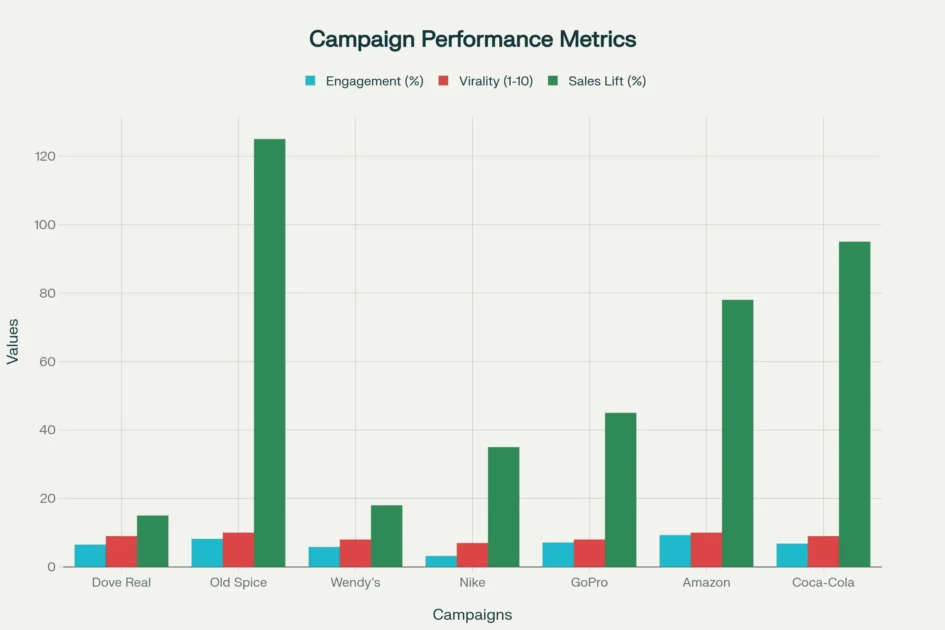
Featured Campaigns Performance Comparison showing Old Spice achieving exceptional 125% sales lift and Amazon #PajamaJam leading engagement at 9.3%
Comparative analysis of seven high-impact Social Media Advertising Campaigns shows Old Spice achieving exceptional 125% sales lift and 10/10 virality, while Amazon #PajamaJam leads engagement at 9.3% and Coca-Cola delivers 95% sales increase.
Leveraging Emotion in Social Media Advertising Campaigns
Coca-Cola’s approach demonstrates how emotion-driven social media advertising campaigns can strengthen brand associations beyond functional product benefits. The Happy Tears campaign connected Coca-Cola with positive emotions of gratitude, kindness, and connection rather than merely refreshment, creating richer brand meaning. Research confirms that emotional content generates higher engagement in social media advertising, with videos eliciting strong emotions receiving 2x more shares than purely rational content. Brands implementing emotion-driven strategies must ensure emotional themes align with brand identity and values to maintain authenticity.
Limited-edition products
Limited-edition products provide powerful mechanisms for creating urgency in social media advertising campaigns without resorting to aggressive sales tactics. The inherent scarcity creates natural motivation for immediate action while making products feel special and collectible rather than commodity purchases. These campaigns featuring limited products benefit from user posts showcasing acquisitions, generating social proof and FOMO that compounds campaign impact. However, brands must balance scarcity with accessibility—products too limited may generate frustration rather than excitement, particularly if perceived as artificially restricted to create hype rather than genuine supply constraints.
Budgeting Your Social Media Advertising Campaigns
| Campaign Type | Small Budget ($5K-$15K) | Medium Budget ($15K-$50K) | Large Budget ($50K+) | Expected Reach |
| Brand Awareness | Single platform, organic focus | 2-3 platforms, paid amplification | Full platform coverage, celebrity | 500K-2M / 2M-8M / 10M+ |
| Lead Generation | Lead magnet, landing page | Multi-channel, email integration | Full funnel, CRM integration | 10K-50K / 50K-200K / 200K+ |
| Product Launch | Soft launch, limited targeting | Multi-platform, targeted ads | Major launch, national reach | 1M-5M / 5M-15M / 20M+ |
| User-Generated Content | Hashtag campaign, small prizes | Contest with prizes, amplification | Major challenge, significant prizes | 1M-3M / 3M-10M / 15M+ |
| Influencer Partnership | Micro-influencers (2-3) | Mid-tier influencers (5-8) | Celebrity/macro-influencers | 500K-3M / 3M-12M / 15M+ |
| Retargeting | Website visitors only | Multi-platform, 30-day window | 90-day multi-touch campaigns | 50K-200K / 200K-800K / 1M+ |
Measuring and Optimizing Social Media Advertising Campaigns
Comprehensive measurement frameworks enable marketers to understand social media advertising campaigns performance across multiple dimensions and continuously optimize for improved results. Effective measurement begins with clear objective definition before campaign launch, establishing specific key performance indicators aligned with business goals rather than vanity metrics.
These campaigns aimed at awareness require different measurement approaches than those focused on conversion, community building, or brand sentiment. The most sophisticated organizations implement layered measurement frameworks examining immediate campaign metrics, medium-term behavioral changes, and long-term brand health indicators.
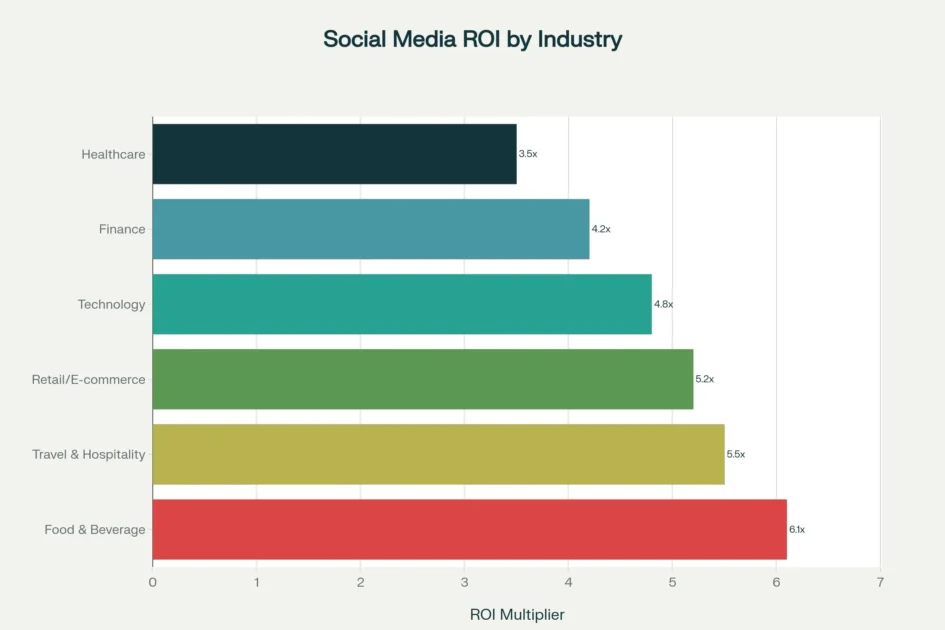
Industry ROI Comparison revealing Food & Beverage achieving highest ROI at 6.1x return, followed by Travel & Hospitality at 5.5x across social media advertising campaigns
Real-time analytics
Real-time analytics enable dynamic optimization of social media advertising campaigns during active execution periods. Platform analytics dashboards provide immediate visibility into engagement patterns, audience demographics, and content performance, allowing marketers to identify successful elements worth amplifying and underperforming components requiring adjustment. A/B testing different creative variations, audience segments, and messaging approaches generates empirical evidence about what resonates with target audiences. The advertising campaigns benefit from systematic testing programs that treat each campaign as a learning opportunity, documenting insights for application in future initiatives.
Attribution modeling
Attribution modeling represents one of social media campaigns’ most complex measurement challenges, as customer journeys typically span multiple touchpoints across platforms before final conversion. First-click attribution credits the initial interaction, last-click attributes success to final touchpoint, and multi-touch models distribute credit across the journey. Each approach provides different insights about social media advertising campaigns’ roles within overall marketing ecosystems. Advanced marketers employ sophisticated attribution models accounting for social media ads’ influence on brand awareness, consideration, and purchase intent even when conversions occur through other channels. Marketing mix modeling and incrementality testing quantify social media ads campaigns’ true impact by comparing outcomes to control groups unexposed to campaigns.
Advanced Analytics for Social Media Advertising Campaigns
Sentiment analysis provides crucial qualitative insights complementing quantitative social media advertising campaigns metrics. Natural language processing tools analyze comment content, determining whether audience responses express positive, negative, or neutral sentiment toward brands and campaigns. This analysis reveals whether high engagement stems from genuine enthusiasm or controversy, informing whether campaigns should be amplified or adjusted. The advertising campaigns generating high engagement through negative sentiment may achieve short-term visibility at expense of long-term brand health, making sentiment monitoring essential for balanced performance evaluation.
Competitive benchmarking
Competitive benchmarking contextualizes social media advertising performance by comparing results to industry standards and competitor achievements. Understanding that a 2% engagement rate significantly exceeds category averages provides a different perspective than viewing the same metric in isolation. Competitive intelligence tools track competitor advertising campaigns, revealing successful strategies worth testing and mistakes worth avoiding. The most effective benchmarking programs establish performance baselines, track progress over time, and identify specific areas requiring improvement rather than obsessing over beating competitors on every metric.
Planning Social Media Advertising Campaigns Timeline
| Campaign Phase | Duration (Days) | Team Size Required | Budget Allocation (%) | Key Deliverables |
| Strategy & Planning | 7 | 3 | 10 | Campaign brief, audience personas, KPIs |
| Creative Development | 14 | 5 | 25 | Concepts, scripts, storyboards |
| Content Production | 10 | 8 | 30 | Videos, images, copy variations |
| Platform Setup & Testing | 5 | 2 | 5 | Ad accounts, tracking pixels, A/B tests |
| Launch & Monitoring | 3 | 4 | 15 | Campaign go-live, real-time monitoring |
| Optimization Period | 30 | 3 | 10 | Performance analysis, creative adjustments |
| Analysis & Reporting | 7 | 2 | 5 | Final reports, insights, recommendations |
Conclusion:
The seven social media advertising campaigns examined throughout this analysis demonstrate that breakthrough success stems from authentic connection, strategic creativity, and flawless execution rather than massive budgets or celebrity endorsements. Dove, Old Spice, Wendy’s, Nike, GoPro, Amazon, and Coca-Cola each created memorable campaigns through different approaches—emotional storytelling, humor, bold personality, cultural movements, user participation, hashtag challenges, and limited editions—proving multiple paths exist to social media advertising campaigns excellence.
These diverse strategies share common foundations including deep audience understanding, platform optimization, authentic brand voice, and measurable business objectives that guide strategic decisions throughout campaign lifecycles. Implementing high-impact advertising campaigns requires organizational commitment extending beyond marketing departments to encompass executive leadership, creative teams, customer service, and operational functions.
The most successful campaigns integrate across traditional silos, ensuring consistent messaging and seamless customer experiences across touchpoints. Organizations must cultivate cultures embracing appropriate risk-taking, rapid learning, and customer-centricity that enables creative excellence.These campaigns succeed when teams feel empowered to push boundaries while remaining grounded in strategic objectives and brand values.
The future of social media advertising campaigns will increasingly leverage emerging technologies including artificial intelligence, augmented reality, and personalization engines that enable unprecedented targeting precision and creative customization. However, technological advancement cannot replace fundamental human insights about motivation, emotion, and connection that drive social media advertising campaigns effectiveness.
Brands investing in both cutting-edge capabilities and timeless marketing principles will build sustainable competitive advantages in increasingly crowded digital environments. The opportunity exists for organizations of every size to create breakthrough social media advertising campaigns that drive awareness, engagement, and business growth through strategic creativity and authentic audience connection.
Citations
- https://www.statista.com/outlook/amo/advertising/social-media-advertising/united-states
- https://www.sprinklr.com/blog/social-media-marketing-statistics/
- https://sproutsocial.com/insights/social-media-marketing-roi-statistics/
- https://www.byyd.me/en/blog/2025/03/us-advertising-market-trends/
- https://brand24.com/blog/nike-social-media-strategy/
- https://inbeat.agency/blog/ugc-statistics
- https://everyonesocial.com/blog/user-generated-content-statistics/
- https://www.sprinklr.com/blog/social-media-marketing-examples/
- https://www.superside.com/blog/digital-ad-campaigns
- https://moosend.com/blog/best-marketing-campaigns/
- https://mediashower.com/blog/old-spices-viral-powerhouse/
- https://www.myhoardings.com/blog/old-spicethe-man-your-man-can-smell-like-campaign/
- https://www.jeffbullas.com/11-social-media-marketing-lessons-from-the-old-spice-campaign/
- https://illuminea.com/oldspice-transforms-social-media-and-makes-me-laugh/
- https://mediashower.com/blog/wendys-roast-campaign/
- https://socialsci.libretexts.org/Courses/Southern_Illinois_University_Edwardsville/Social_Media_for_Public_Relations/04:_Social_Media_for_PR_Case_Studies/4.03:_Case_study_Wendys_social_media_success_with_the_Roast_campaign
- https://www.pennep.com/blogs/how-wendy-s-twitter-roasts-became-a-viral-marketing-phenomenon
- https://www.forbes.com/sites/andriacheng/2018/10/08/wendys-twitter-roasts-have-become-the-envy-of-marketers-heres-how-it-does-it/
- https://everything-pr.com/the-evolution-of-nikes-digital-marketing-a-case-study-of-justdoit-on-social-media/
- https://sproutsocial.com/insights/nike-social-media-strategy/
- https://www.manypixels.co/blog/social-media-design/ad-inspiration
- https://storychief.io/blog/social-media-campaign-examples-irQ998LulCDkEF
- https://sproutsocial.com/insights/social-media-campaigns/
- https://www.facebook.com/business/success/instagram
- https://www.talkwalker.com/blog/best-social-media-campaigns
- https://www.goinflow.com/blog/facebook-ads-case-study-seltzer-goods/
- https://www.facebook.com/business/marketing-partners/case-studies
- https://www.superside.com/blog/social-media-campaigns
- https://www.extole.com/blog/36-social-marketing-examples-that-really-paid-off/
- https://digitalscholar.in/facebook-marketing-case-studies-in-india/
- https://business.adobe.com/blog/basics/digital-marketing-campaign-examples
- https://www.gwi.com/blog/10-powerful-examples-of-marketing-that-works
- https://blog.hubspot.com/marketing/facebook-case-study
- https://www.semrush.com/blog/best-social-media-campaigns/
- https://cropink.com/meta-ads-examples
- https://poweradspy.com/success-of-clever-instagram-marketing-campaigns/
- https://www.fastsimon.com/ecommerce-wiki/optimized-ecommerce-experience/lessons-from-successful-social-media-marketing-campaigns/
- https://business.x.com/en/success-stories
- https://www.linkedin.com/business/marketing/blog/content-marketing/get-inspired-by-7-of-our-favorite-b2b-campaigns-from-2019
- https://www.youtube.com/intl/en_il/ads/resources/success-stories/
- https://bluegiftdigital.com/what-twitter-ads-case-studies-2025/
- https://www.linkedin.com/business/marketing/blog/linkedin-ads/10-examples-of-linkedin-ads-that-totally-crushed-it
- https://www.youtube.com/playlist?list=PLLF5BHcPOPUnBmUditFOnNJ5RMiC54W2F
- https://improvado.io/blog/twitter-ads-guide
- https://www.theb2bhouse.com/linkedin-ad-examples/
- https://proschoolonline.com/blog/youtube-case-studies
- https://www.7boats.com/how-to-run-a-successful-x-twitter-campaign/
- https://www.linkedin.com/business/marketing/blog/brand/memorable-b2b-marketing-campaigns-creativity
- https://blog.tubesift.com/category/youtube-ads-case-studies/
- https://blog.hootsuite.com/twitter-ads/
- https://advanttechnology.com/the-best-b2b-ads-on-linkedin/
- https://www.rivaliq.com/blog/7-youtube-marketing-case-studies/
- https://www.spiralytics.com/blog/x-twitter-ads-statistics-you-should-know/
- https://business.linkedin.com/marketing-solutions
- https://searchengineland.com/ai-youtube-marketing-insights-case-studies-436536
- https://brand24.com/blog/best-twitter-marketing-campaigns/
- https://www.konstructdigital.com/content-marketing/linkedin-b2b-marketing-examples/
- https://www.hubspot.com/marketing-statistics
- https://backlinko.com/ugc-statistics
- https://www.statista.com/statistics/736971/social-media-ad-spend-usa/
- https://sproutsocial.com/insights/social-media-statistics/
- https://www.statista.com/topics/1538/social-media-marketing/
- https://www.emarketer.com/content/us-social-network-ad-spending-forecast-h1-2025
- https://www.bambassadors.com/blog/measuring-the-impact-how-to-evaluate-the-success-of-user-generated-content-campaigns
- https://marketful.com/blog/digital-marketing-roi-statistics/
- https://www.digitalsilk.com/digital-trends/digital-advertising-statistics/
- https://blog.hootsuite.com/user-generated-content-ugc/
- https://www.hootsuite.com/research/social-trends
- https://www.oberlo.com/statistics/social-media-ad-spend
- https://www.trueloyal.com/blog/user-generated-content-stats-2021/
- https://www.marketingdive.com/news/global-ad-spend-rise-faster-than-expected-amid-digital-boom-warc/761119/
- https://penji.co/nike-social-media-marketing/
- https://digitalagencynetwork.com/nike-digital-marketing-strategy/
- https://www.rivaliq.com/blog/wendys-social-media-strategy/
- https://www.wk.com/work/old-spice-smell-like-a-man-man/
- https://mba-esg.in/nike-digital-marketing-strategies/
- https://www.wildnettechnologies.com/case-studies/how-wendys-became-a-marketing-powerhouse
- https://www.youtube.com/watch?v=yBIG_6lt8SM
- https://filestage.io/blog/best-nike-marketing-campaigns/
- https://www.linkedin.com/pulse/wendys-social-media-strategy-humor-engagement-impact-bizz-o-tech-jaz2f
- https://5wpr.net/airbnbs-live-there-a-masterclass-in-authentic-travel-marketing/
- https://nogood.io/blog/spotify-wrapped-marketing-strategy/
- https://www.marketingdive.com/news/cerave-michael-cera-super-bowl-campaign-trail/707307/
- https://marketing.x.com/en_apac/success-stories/airbnb-drives-global-marketing-campaign-on-twitter
- https://www.linkedin.com/pulse/spotify-wrapped-2024-success-failure-engagement-truth-josiah-du-fault-tfh6c
- https://www.dandad.org/work/d-ad-awards-archive/michael-cerave
- https://digitalagencynetwork.com/best-marketing-strategies-and-advertising-campaigns-of-airbnb/
- https://www.spotify.com/us/wrapped
- https://shortyawards.com/17th/cerave-michael-cerave
- https://www.socialsellinator.com/social-selling-blog/case-study-social-media-marketing-success/
- https://www.moengage.com/blog/spotify-wrapped-2020-app-downloads-engagement/
- https://www.clickz.com/analyzing-the-success-of-michaels-cerave-super-bowl-commercial/269218/
- https://iide.co/case-studies/marketing-strategy-of-airbnb/
- https://hightouch.com/blog/how-spotify-wrapped-works
- https://www.youtube.com/watch?v=6A9zZpEzJi0
- https://newsletter.thousandfaces.club/p/airbnb-champions-eventled-influencer-marketing
- https://ioaglobal.org/blog/spotify-wrapped-and-the-role-of-data-analysis-in-driving-engagement/
- https://lbbonline.com/news/how-michael-cera-earned-cerave-9-billion-impressions-before-the-super-bowl-kicked-off
- https://insideiim.com/decoded-how-airbnbs-live-anywhere-campaign-boosted-long-term-stays-by-10
- https://www.harveedesigns.com/blog/why-spotify-wrapped-is-a-genius-viral-marketing-campaign/