

Securing funding remains one of the most formidable challenges facing American entrepreneurs today. While traditional financing options often require collateral, pristine credit scores, or equity dilution, small business grants offer a fundamentally different proposition: non-repayable capital that can transform promising ventures into thriving enterprises. In 2025, with over 36.2 million small businesses operating across the United States and contributing 46 percent of all private sector employment, small business grants programs have become increasingly vital to the entrepreneurial ecosystem.
Yet navigating this model requires more than wishful thinking—it demands strategic planning, meticulous preparation, and an understanding of which opportunities align with your business model and growth trajectory. This comprehensive examination explores nine premier grant programs available to American small business owners in 2025, offering detailed insights into eligibility requirements, application strategies, and the nuanced factors that distinguish successful applicants from the thousands who fall short each year.
The competitive nature of Small Business Grants programs cannot be overstated. Federal research grants through the Small Business Innovation Research program maintain success rates hovering around 17 percent for Phase I applications, while corporate grant competitions like the FedEx Small Business Grant Contest receive thousands of applications for just ten awards.
Despite these sobering statistics, entrepreneurs who approach the application process with proper preparation, authentic storytelling, and clear alignment between their business objectives and grant priorities consistently achieve funding success. Understanding the distinct characteristics of each Small Business Grants program from multi-million-dollar federal research grants to smaller corporate awards offering comprehensive business support—enables business owners to target opportunities where their ventures possess genuine competitive advantages.
Small Business Innovation Research and Small Business Technology Transfer Programs: Federal Small Business Grants for Innovation
The Small Business Innovation Research and Small Business Technology Transfer programs represent the most substantial federal investment in early-stage technology development, with participating agencies obligating $4.73 billion in fiscal year 2022 across 3,859 Phase I and 1,871 Phase II awards. Coordinated by the Small Business Administration but administered through eleven federal agencies including the National Science Foundation, Department of Defense, National Institutes of Health, and Department of Energy, these programs fund small businesses conducting scientific research with strong commercialization potential.

Maximum award amounts for the top 9 small business grants in 2025, ranging from $4,000 to $2 million
The SBIR program targets small businesses engaged in federal research initiatives that advance technological innovation while meeting specific agency mission requirements. Companies must employ fewer than 500 employees and be majority-owned by United States citizens or permanent residents. The program operates through a three-phase structure: Phase I awards typically provide $50,000 to $275,000 for feasibility studies lasting six to twelve months, Phase II grants extend $750,000 to $2 million over two years for continued research and development, and Phase III involves commercialization without additional SBIR funding but often leading to procurement contracts.
The STTR program follows a similar structure but mandates formal partnerships between small businesses and nonprofit research institutions such as universities. This requirement facilitates technology transfer from academic research environments into commercial applications, with at least 40 percent of research conducted by the small business partner and at least 30 percent performed by the research institution.
SBIR and STTR Success Rates and Competition
Success rates vary considerably across participating agencies. The National Science Foundation maintains an 11 percent selection rate for Phase I proposals, while the Department of Energy achieves 19 percent, and the Department of Health and Human Services funds approximately 16 percent of applications. For Phase II proposals, success rates improve dramatically, with many agencies funding between 60 to 76 percent of eligible applications. However, recent data reveals concerning trends—the National Institutes of Health reported Phase I success rates dropping below 10 percent for the first time in 2024, attributed partly to increased application volume driven by artificial intelligence-assisted proposal generation.
Winning SBIR and STTR Small Business Grants
Winning SBIR and STTR grants requires meticulous alignment between your research objectives and specific agency priorities detailed in solicitation topics. Applications demand comprehensive technical proposals demonstrating both scientific merit and commercial viability, supported by preliminary data, detailed work plans, and evidence of team qualifications. Companies with prior Phase I awards exceeding twenty across all federal agencies must maintain at least a 25 percent Phase I to Phase II transition rate to remain eligible for new Phase I applications. The program has generated remarkable success stories, with funded companies creating thousands of jobs and generating billions in subsequent revenue.
FedEx Small Business Grants: Corporate Funding Opportunities
The FedEx Small Business Grant Contest stands as one of corporate America’s most prestigious small business competitions, awarding $230,000 annually since its 2012 inception. The program distributes a $50,000 grand prize to one winner and $20,000 grants to nine additional recipients, accompanied by comprehensive business support services valued at thousands of dollars.
Eligibility requirements mandate that applicants operate for-profit small businesses domiciled in the fifty United States or District of Columbia, possess valid FedEx shipping accounts active for at least six months prior to March first, maintain continuous operations selling products or services for minimum six months before the deadline, and employ no more than 99 people including owners and part-time staff. The contest typically opens applications during March and April, with winners announced several months later following a multi-stage evaluation process.
FedEx Small Business Grants Application Components
Applications for these small business grants consist of two primary components. First, businesses complete a detailed company profile articulating their mission, operational structure, shipping requirements, and competitive differentiators. Second, applicants submit compelling narratives explaining how grant funds would accelerate growth, create jobs, or drive community impact. Judges evaluate submissions based on business innovation, community engagement, growth potential, and overall story authenticity.
Beyond monetary awards, small business grants winners receive substantial additional benefits including $500 credits for FedEx Office printing services, $300 vouchers from My FedEx Rewards, access to Premier Customer Care, consultations on sustainable packaging and digital sales solutions, invitations to the Small Business Strategic Insights Forum, and featured profiles on the FedEx Small Business Center platform. These ancillary benefits often prove as valuable as the cash awards themselves.
Competition intensity for these small business grants has escalated significantly—the 2024 contest attracted over 3,900 applications for ten awards, translating to roughly a 0.25 percent selection rate. This extreme competitiveness underscores the importance of crafting applications that resonate emotionally while demonstrating concrete business fundamentals. Past small business grants winners consistently emphasize authenticity in storytelling, clear articulation of growth plans, and genuine community engagement as distinguishing factors.
Amber Grant: Small Business Grants for Women Entrepreneurs
The Amber Grant program honors the memory of Amber Wigdahl, a young woman who passed away at age nineteen before realizing her entrepreneurial aspirations. Established by WomensNet in 1998, the grant awards $10,000 monthly to three women-led enterprises—one focused on startups, another supporting established businesses, and a third general category. From these monthly winners, three recipients receive additional $25,000 year-end grants, creating potential total awards of $35,000.
The application process embraces remarkable accessibility. Entrepreneurs need only pay a $15 application fee and submit heartfelt proposals describing their business concepts or existing ventures and explaining how grant funds would advance their objectives. Applications require no extensive business plans, detailed financial projections, or complex supporting documentation. WomensNet deliberately designed this streamlined approach to reduce barriers preventing aspiring female entrepreneurs from seeking capital.
Eligibility and Accessibility of Women-Focused Small Business Grants
Eligibility for these small business grants extends beyond established business owners to include women with compelling business ideas not yet launched. This inclusive philosophy recognizes that access to seed capital often determines whether promising concepts ever materialize into operating companies. These small business grants therefore serve dual purposes: providing working capital for existing businesses facing growth constraints and enabling aspiring entrepreneurs to transform ideas into reality.
Monthly application deadlines create twelve annual opportunities for submission, with small business grants winners announced by the twenty-third day of the following month. This rolling structure means businesses can apply multiple times throughout the year if initial attempts prove unsuccessful, though each application requires a separate $15 fee. The Amber Grant Foundation has distributed over $1 million cumulatively since its founding, with award amounts increasing over time and application frequency expanding to monthly cycles.
Success stories from these small business grants recipients illustrate diverse applications of award funds. Winners have invested in equipment purchases, marketing campaigns, inventory expansion, website development, and professional service consultations. The grant’s flexibility in permitted uses appeals to entrepreneurs facing varied financial needs across different business development stages.
National Association for the Self-Employed Growth Grant: Member-Based Small Business Grants
The National Association for the Self-Employed operates one of the most consistent small business grants programs in America, having awarded nearly $1 million to members since 2006 through its Growth Grants initiative. The program provides up to $4,000 quarterly to members demonstrating clear plans for deploying grant funds toward specific business expansion activities.

Distribution of small business grants by eligibility focus, showing R&D/tech innovation leading at 35% and women/minority-owned businesses at 25%
Eligibility requires active NASE membership in good standing. Annual members, veteran members, and those paying annually for silver or gold membership tiers can apply immediately upon joining, while monthly members and monthly-paying silver members must maintain membership for at least ninety days before application submission. This membership prerequisite generates modest barriers to entry but ensures grant recipients possess sustained commitment to their entrepreneurial ventures rather than seeking one-time opportunistic funding.
How NASE Small Business Grants Support Growth
Grant funds may be allocated toward marketing initiatives, advertising campaigns, employee hiring and training, facility expansion, equipment purchases, and other specific business development needs. However, the program explicitly prohibits using awards for debt repayment or rent and mortgage obligations. This restriction ensures grants genuinely drive growth rather than addressing existing financial obligations, aligning with the program’s name and fundamental purpose.
Applications undergo quarterly review cycles following a predictable schedule. Submissions received during January through March receive evaluation in April, April through June applications are reviewed in July, July through September submissions undergo review in October, and October through December applications are assessed the following January. This structured timeline allows businesses to plan application timing strategically based on when growth capital would prove most beneficial.
The evaluation process examines several critical factors:
The evaluation process for these small business grants examines several critical factors: identification of specific business needs, detailed explanation of how grant proceeds would address those needs, potential of the grant to satisfy identified requirements, and projected impact on overall business growth and success. Recipients must maintain records documenting fund utilization and agree to publicize their award through displaying the NASE Member Badge on their websites for one year.
Unlike many competitive small business grants programs, the NASE Growth Grant focuses primarily on member businesses genuinely positioned to deploy modest capital amounts effectively rather than seeking the most innovative or disruptive ventures. This philosophy creates opportunities for traditional small businesses—consultants, contractors, service providers, retailers—who often struggle competing against technology startups in other grant competitions.
Verizon Digital Ready: Technology-Focused Small Business Grants
Verizon’s Small Business Digital Ready initiative combines free educational resources with substantial grant funding, reflecting the company’s $5 billion commitment over five years to supporting American small business suppliers and entrepreneurs. The grant component awards $10,000 to fifty small businesses annually, distributed across multiple application cycles throughout the year.
The program’s unique structure requires businesses to demonstrate engagement with digital skills training before unlocking small business grants application access. Entrepreneurs must create free accounts on the Verizon Small Business Digital Ready platform, then complete any combination of two courses or virtual events between designated periods—typically July through December for the fall grant cycle. These educational requirements ensure small business grants recipients possess fundamental digital competencies essential for contemporary business success.
Educational Requirements for Verizon Small Business Grants
Courses cover diverse topics including financial management, social media marketing, digital sales strategies, and technology integration. Live coaching sessions provide opportunities to engage directly with industry experts, while peer networking events facilitate relationship building with fellow entrepreneurs. Once the two-course requirement is satisfied, participants can access grant applications requiring standard business information, financial documentation, and narratives explaining how funding would accelerate digital transformation or business growth.
The fall 2025 small business grants cycle
The fall 2025 grant cycle opened October first with applications accepted through December tenth. Selection criteria prioritize businesses serving historically underserved communities with limited access to flexible, affordable capital. Nonprofit organizations remain ineligible, and applicants can apply for only one business per cycle. Winners receive notification by early January, approximately three to four weeks after application closure.
Since 2021, Verizon has awarded more than $14 million through the Digital Ready Small Business Grants program in partnership with the Local Initiatives Support Corporation. The initiative aims to equip one million small businesses with digital economy tools by 2030, with nearly 500,000 entrepreneurs already supported through the platform. This ambitious scope reflects growing recognition that digital literacy represents not merely an advantage but an essential requirement for small business survival in increasingly technology-driven markets.
Beyond grant funding, the Digital Ready platform offers permanent value through its comprehensive free resource library. Entrepreneurs gain unlimited access to over fifty expert-curated courses, one-on-one coaching opportunities, business plan templates, financial modeling tools, and connections to other funding opportunities through the Small Business Funding Marketplace. These sustained benefits often exceed the direct monetary value of grant awards for businesses committed to continuous learning and improvement.
Comcast RISE: Community-Centered Small Business Grants
Comcast RISE (Representation, Investment, Strength, and Empowerment) emerged during the COVID-19 pandemic to address acute challenges facing small businesses, particularly those in underserved communities. Now in its fifth year as part of Comcast’s $1 billion Project UP initiative, the program has provided $160 million in combined monetary, marketing, and technology resources to 14,500 small businesses nationwide.
The 2025 program awarded comprehensive grant packages to 500 recipients across five metropolitan regions: Boston, Massachusetts; Grand Rapids, Michigan; Nashville, Tennessee; Seattle, Washington; and South Valley, Utah. Unlike traditional cash-only grants, each Comcast RISE package delivers multifaceted support worth significantly more than its $5,000 monetary component.
Comprehensive Benefits of Comcast RISE Small Business Grants
Winners of these small business grants receive technology makeovers including computer equipment plus one year of complimentary internet, voice, and cybersecurity services from Comcast Business. Creative production services provide professionally produced thirty-second television commercials, media strategy consultations, and six-month advertising schedules on Comcast networks. Educational resources include twelve months of unlimited access to entrepreneurship courses and business development modules. Business consultation services offer personalized assessments and dedicated coaching sessions.
Eligibility criteria for these small business grants restrict applications to businesses established for at least two years, employing 100 or fewer full-time or part-time staff members, independently owned and operated, and located within specified geographic areas for each application cycle. The May 2025 application window opened on the first and closed on the thirty-first, with small business grants awarded in September.
The program explicitly focuses on supporting businesses committed to uplifting their local communities. Application narratives should articulate specific ways businesses contribute to community wellbeing beyond standard commercial operations—whether through employee volunteer programs, support for local initiatives, meals for first responders, or stepping forward during community crises. This emphasis on community impact distinguishes Comcast RISE from purely commercially focused grant competitions.
For businesses located in designated service areas, the comprehensive nature of Comcast RISE packages often delivers greater total value than larger monetary grants without supplementary services. Professional television commercials alone typically cost $10,000 to $50,000 when purchased through conventional marketing channels, while year-long technology services and cybersecurity protections address substantial ongoing operational expenses. The strategic combination of cash, marketing firepower, technology infrastructure, and educational resources creates conditions for sustainable growth rather than temporary relief.
Hello Alice Small Business Grants
Hello Alice operates one of the most dynamic and diversified grant ecosystems in the American small business, partnering with major corporations, foundations, and government entities to distribute millions in funding annually. Unlike single-purpose small business grants programs, Hello Alice facilitates numerous distinct initiatives with varying eligibility criteria, award amounts, application timelines, and selection processes.
The platform’s Small Business Growth Fund, presented in partnership with the Global Entrepreneurship Network and funded by companies including Etsy and Progressive, provides grants ranging from $5,000 to $25,000 to accelerate business expansion and help entrepreneurs achieve significant growth milestones. Recipients in 2023 represented diverse industries and backgrounds, exemplifying the program’s commitment to inclusive capital access.
Multiple Small Business Grants Through One Platform
The Allstate Main Street Grants Program illustrates Hello Alice’s approach to combining financial support with structured business education. This initiative selects 250 entrepreneurs for a twelve-week virtual Boost Camp focused on marketing, finance, operations, and growth strategy. From those participants, sixty-three receive $20,000 grants to invest in tools, resources, or strategies strengthening business operations. Based on platform data, 82 percent of Boost Camp participants report increased confidence leading their businesses and greater likelihood of pursuing future funding.
Additional Hello Alice programs include the FedEx Entrepreneur Fund offering $10,000 grants alongside 150 spots in a twelve-week digital growth accelerator, the DoorDash Local Business Relief Fund providing $5,000 to $15,000 for businesses impacted by natural disasters or infrastructure failures, and various demographic-specific initiatives targeting women entrepreneurs, veterans, and underrepresented communities.
Accessing Hello Alice opportunities begins with creating a free account on the platform. The comprehensive profile system matches businesses with relevant small business grants programs, eliminating the need to search manually across dozens of separate websites. Applications typically require less than one hour to complete, with standardized formats reducing repetitive data entry across multiple submissions.
Review timelines vary by specific program but generally span two to three months from application closure to recipient announcement. The platform’s transparency regarding selection criteria, timelines, and evaluation processes stands out among grant providers, helping entrepreneurs make informed decisions about where to invest application energy.
Hello Alice’s model demonstrates how technology platforms can democratize grant access by aggregating opportunities, streamlining applications, and providing business development resources beyond mere financial awards. The company has supported over one million entrepreneurs through its ecosystem, with thousands receiving grant funding in recent years. This scale reflects both the substantial unmet demand for small business capital and the effectiveness of centralized platforms in connecting businesses with appropriate funding sources.

Comparison of success rates across major small business grants programs, with SBIR Phase II showing highest at 60% and FedEx at 8%
United States Department of Agriculture Rural Business Development Grants
The USDA Rural Business Development Grant program channels federal resources toward strengthening rural economies through support for small businesses, cooperatives, and entrepreneurial ventures in historically underserved geographic areas. These small business grants program provides technical assistance, training, and development support helping rural businesses launch, expand, and create employment opportunities in their communities.
Eligible applicants include towns, cities, counties, communities, state agencies, economic development authorities, federally recognized tribes, nonprofit organizations, and institutions of higher education. While for-profit businesses cannot apply directly, they benefit through grants awarded to eligible organizations that subsequently provide services, training, or sub-grants to individual enterprises. This structure ensures professional administration and maximizes impact through experienced intermediary organizations.
USDA Small Business Grants Funding and Activities
Grant amounts typically range from $10,000 to $500,000, though the program establishes no absolute ceiling. Funded activities encompass diverse business development needs: technical assistance and training for small rural businesses, business incubator operations, equipment and machinery purchases, feasibility studies and business plan development, capital improvements and infrastructure investments, workforce development and job training programs, and in some cases revolving loan fund establishment.
Applications must be submitted through USDA Rural Development State Offices, with most states maintaining annual deadlines typically falling in late February. Complete applications may be submitted in paper or electronic format and must arrive by 4:30 p.m. local time on designated deadlines. Prospective applicants should contact their state offices well in advance to discuss project concepts, understand state-specific priorities, and clarify documentation requirements.
Evaluation criteria assess evidence demonstrating job creation potential at local businesses, percentage of non-federal funding committed to projects, economic need in areas to be served, consistency with local economic development priorities, and grantee experience with similar efforts. This scoring methodology rewards partnerships leveraging multiple funding sources and aligning with broader community development strategies rather than isolated initiatives.
The definition of “rural” for USDA programs encompasses substantial portions of American geography—generally areas with populations under 50,000 residents and not located in metropolitan statistical areas. This broad definition means numerous small towns, agricultural regions, and less densely populated counties qualify, creating opportunities for millions of businesses often overlooked by urban-focused small business grants programs.
Recent USDA initiatives have expanded focus on climate-smart practices, renewable energy investments, and sustainable land management, reflecting the Inflation Reduction Act’s influence on agricultural and rural development priorities. Businesses engaged in solar installations, energy efficiency improvements, sustainable farming technologies, or environmental conservation may find particularly receptive audiences within current USDA funding cycles.
State Trade Expansion Program: Export-Focused Small Business Grants
The State Trade Expansion Program operates through a unique federal-state partnership structure, with the Small Business Administration providing funding to state and territory governments that subsequently support small businesses pursuing international market expansion. Since its 2011 inception, STEP has helped thousands of American small businesses access foreign markets through financial assistance for export-related activities.
Award amounts vary significantly across participating states based on their STEP allocations and program designs. Typical supported activities include participation in foreign trade shows and missions, international marketing campaigns, website translation services, export training programs, trade counseling services, and foreign market research. Some states provide direct grants reimbursing portions of specific export expenses, while others offer vouchers or credits reducing costs for approved activities.
Accessing State Trade Expansion Small Business Grants
Eligibility requirements mandate that businesses meet SBA size standards for their industries, typically defined as companies with fewer than 500 employees. Businesses must operate in eligible states or territories participating in the current STEP grant cycle. Application processes and deadlines vary by state, requiring entrepreneurs to contact their state-level STEP offices directly for specific information.
The federal SBA structure means STEP funding and state participation fluctuate based on annual congressional appropriations and state government decisions regarding program continuation. Prospective applicants should verify current availability through the SBA website’s STEP program page, which maintains updated contact information for active state programs.
For businesses with realistic export potential, STEP represents one of the most practical small business grants programs available. Unlike research-focused or demographic-specific initiatives, STEP directly subsidizes concrete business development expenses that entrepreneurs would otherwise fund entirely from operating capital. A $5,000 STEP grant covering trade show participation costs, booth setup, travel expenses, and marketing materials can enable market entry that might otherwise remain financially infeasible for bootstrapped small businesses.
The program particularly benefits manufacturers, agricultural producers, technology companies, and specialty consumer goods businesses with products possessing international appeal. Service businesses face greater challenges demonstrating export potential, though software, consulting, and digital services with remote delivery capabilities increasingly qualify for support.
Strategic STEP applicants often leverage awards to explore multiple foreign markets simultaneously through carefully planned trade show schedules, maximizing grant impact by testing product reception across diverse international customer bases during single business trips abroad.
Comprehensive Comparison and Strategic Selection of the Right Small Business Grants for Your Venture
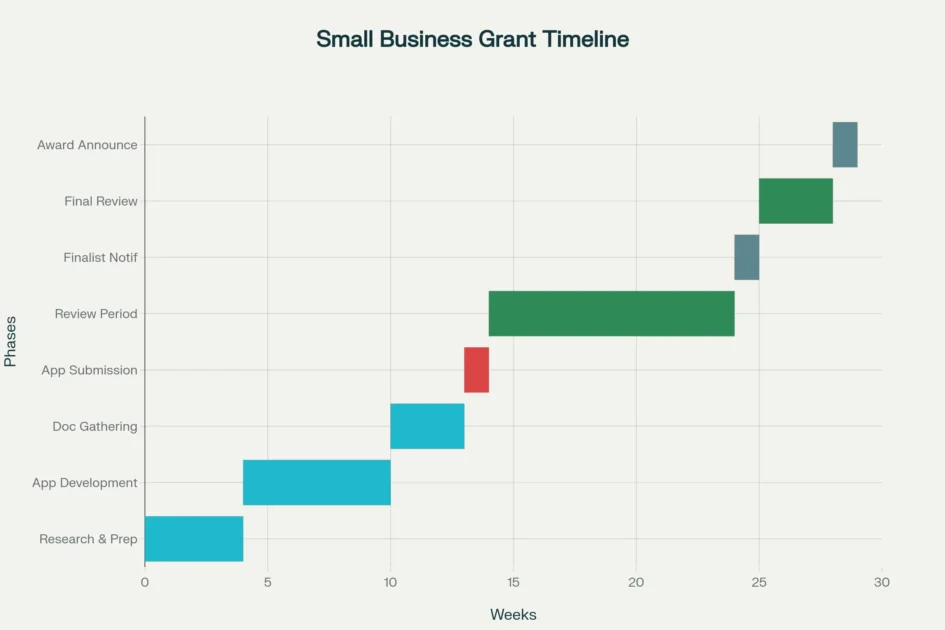
Timeline visualization of the typical small business grant application process, showing an average 6-8 month journey from research to award
Understanding which small business grants programs align with your business profile, growth stage, and strategic objectives determines application success more than any other factor. The nine programs examined here span an enormous range—from $4,000 quarterly awards supporting immediate growth needs to multi-million dollar research grants funding years of product development. Successfully navigating this prototype requires honest assessment of your business characteristics, competitive positioning, and realistic evaluation of your capacity to meet various program requirements.
Technology and research-focused ventures with genuine innovation potential should prioritize SBIR and STTR programs despite their complexity and extended timelines. These programs offer unmatched funding levels without equity dilution, with Phase II awards potentially exceeding $2 million. However, businesses must possess authentic research and development capabilities, with proposals demonstrating technical feasibility through preliminary data and qualified scientific personnel. Companies without legitimate R&D operations should avoid these programs, as superficial applications waste substantial preparation time while achieving no realistic funding prospects.
Established businesses with six-plus months of operations, existing customer bases, and clear growth trajectories should consider the FedEx Small Business Grant Contest. While extremely competitive, the comprehensive benefits package extending beyond monetary awards provides winners with marketing, technology, and strategic resources typically accessible only to much larger organizations. The contest welcomes diverse industries and business models, making it broadly applicable across the small business community.
Women entrepreneurs benefit from dedicated initiatives including the Amber Grant and programs through platforms like IFundWomen and Hello Alice. These targeted opportunities recognize that female-owned businesses receive substantially less venture capital investment than male-led companies despite often outperforming them. The Amber Grant’s monthly application cycle and modest application fee create accessible entry points for aspiring entrepreneurs who might hesitate before more demanding application processes.
Membership-based organizations like the NASE serve entrepreneurs seeking predictable, modest funding amounts with straightforward application requirements. The quarterly review schedule and focus on specific growth activities rather than revolutionary innovation create opportunities for traditional service businesses, consultants, contractors, and retailers competing against technology startups in other grant competitions.
Businesses prioritizing digital transformation and willing to invest time in skills development should explore Verizon’s Digital Ready Grant. The educational prerequisite ensures grant recipients possess fundamental digital competencies while providing permanent access to valuable training resources. The relatively modest $10,000 award amount may prove less compelling than programs offering larger sums, but the accompanying digital skills and ongoing platform access deliver sustained value extending far beyond the initial grant period.
Rural businesses often overlook USDA Rural Business Development Grants despite their substantial funding potential and comparatively less intense competition than urban-focused programs. The indirect application structure through nonprofit intermediaries may seem cumbersome but often provides valuable support throughout the application process from experienced grant administrators. Rural entrepreneurs should proactively engage their local USDA Rural Development offices, Small Business Development Centers, and regional economic development organizations that frequently receive these grants and seek qualified businesses to support.
Businesses with genuine export potential should investigate State Trade Expansion Program opportunities through their state governments. Unlike aspirational small business grants programs funding concept development, STEP provides practical reimbursement for concrete international marketing expenses entrepreneurs would otherwise fund personally. This direct return on investment makes STEP among the most valuable programs for eligible businesses actually prepared to pursue foreign markets.
Essential Application Strategies and Common Pitfalls
Success in small business grant competitions requires far more than simply completing application forms. Review committees evaluate hundreds or thousands of submissions seeking compelling reasons to select specific applicants from vast pools of qualified candidates. Understanding what distinguishes winning applications from rejected ones can dramatically improve your success probability.
Authenticity consistently emerges as a critical factor across diverse small business grants programs. Reviewers possess extensive experience reading business proposals and immediately recognize generic, templated responses lacking genuine connection to specific businesses and their unique circumstances. Applications should reflect your actual voice, experiences, challenges, and aspirations rather than attempting to sound “corporate” or adopting artificial formality. Past grant winners frequently emphasize that sharing genuine stories from the heart proved more effective than sophisticated business jargon.
Alignment between your business objectives and grant program missions represents another essential element. Every grant initiative serves specific purposes—advancing federal research priorities, supporting underserved communities, promoting international trade, or achieving other defined goals. Your application must explicitly demonstrate how funding your business advances those objectives rather than merely benefiting your company. For example, a Comcast RISE application should emphasize community impact and local economic contribution beyond standard business operations.
Specificity and measurable outcomes strengthen applications substantially. Vague statements like “we will expand our marketing” pale compared to detailed plans explaining “we will invest $3,000 in targeted Facebook advertising reaching 50,000 potential customers in our demographic, $1,500 in professional product photography for our website and social media, and $1,500 attending the National Retail Federation trade show to establish three new wholesale relationships”. Concrete numbers, timelines, and expected results demonstrate serious planning and accountability.
Complete and accurate documentation proves essential. Missing required forms, incomplete financial statements, or inconsistent information across application sections create immediate disqualification opportunities. Before submission, verify you have provided every requested document, answered all questions thoroughly, and maintained consistency throughout your application materials. Having trusted advisors review your complete application often catches errors you overlook after extensive personal involvement with the content.
Following directions exactly as specified seems obvious yet remains a frequent failure point. Small business grants programs establish specific requirements regarding eligibility criteria, application formats, page limits, font sizes, submission methods, and deadlines for valid reasons. Applicants who ignore these instructions or assume flexibility where none exists immediately disadvantage themselves against competitors who demonstrate capacity to follow explicit guidelines.
Overextending application efforts across too many simultaneous opportunities often produces lower-quality submissions everywhere. Rather than submitting mediocre applications to fifteen programs, concentrate on three to five opportunities where your business possesses genuine competitive advantages. Invest the time saved from broader scattershot approaches into crafting truly compelling narratives, gathering stronger supporting evidence, and developing more detailed implementation plans for targeted programs.
Expecting immediate success represents unrealistic thinking. Learning to submit competitive grant applications requires time, experience, and often multiple rejections before achieving funding. Unsuccessful applicants should request feedback from program administrators when permitted, using that guidance to strengthen subsequent submissions. Many eventually successful grant recipients describe their initial rejections as valuable learning experiences that ultimately led to better-prepared, more competitive applications in future cycles.
Conclusion
The American small business grants in 2025 offers unprecedented opportunities for entrepreneurs willing to invest the effort required to navigate complex application processes, demonstrate genuine alignment with program objectives, and articulate compelling narratives explaining how funding would accelerate their ventures. From the Small Business Innovation Research program’s multi-million dollar awards supporting cutting-edge technology development to the Amber Grant’s accessible monthly competitions celebrating women entrepreneurs, diverse initiatives span nearly every business profile, industry, and growth stage.
Yet opportunity alone guarantees nothing. Success requires strategic program selection based on honest assessment of your competitive positioning, meticulous application preparation that addresses every requirement, authentic storytelling that resonates with reviewers, and realistic expectations acknowledging the competitive intensity of most small business grants programs. The nine programs examined here represent merely a starting point—hundreds of additional federal, state, local, corporate, and nonprofit grant initiatives operate across the country, many targeting specific industries, demographics, or geographic regions.
Begin your small business grants journey by thoroughly researching programs aligned with your business characteristics. Create accounts on platforms like Hello Alice and Grants.gov to access centralized databases of current opportunities. Join relevant membership organizations like the NASE that offer grants alongside valuable business resources. Engage your local Small Business Development Center, SCORE chapter, or regional economic development organization for personalized guidance throughout the application process.
Most importantly, start pursuing small business grants now. Grant application cycles operate throughout the year with varying deadlines, but preparation requires substantial time investment. Businesses beginning research and documentation gathering today position themselves to submit competitive applications when ideal opportunities emerge, while those who wait until discovering perfect programs often cannot meet rapidly approaching deadlines. The funding your business needs to achieve its next growth milestone likely exists somewhere in the grant ecosystem—your task is identifying the right program and crafting the winning application that brings those resources to your venture.
Citations
- https://www.bankrate.com/loans/small-business/small-business-statistics/
- https://firebearstudio.com/blog/fedex-small-business-grant.html
- https://www.ebhoward.com/success-rates-of-the-national-science-foundations-sbir-sttr/
- https://www.sba.gov/funding-programs/grants
- https://www.shopify.com/in/blog/small-business-grants
- https://www.lendio.com/blog/sba-grant-guide-funding-opportunities-for-small-businesses
- https://www.sbir.gov/sites/default/files/SBA_FY22_SBIR_STTR_Annual_Report.pdf
- https://www.linkedin.com/posts/kirk-macolini-25148b12_nih-sbir-sttr-activity-7328164071042686976-fsG7
- https://www.nsf.gov/funding/opportunities/sbirsttr-phase-i-nsf-small-business-innovation-research-small-business/nsf24-579/solicitation
- https://opengrants.io/winning-sbir-grants-in-2025/
- https://www.sbir.gov/success-stories
- https://usbusinessgrants.org/grants/fedex-small-business-grant-contest.html
- https://opengrants.io/top-10-grants-for-women-entrepreneurs-unlocking-opportunities-in-2025/
- https://www.sofi.com/learn/content/business-grants-for-women/
- https://ambergrantsforwomen.com/get-an-amber-grant/
- https://www.joinhomebase.com/blog/small-business-grants
- https://www.legalzoom.com/articles/small-business-grants-2025
- https://microbizinsocal.org/grants/nase-growth-grant/
- https://www.nase.org/become-a-member/member-benefits/business-resources/growth-grants
- https://www.disabilitysmallbusiness.org/event/10000-fall-2025-verizon-small-business-digital-ready-grant-opportunity/
- https://www.lisc.org/our-initiatives/small-business/our-work/verizon-small-business-digital-ready/grant-program/
- https://www.verizon.com/about/news/verizon-announces-commitment-supporting-small-businesses
- https://www.midamericalgbt.org/verizon-10000-fall-grants-now-live/
- https://www.lisc.org/media/filer_public/3b/e5/3be5a61e-c323-46bc-82c2-5df044746708/ns224_nationalstandardgrant_faqs_jan25_eng2.pdf
- https://startupnation.com/grow-your-business/qa-verizon-small-business-digital-ready-can-help/
- https://www.asbn.com/articles/comcast-to-award-500-small-business-grant-packages-across-five-u-s-regions/
- https://www.seattlechamber.com/news/2025/04/29/community-news/comcast-rise-is-back-apply-may-1-31-for-5k-grants-and-extras/
- https://corporate.comcast.com/press/releases/comcast-commitment-american-small-business-growth-500-grant-packages-entrepreneurs
- https://risegrants.ey.com/RISE/
- https://www.davisjournal.com/2025/04/15/529322/comcast-rise-to-award-millions-in-small-business-grants
- https://www.linkedin.com/pulse/small-business-opportunity-comcast-t67sc
- https://helloalice.com/grants/sbgf/
- https://helloalice.com/grants/allstate-main-street-grants-program/
- https://helloalice.com/funding/grants/
- https://awbc.org/directory/hello-alice-small-business-grants-guides-and-events/
- https://support.helloalice.com/hc/en-us/sections/31539574064155-2025-Grant-Review-Timeline
- https://nativecdfi.net/usda-rural-development/usda-rd-rural-business-development-grants/
- https://www.rd.usda.gov/programs-services/business-programs/rural-business-development-grants
- https://www.zenbusiness.com/blog/best-small-business-grants/
- https://www.grants.gov/search-results-detail/356757
- https://farmonaut.com/usa/usda-financing-2025-powerful-programs-grants-for-farmers
- https://www.sba.gov/business-guide/grow-your-business/rural-businesses
- https://www.clubchasm.com/article/top-10-grants-for-women-entrepreneurs-in-2025-and-how-to-apply
- https://www.ifundwomen.com/grants/apply-for-grants
- https://www.nase.org/become-a-member/grants-and-scholarships
- https://capsulecrm.com/blog/small-business-grants/
- https://www.uschamber.com/co/run/business-financing/small-business-grant-application-best-practices
- https://ambergrantsforwomen.com/get-an-amber-grant/apply-now/
- https://www.grants.gov
- https://www.startupindia.gov.in/content/sih/en/government-schemes.html
- https://www.grants.gov/learn-grants/grant-making-agencies/small-business-administration-sba
- https://www.egniol.co.in/blogs/grants-for-businesses-in-2025
- https://www.nkbkredit.com/top-5-government-schemes-for-small-businesses/
- https://www.usa.gov/start-business
- https://elementor.com/blog/small-business-grants/
- https://fundsforcompanies.fundsforngos.org/how-to-get-funds-for-my-small-business/top-10-grants-every-small-business-owner-should-apply-for-in-2025/
- https://business.amazon.com/en/small-business/success-studio/blogs/amazon-business-continues-small-business-grants-program-2025
- https://www.usbusinessgrants.org/index.html
- https://www.startupindia.gov.in/content/sih/en/home-page.html
- https://www.sba.gov/funding-programs
- https://rapidconsulting.in/government-grants-for-business-development-in-2025/
- https://www.nerdwallet.com/article/small-business/small-business-grants-for-women
- https://www.linkedin.com/pulse/2025-small-business-grants-where-how-find-them-tailor-brands-v1n3f
- https://www.fedex.com/en-in/small-business/success-journey.html
- https://newsroom.fedex.com/fedex-recognizes-four-innovative-startups-in-its-2025-small-business-grant-contest-in-asia-pacific
- https://www.reinvestwealth.com/post/top-3-business-grants-for-women-in-canada
- https://www.fedex.com/en-us/small-business/grants.html
- https://helloalice.com/funding/
- https://www.youtube.com/watch?v=a5FSmNt1K9E
- https://www.comcastrise.com/faq/
- https://www.nav.com/resource/small-business-grants/
- https://www.rd.usda.gov/programs-services/business-programs/rural-economic-development-loan-grant-programs
- https://report.nih.gov/nihdatabook/report/96
- https://www.cartierwomensinitiative.com
- https://www.fedsmallbusiness.org/reports/survey/2025/2025-report-on-employer-firms
- https://www.ifundwomen.com/visa-india
- https://www.instagram.com/cartierawards/?hl=en
- https://www.ifundwomen.com/visa
- https://www.youtube.com/user/CartierWomenAwards
- https://www.visa.co.in/about-visa/newsroom/press-releases/visa-and-ifundwomen-bring-global-grant-program-to-india-to-support-women-entrepreneurs.html
- https://www.youtube.com/watch?v=W_JXW4gc7Gs
- https://www.ifundwomen.com/projects/grants-women-business
- https://triple-funds.com/tf-entry/cartier-womens-initiative-awards-2025/
- https://www.sba.gov/national-small-business-week/awards
- https://www.ifundwomen.com/network/channel-grants
- https://www.linkedin.com/posts/cartier_the-2025-edition-of-the-cartier-womens-initiative-activity-7317938617606168576-Dzoa
- https://www.energy.gov/osdbu/annual-doe-small-business-awards-program