

7 Essential Resume Writing Tips to Land Your Dream Job
In an increasingly competitive job market where 180 applicants compete for every available position, mastering effective resume writing tips has become more crucial than ever for career success. Recent data from 2024-2025 hiring surveys reveals that only 5% of applicants reach the interview stage, making your resume the single most important factor in determining whether you advance in the hiring process.
With 73% of hiring managers rejecting candidates due to poor formatting alone and 44% citing lack of measurable achievements as a dealbreaker, understanding what works in today’s ATS-driven environment is essential. Modern resume writing go far beyond traditional advice, requiring strategic optimization for both artificial intelligence screening systems and human reviewers who spend just 6-8 seconds on initial resume scans.
The transformation of hiring practices in 2024-2025 has fundamentally changed how professionals must approach resume creation, with 82% of companies now using Applicant Tracking Systems and 83% planning to use AI for resume review. These technological shifts mean that effective resume writing tips must address both algorithmic parsing and human psychology, balancing keyword optimization with compelling storytelling.
Furthermore, hiring managers now prefer two-page resumes over traditional one-page formats by a margin of 53% to 43%, while 75% specifically want to see quantifiable achievements rather than vague job descriptions. The stakes have never been higher, with applications per hire increasing by 182% since 2021, making it imperative that job seekers understand and implement proven resume writing that cut through the noise.
What makes the difference between resumes that land interviews and those that disappear into digital black holes lies in understanding both the science and art of modern resume construction. This comprehensive guide presents seven essential resume writing tips backed by extensive research from hiring managers, ATS analysis, and successful job placement data from across the United States. These strategies address everything from format selection and keyword optimization to achievement quantification and visual presentation, providing actionable insights that job seekers can implement immediately to improve their application success rates.
The following resume writing tips represent a synthesis of current best practices, emerging trends, and proven methodologies that have helped thousands of professionals secure interviews at top companies. By implementing these evidence-based strategies, you’ll transform your resume from a simple job history document into a powerful marketing tool that speaks directly to both automated screening systems and the human decision-makers who ultimately determine your career trajectory.
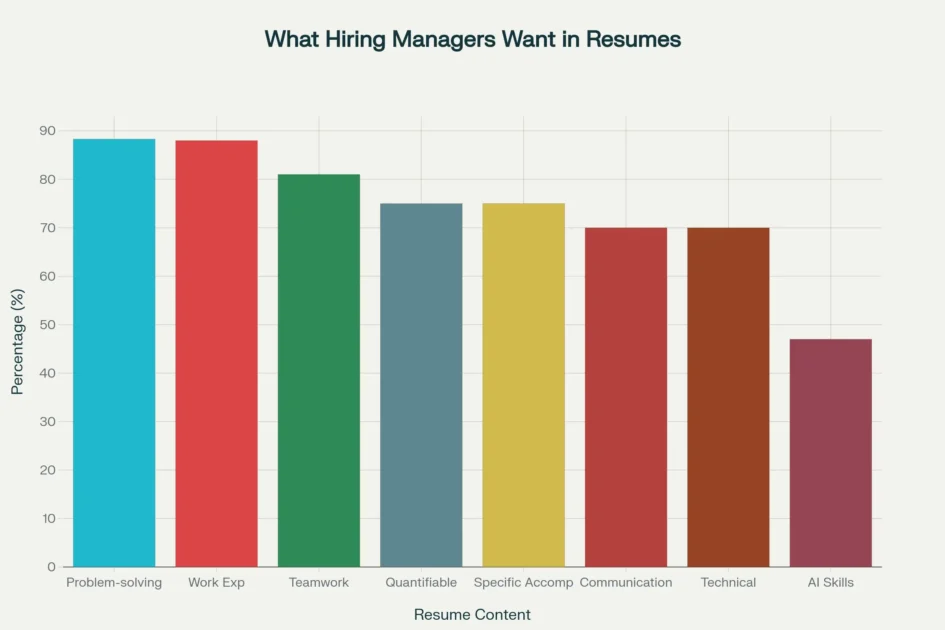
What Hiring Managers Look for Most in Resumes – Based on 2024-2025 US Hiring Survey Data
Understanding the Modern Hiring Practices
The Numbers Behind Today’s Job Market
The current job market presents unprecedented challenges that directly impact how resume writing tips must be applied in practice. According to comprehensive 2024-2025 data, the average small-to-medium business receives approximately 180 applications for every position they fill, with tech hubs like San Jose seeing even higher competition at 153.77 applicants per job posting within just one week. This dramatic increase in application volume means that effective resume writing must account for both increased competition and shortened review times.
Hiring managers now spend between 1-3 minutes reviewing promising resumes, with 57% falling into this category, while 21% spend over three minutes on exceptional candidates. However, the initial screening remains brutally brief, with recruiters making first impressions within 6-8 seconds of opening a resume. These statistics underscore why modern resume writing emphasize immediate visual impact and front-loaded information hierarchy.
The conversion rates throughout the hiring funnel reveal the critical importance of optimized resume writing tips. Only 5% of applicants progress from application to interview, and of those interviewed, 36% receive job offers. This means that out of 180 applicants, roughly nine will get interviews, and approximately three will receive offers. These numbers highlight why implementing strategic resume writing tips isn’t just helpful—it’s absolutely essential for career advancement.
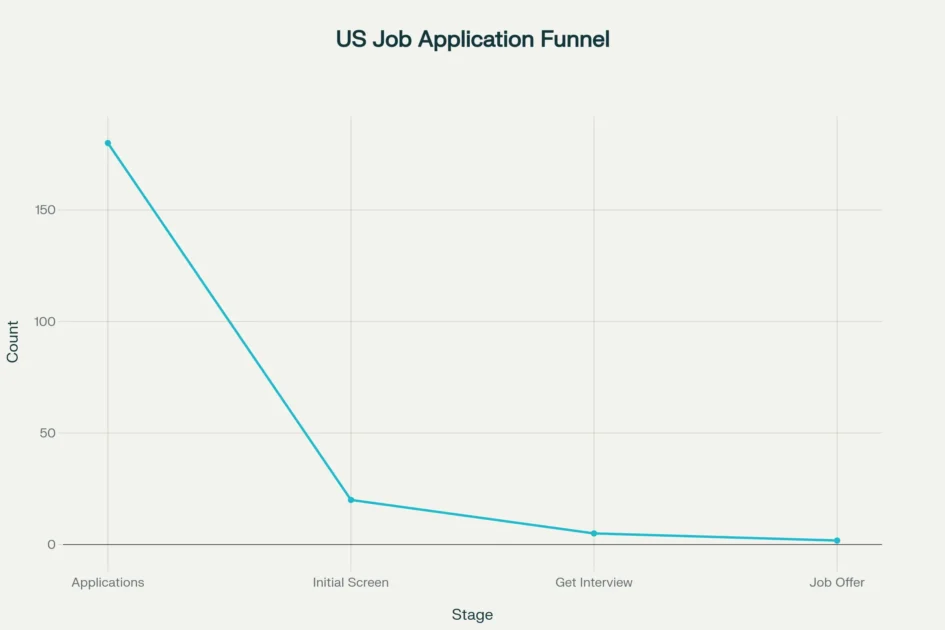
The US Job Application Funnel: From Application to Hire – Average numbers per successful hire in 2024-2025
Technology’s Impact on Resume Screening
The widespread adoption of Applicant Tracking Systems has fundamentally altered how resume writing must be structured and implemented. Research shows that 97.8% of Fortune 500 companies now use ATS technology, with 99.7% employing ATS filters to screen candidates. This technological shift means that effective resume writing must prioritize both algorithmic readability and human appeal.
Modern ATS systems have evolved beyond simple keyword matching to incorporate sophisticated parsing algorithms that analyze context, formatting, and relevance. However, studies indicate that up to 75% of resumes are rejected by these systems before reaching human reviewers. This statistic emphasizes why contemporary resume writing must include specific technical optimization strategies.
The integration of artificial intelligence in hiring processes continues expanding, with 83% of companies planning to use AI for resume review in 2025. These AI systems can analyze writing patterns, identify skill gaps, and even detect potential bias indicators. Consequently, modern resume writing tips must address both traditional optimization techniques and emerging AI evaluation criteria.
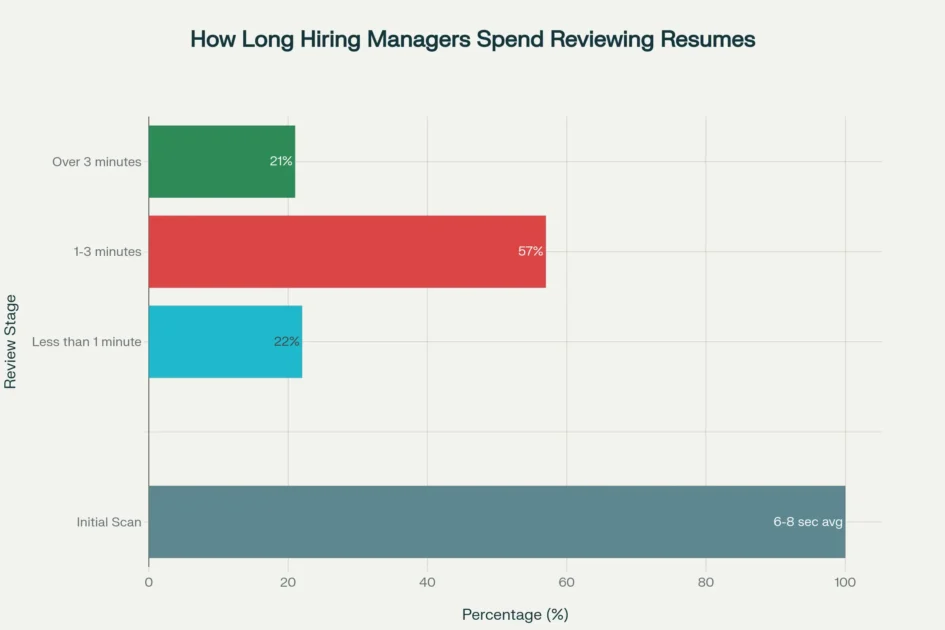
How Long Hiring Managers Spend Reviewing Resumes – US Data 2024-2025
Resume Writing Tip #1: Master the Art of Format Selection
The Rise of Skills-Based Formats
Contemporary hiring research reveals a significant shift in format preferences that directly impacts how resume writing should be applied. Contrary to conventional wisdom favoring chronological formats, 47.5% of HR professionals now prefer functional or skills-based resume formats, compared to only 39.1% who still favor reverse-chronological layouts. This preference change reflects the modern emphasis on competency-based hiring and skills-first evaluation.
Skills-based formats allow candidates to implement resume writing tips that prioritize relevant capabilities over chronological work history. This approach proves particularly effective for career changers, professionals with employment gaps, or those whose most relevant experience doesn’t align with their most recent positions. The format enables strategic presentation of transferable skills while de-emphasizing potential timeline inconsistencies.
When implementing this resume writing tip, structure your document with a comprehensive skills section immediately following your professional summary. Organize skills into categories such as technical proficiencies, leadership capabilities, and industry-specific expertise. Each skill should be supported by concrete examples and measurable outcomes from your experience portfolio.
Enhanced Chronological Approaches
For professionals with strong, consistent career progression, enhanced chronological formats represent the evolution of traditional timeline-based resume writing tips. This approach maintains the familiar structure that hiring managers expect while incorporating modern optimization elements such as keyword density, achievement quantification, and strategic white space utilization.
Enhanced chronological resume writing focus on transforming standard job descriptions into compelling achievement narratives. Instead of listing responsibilities, this format emphasizes measurable outcomes, process improvements, and career advancement indicators. Each position entry should demonstrate progression and increasing responsibility levels.
The key to successful enhanced chronological resume writing tips lies in strategic information architecture. Place your most impressive and relevant achievements within the first two positions listed, as these receive the most attention during initial screening phases. Use consistent formatting, strong action verbs, and quantified results to maintain reader engagement throughout the employment history section.
Avoiding Format Pitfalls
Common formatting mistakes can undermine even the most strategically crafted resume writing tips. Research indicates that 73% of hiring managers reject candidates specifically due to poor formatting choices. These rejections often occur within the first few seconds of resume review, before content quality can be evaluated.
Critical formatting elements that support effective resume writing include consistent font selection, appropriate white space distribution, and logical section organization. Avoid creative fonts, excessive graphics, or complex layouts that confuse ATS parsing systems. Instead, focus on clean, professional presentation that enhances rather than distracts from your content.
Length considerations have also evolved, with current data showing that 53% of hiring managers prefer two-page resumes while only 43% prefer single-page formats. This shift reflects the modern preference for comprehensive skill demonstration over artificial brevity constraints. However, ensure that every line of content adds value and directly supports your candidacy for target positions.
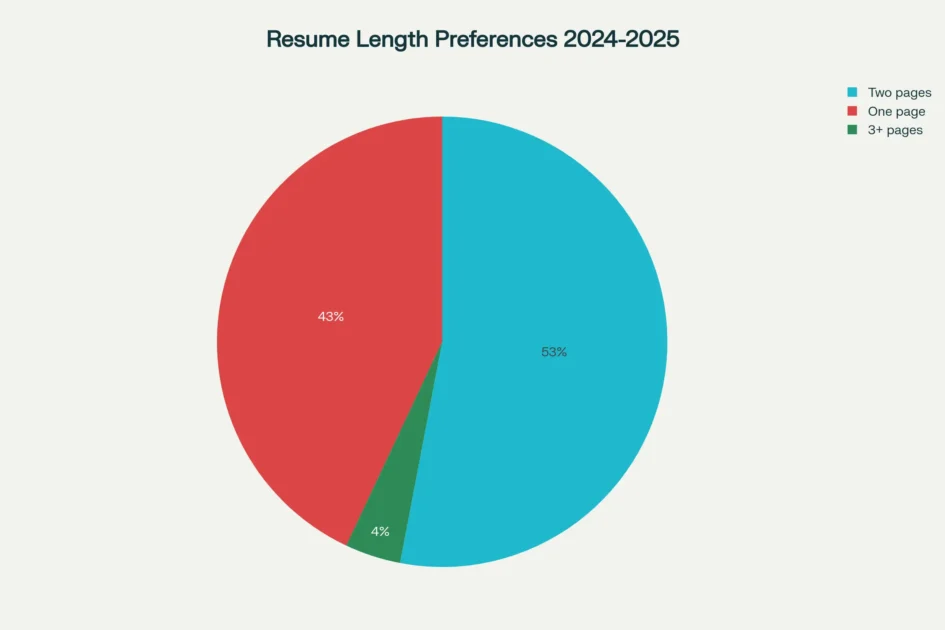
Resume Length Preferences Among US Hiring Managers 2024-2025
Resume Writing Tip #2: Optimize for ATS and Keyword Performance
Strategic Keyword Integration
Successful ATS optimization represents one of the most critical resumes writing for modern job seekers. Research demonstrates that effective keyword integration can improve application success rates by up to 40% while also increasing interview callback rates significantly. However, keyword optimization must be approached strategically rather than through simple keyword stuffing techniques.
The most effective CV writing tips for keyword optimization begin with thorough job description analysis. Extract 10-15 primary keywords from target job postings, focusing on both hard skills and industry-specific terminology. These keywords should be naturally integrated throughout your resume, with the highest concentration in your professional summary and skills sections.
Advanced keyword optimization CV writing tips include using contextual variations and synonyms to avoid repetition while maximizing ATS recognition. For example, instead of repeatedly using “project management,” incorporate variations like “program coordination,” “initiative leadership,” and “project delivery” throughout different sections of your resume.
Technical Optimization Standards
Modern ATS systems require specific technical formatting to ensure accurate parsing and evaluation. Essential resume writing tips for technical optimization include using standard section headers such as “Professional Experience,” “Education,” and “Skills” rather than creative alternatives that may confuse parsing algorithms.
File format selection represents another crucial technical resume writing tip. While many candidates default to PDF formats for visual consistency, .docx files parse more reliably across different ATS platforms. However, always check specific application requirements, as some systems may specify format preferences.
Formatting elements that support effective CV writing tips include avoiding tables, text boxes, and complex layouts that can scramble during ATS processing. Instead, use simple, single-column layouts with clear section divisions and consistent formatting hierarchy throughout the document.
Measuring Optimization Success
Quantifying the effectiveness of your resume writing tips requires systematic testing and performance tracking. Monitor your application response rates across different versions of your resume to identify which optimization strategies produce the best results. Industry benchmarks suggest that well-optimized resumes should generate response rates between 10-15% in competitive markets.
Utilize available ATS testing tools to evaluate how effectively your CV writing tips translate into machine-readable content. Services like Jobscan, Resume Worded, and Skillsyncer can provide immediate feedback on keyword density, formatting compatibility, and overall ATS readiness.
Track performance metrics including application submission volume, initial response rates, interview request frequency, and final hiring outcomes. This data enables continuous refinement of your resume writing tips and ensures optimal performance across different job opportunities and industry sectors.
Resume Writing Tip #3: Quantify Achievements with Measurable Impact
The Power of Numbers in Resume Content
Quantified achievements represent one of the most impactful resume writing tips for capturing hiring manager attention and demonstrating tangible value. Current hiring research shows that resumes featuring quantified metrics have up to 40% higher chances of securing interviews compared to those with generic achievement statements. This statistical advantage stems from the concrete evidence that numbers provide regarding a candidate’s potential impact.
Effective CV writing tips for achievement quantification extend beyond simple revenue figures to encompass various measurable outcomes. Consider metrics such as percentage improvements, time savings, cost reductions, team sizes managed, customer satisfaction scores, process efficiency gains, and project completion rates. These diverse quantification approaches enable professionals across all industries to implement these resume writing tips effectively.
The psychology behind quantified achievements reveals why this resume writing tip proves so effective. Hiring managers process numerical information faster than descriptive text, and numbers provide immediate context for evaluating candidate capabilities. When reviewing hundreds of applications, quantified achievements create memorable impressions that distinguish candidates from competitors using vague accomplishment descriptions.
Industry-Specific Quantification Strategies
Different industries require tailored approaches to implementing quantified achievement resume writing tips. Sales professionals should emphasize revenue generation, quota attainment, customer acquisition rates, and market share growth. Marketing specialists can highlight campaign performance metrics, engagement rates, conversion improvements, and brand awareness increases.
Technical professionals benefit from CV writing tips that emphasize efficiency improvements, system performance enhancements, code quality metrics, and project delivery timelines. Healthcare workers can quantify patient care improvements, operational efficiency gains, safety record enhancements, and compliance achievement rates.
Administrative and support professionals often overlook quantification opportunities, but effective resume writing tips for these roles include process improvement percentages, cost savings achieved, customer satisfaction scores, and productivity increases. Even volunteer experiences and academic projects can incorporate quantified achievements when professional experience is limited.
Creating Compelling Achievement Narratives
The most effective resume writing tips for achievement presentation follow the “Accomplished X as measured by Y by doing Z” formula popularized by former Google executive Laszlo Bock. This structure provides context, quantification, and methodology in a concise format that hiring managers can quickly process and understand.
Strong achievement narratives incorporating these CV writing tips might include examples such as: “Reduced customer service response times by 35% (from 4 hours to 2.6 hours) by implementing automated ticketing system and cross-training support staff” or “Increased quarterly sales revenue by $2.3 million (28% growth) through targeted account-based marketing campaigns and strategic partnership development.”
When specific numbers aren’t available, effective resume writing tips include using ranges, percentages, or comparative terms that still provide measurable context. Phrases like “reduced processing time by more than half,” “increased team productivity significantly,” or “managed budgets exceeding $500,000” offer quantified context even without precise figures.
Resume Writing Tip #4: Craft Compelling Professional Summaries
The Strategic Importance of Opening Statements
Professional summaries function as the cornerstone of effective resume writing tips, serving as the first impression that determines whether hiring managers continue reading your application. Research indicates that 79.4% of hiring managers check the work experience section first, but a compelling professional summary can redirect attention and frame the entire resume narrative. This strategic positioning makes professional summary optimization one of the most critical CV writing tips for modern job seekers.
Effective professional summaries implementing these resume writing tips should occupy 2-4 lines and immediately communicate your value proposition to potential employers. The summary must incorporate your target job title, years of relevant experience, and 2-3 key achievements or skills that align with employer needs. This concentrated approach ensures that even during brief 6-8 second initial scans, hiring managers receive essential information about your candidacy.
The evolution of professional summary best practices reflects changing hiring manager preferences and ATS requirements. Modern resume writing tips emphasize keyword-rich summaries that satisfy both algorithmic parsing and human evaluation criteria. Include industry-specific terminology, relevant skill keywords, and measurable outcomes within your summary to maximize both ATS scores and human reader engagement.
Formula-Driven Summary Construction
Successful professional summary creation follows proven formulas that incorporate established resume writing tips for maximum impact. The most effective structure begins with a descriptive adjective (experienced, innovative, results-driven), followed by your professional title, experience level, and industry focus. This foundation provides immediate context for hiring managers reviewing multiple applications.
The second component of effective CV writing tips for summaries includes 2-3 specific accomplishments or capabilities that differentiate you from other candidates. These elements should directly relate to the target position requirements while showcasing your unique value proposition. Include quantified achievements whenever possible to provide concrete evidence of your capabilities.
Advanced resume writing tips for professional summaries incorporate subtle keyword optimization without sacrificing readability or authenticity. Research target job descriptions to identify frequently mentioned skills, qualifications, and responsibilities, then naturally integrate these terms throughout your summary. This approach satisfies ATS requirements while maintaining compelling human-readable content.
Industry-Specific Summary Examples
Different industries require tailored approaches to professional summary resume writing tips. Technology professionals should emphasize technical expertise, project leadership capabilities, and innovation outcomes. For example: “Innovative Software Engineer with 7+ years developing scalable web applications, leading cross-functional teams of 12+ developers, and reducing system processing times by 40% through architectural optimization.”
Marketing and communications professionals benefit from CV writing tips that highlight campaign results, audience growth, and brand impact measurements. Consider: “Results-driven Digital Marketing Manager with expertise in B2B lead generation, having increased qualified leads by 150% while reducing acquisition costs by 30% through integrated content and automation strategies.”
Healthcare and service industry professionals should implement resume writing tips that emphasize patient care, operational efficiency, and compliance achievements. Example: “Dedicated Registered Nurse with 5+ years ICU experience, maintaining 98% patient satisfaction scores while reducing medication errors by 25% through implementation of double-verification protocols.”
Resume Writing Tip #5: Leverage Strategic Skills Presentation
Hard Skills vs. Soft Skills Balance
Contemporary hiring research reveals critical insights about skills presentation that inform effective resume writing tips for today’s job market. Data shows that 88% of hiring managers focus on hard skills when reviewing resumes, while 91% also value soft skills, indicating the importance of balanced skills presentation strategies. This dual emphasis requires sophisticated resume writing tips that address both technical competencies and interpersonal capabilities.
Hard skills documentation should follow CV writing tips that emphasize specific, measurable, and industry-relevant technical capabilities. Include programming languages, software proficiencies, certifications, and specialized tools relevant to your target positions. These skills should be presented with proficiency levels and, where possible, years of experience or specific applications.
Soft skills integration requires more nuanced CV writing tips, as these capabilities are harder to quantify but equally important for hiring decisions. Rather than simply listing soft skills, demonstrate them through achievement narratives and context within your work experience descriptions. Show leadership through team management examples, communication skills through presentation achievements, and problem-solving abilities through specific challenge resolution cases.
Skills Prioritization Matrix
| Skill Category | Hiring Manager Priority (%) | ATS Weight | How to Present | Evidence Examples |
| Technical Skills (Hard) | 88 | High | List specific technologies, programming languages, tools | Python, Java, AWS (5+ years), Salesforce Administration |
| Software Proficiency | 85 | High | Name software with proficiency level (Expert/Advanced/Intermediate) | Advanced Excel (pivot tables, macros), Expert PowerPoint |
| Industry Certifications | 78 | Critical | Include certification name, issuing body, year obtained | PMP (2023), Google Analytics Certified, CPA Licensed |
| Language Skills | 67 | Medium | List languages with proficiency level (Native/Fluent/Conversational) | Spanish (Fluent), Mandarin (Conversational), French (Basic) |
| Leadership Skills (Soft) | 91 | Medium | Demonstrate through team size managed, projects led | Led cross-functional teams of 15+, managed 8 direct reports |
| Communication Skills (Soft) | 89 | Medium | Show through presentations given, stakeholders managed | Delivered 50+ presentations, managed C-suite relationships |
| Problem-Solving (Soft) | 88 | Medium | Evidence through challenges solved, improvements made | Reduced processing time 40%, solved critical system failures |
| Analytical Skills | 82 | High | Quantify through data analyzed, insights generated | Analyzed datasets of 1M+ records, generated predictive models |
| Project Management | 79 | High | Detail methodologies used (Agile, Waterfall), team sizes | Managed 25+ projects using Scrum, 95% on-time delivery rate |
| Digital Literacy | 76 | High | Show adaptation to new technologies, platforms mastered | Mastered 12 new software platforms, led digital transformation |
Skills Section Architecture
Modern skills section design incorporating effective CV writing tips should organize capabilities into logical categories that enhance readability and ATS parsing. Create distinct subsections for technical skills, software proficiencies, languages, and certifications. This organizational approach enables hiring managers to quickly locate relevant capabilities while ensuring comprehensive ATS keyword capture.
Advanced resume writing tips for skills presentation include incorporating context and evidence for each major capability listed. Instead of simply stating “Project Management,” expand to “Project Management (PMP Certified, managed 15+ cross-functional projects, average 15% under budget completion rate).” This approach provides verification and impact evidence within the skills section itself.
Prioritization represents another crucial element of effective skills section CV writing tips. List skills in order of relevance to your target positions, with the most important capabilities appearing first. This strategic ordering ensures that both human reviewers and ATS systems encounter your strongest qualifications early in their evaluation process.
Emerging Skills and Future-Proofing
The rapid evolution of workplace requirements necessitates resume writing tips that address both current and emerging skill demands. Research indicates that 47% of hiring managers now consider AI abilities among the top hard skills for 2025, including machine learning, generative AI tools, and data analysis capabilities. Professionals should proactively develop and showcase these emerging competencies.
Future-focused CV writing tips include continuous skills inventory updates and strategic capability development aligned with industry trends. Monitor job postings in your field to identify emerging skill requirements and invest in professional development opportunities that address these evolving needs. Document these learning initiatives through certifications, project applications, and measurable outcomes.
Technology adaptation skills represent universally valuable capabilities that support effective resume writing tips across all industries. Demonstrate your ability to learn new systems, adapt to changing processes, and integrate emerging tools into existing workflows. These adaptability indicators signal to employers that you can navigate future technological changes successfully.
Resume Writing Tip #6: Master Action Verbs and Power Words
The Science Behind Impactful Language
Strategic language selection represents one of the most underutilized CV writing tips for creating memorable and compelling applications. Research in cognitive psychology demonstrates that action verbs create stronger mental images and emotional responses than passive language, making them essential components of effective resume writing tips. Power words immediately convey competence, initiative, and achievement in ways that generic phrases cannot match.
The effectiveness of action-oriented CV writing tips stems from their ability to transform static job descriptions into dynamic achievement narratives. Instead of stating “responsible for customer service,” powerful alternatives include “orchestrated,” “optimized,” “transformed,” or “accelerated” customer service operations. These linguistic choices create immediate differentiation and suggest proactive leadership rather than passive task completion.
Modern hiring managers process hundreds of applications weekly, making distinctive language crucial for capturing and maintaining attention. CV writing tips that incorporate varied, specific action verbs help candidates avoid the generic language patterns that characterize most applications, thereby increasing memorability and interview potential.
Industry-Specific Power Word Selection
Different professional contexts require tailored approaches to implementing power word resume writing tips effectively. Technical and engineering professionals should emphasize action verbs like “architected,” “engineered,” “optimized,” “integrated,” and “automated” that reflect their problem-solving and innovation capabilities.
Sales and business development professionals benefit from CV writing tips incorporating power words such as “negotiated,” “secured,” “generated,” “penetrated,” and “converted” that demonstrate revenue impact and relationship building skills. These terms immediately communicate commercial acumen and results orientation.
Management and leadership roles require resume writing tips featuring action verbs like “orchestrated,” “spearheaded,” “mentored,” “aligned,” and “transformed” that convey team leadership and organizational impact. These words suggest strategic thinking and change management capabilities that employers value highly.
Avoiding Overused and Weak Language
Effective resume writing tips include systematic elimination of weak, overused, and passive language that diminishes impact and credibility. Common phrases like “responsible for,” “worked with,” “helped,” and “assisted” suggest passive participation rather than active leadership and should be replaced with stronger alternatives.
Industry data reveals that certain action verbs appear so frequently in resumes that they’ve lost their impact value. CV writing tips should avoid overused terms like “managed,” “led,” “created,” and “developed” unless they can be enhanced with specific context and measurable outcomes. Instead, seek more distinctive alternatives that convey similar meanings with greater impact.
Advanced resume writing tips include varying verb selection throughout your document to maintain reader engagement and demonstrate vocabulary range. Use each power word only once if possible, and ensure that verb choices accurately reflect the scope and nature of your actual accomplishments and responsibilities.

ATS-friendly resume optimization infographic for professional use
Resume Writing Tips #7: Perfect Your Visual Presentation and Formatting
The Psychology of Visual First Impressions
Visual presentation significantly impacts hiring manager perceptions and represents one of the most underestimated resume writing tips for modern job applications. Research demonstrates that 73% of hiring managers prefer visually appealing resumes, while 68% reject candidates based on poor formatting alone. These statistics underscore the critical importance of professional visual design in contemporary CV writing tips.
The human brain processes visual information exponentially faster than text, making strategic visual hierarchy essential for effective resume writing tips. Hiring managers form initial impressions within 6-8 seconds, during which visual elements like formatting, layout, and information organization determine whether they continue reading or move to the next application.
Effective visual CV writing tips leverage principles of graphic design to guide reader attention toward your most important qualifications and achievements. Strategic use of white space, consistent formatting, and logical information flow create professional impressions that support rather than distract from your content quality.
Modern Formatting Standards
Contemporary formatting requirements for resume writing tips reflect both ATS compatibility needs and human aesthetic preferences. Use professional fonts like Arial, Calibri, or Times New Roman in 10-12 point sizes for optimal readability across different viewing platforms and printing scenarios. Avoid decorative fonts that may not render properly in ATS systems.
Margin and spacing considerations represent crucial technical aspects of effective CV writing tips. Maintain 0.5-1 inch margins on all sides while ensuring adequate white space between sections. Line spacing should be set between 1.0-1.15 to maximize content density while preserving readability.
Color usage in modern resume writing tips should be minimal and strategic, with black text on white backgrounds providing optimal ATS compatibility. If incorporating color elements, use them sparingly for section dividers or contact information highlights, ensuring that the document remains professional when printed in black and white.
Length and Information Architecture
Resume length preferences have evolved significantly, with current data showing that 53% of hiring managers prefer two-page resumes compared to 43% favoring single-page formats. This shift enables more comprehensive skills presentation and detailed achievement documentation, supporting more thorough implementation of quantified CV writing tips.
Information architecture represents a strategic component of effective resume writing tips, determining how hiring managers navigate and process your qualifications. Place your most compelling information in the top half of the first page, including professional summary, key skills, and most relevant work experience. This positioning ensures critical information receives attention even during brief initial scans.
Section ordering should follow logical progression that supports your career narrative and target position requirements. Standard CV writing tips suggest the sequence: contact information, professional summary, key skills, professional experience, education, and additional sections as relevant. However, recent graduates or career changers might benefit from alternative arrangements that highlight their strongest qualifications first.
Resume Word Count Guide
| Resume Section | Recommended Word Count | Content Focus | Common Mistakes | Optimization Tips |
| Professional Summary | 50-80 words (2-4 lines) | Value proposition, key achievements, target role alignment | Too generic, too long (over 100 words), lacks focus | Include target job keywords, quantify when possible, show personality |
| Work Experience (per role) | 100-150 words (4-6 bullet points) | Quantified achievements, relevant responsibilities, career progression | Too brief (under 75 words), no quantification, outdated info | Lead with strongest achievements, use varied action verbs, show progression |
| Skills Section | 30-50 words (skills list format) | Job-relevant technical and soft skills with proficiency levels | Irrelevant skills, no proficiency levels, too many listed | Align with job requirements, group similar skills, include emerging tech |
| Education Section | 20-40 words per degree | Degree, institution, graduation year, honors/GPA if recent | Too much detail, irrelevant coursework, missing graduation year | Highlight relevant coursework for career changers, include honors |
| Certifications | 5-15 words per certification | Certification name, issuing organization, year obtained | Expired certifications, irrelevant credentials, no dates | Prioritize current/relevant certifications, include renewal dates |
| Additional Sections | 20-60 words depending on relevance | Volunteer work, publications, awards relevant to target role | Too much personal info, irrelevant activities, poor relevance | Select based on job relevance, quantify volunteer impact when possible |
| Contact Information | 15-25 words | Phone, email, LinkedIn, city/state, portfolio URL if relevant | Unprofessional email, missing LinkedIn, incomplete address | Use professional email address, ensure all links work, keep updated |
| Total Resume Length | 400-800 words (1-2 pages) | Comprehensive career story with quantified impact evidence | Too long (over 1000 words), too brief (under 300), poor balance | Balance comprehensive content with readability, use white space effectively |
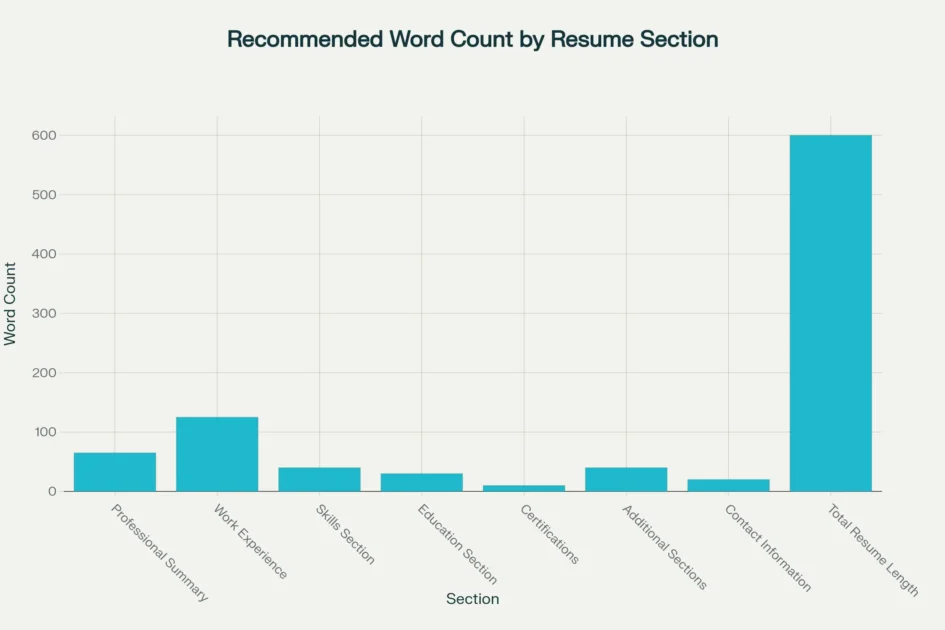
Recommended word count midpoints for each resume section, guiding optimal content allocation for a 1–2 page professional resume.
Common Resume Writing Mistakes to Avoid
Content and Messaging Pitfalls
Even well-intentioned resume writing tips can fail when fundamental content mistakes undermine overall effectiveness. One of the most damaging errors involves generic, template-based language that fails to differentiate candidates from their competition. Research shows that 62% of hiring managers cite lack of customization as a significant resume mistake, emphasizing the importance of tailored content for each application.
Vague achievement descriptions represent another critical error that negates the impact of otherwise sound CV writing tips. Statements like “increased sales significantly” or “improved team performance” provide no measurable context for evaluating candidate impact. Replace these generic claims with specific, quantified outcomes that demonstrate tangible value creation.
Inconsistent tense usage throughout resume content creates confusion and suggests poor attention to detail. Resume writing tips emphasize using past tense for previous positions and present tense only for current roles. Maintain this consistency throughout all sections to project professionalism and careful document preparation.
Technical and Formatting Errors
Technical mistakes can instantly disqualify otherwise strong applications, making error prevention a crucial component of effective resume writing tips. Spelling and grammar errors appear in approximately 58% of resumes according to hiring manager surveys, with 80% of recruiters rejecting candidates due to such mistakes. Implement systematic proofreading processes including spell-check tools, grammar verification, and multiple human reviews.
Contact information errors represent surprisingly common mistakes that render even excellent CV writing tips ineffective. Verify that phone numbers, email addresses, and LinkedIn profiles are accurate and professional. Use email addresses that incorporate your name rather than creative or outdated alternatives that may create negative impressions.
File naming conventions often receive insufficient attention in standard resume writing tips guidance. Save your resume with a professional filename that includes your name and the word “resume” (e.g., “John-Smith-Resume.docx”). Avoid generic names like “Resume1.docx” or creative alternatives that may confuse hiring managers or ATS systems.
Strategic Positioning Mistakes
Poor keyword optimization represents a fundamental error that undermines the effectiveness of all other resume writing tips. Failing to incorporate relevant industry terminology and job-specific keywords results in ATS rejection before human review occurs. Systematically analyze target job descriptions and integrate appropriate keywords naturally throughout your resume content.
Inappropriate skills emphasis can derail otherwise effective CV writing tips implementation. Including irrelevant skills or overemphasizing less important capabilities dilutes your message and confuses hiring managers about your primary qualifications. Focus on skills directly relevant to your target positions while eliminating outdated or peripheral capabilities.
Reference handling mistakes include providing references on your resume or using the phrase “references available upon request.” Current resume writing tips recommend omitting reference information entirely, as employers request references only after expressing serious interest in candidates. Use the space instead for additional achievements or relevant qualifications.
Future-Proofing Your Resume Strategy
Adapting to Technological Changes
The continued evolution of hiring technology requires forward-thinking approaches to resume writing tips that anticipate future changes rather than simply responding to current requirements. Artificial intelligence integration in hiring processes will continue expanding, with 83% of companies planning to implement AI resume screening by 2025. This trend necessitates CV writing tips that optimize for both current ATS systems and emerging AI evaluation criteria.
Machine learning algorithms increasingly analyze writing patterns, achievement authenticity, and candidate fit beyond simple keyword matching. Future-effective resume writing tips must emphasize authentic accomplishment narratives supported by verifiable data and logical career progression patterns. Avoid generic language or exaggerated claims that AI systems may flag as potentially misleading.
Voice and conversational AI interfaces may eventually influence how CV writing tips must be structured for optimal performance. Consider how your resume content would sound when read aloud or processed through voice-activated systems, ensuring natural language flow alongside traditional formatting optimization.
Industry Evolution Considerations
Rapid industry changes require adaptable resume writing tips that accommodate shifting skill requirements and emerging job categories. The accelerating pace of technological change means that hard skills become obsolete faster while adaptability and learning capabilities gain increased importance in hiring decisions.
Remote work normalization has permanently altered how CV writing tips should address location, collaboration, and communication capabilities. Emphasize virtual team leadership, digital communication proficiency, and remote project management experience as these become standard expectations rather than special qualifications.
Environmental and social responsibility factors increasingly influence hiring decisions, suggesting that future CV writing tips should incorporate sustainability achievements, diversity and inclusion contributions, and community engagement activities where relevant to target positions.
Continuous Improvement Strategies
Effective resume writing tips require ongoing refinement based on application performance data and industry feedback. Track your resume’s effectiveness across different job applications, measuring response rates, interview requests, and final hiring outcomes to identify areas for improvement.
Professional development activities should align with resume writing tips goals, ensuring that new skills, certifications, and experiences strengthen your overall candidacy profile. Regularly update your resume to reflect recent achievements and remove outdated information that may dilute your current value proposition.
Network feedback represents an invaluable resource for refining CV writing tips implementation. Seek input from industry professionals, hiring managers, and career counselors who can provide objective perspectives on your resume’s effectiveness and suggest specific improvements.
Conclusion
The transformation of hiring practices in 2024-2025 has fundamentally redefined what constitutes effective resume writing tips for modern professionals. With 180 applicants competing for every available position and only 5% reaching the interview stage, implementing strategic CV writing tips has become essential rather than optional for career advancement. The seven essential strategies presented in this guide address the complete spectrum of challenges facing today’s job seekers, from ATS optimization and quantified achievement presentation to visual formatting and future-proofing approaches.
The statistical evidence supporting these CV writing tips demonstrates their critical importance in navigating contemporary hiring processes. When 73% of hiring managers reject candidates due to poor formatting, 44% cite lack of measurable achievements as dealbreakers, and 75% specifically seek quantified accomplishments, the strategic application of proven resume writing tips becomes the differentiating factor between successful and unsuccessful applications. These data points underscore why generic, template-based approaches no longer suffice in today’s competitive landscape.
The technological evolution of hiring processes, with 97.8% of Fortune 500 companies using ATS systems and 83% planning AI implementation, requires sophisticated CV writing tips that address both algorithmic evaluation and human psychology. The strategies outlined in this guide provide frameworks for optimizing resume performance across both technological and human evaluation criteria, ensuring comprehensive preparation for modern hiring processes.
Implementation of these resume writing tips requires systematic approach and continuous refinement based on performance feedback and industry evolution. Monitor your application success rates, track interview conversion percentages, and adjust your strategies based on real-world results. The job market will continue evolving, but the fundamental principles underlying effective CV writing tips—clear communication, quantified value demonstration, and strategic positioning—will remain constant foundations for career success. By mastering these seven essential strategies and adapting them to your specific industry and career objectives, you position yourself for success in today’s challenging but opportunity-rich employment landscape.
Take action today: Begin implementing these resume writing tips immediately by conducting a comprehensive audit of your current resume against the standards presented in this guide. Focus first on quantifying your achievements and optimizing for ATS performance, as these changes typically produce the most immediate improvements in application success rates. Your dream job opportunity may be just one optimized resume away.
Citations
- https://high5test.com/resume-statistics/
- https://enhancv.com/blog/resume-statistics/
- https://www.resumly.ai/blog/best-resume-optimization-strategies-for-2025
- https://novoresume.com/career-blog/hr-survey
- https://www.linkedin.com/pulse/optimize-your-resume-ats-systems-chatgpt-rodney-teat-ccss-xgqle
- https://resumeworded.com/how-to-quantify-resume-key-advice
- https://neuracv.com/blog/2024-resume-trends-and-best-practices
- https://blog.theinterviewguys.com/resume-keyword-list/
- https://novoresume.com/career-blog/how-to-write-a-resume-guide
- https://www.resumebuilder.com/resume-examples/nearly-half-of-hiring-managers-say-ai-is-the-most-important-skill-to-have-on-your-resume-in-2025/
- https://careerservices.fas.harvard.edu/resources/create-a-strong-resume/
- https://gocrackit.com/5-resume-trends-to-watch-in-2024/
- https://www.jobscan.co/blog/top-resume-keywords-boost-resume/
- https://in.indeed.com/career-advice/resumes-cover-letters/10-resume-writing-tips
- https://www.visualcv.com/blog/hiring-statistics/
- https://www.coursera.org/in/articles/resume-tips
- https://www.kickresume.com/en/press/hr-statistics/
- https://resumegenius.com/blog/resume-help/resume-format
- https://www.cnbc.com/2025/05/12/ive-reviewed-over-1000-resumes-as-a-hiring-manager-biggest-mistakes-job-seekers-make.html
- https://pesto.tech/resources/resume-trends-that-you-should-follow-in-2024
- https://extendedstudies.ucsd.edu/news-events/extended-studies-blog/12-resume-best-practices-from-a-career-advisor-how-to-make-your-resume-stand-out-in-2025
- https://www.apollotechnical.com/recruiting-statistics-for-hiring-managers/
- https://www.sparklehood.org/new-blog-posts/beat-the-ats-top-rated-resume-screening-tool-for-higher-rankings-2024
- https://www.myperfectresume.com/career-center/resumes/how-to
- https://skima.ai/blog/industry-trends-and-insights/recruitment-statistics
- https://www.indeed.com/career-advice/resumes-cover-letters/how-to-quantify-resume
- https://resumeworded.com/skills-and-keywords/research-skills-group
- https://www.forbes.com/sites/chriswestfall/2024/01/26/study-says-hiring-managers-expect-and-prefer-ai-enhanced-resumes/
- https://resumegenius.com/blog/job-hunting/unfiltered-hiring-insights
- https://novoresume.com/career-blog/how-to-write-your-achievements-in-your-resume
- https://www.myperfectresume.com/career-center/careers/basics/hiring-outlook
- https://www.reddit.com/r/resumes/comments/11i0g0l/how_do_people_realistically_quantify_their/
- https://ieeexplore.ieee.org/document/10883246/
- https://www.jobscan.co/blog/resume-accomplishments-examples/
- https://www.resumepilots.com/blogs/career-advice/ats-keyword-optimization-tips
- https://flair.hr/en/blog/resume-statistics/
- https://www.evalcommunity.com/resume-help/quantifiable-achievements/
- https://www.reddit.com/r/jobsearchhacks/comments/1j530wc/full_guide_to_optimizing_resume_keywords_to_pass/
- https://www.resumebuilder.com/pronouns-on-resume/
- https://www.indeed.com/career-advice/resumes-cover-letters/hard-skills-vs-soft-skills
- https://resumegenius.com/blog/cover-letter-help/cover-letter-statistics
- https://novoresume.com/career-blog/resume-formats
- https://www.edgepointlearning.com/blog/hard-skills-vs-soft-skills/
- https://blog.theinterviewguys.com/cover-letters-are-making-a-comeback/
- https://in.indeed.com/career-advice/resumes-cover-letters/resume-format-guide-with-examples
- https://www.boutiquerecruiting.com/common-skills-for-resume-hard-skills-vs-soft-skills-what-employers-prefer/
- https://resumeworded.com/blog/are-cover-letters-still-necessary/
- https://www.cvmaker.com/blog/resume-writing/best-resume-formats-for-2022-examples-templates-tips
- https://www.coursera.org/in/articles/hard-skills-vs-soft-skills
- https://www.coursera.org/articles/are-cover-letters-necessary
- https://blog.theinterviewguys.com/5-resume-formats-that-will-dominate/
- https://www.redlinegroup.com/insight-details/the-importance-of-including-both-hard-and-soft-skills-in-a-job-description
- https://resumelab.com/cover-letter/are-cover-letters-necessary
- https://www.rezi.ai/posts/resume-format
- https://vervoe.com/hard-skills-vs-soft-skills/
- https://blog.9cv9.com/top-80-cover-letter-statistics-data-trends-in-2025/
- https://hyresnap.com/blogs/best-resume-formats
- https://novoresume.com/career-blog/soft-skills
- https://novoresume.com/career-blog/top-10-most-powerful-action-words-for-resume
- https://topresume.com/success-stories
- https://novoresume.com/career-blog/resume-summary
- https://www.indeed.com/career-advice/resumes-cover-letters/resume-power-words
- https://resumespice.com/why-us/houston-professional-resume-samples/
- https://www.myperfectresume.com/career-center/resumes/how-to/summary
- https://www.rezi.ai/posts/resume-action-words
- https://www.toplinkcv.com/success-stories-and-example-case-studies/
- https://resumegenius.com/blog/resume-help/resume-summary
- https://resumeworded.com/action-verbs
- https://topresume.com/success-stories/leslie
- https://in.indeed.com/career-advice/resumes-cover-letters/how-to-write-a-resume-summary
- https://capd.mit.edu/resources/resume-action-verbs/
- https://careertuners.com/samples/
- https://www.resumebuilder.com/resume-examples/
- https://www.coursera.org/in/articles/resume-action-words
- https://www.kickresume.com/en/blog/coolest-resume-examples/
- https://www.canva.com/resumes/templates/professional/
- https://www.resumegiants.com/blog/resume-power-words/
- https://igotanoffer.com/blogs/mckinsey-case-interview-blog/consulting-resume