


How This SaaS Startup Grew Revenue by 300% with Zero Funding
The prevailing wisdom in Silicon Valley suggests that venture capital is the lifeblood of successful startups. Yet, beneath the glossy headlines of multi-million-dollar funding rounds lies an inspiring counter-narrative: SaaS startup companies that have achieved remarkable growth without a single dollar of external investment. These bootstrapped success stories challenge conventional thinking and demonstrate that sustainable, profitable growth doesn’t always require venture capital backing.
In an era where SaaS customer acquisition costs have increased by 50% over the past five years and the global SaaS market is projected to reach $790 billion by 2030, the pressure to secure funding has never been greater.

The global SaaS market is projected to grow from $130 billion in 2020 to $790 billion by 2030, representing a massive opportunity for bootstrapped startups
However, a growing number of American entrepreneurs are proving that strategic bootstrapping can lead to extraordinary results. From Basecamp’s journey to $280 million in annual revenue to Mailchimp’s $12 billion acquisition by Intuit, these companies have rewritten the playbook for SaaS growth.
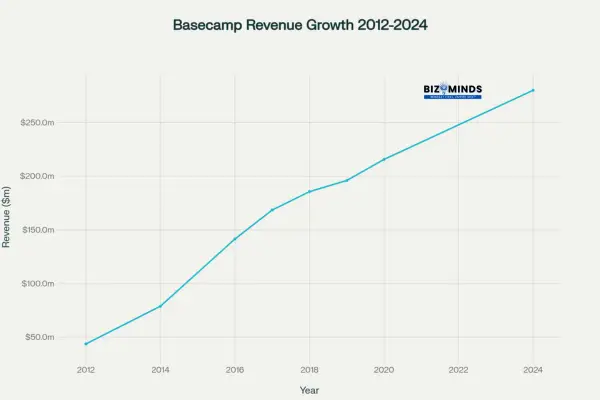
Basecamp’s remarkable bootstrap journey shows consistent revenue growth from $43.7M in 2012 to $280M in 2024, proving that SaaS startup can achieve substantial growth without external funding
The data reveals a compelling truth: while VC-backed companies often grab headlines with their rapid expansion, bootstrapped SaaS startup companies frequently outperform their funded counterparts in terms of sustainable growth, customer retention, and long-term profitability. This comprehensive analysis examines how smart entrepreneurs leverage product-led growth, strategic cost management, and customer-centric approaches to achieve 300% revenue growth without external funding.
The SaaS Startup Bootstrap Advantage: Why Zero Funding Drives Maximum Growth
Understanding the Bootstrap Methodology
Bootstrapping represents more than just a funding strategy—it embodies a fundamental philosophy of business building that prioritizes sustainability over speed, profitability over valuation, and customer value over investor expectations. For SaaS startup founders, this approach offers unique advantages that often translate into superior long-term outcomes.
The financial discipline required by bootstrapping forces entrepreneurs to make every dollar count. Unlike VC-backed companies that can afford to experiment with expensive marketing campaigns or premature scaling, bootstrapped startups must identify the most efficient paths to growth from day one. This constraint-driven innovation often leads to more creative solutions and deeper customer understanding.
Research from McKinsey reveals that successful SaaS companies achieving the “Rule of 40″—where growth rate plus profit margin equals or exceeds 40%—often emerge from bootstrapped origins. These companies develop strong unit economics early, focusing on customer lifetime value over rapid user acquisition. The result is a more sustainable business model that can weather economic downturns and market volatility.
The Psychology of Ownership
Bootstrapped founders maintain complete control over their company’s vision and direction. This autonomy enables rapid decision-making without the need for board approvals or investor consensus. David Hollander, founder of Order Desk, describes this freedom: “We’ve never had to worry about satisfying external investors or compromising our vision for short-term metrics. Every decision we make is focused on creating value for our customers”.
This control extends to company culture and values. Bootstrapped SaaS startup companies often develop stronger, more cohesive teams because hiring decisions aren’t driven by external growth pressures. Basecamp, for example, has maintained a team of just 171 employees while generating $280 million in revenue, resulting in exceptional productivity per employee.
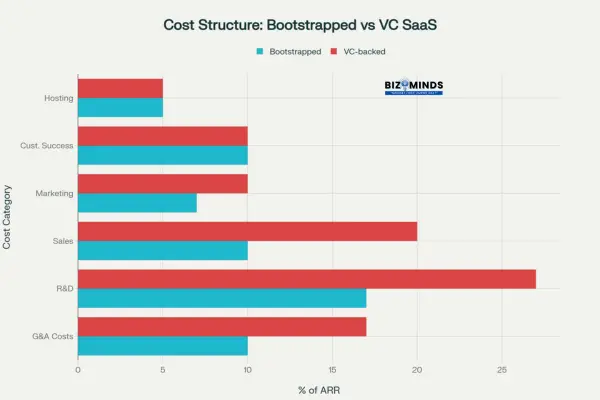
Bootstrapped SaaS companies maintain leaner cost structures (80% of ARR) compared to VC-backed companies (108% of ARR), focusing on efficiency over rapid expansion
The psychological benefits of ownership cannot be understated. Founders who retain equity are more likely to think long-term, invest in customer relationships, and build sustainable competitive advantages. This mindset shift from “growth at all costs” to “profitable, sustainable growth” creates a stronger foundation for lasting success.
Financial Efficiency and Resource Optimization
Bootstrapped SaaS startup companies develop an acute sense of financial discipline that becomes their competitive advantage. Data from SaaS Capital shows that bootstrapped SaaS Startup companies typically spend around 80% of their Annual Recurring Revenue (ARR), compared to VC-backed companies that often exceed 100% of ARR in expenses. This efficiency stems from necessity—every expense must be justified by direct impact on revenue or customer satisfaction.
The cost structure differences are particularly striking in key areas:
- Sales and Marketing: Bootstrapped SaaS startup companies allocate 17% to combined sales and marketing efforts, while VC-backed companies spend 30%
- Research and Development: 17% for bootstrapped versus 27% for VC-backed companies
- Bootstrapped startups typically allocate about 10% of their budget to general and administrative expenses, while funded companies spend closer to 17%
These differences reflect strategic choices rather than limitations. Bootstrapped SaaS startup founders focus on organic growth channels that require creativity rather than capital. Content marketing, SEO optimization, referral programs, and partnership development become core competencies rather than afterthoughts.
Product-Led Growth for SaaS Startup Bootstrapping Success
Defining Product-Led Growth for SaaS
Product-led growth (PLG) has emerged as the dominant strategy for bootstrapped SaaS startup companies, with 91% of SaaS companies with over $50 million in ARR adopting PLG approaches. Unlike traditional sales-led models that require significant upfront investment in sales teams and marketing infrastructure, PLG leverages the product itself as the primary driver of customer acquisition, retention, and expansion.
The PLG model aligns perfectly with bootstrap constraints. Instead of expensive sales demos and lengthy procurement processes, customers can experience value immediately through free trials, freemium tiers, or interactive product tours. This self-service approach reduces customer acquisition costs while improving the overall user experience.
Successful PLG companies focus on three critical elements: rapid time-to-value, intuitive user experience, and built-in virality. The product must demonstrate clear value within minutes of first use, require minimal training or support, and naturally encourage users to invite colleagues or share their positive experiences.
SaaS Startup PLG Implementation Strategies
The most successful bootstrapped SaaS startup companies implement PLG through carefully designed user journeys that maximize engagement and minimize friction. This begins with a streamlined signup process that collects minimal information while providing immediate access to core functionality.
JotForm, the bootstrapped form-building unicorn, exemplifies this approach. Founder Aytekin Tank explains: “We always had this 50% revenue growth rate, and we still have that. We focus on making the product so good that people naturally want to use it and recommend it to others”. The company’s success stems from product excellence rather than marketing spend.
Key PLG implementation tactics include:
- Freemium Models: Offering substantial value for free while creating natural upgrade paths
- Contextual in-app tips and stepwise tutorials guide users to navigate and utilize advanced features effectively
- Usage-Based Pricing: Aligning costs with value received, reducing barriers to initial adoption
- Social Proof Integration: Displaying user testimonials, case studies, and adoption metrics within the product
- Viral Mechanics: Built-in sharing, collaboration, and referral features that drive organic growth
SaaS Startup Product-Led Growth Metrics to Track
Product-driven companies monitor distinct key performance indicators compared to conventional sales-focused organizations. While sales-led companies focus on pipeline metrics and conversion rates, PLG companies prioritize product engagement, feature adoption, and user activation rates.
Critical PLG metrics include:
- Time to First Value: How quickly users experience meaningful benefits
- Product Qualified Leads (PQLs) refer to users who actively engage with key features
- Feature Adoption Rate: Percentage of users utilizing key functionality
- Expansion Revenue: Growth within existing accounts through increased usage
- Net Revenue Retention measures a company’s capacity to increase revenue from its current customer base
Successful bootstrapped SaaS startup companies often achieve net revenue retention rates exceeding 120%, meaning they grow revenue from existing customers by 20% annually without acquiring any new accounts. This metric becomes crucial for sustainable growth in resource-constrained environments.
Customer-Centric SaaS Startup Growth Strategies
Deep Customer Understanding
Bootstrapped SaaS startup companies excel at customer intimacy because they lack the resources for broad market approaches. This constraint forces founders to develop deep relationships with their users, leading to better product-market fit and higher customer satisfaction scores.
The most successful bootstrap companies implement systematic customer feedback loops from day one. They conduct regular user interviews, analyze support tickets for pattern recognition, and maintain direct communication channels with key accounts. This customer-centric approach informs product development, feature prioritization, and go-to-market strategies.
Basecamp’s founders, Jason Fried and David Heinemeier Hansson, built their company by solving their own problems first, then expanding to serve similar businesses. This autobiographical approach to product development ensures strong initial product-market fit and provides authentic messaging that resonates with target customers.
Community Building and Brand Development for SaaS Startup
Resource constraints drive bootstrapped SaaS startup companies to build communities rather than audiences. Community building creates sustainable competitive advantages because engaged communities provide ongoing feedback, peer-to-peer support, and organic word-of-mouth marketing.
Successful community-building strategies include:
- Educational Content Creation: Publishing valuable insights, tutorials, and industry analysis
- User-Generated Content Programs: Encouraging customers to share success stories and use cases
- Online Events and Webinars: Regular educational sessions that provide value beyond the product
- Social Media Engagement: Authentic, helpful interactions rather than promotional messages
- Partnership Ecosystems: Collaborative relationships with complementary service providers
The authenticity inherent in bootstrap companies creates stronger emotional connections with customers. Without VC pressure to scale rapidly, founders can invest time in building genuine relationships that translate into long-term customer loyalty and higher lifetime values.
Customer Success as Growth Driver of SaaS Startup
For bootstrapped SaaS startup companies, customer success isn’t just about retention—it’s the primary growth engine. Because gaining new customers is much more expensive than growing existing ones, thriving bootstrapped companies prioritize substantial investment in customer success programs.
McKinsey research identifies customer success as the “most underused booster” for SaaS growth, particularly relevant for resource-constrained companies. Effective customer success programs focus on:
- Proactive Engagement: Regular check-ins, health scoring, and usage monitoring
- Educational Resources: Comprehensive documentation, video tutorials, and best practices guides
- Expansion Opportunities: Identifying natural upgrade paths and additional use cases
- Advocacy Development: Converting satisfied customers into references, case studies, and referrals
The most successful bootstrapped SaaS startup companies achieve gross revenue retention rates above 90% and net revenue retention above 110%, indicating both strong customer satisfaction and successful account expansion.
Financial Mastery for SaaS Startup Bootstrapping
Unit Economics and Cash Flow Management
Financial discipline separates successful bootstrapped SaaS Startup companies from those that struggle to achieve sustainable growth. Every SaaS startup founder must become proficient in unit economics—understanding the true cost of acquiring and serving customers relative to the lifetime value they provide.
The fundamental equation for SaaS unit economics compares Customer Acquisition Cost (CAC) to Customer Lifetime Value (CLV). Successful bootstrapped companies typically achieve CLV:CAC ratios of 3:1 or higher, with payback periods under 18 months. These metrics ensure that growth investments generate positive cash flow quickly enough to fund continued expansion.
Bootstrapped SaaS startup companies track several key financial metrics daily:
- Monthly Recurring Revenue (MRR): Predictable revenue stream measurement
- Annual Recurring Revenue (ARR): Year-over-year growth tracking
- Customer Acquisition Cost (CAC): Total sales and marketing expense per new customer
- Customer Lifetime Value (CLV) represents the average revenue earned from each customer throughout their entire relationship with the company
- Churn Rate: Monthly percentage of customers canceling service
- Net Revenue Retention: Revenue growth from existing customer base
Advanced bootstrapped companies implement cohort analysis to understand how customer behavior evolves over time. By analyzing data at a granular level, companies can pinpoint the acquisition sources delivering top-tier customers and the key product features driving strong retention rates.
Pricing Strategy and Value Communication
Pricing represents one of the most critical decisions for bootstrapped SaaS startup companies because it directly impacts cash flow, market positioning, and growth potential. Unlike VC-backed companies that can afford to underprice for market share, bootstrap companies must price for profitability from day one.
Effective SaaS pricing strategies for bootstrapped SaaS startup companies include:
- Value-Based Pricing: Aligning costs with customer outcomes rather than feature lists
- Tiered Pricing Models: Multiple options that accommodate different customer segments and use cases
- Usage-Based Components: Additional charges for consumption above base limits
- Annual Payment Incentives: Discounts for upfront payments that improve cash flow
- Transparent Pricing: Clear, public pricing that reduces sales friction and builds trust
Many successful bootstrapped SaaS startup companies start with higher prices than funded competitors because they must achieve profitability quickly. This counterintuitive approach often improves positioning because higher prices signal higher value in the minds of potential customers.
Growth Investment and Resource Allocation for Bootstrapped SaaS Startups
Bootstrapped SaaS startup companies must be exceptionally strategic about growth investments because capital is limited and mistakes are costly. The most successful SaaS startup companies develop systematic approaches to resource allocation that maximize return on investment while maintaining financial stability.
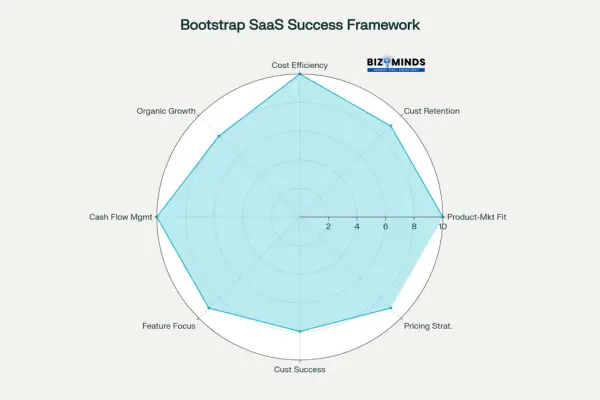
Successful bootstrapped SaaS startup excel in cost efficiency, cash flow management, and product-market fit while maintaining strong customer retention and focused feature development
Effective resource allocation strategies include:
- 70-20-10 Rule: 70% of resources on proven growth channels, 20% on improving existing channels, 10% on experimental initiatives
- Cohort-Based Budgeting: Allocating marketing spend based on historical customer lifetime values by acquisition channel
- Milestone-Based Hiring: Adding team members only after achieving specific revenue or growth milestones
- Technology Investment: Prioritizing tools and systems that provide measurable efficiency gains
The key insight for bootstrapped companies is that sustainable growth requires consistent profitability. Unlike VC-backed companies that can sustain losses for years, bootstrap companies must generate positive cash flow to fund continued expansion. This constraint often leads to more innovative and efficient growth strategies.
SaaS Startup Technology and Operational Excellence
Building Scalable Infrastructure
Successful bootstrapped SaaS startup companies must build technology infrastructure that can scale efficiently without requiring significant capital investment. This challenge demands careful architectural decisions from the earliest stages of development, as rebuilding systems later becomes prohibitively expensive for resource-constrained companies.
Modern cloud infrastructure provides bootstrapped companies with unprecedented advantages. Amazon Web Services, Google Cloud Platform, and Microsoft Azure offer pay-as-you-grow pricing models that align costs with usage, eliminating large upfront infrastructure investments. Many successful SaaS startup companies start with minimal infrastructure costs—often under $500 monthly—while serving thousands of users.
Key technology decisions for bootstrapped SaaS startup companies include:
- Cloud-Native Architecture: Designing applications specifically for cloud deployment and scaling
- Microservices Design: Building modular systems that can be scaled independently
- Automated Testing: Implementing comprehensive testing to reduce manual QA requirements
- Performance monitoring provides real-time insights into system functionality and enhances the user experience
- Security-First Development: Building security into the architecture rather than adding it later
The most successful SaaS startup companies choose proven technology stacks rather than cutting-edge solutions. PHP, Ruby, Python, and JavaScript frameworks provide mature ecosystems with extensive documentation and community support. Adopting this prudent approach lowers development risks and shortens the time required to launch to market.
Automation Tools for SaaS Startup Efficiency
Automation becomes critical for bootstrapped companies because human resources are limited and expensive. The most successful companies identify repetitive processes early and implement automation solutions that scale without requiring additional personnel.
Critical automation areas include:
- Customer Onboarding: Automated welcome sequences, tutorial delivery, and initial setup guidance
- Customer Support: Chatbots, knowledge bases, and ticket routing systems that handle common inquiries
- Marketing Workflows: Email sequences, social media posting, and lead nurturing campaigns
- Financial operations encompass billing, invoice creation, payment handling, and managing subscriptions efficiently
- Development Operations: Code deployment, testing, monitoring, and backup systems
Tools like Zapier, which connects over 1,000 applications, enable bootstrapped companies to create sophisticated workflows without custom development. HubSpot provides comprehensive marketing, sales, and customer service automation in a single platform. These solutions allow small teams to operate with the efficiency of much larger organizations.
Embracing Remote-First Operations in SaaS Startups
The most successful bootstrapped SaaS startup companies often embrace remote-first operations from inception, reducing overhead costs while accessing global talent pools. SaaS startup Companies like Basecamp, Buffer, and Zapier have demonstrated that distributed teams can be more productive and cost-effective than traditional office-based organizations.
Remote-first operations provide several advantages for bootstrapped companies:
- Reduced Overhead: Eliminating office rent, utilities, and physical infrastructure costs
- Global Talent Access: Hiring the best people regardless of geographic location
- Improved Work-Life Balance: Higher employee satisfaction and reduced turnover
- Flexible Scaling: Adding team members without physical space constraints
- Disaster Resilience: Business continuity during disruptions or market changes
Successful remote operations require investment in communication tools, project management systems, and company culture development. However, the cost savings and talent advantages typically outweigh these investments, especially for companies with limited capital.
SaaS Startup Market Positioning and Competitive Strategy
Dominating Niche Markets as a SaaS Startup
Bootstrapped SaaS startup companies often achieve success by dominating specific market niches rather than competing in broad, highly contested categories. This focused approach allows resource-constrained companies to become the definitive solution for particular customer segments or use cases.
Niche domination strategies include:
- Vertical Market Focus: Specializing in specific industries like healthcare, legal, or manufacturing
- Functional Specialization: Becoming the best solution for particular business functions or workflows
- Geographic Concentration: Focusing on specific regions, countries, or language markets
- Customer Size Targeting: Optimizing for enterprises, mid-market, or small business segments
- Technology Integration: Building deep integrations with popular platforms or ecosystems
BambooHR exemplifies successful niche domination by focusing exclusively on human resources software for small and medium businesses. Rather than competing with enterprise HR platforms, they built a solution specifically designed for companies with 100-500 employees. This focus enabled them to achieve over $200 million in ARR without external funding.
The key insight is that becoming the #1 solution in a $100 million market is often more profitable and sustainable than being #10 in a $10 billion market. Niche leaders command premium pricing, enjoy stronger customer relationships, and face less competitive pressure.
Differentiation through Service in SaaS Startups
Without large marketing budgets, bootstrapped SaaS Startup companies must differentiate through exceptional customer experience rather than brand awareness. This service excellence becomes a sustainable competitive advantage because it’s difficult for larger, more bureaucratic competitors to replicate.
Service excellence strategies include:
- Rapid Response Times: Answering support inquiries within hours rather than days
- Personal Relationships: Founders and senior team members maintaining direct customer contact
- Proactive Communication: Regular updates, feature announcements, and industry insights
- Educational Content: Providing valuable resources beyond the core product offering
- Customization and Flexibility: Adapting the product to meet specific customer needs
Order Desk built a seven-figure SaaS business with zero advertising spend by focusing entirely on customer service excellence. Founder David Hollander explains: “We’ve built thousands of happy customers through partnerships and referrals alone. When you truly solve customer problems, they become your best marketing channel”.
Strategic Partnerships and Ecosystem Development
Companies with limited resources need to utilize strategic partnerships to broaden their reach and enhance their capabilities. The most successful bootstrapped SaaS startup companies develop strategic alliances that provide mutual benefit while expanding market access.
Effective partnership strategies include:
- Integration Partnerships: Connecting with popular platforms to reach existing user bases
- Reseller Networks: Enabling other companies to sell your solution to their customers
- Technology Alliances: Collaborating with complementary service providers
- Content Partnerships: Co-creating valuable resources with non-competing companies
- Industry Associations: Participating in professional organizations and trade groups
Zapier built their business primarily through integration partnerships, connecting thousands of applications and becoming essential infrastructure for many businesses. This ecosystem approach created network effects that drove organic growth without traditional marketing investments.
SaaS Startup Case Studies: American Bootstrapped Success
Basecamp: The Iconic SaaS Startup Bootstrap Story
Basecamp’s journey from a small Chicago web design firm to a $280 million revenue software company represents the quintessential American bootstrap success story. Founded in 1999 by Jason Fried and David Heinemeier Hansson, the company demonstrates how consistent focus on customer needs and operational discipline can drive extraordinary growth without external funding.
The company’s growth trajectory reveals the power of compound returns in bootstrapped businesses:
- 2012: $43.7 million revenue
- 2016: $141.5 million revenue
- 2020: $215.6 million revenue
- 2024: $280 million revenue
This represents an average annual growth rate of approximately 16% over 12 years, achieved entirely through reinvested profits and organic customer acquisition. With only 171 employees generating $280 million in revenue, Basecamp achieves productivity levels of $1.6 million per employee—far exceeding industry averages.
Basecamp’s success stems from several key decisions of SaaS Startup:
- Product Simplicity: Focusing on essential project management features rather than comprehensive suites
- Pricing Discipline: Maintaining premium pricing that reflects value rather than competing on cost
- Company Culture: Prioritizing employee satisfaction and work-life balance over rapid growth
- Customer Focus: Making decisions based on customer feedback rather than investor pressure
- Operational Efficiency: Maintaining lean operations while scaling revenue significantly
The company’s approach challenges conventional startup wisdom by proving that steady, profitable growth often creates more value than venture-funded hypergrowth.
JotForm: SaaS Startup Unicorn Without Funding
JotForm represents one of America’s most impressive bootstrap unicorn success storiesFounded by Aytekin Tank, the company has achieved steady 50% yearly growth while developing a form-building platform trusted by millions of organizations globally.
The company’s unique organizational structure reflects bootstrap values: small cross-functional teams of no more than six people working on specific product areas. This structure maintains startup agility while scaling to enterprise levels, enabling rapid innovation and customer responsiveness.
Key success factors for JotForm include:
- Technical Excellence: Building a robust, reliable platform that handles millions of form submissions
- Customer-Centric Development: Continuous feature development based on user feedback and requests
- Global Reach: Serving customers in over 190 countries through localized product offerings
- Freemium Strategy: Providing substantial free functionality that converts to paid plans
- Bootstrap Mindset: Emphasizing profitability and steady, sustainable growth at every stage of the business journey
The company’s ability to reach unicorn status ($1 billion valuation) without external funding demonstrates the potential of disciplined bootstrap strategies in large addressable markets.
BambooHR: SaaS Startup in the SMB HR Market
Utah-based BambooHR has become America’s leading human resources software provider for small and medium businesses, achieving over $200 million in ARR through bootstrap funding alone. The company exemplifies successful niche market domination by focusing exclusively on the underserved SMB HR market.
Founded in 2008, BambooHR identified that existing HR software was designed for enterprise customers, creating an opportunity to serve smaller organizations with simpler, more affordable solutions. This market focus enabled the company to build deep domain expertise and strong customer relationships.
BambooHR’s growth strategy for SaaS Startup includes:
- Market Focus: Exclusively serving companies with 100-500 employees
- Product Integration: Comprehensive HR suite covering recruiting, onboarding, performance, and benefits
- Customer Success: High-touch support and implementation services
- Content Marketing: Educational resources that establish thought leadership
- Partner Channel: Network comprising HR advisors and expert implementation professionals
The company’s success demonstrates how bootstrap companies can achieve significant scale by becoming the definitive solution for specific customer segments rather than competing in broader markets.
Order Desk: The Profitable Automation Platform
David Hollander’s Order Desk represents the archetypal American bootstrap success story: identifying a specific customer problem, building an elegant solution, and scaling to seven-figure revenues through customer satisfaction and word-of-mouth referrals.
Starting as a freelance developer in 2011, Hollander built Order Desk to solve order management challenges for his ecommerce clients. The solution resonated with thousands of merchants who needed to automate their fulfillment workflows, creating a sustainable business that now serves customers globally.
Order Desk’s growth principles include:
- Problem-First Approach: Building solutions for real customer problems rather than theoretical markets
- Partnership Strategy: Growing through integrations and referral relationships rather than advertising
- Operational Excellence: Focusing on product reliability and customer service quality
- Team Culture: Building a remote-first organization with competitive compensation globally
- Financial Discipline: Maintaining profitability while reinvesting in product development and team growth
The company’s journey from freelance project to seven-figure SaaS business demonstrates how individual entrepreneurs can build significant technology companies through disciplined execution and customer focus.
Growth Hacking Techniques for Resource-Constrained Companies
Content-Driven Customer Acquisition
Bootstrapped SaaS startup companies must master content marketing because it provides sustainable, cost-effective customer acquisition that compounds over time. Unlike paid advertising that requires ongoing investment, high-quality content continues generating leads months or years after creation.
Successful content strategies for bootstrap companies focus on solving real customer problems rather than promoting products. This approach builds trust and establishes thought leadership while naturally introducing potential customers to company solutions.
Effective content marketing tactics include:
- Educational Blog Posts: In-depth articles addressing common industry challenges and solutions
- Video Tutorials: Step-by-step guidance for complex processes or workflows
- Industry Research: Original data and insights that generate media coverage and backlinks
- Template Libraries: Practical resources that provide immediate value to potential customers
- Case Studies: Detailed success stories that demonstrate product value and ROI
Ahrefs, a bootstrapped SEO tool company, built a $100 million business primarily through content marketing. Their blog generates over 4 million monthly visitors by providing valuable SEO insights and tutorials, creating a massive top-of-funnel that converts to paid subscriptions.
Strategic Social Media and Community Building
Social media provides bootstrapped SaaS startup companies with unprecedented access to potential customers and industry influencers. The key is focusing on platforms where target customers actively engage rather than trying to maintain presence everywhere.
LinkedIn has become particularly valuable for B2B SaaS startup companies because it enables precise targeting of decision-makers and industry professionals. Effective LinkedIn strategies include:
- Executive Thought Leadership: Founders sharing industry insights and company lessons learned
- Employee Advocacy: Team members sharing company content and achievements
- Industry Group Participation: Contributing valuable insights to relevant professional discussions
- Connection-Based Outreach: Building relationships rather than making immediate sales pitches
- Content Syndication: Sharing blog posts, whitepapers, and case studies with professional networks
The most successful bootstrap companies treat social media as relationship-building rather than broadcasting, creating authentic connections that translate into business opportunities over time.
Referral Programs and Customer Advocacy
Word-of-mouth referrals represent the most cost-effective customer acquisition channel for bootstrapped companies. Satisfied customers become unpaid sales representatives who provide warm introductions to potential accounts.
Effective referral program design includes:
- Clear Value Proposition: Simple explanation of benefits for both referrer and referee
- Easy Participation: Minimal friction for customers to make referrals and track progress
- Meaningful Rewards: Incentives that motivate action without attracting unqualified referrals
- Follow-Up Systems: Automated tracking and acknowledgment of successful referrals
- Social Proof Integration: Showcasing successful referrals to encourage continued participation
Dropbox famously grew from 100,000 to 4 million users in 15 months primarily through referral programs that provided additional storage space for successful referrals. This viral growth mechanism enabled massive scale without proportional marketing investment.
Partnership-Driven Distribution
Strategic partnerships provide bootstrapped SaaS startup companies with access to established customer bases and distribution channels. The most successful partnerships create mutual value rather than one-sided benefit arrangements.
Partnership categories include:
- Integration Partners: Software companies with complementary solutions
- Reseller Networks: Service providers who can recommend and implement solutions
- Industry Consultants: Professionals who influence technology decisions
- Platform Marketplaces: App stores and solution directories with built-in traffic
- Content Collaborations: Joint webinars, whitepapers, and educational resources
Zapier built their entire business model around partnerships, creating connections between thousands of applications. This ecosystem approach made them indispensable to many businesses while generating massive organic growth through partner referrals.
The 300% Growth Formula: Putting It All Together
Phase 1: Foundation and Product-Market Fit (Months 1-12)
Achieving 300% revenue growth begins with establishing a solid foundation built on genuine product-market fit. This phase focuses on understanding customer needs, building core product functionality, and establishing sustainable unit economics.
Foundation activities include:
- Customer Discovery: Conducting 50+ customer interviews to understand pain points and willingness to pay
- Minimum Viable Product: Building core functionality that solves the most critical customer problems
- Initial Pricing Strategy: Testing different pricing models to optimize for both acquisition and lifetime value
- Early Customer Success: Ensuring first customers achieve significant value and become referenceable advocates
- Basic Infrastructure: Implementing reliable systems for billing, support, and product analytics
Success metrics for Phase 1:
- Product-market fit score >40% (customers would be “very disappointed” if product disappeared)
- Monthly churn rate <5%
- Customer acquisition cost payback period <12 months
- Net Promoter Score >50
- At least $10,000 monthly recurring revenue
Phase 2: Growth Engine Development (Months 13-24)
Phase 2 focuses on building repeatable, scalable growth processes that can drive consistent customer acquisition without proportional increases in expense. This phase emphasizes organic growth channels and operational efficiency.
Growth engine components include:
- Content Marketing System: Publishing valuable content that generates qualified leads consistently
- Product-Led Growth Features: Self-service onboarding, viral mechanics, and expansion revenue drivers
- Customer Success Programs: Proactive retention and expansion processes that maximize lifetime value
- Referral and Partnership Programs: Systems that leverage satisfied customers and strategic partners for growth
- Marketing Automation: Workflows that nurture leads and guide customers through conversion processes
Success metrics for Phase 2:
- 25%+ monthly revenue growth rate
- Customer acquisition cost <$500 for SMB, <$5,000 for enterprise
- Net revenue retention >110%
- Organic traffic growth >50% annually
- Partnership-driven revenue >20% of total
Phase 3: Scale and Optimization (Months 25-36)
Phase 3 concentrates on scaling successful growth channels while optimizing operations for efficiency. This phase often drives the dramatic revenue growth that characterizes 300% annual increases.
Scaling activities include:
- Channel Optimization: Doubling down on most effective customer acquisition channels while eliminating underperformers
- Team Building: Adding specialists in areas like customer success, content marketing, and product development
- Product Expansion: Introducing complementary features or products that increase customer lifetime value
- Market Expansion: Entering adjacent customer segments or geographic markets with proven product-market fit
- Automation Implementation: Streamlining operations to maintain service quality while scaling volume
Success metrics for Phase 3:
- 300%+ annual revenue growth
- Rule of 40 compliance (growth rate + profit margin ≥ 40%)
- Customer lifetime value >3x customer acquisition cost
- Market leadership in chosen niche
- Team productivity >$500,000 revenue per employee
Critical Success Factors
Several factors consistently differentiate companies that achieve 300% bootstrap growth from those that plateau at modest levels:
Financial Discipline: Maintaining detailed unit economics tracking and cash flow management throughout the growth journey. Companies that lose financial discipline often scale unprofitably and run out of cash during market downturns.
Customer Obsession: Making decisions based on customer value rather than competitor actions or industry trends. The most successful companies develop deep customer relationships that translate into predictable revenue growth.
Product Excellence: Continuously improving product functionality, reliability, and user experience. Bootstrap companies cannot overcome product deficiencies through marketing spend, so product quality becomes paramount.
Team Development: Fostering a culture centered on ownership, responsibility, and ongoing learning. Small teams must be exceptionally productive and aligned around common goals.
Market Timing: Entering markets with strong growth trends and favorable competitive dynamics. Even excellent execution cannot overcome poor market timing.
Measuring Success: Key Metrics and Benchmarks
Financial Performance Indicators
Bootstrapped SaaS startup companies must track different metrics than their VC-backed counterparts because they prioritize sustainable growth over rapid expansion. The most critical financial metrics focus on efficiency, profitability, and cash generation rather than gross revenue or user counts.
Essential financial metrics include:
Annual Recurring Revenue (ARR) Growth: Target 50-100% annual growth during early stages, stabilizing at 30-50% as the company matures. Basecamp maintained consistent growth for over a decade, demonstrating the sustainability of disciplined approaches.
Customer Acquisition Cost (CAC): Bootstrap companies should achieve CAC payback periods of 6-12 months, compared to 12-18 months for VC-backed companies. Shorter payback periods allow for quicker reinvestment of cash flow into business growth strategies.
Customer Lifetime Value (CLV): Target CLV:CAC ratios of 5:1 or higher for bootstrap companies, indicating strong unit economics and pricing power. Higher ratios provide cushion for market downturns and competitive pressure.
Net Revenue Retention (NRR): Bootstrap companies should achieve NRR rates above 110%, indicating successful account expansion and strong customer satisfaction. The best companies achieve NRR above 120%.
Gross Margin: SaaS companies should maintain gross margins above 80%, with best-in-class companies exceeding 90%. High margins provide flexibility for growth investments and market changes.
Operational Performance Metrics
Beyond financial metrics, operational indicators provide insight into business health and growth sustainability. These metrics help identify potential problems before they impact revenue or customer satisfaction.
Critical operational metrics include:
- Monthly Churn Rate: Target churn rates below 3% monthly for SMB customers, below 1% for enterprise accounts
- Time to First Value tracks the speed at which new customers realize significant benefits from the product
- Product Adoption Rate: Track percentage of users utilizing core product features within first 30 days
- Support Ticket Volume: Monitor support requests per customer as leading indicator of product quality
- Employee Productivity: Revenue per employee should exceed $200,000 annually for efficient operations
Competitive Benchmarking
Understanding industry benchmarks helps bootstrap companies assess performance relative to peers and identify improvement opportunities. However, bootstrap companies should focus on sustainable metrics rather than vanity metrics that don’t correlate with long-term success.
Industry benchmarks for bootstrapped SaaS companies:
- Median ARR growth: 20% for companies with $3M-20M ARR
- Top quartile growth: 51% for same cohort
- Customer acquisition cost ranges from $0.28 to $0.94 for every dollar gained in new annual recurring revenue (ARR)
- Revenue per employee: $150,000-300,000 depending on market segment
- Marketing spend: 7-10% of revenue for organic growth strategies
The key insight is that bootstrap companies often outperform VC-backed companies on efficiency metrics while achieving lower absolute growth rates. This trade-off typically results in better long-term outcomes and higher founder satisfaction.
Conclusion: The Bootstrap Path to Sustainable Success
The evidence is clear: bootstrapped SaaS startup companies can achieve extraordinary growth without venture capital funding. From Basecamp’s journey to $280 million in revenue to JotForm’s unicorn status with 50% annual growth rates, American entrepreneurs continue demonstrating that strategic bootstrapping often produces superior long-term outcomes compared to traditional funding approaches.
Sustaining 300% revenue growth requires a focused approach combining product-led tactics to reduce acquisition expenses, maximizing customer lifetime value, operational scalability, and maintaining profitability through strong financial controls. While this path demands greater resourcefulness and patience than VC-backed alternatives, it offers founders complete control over their company’s destiny and often results in more sustainable, profitable businesses.
The global SaaS market’s projected growth to $790 billion by 2030 creates unprecedented opportunities for bootstrap entrepreneurs willing to focus on efficiency over speed, customer value over investor metrics, and sustainable growth over hockey-stick trajectories. As customer acquisition costs continue rising and market competition intensifies, the bootstrap advantage—built on financial discipline, customer intimacy, and operational efficiency—becomes increasingly valuable.
Aspiring SaaS founders choosing the bootstrap route can be optimistic: with the right strategy, disciplined implementation, and a strong focus on customer value, hitting 300% revenue growth without external investment is increasingly attainable. The question isn’t whether bootstrap companies can compete with funded alternatives, but whether funded companies can match the efficiency, focus, and customer dedication that characterize successful bootstrap ventures.
Frequently Asked Questions
1. How long does it typically take for a bootstrapped SaaS startup to reach 300% revenue growth?
Most successful bootstrapped SaaS startup companies achieve 300% annual revenue growth within 24-36 months of launch, though this varies significantly based on market conditions, founder experience, and product-market fit quality. Companies like JotForm maintained 50% annual growth for multiple years, while others like Order Desk achieved seven-figure revenues within five years. The key is establishing strong unit economics early and maintaining consistent growth rather than pursuing unsustainable hockey-stick trajectories.
2. What are the biggest challenges bootstrapped SaaS companies face when trying to scale rapidly?
The primary challenges include limited capital for customer acquisition, inability to hire specialists quickly, and pressure to maintain profitability during growth phases. Unlike VC-backed companies that can sustain losses for years, bootstrap companies must maintain positive cash flow while investing in growth. However, these constraints often lead to more innovative solutions and stronger unit economics that provide competitive advantages long-term.
3. How do bootstrapped SaaS companies compete against well-funded competitors?
Bootstrap companies succeed by focusing on specific market niches, delivering superior customer service, and building more intimate customer relationships. They often win through product excellence, faster decision-making, and pricing strategies that reflect their efficient cost structures. Many customers prefer working with bootstrap companies because they offer more personalized attention and aren’t subject to investor pressure that might change product direction suddenly.
4. What percentage of SaaS unicorns started as bootstrapped companies?
Research indicates that approximately 7% of leading SaaS companies in the Forbes Cloud 100 list started as bootstrapped ventures, including notable examples like Mailchimp, Atlassian, and Zoho. However, many more companies achieve significant success without reaching unicorn valuations, often providing better returns for founders who retain full ownership compared to diluted equity in highly valued companies.
5. How important is product-led growth for bootstrapped SaaS success?
Product-led growth is essential for bootstrap success because it enables customer acquisition without large sales and marketing teams. Approximately 91% of SaaS companies with over $50 million ARR have adopted PLG strategies, and this percentage is even higher among bootstrapped companies. PLG aligns perfectly with resource constraints by using the product itself as the primary growth driver.
6. What are the optimal pricing strategies for bootstrapped SaaS companies?
Successful bootstrap companies often price higher than funded competitors because they must achieve profitability quickly. Value-based pricing, annual payment incentives, and tiered pricing models work particularly well. The key is aligning pricing with customer outcomes rather than feature comparisons, enabling premium positioning that supports healthy unit economics.
7. How do bootstrapped companies handle customer acquisition cost increases?
Bootstrap companies combat rising CAC through diversified acquisition channels, improved conversion optimization, and increased focus on customer lifetime value. They invest heavily in content marketing, referral programs, and partnership development to create sustainable organic growth channels that aren’t subject to the same cost inflation as paid advertising.
8. What role does company culture play in bootstrap success?
Company culture becomes crucial for bootstrap companies because they must attract and retain exceptional talent without offering equity upside or high salaries typical at funded startups. Successful companies create cultures emphasizing ownership, flexibility, learning opportunities, and meaningful work that appeals to employees who value more than just financial compensation.
9. How do bootstrapped SaaS companies fund international expansion?
International expansion for bootstrap companies typically happens organically through customer demand rather than proactive market development. Companies often start by serving international customers through existing channels, then gradually add localized features, support, and marketing. This demand-driven approach reduces risk and capital requirements compared to aggressive international expansion strategies.
10. What are the most effective growth hacking techniques for resource-constrained SaaS companies?
The most effective techniques include content marketing that builds thought leadership, referral programs that leverage satisfied customers, strategic partnerships that provide distribution channels, and product-led growth features that enable viral expansion. Social media engagement, community building, and educational webinars also provide high-impact, low-cost growth opportunities for companies with limited marketing budgets.
11. How do bootstrapped companies maintain growth momentum during economic downturns?
Bootstrap companies often perform better during economic downturns because their efficient cost structures and focus on profitability provide resilience. They maintain growth by doubling down on customer success to reduce churn, focusing on essential use cases that customers can’t eliminate, and potentially gaining market share from funded competitors that struggle with cash flow during difficult periods.
12. What metrics should bootstrapped SaaS founders track daily?
Daily metrics should include cash flow, new customer acquisitions, monthly recurring revenue, customer churn, and key product usage indicators. Weekly metrics might include conversion rates, customer acquisition costs, and support ticket trends. The key is focusing on metrics that directly impact business sustainability rather than vanity metrics that don’t correlate with long-term success.
Citations
- https://chartmogul.com/reports/saas-growth-vc-bootstrapped/
- https://getlatka.com/companies/basecamp
- https://getlatka.com/companies/mailchimp
- https://guptadeepak.com/bootstrapping-growth-how-b2b-saas-startups-can-thrive-on-a-shoestring-budget/
- https://www.finoit.com/articles/bootstrapping-saas-startup/
- https://www.mckinsey.com/industries/technology-media-and-telecommunications/our-insights/saas-and-the-rule-of-40-keys-to-the-critical-value-creation-metric
- https://joinhampton.com/blog/david-hollander-order-desk
- https://electroiq.com/stats/basecamp-statistics/
- https://capstonecfo.com/blog/benchmarked-cost-structure-for-a-bootstrapped-vc-backed-saas-company
- https://www.kovai.co/blog/product-led-growth-dominating-saas-in-2025/
- https://userpilot.com/blog/product-led-growth-playbook/
- https://www.smartlook.com/blog/product-led-growth/
- https://www.saastock.com/blog/how-aytekin-tank-ceo-of-jotform-bootstrapped-a-unicorn-saas-with-teams-of-no-more-than-six-people/
- https://aimers.io/blog/the-best-saas-growth-hacking-tips-for-2025
- https://www.getsmartcue.com/blog/saas-growth-hacking
- https://productled.com/blog/product-led-growth-definition
- https://www.flinder.co/insights/successful-bootstrapping-in-saas-case-studies-and-lessons
- https://www.forcemanagement.com/blog/the-top-20-percent-lessons-for-leaders-on-scaling-b2b-saas-mckinsey-research
- https://www.saas-capital.com/blog-posts/benchmarking-metrics-for-bootstrapped-saas-companies/
- https://www.postdigitalist.xyz/blog/customer-acquisition-cost
- https://saas.group/blog/the-most-important-metric-for-bootstrapped-founders-to-track/
- https://www.cfoconnect.eu/en/resources/finance-insights/ideal-saas-dashboard-key-metrics/
- https://www.lightercapital.com/blog/how-to-calculate-customer-acquisition-cost-cac
- https://www.mckinsey.com/featured-insights/mckinsey-explainers/what-is-saas
- https://www.valuecoders.com/blog/software-engineering/saas-startup-tips-for-bootstrapping-and-scaling/
- https://www.setproduct.com/blog/launching-saas-with-zero-investments
- https://www.cobloom.com/blog/saas-growth-hacking-strategies
- https://ghl-services-playbooks-automation-crm-marketing.ghost.io/zero-to-saas-agency-the-complete-startup-blueprint/
- https://revenuezen.com/b2b-saas-growth-hacks/
- https://www.saastr.com/are-there-any-examples-of-a-unicorn-startup-that-was-bootstrapped/
- https://vizologi.com/basecamp-business-model-how-basecamp-works-makes-money/
- https://ahrefs.com/blog/top-bootstrapped-saas-companies/
- https://www.linkedin.com/pulse/ultimate-growth-hacking-playbook-saas-companies-guide-smit-makwana-hafsf
- https://devsquad.com/blog/bootstrapped-saas
- https://www.mckinsey.com/capabilities/people-and-organizational-performance/our-insights/from-start-up-to-centaur-leadership-lessons-on-scaling
- https://www.drivetrain.ai/post/obscuring-the-true-cost-of-customer-acquisition
- https://entrackr.com/2024/01/velocity-launches-300-cr-growth-capital-fund-for-b2b-saas-startups/
- https://devsquad.com/blog/startup-case-studies
- https://saasclub.io/podcast/rob-walling-drip/
- https://www.trustshoring.com/blog/bootstrapping-a-saas-the-strategies-every-founder-can-learn/
- https://www.saastr.com/the-top-bootstrapped-saas-companies-ever/
- https://www.eleken.co/blog-posts/average-saas-growth-rate-brief-guide-for-startups
- https://www.linkedin.com/pulse/bootstrapped-success-stories-startups-thrived-without-kanwal-zaidi
- https://www.yesoptimist.com/saas-seo-case-study/
- https://www.omnius.so/blog/leading-us-saas-startups
- https://www.startmotionmedia.com/bootstrapped-saas-startups-success-stories/
- https://www.smartwriter.ai/saas-growth-case-studies
- https://explodingtopics.com/blog/b2b-saas-startups
- https://www.reddit.com/r/SaaS/comments/vu5bf9/our_bootstrapped_saas_just_turned_3_and_reached/
- https://www.linkedin.com/pulse/zero-funded-create-winning-pitch-deck-b2b-saas-arun-prasath-r-1s8tc
- https://www.recurclub.com/blog/b2b-saas-startup-funding-trends-guide
- https://www.sramanamitra.com/2023/12/14/best-of-bootstrapping-bootstrapped-a-saas-company-from-finland/
- https://payproglobal.com/answers/what-is-saas-venture-capital-vc/
- https://www.ijfmr.com/papers/2025/4/40464.pdf
- https://chartmogul.com/reports/saas-growth-vc-bootstrapped/saas-growth-vc-bootstrapped-2024.pdf
- https://openviewpartners.com/blog/6-lessons-i-learned-growing-a-self-funded-saas-company/
- https://devsdata.com/bootstrapped-saas-strategy-to-start-and-scale/
- https://asperbrothers.com/blog/bootstrapping-startup/
- https://www.imensosoftware.com/blog/how-to-bootstrap-a-saas-startup-in-2025-a-detailed-guide/
- https://www.weareuncapped.com/eu/blog/the-rule-of-40-a-first-time-founders-guide
- https://www.cobloom.com/blog/startup-funding
- https://www.cloudzero.com/blog/rule-of-40/
- https://www.eleken.co/blog-posts/how-to-launch-a-saas-business
- https://www.reddit.com/r/SaaS/comments/1enz133/my_personal_guide_growing_a_bootstrap_b2b_startup/
- https://www.feinternational.com/blog/saas-metrics-value-saas-business
- https://mailchimp.com/newsroom/2024-holiday-season-trends/
- https://www.howtheygrow.co/p/how-atlassian-grows
- https://www.youtube.com/watch?v=fe5Xp57pYaE
- https://www.analysysmason.com/contentassets/d2ca6ccff2d44846a8437057ec39333f/analysys_mason_intuit_mailchimp_purchase_oct2021.pdf
- https://www.thesoftwarereport.com/how-atlassians-co-founders-bootstrapped-for-nearly-a-decade-and-built-a-8-billion-company/
- https://usesignhouse.com/blog/basecamp-stats/
- https://investors.intuit.com/news-events/press-releases/detail/1221/new-report-from-intuit-mailchimp-shows-most-marketers-are-using-ai-highlights-differentiators-for-top-performers
- https://changeleadersplaybook.com/p/the-bootstrap-guide-to-market-dominance
- https://growjo.com/company/Startup_Basecamp
- https://www.youtube.com/watch?v=so-8GxtvFGA
- https://www.forbes.com/sites/karenwalker/2023/06/23/product-led-growth-the-atlassian-way-to-28b-and-counting/
- https://growjo.com/company/Basecamp
- https://mailchimp.com/resources/the-revenue-blueprint/
- https://getlatka.com/blog/atlassian-revenue/
- https://basecamp.com/pricing/
- https://mailchimp.com/resources/calculate-revenue-growth-rate/
- https://hbr.org/sponsored/2022/10/how-software-as-a-service-is-accelerating-digital-transformation
- https://www.sciencedirect.com/science/article/abs/pii/S0167923613001619
- https://hbr.org/2023/04/the-rebirth-of-software-as-a-service
- https://www.mckinsey.com/capabilities/mckinsey-digital/our-insights/the-saas-factor-six-ways-to-drive-growth-by-building-new-saas-businesses
- https://onlinelibrary.wiley.com/doi/10.1155/2017/2536040
- https://www.bu.edu/questrom/blog/hbr-are-you-missing-growth-opportunities-for-your-platform/
- https://journals.sagepub.com/doi/10.1177/0748175616639106
- https://hbr.org/1983/05/the-five-stages-of-small-business-growth
- https://www.casebasix.com/pages/10-benefits-startups-get-by-hiring-an-ex-mckinsey-consultant
- https://www.diva-portal.org/smash/get/diva2:1697563/FULLTEXT01.pdf
- https://hbr.org/2013/05/why-the-lean-start-up-changes-everything
- https://online.hbs.edu/blog/post/go-to-market-strategy-framework
- https://www.hbsp.harvard.edu/product/H08ERV-PDF-ENG
- https://www.mckinsey.com/industries/technology-media-and-telecommunications/how-we-help-clients/startups-venture-capital
- https://hbr.org/2017/09/scaling-customer-service-as-your-startup-grows
- https://www.leadfeeder.com/blog/growth-hacking-trends/
- https://www.productled.org/foundations/what-is-product-led-growth
- https://www.mindbowser.com/saas-growth-hacking-strategies-that-arent-going-anywhere-in-10-years/
- https://www.paddle.com/resources/product-led-growth-for-saas
- https://productschool.com/blog/product-strategy/product-led-growth-strategy
- https://rocketdevs.com/blog/best-successful-bootstrapped-startups
- https://growfusely.com/blog/us-vc-firms-for-saas/
- https://www.ecaplabs.com/blogs/saas-funding
- https://www.sramanamitra.com/2024/04/09/best-of-bootstrapping-bootstrapped-a-saas-business-with-a-paycheck-and-scaled/
- https://www.sramanamitra.com/2023/05/19/best-of-bootstrapping-bootstrapped-a-unicorn-first-using-services-from-utah/
- https://www.ycombinator.com/companies/industry/saas
- https://growfusely.com/blog/success-lessons-from-saas-startups/
- https://explodingtopics.com/blog/saas-startups
- https://www.cloudzero.com/blog/top-saas-companies/
- https://www.sramanamitra.com/2023/10/24/best-of-bootstrapping-bootstrapped-unicorn-startups/
- https://fortune.com/2024/08/05/how-we-built-bootstrapped-startup-different-sold-it-for-40m-ignored-entrepreneur-myths/
- https://www.softwaresuggest.com/blog/saas-companies-got-funded/
- https://en.wikipedia.org/wiki/List_of_unicorn_startup_companies
- https://www.linkedin.com/pulse/bootstrapping-success-stories-almost-without-raising-funds-piti%C3%A9-kafjf
- https://clockwise.software/blog/top-ten-fast-growing-saas-startups-to-follow/