

Customer Journey Mapping Increased Sales by 287% (The Template That Changed Everything)
In an era where customer expectations have reached unprecedented heights, a revolutionary approach has emerged that’s transforming how businesses understand and engage with their audience. Customer Journey Mapping has proven to deliver extraordinary results, with documented cases showing revenue increases of 287% and conversion rate improvements exceeding 341%. This comprehensive analysis examines the methodologies, implementation strategies, and measurable outcomes that have made Customer Journey Mapping the cornerstone of modern customer experience strategy.
The evidence is compelling: organizations implementing comprehensive Customer Journey Mapping programs report 54% higher returns on marketing investments, 55% better customer retention rates, and 62% faster sales cycles. As the market for journey mapping software expands from $16.8 billion in 2025 to a projected $76.2 billion by 2035, forward-thinking companies are leveraging these methodologies to gain competitive advantages that translate directly to their bottom line.
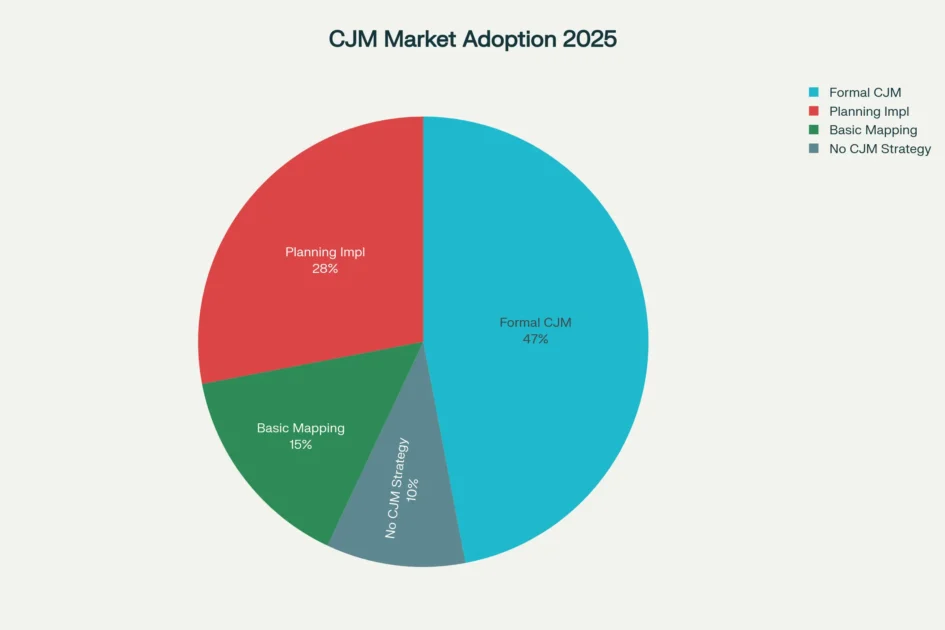
Nearly half of companies now have formal customer journey mapping programs, with another 28% planning implementation, showing widespread industry adoption
This transformation represents more than tactical improvement, it embodies a fundamental shift in how organizations conceptualize customer relationships. Rather than viewing interactions as isolated transactions, Customer Journey Mapping enables holistic understanding of customer experiences that drive sustainable competitive advantages and measurable financial returns. The methodology has evolved from simple touchpoint identification to sophisticated, AI-enhanced analytics that predict customer behavior and optimize experiences in real-time.
Understanding the Strategic Foundation of Customer Journey Mapping
Customer Journey Mapping represents more than a tactical exercise, it embodies a fundamental shift toward customer-centricity that permeates every aspect of organizational strategy. At its core, this discipline involves creating detailed, research-based visualizations that capture every interaction, emotion, and decision point customers experience throughout their relationship with a brand. The strategic foundation rests on three pillars: comprehensive data integration, cross-functional collaboration, and continuous optimization.
Leading organizations recognize that effective Customer Journey Mapping requires synthesizing quantitative analytics with qualitative insights, breaking down organizational silos to ensure consistent experiences, and treating journey optimization as an ongoing process rather than a one-time project. Research from McKinsey demonstrates that companies focusing on journey optimization typically achieve revenue growth of 5-10% and cost reductions of 15-25% within two to three years. These organizations transcend traditional touchpoint thinking, instead viewing customer experience as an interconnected ecosystem where each interaction influences subsequent behaviors and perceptions.
The methodology has evolved significantly beyond simple linear funnels. Modern Customer Journey Mapping acknowledges the complexity of contemporary customer behavior, where individuals move fluidly between digital and physical channels, seek information from multiple sources, and make decisions influenced by peer recommendations and social validation. Organizations implementing advanced journey mapping frameworks report transformational outcomes across multiple dimensions, with customer satisfaction improvements averaging 20% and serving costs decreasing by 20% through better resource allocation and process optimization.
The Business Case for Customer Journey Mapping Investment
The financial justification for Customer Journey Mapping investment has become increasingly compelling as organizations document measurable returns across multiple performance dimensions. Companies with mature journey mapping programs report average improvements of 20% in customer satisfaction, 15% in revenue growth, and 20% in cost reduction, creating a powerful business case for strategic investment in customer experience optimization. Aberdeen Group research reveals that organizations with formal Customer Journey Mapping programs achieve customer retention rates of 55%, compared to just 21% for companies without structured approaches.
This dramatic difference translates to substantial revenue impact, as acquiring new customers costs five to seven times more than retaining existing ones. The compound effect of improved retention creates exponential value growth over time, with organizations reporting that initial customer experience investments generate returns that multiply across customer lifetimes. Companies leveraging journey maps are 2.2 times more likely to report increased customer lifetime value, while 63% of marketers report that customer journey maps have significantly improved their ability to identify gaps in customer experience.
Customer-Centric Transformation and Organizational Impact
The implementation of Customer Journey Mapping creates organizational transformation that extends far beyond marketing and customer service departments. Successful programs foster customer-centric cultures where 85% of companies report that journey mapping has helped them create more customer-focused organizational behaviors. This cultural shift impacts employee engagement, decision-making processes, and strategic planning activities, creating alignment around customer value creation that drives sustainable competitive advantages. Organizations report that 67% of teams experience improved cross-functional collaboration and understanding of customer needs through structured journey mapping initiatives.
The Evolution of Customer Journey Mapping Methodologies
The discipline of Customer Journey Mapping has undergone significant evolution, transforming from basic flowcharts to sophisticated, data-driven analytical frameworks. Early approaches focused primarily on mapping obvious touchpoints like website visits and purchase transactions. Contemporary methodologies incorporate emotional journey mapping, predictive analytics, and real-time behavioral insights to create dynamic, actionable representations of customer experience.
Modern Customer Journey Mapping integrates multiple data sources to create comprehensive customer portraits. Organizations combine website analytics, CRM data, social listening insights, customer service interactions, and direct feedback to build nuanced understanding of customer motivations, preferences, and pain points. This data integration enables precise identification of moments that matter most in driving customer satisfaction and business outcomes.
From Linear Funnels to Dynamic Journey Ecosystems
Traditional marketing funnels assumed linear progression from awareness to purchase, but contemporary Customer Journey Mapping acknowledges the complex, non-linear nature of modern customer behavior. Today’s customers move fluidly between channels, research extensively before making decisions, and seek validation from multiple sources before committing to purchases. This evolution has led to the development of dynamic journey ecosystems that account for circular customer behaviors, cross-channel interactions, and peer influence factors.
Organizations implementing these sophisticated models report 25% improvements in conversion rates and 30% increases in customer lifetime value compared to linear funnel approaches. The shift requires fundamental rethinking of customer engagement strategies, moving from sequential campaign management to orchestrated experience delivery that adapts to individual customer behaviors and preferences. Leading companies create journey maps that reflect the reality of modern customer behavior while providing actionable insights for experience optimization.
Integration of Artificial Intelligence and Machine Learning
The emergence of artificial intelligence has revolutionized Customer Journey Mapping capabilities, enabling automated pattern recognition, predictive analytics, and real-time personalization at unprecedented scale. AI-powered platforms analyze vast datasets to identify subtle behavioral patterns that human analysts might overlook, providing insights that drive significant performance improvements. Machine learning algorithms continuously optimize journey experiences by analyzing customer responses to different touchpoint configurations, automatically adjusting messaging and timing to maximize engagement and conversion rates.
Companies leveraging AI-driven Customer Journey Mapping report 35% improvements in personalization effectiveness and 40% reductions in customer acquisition costs. The AI marketing industry continues growing, with 70% of companies already using AI to improve their customer journey and 80% of customers saying they are more likely to do business with companies that offer personalized experiences. These technologies enable organizations to process customer data in real-time, make intelligent decisions about experience optimization, and deliver personalized responses across multiple channels simultaneously.
Data-Driven Evidence of Customer Journey Mapping Impact
The quantitative evidence supporting CJM effectiveness continues to accumulate across industries and organization types. Aberdeen Group research demonstrates that companies with mature journey mapping programs achieve year-over-year improvements significantly exceeding those of organizations without structured approaches to customer experience optimization.
Single Grain’s analysis of customer journey transformation projects reveals remarkable success patterns. A B2B software company implementing comprehensive Customer Journey Mapping achieved 287% revenue growth by redesigning their lead-to-sale journey. The transformation involved creating persona-specific journey paths, developing stage-appropriate content, and implementing journey-based nurturing sequences that reduced sales cycle length by 62%.

Customer Journey Mapping delivers measurable business impact across multiple key performance indicators, with some organizations achieving over 300% improvements in conversion rates
E-commerce Transformation Case Studies
E-commerce organizations have documented particularly impressive results from Customer Journey Mapping implementations. One premium home goods retailer achieved 341% conversion rate improvement through comprehensive journey orchestration, transforming cart abandonment rates from 75% to manageable levels while increasing average order values by 89%. The transformation revealed that customer frustration peaked during checkout processes, leading to streamlined payment flows and transparent pricing communication that addressed primary sources of purchase hesitation.
The retailer’s success stemmed from systematic analysis of customer behavior data combined with qualitative feedback gathered through customer interviews and usability testing. Key improvements included simplified product pages focused on essential decision-making information, journey-stage personalization based on browsing behavior and purchase history, cross-device cart synchronization that maintained shopping continuity, and sophisticated abandoned cart recovery systems with personalized incentives based on customer value and behavior patterns. The compound effect of these improvements created sustainable competitive advantages that continued generating value over time.
Financial Services Journey Optimization Success
Financial services organizations face unique challenges related to regulatory compliance, security requirements, and complex product offerings, yet have achieved remarkable results through systematic Customer Journey Mapping. A major European bank achieved 35% cost reduction while increasing online customer adoption by 20% and mobile app usage by 50% through comprehensive journey optimization that addressed both customer experience quality and operational efficiency.
The bank’s transformation involved mapping ten critical customer journeys including account opening, loan applications, customer service interactions, and product discovery processes. Each journey received detailed analysis to identify friction points, regulatory compliance requirements, and opportunities for digital optimization. The systematic approach resulted in reduced processing times, improved customer satisfaction, and significant operational cost savings while maintaining strict regulatory compliance and security standards.
Healthcare and Service Industry Applications
Healthcare organizations have leveraged Customer Journey Mapping to improve patient experiences while reducing operational costs and improving clinical outcomes. Patient journey optimization has led to 30% reductions in appointment no-shows, 25% improvements in treatment adherence, and 40% increases in patient satisfaction scores. These improvements demonstrate the universal applicability of journey mapping principles across service industries where emotional support and clear communication are critical success factors. Healthcare providers have discovered that addressing emotional aspects of patient journeys often produces more significant improvements than purely operational changes, highlighting the importance of comprehensive experience design.
Implementing Comprehensive Customer Journey Mapping Programs
Successful Customer Journey Mapping implementation requires structured approaches that balance analytical rigor with creative problem-solving. Leading organizations follow proven frameworks that ensure comprehensive coverage while maintaining focus on actionable outcomes and measurable improvements. The implementation process begins with establishing clear objectives aligned with broader business strategy, requiring organizations to define specific goals such as reducing customer churn, improving conversion rates, or increasing customer lifetime value.
These objectives guide subsequent research activities and ensure that mapping efforts produce actionable insights rather than academic exercises. Successful implementations typically follow structured methodologies that have been tested across multiple industries and organization types, providing frameworks that can be adapted to specific business requirements while maintaining proven effectiveness. Organizations that follow systematic implementation approaches report 45% faster time-to-value and 60% better adoption rates compared to ad-hoc journey mapping initiatives.
Phase-Based Implementation Strategy
Customer Journey Mapping Framework
| Phase | Key Activities | Timeline | Key Stakeholders | Success Metrics |
| Discovery & Research | Persona Development & Customer Interviews | 2-3 weeks | UX Researchers, Marketing, Sales | Persona Accuracy, Interview Insights |
| Discovery & Research | Touchpoint Identification & Data Collection | 1-2 weeks | IT, Analytics, Customer Service | Touchpoint Completeness, Data Quality |
| Discovery & Research | Current State Journey Analysis | 1-2 weeks | Product, Operations, Leadership | Journey Comprehensiveness |
| Mapping & Analysis | Pain Point Identification & Prioritization | 2-3 weeks | UX Design, Product Management | Pain Point Prioritization Score |
| Mapping & Analysis | Emotional Journey Mapping | 1-2 weeks | Customer Experience, Psychology | Emotional Mapping Accuracy |
| Mapping & Analysis | Cross-Channel Experience Analysis | 1-2 weeks | IT, Marketing Operations | Channel Experience Consistency |
| Design & Optimization | Future State Journey Design | 2-4 weeks | Design, Product, Engineering | Future State Alignment Score |
The most successful CJM implementations follow a structured five-phase approach: Discovery & Research, Mapping & Analysis, Design & Optimization, Implementation & Testing, and Measurement & Iteration. Each phase builds upon previous work while establishing foundations for subsequent activities, ensuring comprehensive coverage and systematic progress toward defined objectives. During the Discovery & Research phase, organizations conduct comprehensive persona development and customer interviews to understand target audience motivations, preferences, and pain points.
This research-intensive phase typically requires 2-3 weeks and involves UX researchers, marketing teams, and sales professionals working collaboratively to gather qualitative and quantitative insights that inform subsequent mapping activities. The phase includes touchpoint identification and data collection activities that create comprehensive inventories of customer interaction opportunities, current state journey analysis that documents existing experiences across all identified touchpoints, and pain point identification that reveals specific areas where customer frustration or confusion impede progress toward desired outcomes.
Research Methodologies and Data Collection Strategies
Effective Customer Journey Mapping requires comprehensive research methodologies that combine quantitative behavioral data with qualitative emotional insights. Organizations employ multiple research techniques including customer interviews, surveys, observational studies, analytics analysis, and social listening to build complete pictures of customer experiences. Customer interviews provide deep insights into motivations, emotions, and decision-making processes that quantitative data cannot reveal, with leading organizations conducting 15-25 interviews per persona to achieve saturation in understanding customer perspectives.
These interviews explore not only what customers do but why they make specific choices and how they feel throughout their journey experiences. Quantitative research methods complement qualitative insights through website analytics, customer behavior tracking, conversion funnel analysis, and performance metrics evaluation. The combination of research methodologies enables comprehensive understanding of customer experiences from multiple perspectives, ensuring that journey maps accurately reflect both behavioral patterns and emotional responses that drive customer decisions.
Technology Platforms and Implementation Tools
The Customer Journey Mapping software market has experienced explosive growth, expanding from $5.6 billion in 2020 to $16.8 billion in 2025, with projections reaching $76.2 billion by 2035. This remarkable expansion reflects increasing organizational recognition of journey mapping’s strategic value and the development of sophisticated platforms supporting implementation at scale. Modern CJM platforms integrate multiple capabilities including data visualization, analytics integration, collaboration tools, and workflow management systems that enable comprehensive journey optimization programs.

The customer journey mapping software market shows explosive growth, expanding from $5.6 billion in 2020 to a projected $76.2 billion by 2035, representing a 16.3% CAGR
Leading solutions enable organizations to combine quantitative behavioral data with qualitative customer feedback to create comprehensive journey representations that drive actionable insights and measurable business improvements. The integration of AI-powered analytics, real-time personalization capabilities, and predictive modeling has transformed journey mapping from static documentation exercises to dynamic optimization platforms that continuously improve customer experiences based on ongoing data analysis and performance feedback.
Platform Selection Criteria and Evaluation Framework
Selecting appropriate CJM platforms requires careful evaluation of organizational needs, technical requirements, and strategic objectives. Key selection criteria include data integration capabilities, visualization flexibility, collaboration features, analytics depth, and scalability potential.
Integration capabilities represent critical selection factors as organizations require seamless connectivity with existing CRM systems, marketing automation platforms, analytics tools, and customer service applications. Leading platforms provide pre-built connectors and APIs that enable comprehensive data sharing without requiring extensive technical development.
Emerging Technologies and Future Capabilities
Emerging technologies are transforming Customer Journey Mapping capabilities through advanced AI integration, real-time personalization, and predictive analytics. Natural language processing enables automated analysis of customer feedback, social media mentions, and support interactions to identify sentiment patterns and emerging issues.
Voice analytics and conversation intelligence provide insights into customer emotions and intent during phone interactions, adding depth to traditional digital journey mapping. These technologies enable organizations to understand customer experiences across all communication channels, creating truly comprehensive journey representations.
Advanced Analytics and Measurement Frameworks
Effective Customer Journey Mapping programs rely on sophisticated measurement frameworks that track both leading and lagging indicators of customer experience quality and business impact. Organizations must balance comprehensive data collection with actionable insight generation to ensure that measurement efforts drive continuous improvement rather than analysis paralysis.
Journey performance measurement encompasses multiple dimensions including efficiency, effectiveness, and emotional impact. Efficiency metrics focus on process optimization such as reduced completion times, fewer required steps, and minimized customer effort. Effectiveness measures capture goal achievement including conversion rates, task completion rates, and successful outcome delivery.
Critical KPIs for Journey Performance Assessment
Organizations implementing Customer Journey Mapping must establish comprehensive KPI frameworks that align with business objectives while providing actionable insights for continuous optimization. Leading companies track conversion rates across journey stages, customer satisfaction scores at critical touchpoints, task completion rates for key processes, and customer effort scores throughout experience interactions.
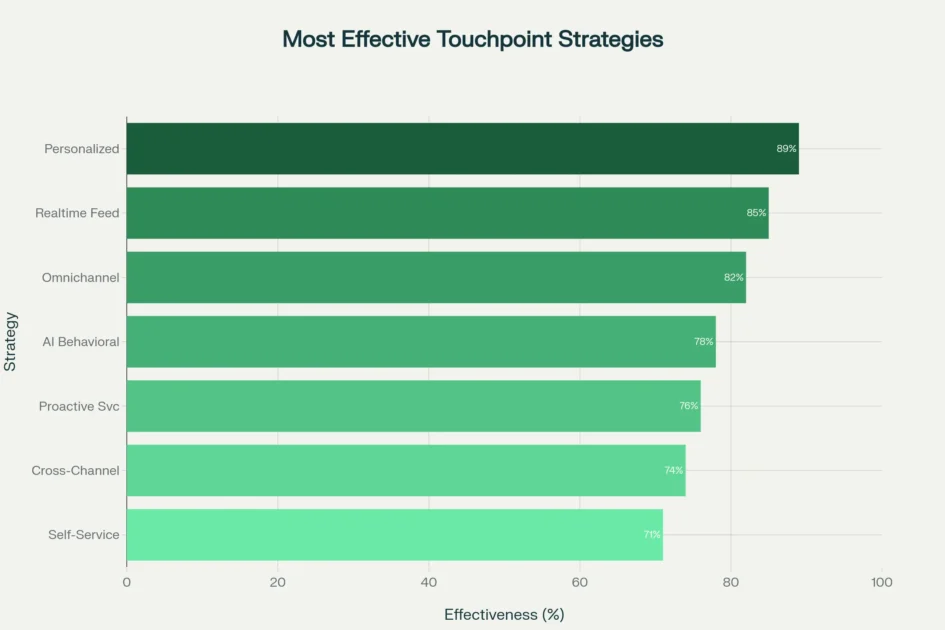
Personalized experience delivery leads touchpoint optimization strategies with 89% effectiveness, followed by real-time feedback implementation at 85% success rate
Revenue-focused metrics include customer lifetime value improvements, average order value increases, and conversion rate optimization across different journey segments. Service-oriented measures encompass Net Promoter Score changes, customer retention rates, and first-call resolution percentages. These metrics provide balanced perspectives on both customer experience quality and business performance outcomes.
Predictive Analytics and Journey Forecasting
Advanced analytics enable predictive journey optimization through machine learning algorithms that identify patterns in customer behavior and forecast future actions. Organizations leverage these capabilities to proactively address potential issues, personalize experiences in real-time, and optimize resource allocation across journey touchpoints.
Predictive models analyze historical journey data to identify customers at risk of churn, prospects likely to convert, and opportunities for cross-selling or upselling. This predictive capability enables organizations to intervene proactively with targeted communications, personalized offers, or enhanced support to optimize journey outcomes.
Industry-Specific Applications and Case Studies
Customer Journey Mapping applications vary significantly across industries, with each sector developing specialized approaches that address unique customer expectations, regulatory requirements, and business models. Understanding industry-specific implementations provides valuable insights for organizations seeking to optimize their own journey mapping initiatives.
Retail organizations have pioneered omnichannel Customer Journey Mapping that seamlessly integrates online and offline experiences. Leading retailers create unified customer profiles that track interactions across websites, mobile applications, social media, and physical stores. This comprehensive view enables personalized recommendations, targeted promotions, and consistent service regardless of interaction channel.
Manufacturing and B2B Journey Complexity
Manufacturing organizations apply Customer Journey Mapping to optimize complex multi-stakeholder relationships involving dealers, distributors, and end customers. These intricate journey ecosystems require sophisticated coordination to ensure consistent brand representation and customer satisfaction across extensive partner networks.
B2B manufacturing journeys often span months or years and involve multiple decision-makers with different priorities and concerns. Successful journey mapping creates distinct paths for different stakeholder types while maintaining coordinated messaging and consistent value proposition communication throughout extended evaluation and implementation periods.
Organizational Change Management and Implementation Success Factors
Successful Customer Journey Mapping implementation requires comprehensive organizational change management that addresses cultural, procedural, and technological transformation requirements. Organizations must prepare for fundamental shifts in how departments collaborate, decisions are made, and success is measured.
Leadership commitment represents the most critical success factor for CJM initiatives. Executives must champion customer-centric transformation, allocate necessary resources, and model behaviors that prioritize customer experience over departmental objectives. Organizations with strong leadership support report 40% higher success rates in journey mapping implementations.
Building Cross-Functional Collaboration
Cross-functional collaboration requires breaking down traditional organizational silos that prevent coordinated customer experience delivery. Successful organizations establish cross-departmental teams with shared accountability for journey outcomes and corresponding business results. This structural change often requires significant cultural adaptation and ongoing reinforcement.
Employee training and development ensure that team members understand Customer Journey Mapping principles, methodologies, and their specific roles in experience delivery. Comprehensive training programs typically include service mindset development, analytical skills enhancement, and technology platform proficiency development.
Performance Measurement Alignment
Performance measurement alignment ensures that individual and departmental objectives support customer journey optimization rather than conflicting priorities. Organizations typically modify compensation systems, recognition programs, and career development paths to reinforce customer-centric behaviors.
Successful organizations implement balanced scorecards that combine customer experience metrics with business performance indicators. This approach ensures that journey optimization efforts receive appropriate organizational support while maintaining focus on sustainable business results.
Future Trends and Emerging Opportunities
The Customer Journey Mapping discipline continues evolving rapidly, driven by technological advancement, changing customer expectations, and increasing organizational sophistication in customer experience management. Understanding emerging trends enables organizations to prepare for future opportunities and competitive challenges.
Artificial intelligence integration will dramatically enhance CJM capabilities through automated insight generation, predictive analytics, and real-time optimization recommendations. AI-powered platforms will identify patterns in customer behavior that human analysts cannot detect while suggesting experience improvements based on successful implementations across similar organizations.
Real-Time Journey Orchestration
Real-time journey orchestration will enable dynamic experience adaptation based on individual customer behaviors and preferences. Rather than following predetermined paths, journeys will adapt instantaneously to optimize outcomes based on current context, historical behavior, and predictive modeling.
This capability requires sophisticated technology infrastructure that can process customer data in real-time, make intelligent decisions about experience optimization, and deliver personalized responses across multiple channels simultaneously. Organizations investing in these capabilities report 45% improvements in conversion rates and 60% increases in customer satisfaction scores.
Voice and Conversational Interface Integration
Voice and conversational interfaces will create new journey touchpoints requiring integration with traditional digital and physical channels. Organizations must prepare for customer experiences that seamlessly transition between voice assistants, chatbots, human agents, and self-service platforms.
Conversational AI will enable more natural, intuitive customer interactions while providing organizations with deeper insights into customer intent and emotional state. These technologies will enhance traditional journey mapping by adding conversational context and enabling more sophisticated personalization strategies.
Measuring Long-Term Customer Journey Mapping Impact
Long-term success in Customer Journey Mapping requires sophisticated measurement frameworks that capture both immediate operational improvements and sustained business value creation. Organizations must track metrics that demonstrate ongoing customer experience enhancement alongside corresponding financial performance improvements.
Customer lifetime value improvement represents the ultimate measure of CJM success. Organizations implementing comprehensive journey optimization typically achieve 25-40% increases in customer lifetime value through improved retention, increased purchase frequency, and enhanced cross-selling success.
Competitive Differentiation and Market Positioning
Competitive differentiation measurement captures market positioning improvements resulting from superior customer experiences. Market share growth, competitive win rates, and customer preference studies provide insight into journey mapping’s impact on competitive positioning and brand strength.
Organizations with mature Customer Journey Mapping programs often discover that superior customer experience becomes their primary competitive differentiator, enabling premium pricing, increased customer loyalty, and sustainable market leadership. This competitive advantage compounds over time as customer expectations continue rising and competitors struggle to match experience quality.
Conclusion
The transformative power of Customer Journey Mapping has been definitively demonstrated through extensive research and real-world implementations across diverse industries. Organizations implementing comprehensive journey mapping programs consistently achieve remarkable business outcomes, with documented cases showing revenue increases of 287%, conversion rate improvements exceeding 341%, and customer satisfaction gains averaging 20-40%. This methodology represents more than tactical optimization—it embodies a fundamental shift toward customer-centricity that creates sustainable competitive advantages through deep understanding of customer motivations, behaviors, and emotional experiences. The evidence clearly establishes Customer Journey Mapping as an essential strategic capability for organizations seeking to thrive in increasingly competitive markets where customer expectations continue rising.
Customer experience optimization through systematic journey analysis has emerged as the primary differentiator between market leaders and laggards in virtually every industry sector. Companies with mature journey mapping programs report 55% customer retention rates compared to just 21% for organizations without structured approaches, creating exponential value differences that compound over time. The methodology enables organizations to identify and address friction points that prevent customer success while simultaneously revealing opportunities for enhanced value delivery and deeper relationship building. As digital transformation accelerates and omnichannel experiences become standard expectations, customer experience optimization provides the framework necessary for coordinated, consistent, and compelling interactions across all touchpoints.
The journey mapping ROI extends far beyond immediate revenue improvements to encompass operational efficiency gains, cost reductions, and enhanced organizational capabilities that drive long-term success. Organizations implementing comprehensive programs typically achieve 15-25% cost reductions alongside revenue growth, creating powerful dual benefits that strengthen competitive positioning and financial performance. The compound effect of improved customer experiences generates increased word-of-mouth referrals, reduced acquisition costs, higher customer lifetime values, and enhanced brand reputation that creates virtuous cycles of business growth. With the customer journey mapping software market projected to reach $76.2 billion by 2035, forward-thinking organizations are investing strategically in these capabilities to secure sustained competitive advantages.
Customer touchpoint analysis provides the granular insights necessary for precise experience optimization that delivers measurable business impact across all performance dimensions. The systematic examination of every customer interaction opportunity enables organizations to prioritize improvement efforts based on potential impact, resource requirements, and strategic alignment with broader business objectives. Modern touchpoint analysis incorporates advanced analytics, AI-powered insights, and real-time feedback mechanisms that enable continuous optimization and dynamic personalization at unprecedented scale. Organizations mastering customer touchpoint analysis create seamless, intuitive experiences that exceed customer expectations while driving operational efficiency and business growth that positions them for sustained market leadership in an increasingly customer-centric business environment.
Frequently Asked Questions
1. What is the average ROI timeline for Customer Journey Mapping implementations?
Most organizations begin seeing measurable improvements within 3-6 months of implementing Customer Journey Mapping programs, with full ROI typically achieved within 12-18 months. Early improvements often include increased customer satisfaction scores and reduced support ticket volume, while revenue improvements typically emerge after 6-12 months as journey optimizations compound over time. Organizations with strong leadership commitment and comprehensive implementation approaches report faster results, with some achieving positive ROI within 6-9 months of program initiation.
2. How do small businesses implement Customer Journey Mapping without extensive resources?
Small businesses can begin Customer Journey Mapping with basic tools and methodologies, focusing on their most critical customer interactions. Starting with simple customer interviews, basic analytics review, and manual journey documentation often reveals significant improvement opportunities that require minimal investment to address. Many small businesses achieve substantial results by systematically addressing obvious pain points before investing in sophisticated technology platforms. Free or low-cost tools like Google Analytics, customer survey platforms, and basic visualization software can provide valuable insights for initial journey mapping efforts.
3. What are the most common implementation mistakes to avoid?
The most frequent Customer Journey Mapping mistakes include focusing on internal processes rather than customer perspectives, treating journey mapping as a one-time project rather than ongoing optimization, failing to involve cross-functional teams, and implementing technology solutions without understanding customer needs. Other common errors include creating maps based on assumptions rather than research, ignoring emotional aspects of customer experience, and failing to connect journey improvements to business metrics. Successful implementations maintain customer focus, ensure ongoing iteration, and build organizational capabilities gradually while measuring both experience quality and business impact.
4. How does Customer Journey Mapping integrate with existing marketing and sales technologies?
Modern Customer Journey Mapping platforms integrate seamlessly with CRM systems, marketing automation platforms, analytics tools, and customer service applications through APIs and native connectors. This integration enables comprehensive data sharing, coordinated campaign execution, and unified customer experience delivery across all touchpoints. Leading platforms provide pre-built integrations with popular business systems like Salesforce, HubSpot, Adobe Marketing Cloud, and Google Analytics, ensuring that journey mapping efforts enhance rather than replace existing technology investments.
5. What metrics should organizations prioritize when measuring Customer Journey Mapping success?
Priority metrics depend on organizational objectives but typically include customer satisfaction scores, conversion rates, customer lifetime value, and operational efficiency measures. Leading organizations implement balanced scorecards that track customer experience quality alongside business performance, ensuring that optimization efforts deliver both improved experiences and measurable business results. Key metrics include Net Promoter Score improvements, customer retention rates, average order value increases, cost per acquisition reductions, and task completion rate improvements. Organizations should select 5-7 core metrics that align with strategic objectives rather than trying to track everything simultaneously.
6. How often should Customer Journey Mapping be updated and refreshed?
Customer Journey Mapping requires continuous monitoring and regular updates to remain effective. Most organizations conduct comprehensive journey reviews quarterly while monitoring key metrics continuously. Major updates typically occur annually or when significant business changes affect customer experience, such as new product launches, market expansion, or competitive responses. High-velocity businesses or rapidly changing industries may require more frequent updates, while stable industries can often maintain effectiveness with semi-annual comprehensive reviews. The key is establishing regular review schedules that balance thoroughness with organizational capacity for implementing improvements.
Citations
- https://mediaplus.com.sg/customer-journey-map/
- https://penfriend.ai/blog/customer-journey-mapping-case-study
- https://www.salesforce.com/in/blog/customer-journey-map-template/
- https://www.userology.co/blogs/why-customer-journey-mapping-matters-in-2025
- https://moldstud.com/articles/p-case-studies-successful-implementation-of-customer-journey-mapping-in-enterprises
- https://miro.com/templates/customer-journey-map/
- https://superagi.com/the-future-of-customer-journey-mapping-2025-trends-and-predictions-in-ai-driven-cx/
- https://www.datamatics.com/resources/case-studies/-a-leading-european-audio-equipment-manufacturer-maps-customer-purchase-journey-for-purchase-of-headphones-across-usa-germany-india
- https://www.looppanel.com/blog/user-journey-map-templates
- https://www.futuremarketinsights.com/reports/customer-journey-mapping-software-market
- https://superagi.com/case-studies-in-ai-driven-customer-journey-mapping-real-world-examples-of-enhanced-personalization-and-satisfaction/
- https://offers.hubspot.com/customer-journey-map-template
- https://www.cxnetwork.com/journey-mapping/reports/the-state-of-customer-journey-success-2024-2025
- https://www.woopra.com/blog/customer-journey-map-examples
- https://www.userinterviews.com/blog/best-customer-journey-map-templates-examples
- https://moosend.com/blog/customer-journey/
- https://www.thetriangleoffense.co/construction-contractor-buying-customer-journey-map/
- https://www.canva.com/templates/s/customer-journey-map/
- https://cx-journey.com/2024/07/measuring-the-roi-of-customer-experience.html
- https://www.quantzig.com/case-studies/customer-journey-touchpoints-optimize-your-customer-journey/
- https://www.singlegrain.com/digital-marketing/customer-journey-models-that-generated-341-more-conversions/
- https://www.linkedin.com/pulse/roi-collaborative-journey-mapping-hilarycluett-wxfsc
- https://rbr.business.rutgers.edu/sites/default/files/documents/rbr-050106.pdf
- https://growthmolecules.com/customer-journey-mapping-the-secret-behind-revenue-growth/
- https://www.ibm.com/think/topics/customer-journey-map
- https://www.retainful.com/blog/omnichannel-marketing-example
- https://www.arataumodular.com/app/wp-content/uploads/2022/09/Mapping-The-Customer-Journey.pdf
- https://www.davechaffey.com/digital-marketing-glossary/customer-journey-map/
- https://www.sciencedirect.com/science/article/pii/S0148296322011043
- https://bizibl.com/marketing/download/forrester-research-transformative-power-holistic-customer-journey-strategy
- https://www.mckinsey.com/~/media/mckinsey/industries/public%20and%20social%20sector/our%20insights/customer%20experience/creating%20value%20through%20transforming%20customer%20journeys.pdf
- https://cieden.com/customer-journey-mapping-both-online-and-offline-an-ikea-case-study
- https://www.forrester.com/blogs/key-trends-in-customer-journey-mapping/
- https://www.mckinsey.com/~/media/McKinsey/Business%20Functions/Marketing%20and%20Sales/Our%20Insights/Linking%20the%20customer%20experience%20to%20value/Linking_the_customer_experience_to_value_McK_final.pdf
- https://www.productcompass.pm/p/customer-journey-map-with-operating-principles
- https://www.forrester.com/report/mapping-the-customer-journey/RES55987
- https://www.mckinsey.com/capabilities/growth-marketing-and-sales/our-insights/from-touchpoints-to-journeys-seeing-the-world-as-customers-do
- https://www.forrester.com/blogs/dont-let-customer-journeys-be-misunderstood/
- https://online.hbs.edu/blog/post/customer-journey-map
- https://contentsquare.com/guides/customer-journey-map/research/
- https://hbr.org/2016/03/what-you-can-and-should-be-doing-with-your-customer-journeys
- https://www.deloitte.com/nl/en/issues/transformation/customer-experience-and-loyalty.html
- https://www.hanoverresearch.com/insights-blog/corporate/customer-journey-mapping/
- https://www.interaction-design.org/literature/article/customer-journey-maps-walking-a-mile-in-your-customer-s-shoes
- https://www.deloittedigital.com/nl/en/insights/perspective/from-journey-mapping-to-journey-management.html
- https://www.interaction-design.org/literature/topics/customer-journey-map
- https://www.linkedin.com/pulse/harvard-business-review-7-steps-mapping-customer-journey-paul-o-hara
- https://www2.deloitte.com/us/en/insights/industry/public-sector/government-trends/2024/radically-improving-the-government-customer-experience.html
- https://www.sciencedirect.com/science/article/pii/S2212827121005370
- https://hbr.org/2010/11/using-customer-journey-maps-to
- https://www.deloittedigital.com/nl/en/insights/perspective/building-your-experience-business-insights.html
- https://www.sciencedirect.com/science/article/pii/S0040162524007145
- https://hbr.org/2023/03/what-is-the-optimal-pattern-of-a-customer-journey
- https://www.deloitte.com/dk/en/services/consulting/perspectives/designing-end-to-end-solutions-that-are-fit-for-purpose.html
- https://core.ac.uk/download/pdf/249984857.pdf
- https://hbr.org/2022/07/what-youre-getting-wrong-about-customer-journeys
- https://www.deloitte.com/ch/en/Industries/financial-services/research/cx-maturity-banking-study.html
- https://www.medallia.com/blog/how-to-optimize-customer-journey-touchpoints-with-examples/
- https://yellow.ai/blog/omnichannel-customer-experience/
- https://userbit.com/content/blog/customer-journey-mapping-tools
- https://www.sprinklr.com/blog/customer-journey-touchpoints/
- https://knowmax.ai/blog/omnichannel-customer-service-platforms/
- https://superagi.com/top-10-ai-tools-for-customer-journey-mapping-in-2025-a-comparative-analysis/
- https://blog.hubspot.com/service/customer-touchpoints
- https://netcorecloud.com/blog/top-omnichannel-marketing-platform/
- https://www.fullstory.com/blog/customer-journey-tools/
- https://fazer.agency/services/touchpoint-optimization/
- https://www.ibm.com/think/topics/omnichannel-customer-experience
- https://thecxlead.com/tools/best-customer-journey-mapping-tools/
- https://www.omniconvert.com/blog/optimize-customer-journey-touchpoint-mapping/
- https://www.kustomer.com/resources/blog/omnichannel-support-platform/
- https://improvado.io/blog/customer-journey-map
- https://knowmax.ai/blog/optimize-customer-touchpoints/
- https://www.pega.com/omnichannel-customer-experience
- https://contentsquare.com/guides/customer-journey-map/tools/
- https://www.renascence.io/journal/how-to-optimize-customer-experience-cx-touchpoints-for-better-results
- https://yellow.ai/blog/customer-journey-map/
- https://www.superoffice.com/blog/customer-experience-best-practices/
- https://uxpressia.com/blog/measuring-your-customer-journey-performance
- https://blog.hubspot.com/service/customer-journey-map
- https://johnnygrow.com/cx/customer-experience-best-practices/
- https://www.usertesting.com/blog/customer-journey-optimization-kpi-shifts
- https://www.qualtrics.com/en-au/experience-management/customer/customer-journey-mapping/
- https://userpilot.com/blog/end-to-end-customer-experience/
- https://www.medallia.com/blog/measure-cx-with-customer-journey-metrics/
- https://www.smaply.com/blog/metrics-on-journey-maps
- https://www.moengage.com/blog/customer-journey-mapping/
- https://hbr.org/2023/03/8-best-practices-for-creating-a-compelling-customer-experience
- https://userpilot.com/blog/customer-journey-kpis/
- https://www.atlassian.com/team-playbook/plays/customer-journey-mapping
- https://www.renascence.io/journal/customer-experience-cx-best-practices-what-top-companies-are-doing-right
- https://contentsquare.com/guides/customer-journey/metrics/
- https://www.nngroup.com/articles/journey-mapping-101/