

8 Proven SEO Keyword Research Tools for Faster Rankings
In today’s hyper-competitive digital marketing environment, the difference between businesses that dominate search engine results and those that struggle for visibility often comes down to one critical factor: their approach to SEO keyword research tools. With over 8.5 billion searches performed on Google daily, the companies that succeed are those that can identify, analyze, and target the exact keywords their potential customers use when searching for products and services. The challenge lies not just in finding these keywords, but in selecting the right tools that can provide accurate data, competitive insights, and actionable intelligence that translate into measurable ranking improvements.
Recent studies have revealed significant disparities in the accuracy and effectiveness of various SEO keyword research tools, with some platforms providing search volume data that differs by as much as 40% from actual search performance. This variance can mean the difference between investing time and resources in high-impact keywords versus chasing phantom opportunities that never materialize into traffic or conversions. The most successful digital marketers understand that their choice of keyword research platform directly impacts their ability to identify low-competition opportunities, understand search intent, and develop content strategies that resonate with both search engines and human users.
The background of SEO keyword research tools has transformed dramatically over the past decade, evolving from simple keyword suggestion engines to sophisticated platforms that incorporate artificial intelligence, competitor analysis, and predictive modeling. Today’s leading tools can process billions of search queries, analyze SERP weaknesses, cluster keywords by intent, and even predict which terms are most likely to drive conversions for specific business models. However, this advancement has also created complexity, with businesses often overwhelmed by the sheer number of options available and uncertain about which features truly matter for their specific ranking objectives.
Understanding which SEO keyword research tools deliver the best return on investment requires examining not just their features and pricing, but their real-world performance in helping businesses achieve faster rankings and increased organic traffic. The most effective platforms combine comprehensive keyword databases with accurate search volume data, sophisticated difficulty scoring, and intuitive interfaces that enable marketers to quickly identify and act on ranking opportunities. By examining the eight most proven tools in the current market, businesses can make informed decisions that accelerate their path to search engine success and sustainable organic growth.

Search volume accuracy comparison of top SEO keyword research tools based on independent studies, showing Semrush leading with 60% accuracy
Understanding The Modern SEO Keyword Research Tools Terrain
The foundation of successful search engine optimization has always been SEO keyword research tools, but the sophistication and capabilities of these platforms have advanced exponentially in recent years. Modern keyword research extends far beyond simply identifying high-volume search terms; it encompasses understanding user intent, analyzing competitive structures, and predicting ranking difficulty with unprecedented accuracy. The most effective SEO keyword research tools now incorporate machine learning algorithms that can process vast datasets to identify patterns and opportunities that would be impossible to detect through manual analysis.
The Evolution of Search Behavior and Tool Capabilities
Search behavior has become increasingly complex, with users employing longer, more conversational queries that reflect natural language patterns. Voice search optimization has emerged as a critical component of keyword strategy, requiring SEO keyword research tools that can identify question-based keywords and long-tail variations that match how people actually speak. The leading platforms have adapted to this shift by incorporating features that specifically target conversational keywords, FAQ optimization, and local search variations that capture the nuances of modern search behavior.
The integration of artificial intelligence into SEO keyword research tools has revolutionized how marketers approach keyword discovery and analysis. Advanced platforms now offer AI-powered features that can automatically cluster keywords by topic relevance, identify semantic relationships between terms, and even suggest content strategies based on keyword analysis. These capabilities have transformed keyword research from a time-intensive manual process into a more strategic, data-driven approach that can uncover opportunities that competitors might miss.
Data Accuracy and Reliability Challenges of SEO keyword research tools
One of the most significant challenges facing users of SEO keyword research tools is the variation in data accuracy across different platforms. Independent studies have revealed substantial differences in search volume reporting, with some tools showing accuracy rates significantly higher than others. These discrepancies can lead to misaligned content strategies and wasted resources if marketers base their decisions on inaccurate data. The most reliable SEO keyword research tools have invested heavily in data collection methodologies and validation processes to ensure their metrics closely align with actual search performance.
Understanding the methodology behind keyword data collection is crucial for making informed decisions about tool selection. Some platforms rely primarily on Google’s API data, while others combine multiple data sources including clickstream data, search engine scraping, and proprietary user research. The most accurate SEO keyword research tools typically employ hybrid approaches that cross-reference multiple data sources to provide more reliable metrics and reduce the likelihood of significant errors in search volume or competition assessments.
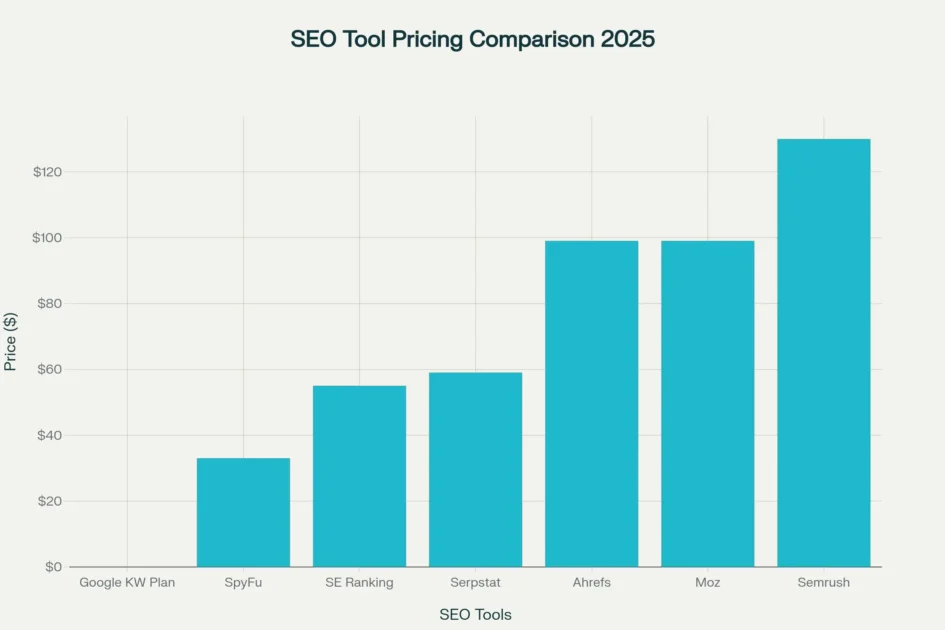
Monthly pricing comparison of leading keyword research tools, from free Google Keyword Planner to premium Semrush at $129.95/month
The 8 Most Proven SEO Keyword Research Tools
1. Semrush – The All-in-One SEO Powerhouse
Semrush stands as the most comprehensive and accurate of all SEO keyword research tools, with independent studies consistently showing it provides the highest search volume accuracy rates at approximately 60%. With a massive database containing over 25 billion keywords, Semrush offers unparalleled coverage across global markets and languages. The platform’s Keyword Magic Tool can generate thousands of keyword variations from a single seed keyword, while its advanced filtering options allow users to sort by search intent, keyword difficulty, and competitive density.
The platform’s competitive analysis capabilities set it apart from other SEO keyword research tools by providing detailed insights into competitors’ organic and paid keyword strategies. Users can identify keyword gaps, analyze competitor content performance, and discover opportunities where competitors are ranking poorly despite keyword relevance. The integration of AI-powered features, including personalized keyword difficulty scores based on specific domains, enables more accurate assessments of ranking potential.
Semrush’s comprehensive feature set extends beyond basic keyword research to include rank tracking, site auditing, backlink analysis, and content optimization tools. This all-in-one approach makes it particularly valuable for agencies and larger businesses that need multiple SEO functions within a single platform. However, the extensive feature set comes with a premium price point starting at $129.95 per month, which may be prohibitive for smaller businesses or individual marketers.
2. Ahrefs – The Backlink and Content Authority
Ahrefs has built its reputation as one of the most powerful SEO keyword research tools through its exceptional backlink database and content analysis capabilities. The platform’s Keywords Explorer provides comprehensive keyword metrics including search volume, keyword difficulty, and unique “traffic potential” calculations that account for Google’s increasing tendency to provide answers directly in search results. This traffic potential metric offers a more realistic assessment of actual click-through potential compared to traditional search volume metrics.
The platform excels at competitive keyword analysis, allowing users to identify which keywords competitors rank for and analyze the content strategies that drive their success. Ahrefs’ Content Explorer can reveal the most shared and linked-to content in any niche, providing valuable insights for content strategy development. The tool’s “Also rank for” feature helps identify secondary keywords that pages naturally rank for, enabling more comprehensive content optimization.
While Ahrefs offers robust keyword research capabilities, its strength lies in the integration with its industry-leading backlink analysis tools. Users can identify link building opportunities alongside keyword research, creating more comprehensive SEO strategies. However, the platform operates on a credit-based system that some users find restrictive, and its pricing starts at $99 per month.
3. Google Keyword Planner – The Free Foundation
Google Keyword Planner remains one of the most accessible SEO keyword research tools, offering direct access to Google’s advertising data at no cost to users with Google Ads accounts. While primarily designed for PPC campaigns, the tool provides valuable insights for organic keyword research, including search volume ranges, competition levels, and seasonal trends. The platform’s forecasting capabilities can help predict keyword performance and identify seasonal opportunities that other tools might miss.
The tool’s greatest advantage is its direct connection to Google’s data, ensuring that keyword suggestions and trends reflect actual search behavior on the world’s largest search engine. However, users should be aware that non-advertisers receive broader search volume ranges rather than specific numbers, and the tool’s keyword suggestions tend to be limited compared to specialized SEO keyword research tools.
Despite its limitations, Google Keyword Planner serves as an excellent starting point for businesses with limited budgets or those just beginning their SEO journey. The tool’s integration with Google Ads also makes it particularly valuable for businesses running both organic and paid search campaigns, enabling better alignment between SEO and PPC strategies.
4. SE Ranking – The Budget-Conscious Choice
SE Ranking has emerged as one of the most cost-effective SEO keyword research tools, offering comprehensive functionality at a fraction of the cost of premium competitors. Starting at just $55 per month, the platform provides access to a database of over 7 billion keywords along with features typically found in more expensive tools. The platform’s keyword research module includes search volume data, keyword difficulty scores, and competitive analysis capabilities that rival those of higher-priced alternatives.
The tool’s strength lies in its user-friendly interface and comprehensive feature integration, combining keyword research with rank tracking, site auditing, and competitor analysis in a single platform. SE Ranking’s keyword grouper tool automatically clusters related keywords, saving time in content planning and strategy development. The platform also offers white-label reporting capabilities, making it particularly attractive to agencies and consultants who need to present professional reports to clients.
While SE Ranking may not have the extensive database size of premium SEO keyword research tools like Semrush or Ahrefs, it provides excellent value for small to medium-sized businesses that need comprehensive SEO functionality without premium pricing. The platform’s regular updates and feature additions demonstrate a commitment to staying competitive in the evolving SEO tool structure.
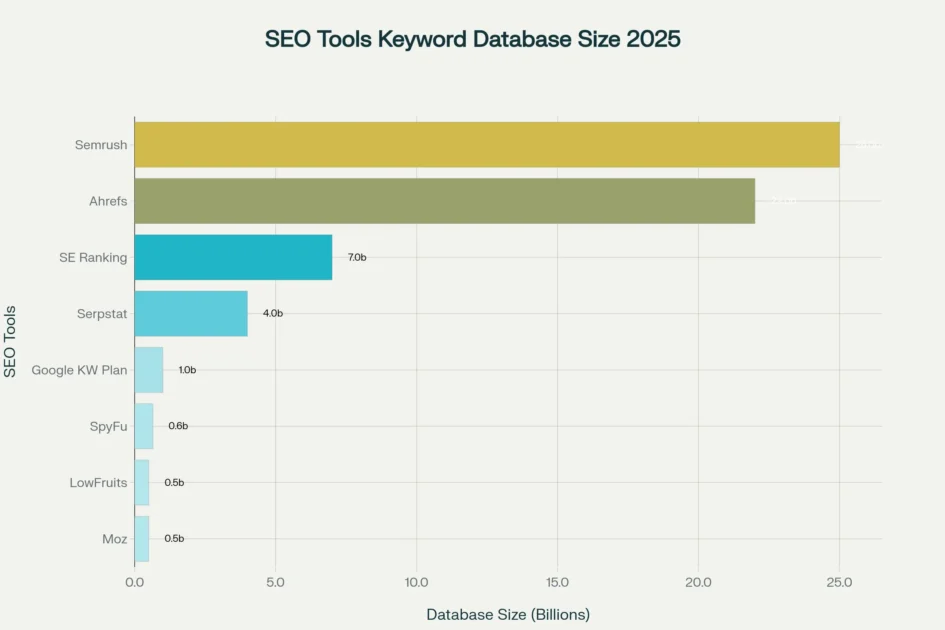
Keyword database size comparison showing Semrush and Ahrefs leading with 25+ and 22+ billion keywords respectively
5. LowFruits – The SERP Analysis Specialist
LowFruits represents a unique approach among SEO keyword research tools, specializing in identifying “low-hanging fruit” keywords by analyzing SERP weaknesses rather than relying solely on traditional difficulty metrics. The platform’s core strength lies in its ability to bulk analyze search engine results pages to identify opportunities where low-authority websites are ranking in top positions, indicating potential ranking opportunities for well-optimized content.
The tool’s wildcard search functionality allows users to discover long-tail keyword combinations that competitors might miss in other SEO keyword research tools. LowFruits groups keywords that share similar search intent into clusters, enabling more efficient content planning and strategy development. The platform’s focus on intent filtering helps users identify keywords that are most likely to drive conversions rather than just traffic.
With pricing starting at just $30 per month, LowFruits offers exceptional value for businesses focused on finding easy-to-rank keywords. However, the platform’s specialized focus means it lacks some of the comprehensive features found in full-service SEO keyword research tools, such as rank tracking and technical SEO analysis. The tool is particularly valuable for content marketers and affiliate marketers who need to quickly identify ranking opportunities in competitive niches.
6. SpyFu – The Competitive Intelligence Expert
SpyFu distinguishes itself among SEO keyword research tools through its exceptional competitive analysis capabilities and historical data tracking. The platform can reveal up to 14 years of competitor keyword and advertising history, providing unprecedented insight into long-term SEO and PPC strategies. This historical perspective enables users to identify trends, understand seasonal patterns, and recognize successful long-term keyword strategies that competitors have employed.
The tool excels at revealing competitor PPC strategies, showing exactly which keywords competitors are bidding on and their ad copy variations. This information can be invaluable for identifying high-converting keywords that competitors consider valuable enough to pay for in advertising campaigns. SpyFu’s “Kombat” feature highlights keyword gaps between competitors, making it easier to identify untapped opportunities.
With pricing starting at just $33 per month, SpyFu offers excellent value for businesses focused on competitive analysis. However, the platform’s strength in competitive intelligence comes at the expense of some traditional keyword research features, and its database size is smaller compared to comprehensive SEO keyword research tools like Semrush or Ahrefs. The tool is particularly valuable for businesses operating in highly competitive markets where understanding competitor strategies is crucial for success.
7. Ubersuggest – The User-Friendly Alternative
Ubersuggest, developed by Neil Patel, has gained popularity as one of the most user-friendly SEO keyword research tools, offering a comprehensive yet accessible approach to keyword research. The platform provides keyword suggestions, search volume data, SEO difficulty scores, and content ideas all within an intuitive interface that makes it particularly appealing to SEO beginners. The tool’s domain overview feature allows users to analyze competitors’ keywords and strategies, making it easier to identify gaps and opportunities in their own SEO approach.
The platform’s strength lies in its ability to simplify complex SEO concepts while still providing actionable data. Ubersuggest offers content ideas alongside keyword suggestions, helping users understand not just what keywords to target but how to create content that ranks for those terms. The tool’s affordable pricing and straightforward interface make it an excellent choice for small businesses and individual marketers who need effective SEO keyword research tools without overwhelming complexity.
While Ubersuggest provides solid basic functionality, it lacks some of the advanced features found in premium SEO keyword research tools. The platform’s database size and accuracy may not match those of industry leaders like Semrush or Ahrefs, but it offers sufficient functionality for most small to medium-sized businesses. The tool’s emphasis on simplicity and affordability makes it particularly valuable for businesses just beginning their SEO journey or those with limited technical expertise.
8. Serpstat – The Multi-Language Specialist
Serpstat rounds out our list of proven SEO keyword research tools with its exceptional multi-language and international SEO capabilities. The platform provides keyword data from over 230 regions and supports multiple languages, making it particularly valuable for businesses with international SEO requirements. Serpstat’s keyword research tool generates comprehensive keyword lists while providing essential metrics like search volume, competition levels, and trend data across different geographic markets.
The platform’s all-in-one approach combines keyword research with rank tracking, site auditing, and competitor analysis, similar to other comprehensive SEO keyword research tools. Serpstat’s keyword clustering features help organize large keyword lists into manageable groups based on search intent and topic relevance. The tool also provides detailed SERP analysis, showing featured snippets, local packs, and other search result features that might impact click-through rates.
With pricing starting at $59 per month, Serpstat offers reasonable value for businesses needing international SEO capabilities. However, some users report occasional slowness and stability issues with the platform. Despite these concerns, Serpstat remains a solid choice for businesses operating in multiple countries or languages, where its specialized international features provide significant value over more generic SEO keyword research tools.
Advanced Features and Automation Capabilities
The composition of SEO keyword research tools has been transformed by the integration of artificial intelligence and automation features that significantly reduce manual effort while improving research quality. Modern platforms now offer AI-powered keyword clustering, automated competitor analysis, and predictive modeling that can identify trending topics before they become highly competitive. These advanced capabilities enable marketers to work more efficiently while uncovering opportunities that manual research might miss.
AI-Powered Keyword Intelligence
The integration of artificial intelligence into SEO keyword research tools has revolutionized how marketers approach keyword discovery and analysis. Advanced AI features can automatically identify semantic relationships between keywords, suggest content topics based on keyword analysis, and even predict which keywords are most likely to drive conversions for specific business models. These capabilities transform keyword research from a reactive process into a proactive strategy that can anticipate market trends and user behavior changes.
AI-Powered Features: Automated Content Optimization
AI-powered features in modern SEO keyword research tools also include automated content optimization suggestions that analyze top-ranking pages and recommend specific improvements. Some platforms can now generate complete content outlines based on keyword analysis, suggest internal linking opportunities, and identify gaps in existing content that could be filled to improve rankings. This level of automation enables marketers to focus on strategy and creativity rather than time-intensive data analysis.
Automation and Workflow Integration
The most sophisticated SEO keyword research tools now offer extensive automation capabilities that can streamline entire keyword research workflows. Automated competitor monitoring can alert users when competitors begin ranking for new keywords or when ranking positions change significantly. Some platforms can automatically update keyword lists based on search trend changes or seasonality patterns, ensuring that keyword strategies remain current without constant manual intervention.
Integration capabilities have become increasingly important as SEO keyword research tools evolve to fit into broader digital marketing ecosystems. Leading platforms now offer API access, integrations with content management systems, and connections to other marketing tools that enable seamless workflow automation. These integrations allow keyword data to flow directly into content creation processes, PPC campaigns, and performance tracking systems, creating more cohesive marketing strategies.
Choosing the Right Tool for Your Business Needs
Selecting the most appropriate SEO keyword research tools requires careful consideration of business size, budget constraints, technical expertise, and specific SEO objectives. Small businesses and startups often benefit most from cost-effective solutions that provide essential keyword research functionality without overwhelming complexity or premium pricing. Growing businesses typically need more sophisticated features like competitor analysis and rank tracking, while enterprise organizations require comprehensive platforms with advanced automation and team collaboration capabilities.

Tool recommendations segmented by business size and budget, from free options for startups to premium enterprise solutions
Budget and ROI Considerations
The investment in SEO keyword research tools should be evaluated based on potential return rather than just upfront costs. While premium platforms may seem expensive, their advanced features can often identify opportunities and efficiencies that more than offset their higher price points. Businesses should consider factors like time savings, opportunity identification accuracy, and the potential traffic value of improved keyword targeting when evaluating tool costs.
Free and low-cost SEO keyword research tools can provide significant value for businesses with limited budgets, but users should understand their limitations. Google Keyword Planner offers excellent basic functionality at no cost, while tools like SE Ranking and LowFruits provide premium features at budget-friendly price points. The key is matching tool capabilities with business needs and growth trajectories rather than simply choosing the cheapest or most expensive option.
Feature Requirements Assessment
Different businesses require different capabilities from their SEO keyword research tools, making feature assessment crucial for tool selection. Content-heavy businesses may prioritize tools with strong keyword clustering and content optimization features, while e-commerce companies might focus on tools with strong local SEO and commercial keyword identification capabilities. Service businesses operating in competitive local markets may benefit most from tools that excel at local keyword research and competitor analysis.
Technical sophistication requirements also vary significantly between businesses. Some organizations need advanced API access and integration capabilities, while others benefit more from intuitive interfaces that require minimal training. The most successful tool implementations occur when businesses honestly assess their technical capabilities and choose SEO keyword research tools that match their team’s expertise level.
Measuring Success and ROI from Keyword Research Tools
The effectiveness of SEO keyword research tools should be measured through concrete business metrics rather than just tool-specific features or data accuracy. Successful keyword research translates into improved search engine rankings, increased organic traffic, and ultimately higher conversion rates and revenue. The most valuable SEO keyword research tools are those that consistently help identify keywords that drive not just traffic, but qualified traffic that converts into business results.
Tracking Keyword Performance and Rankings
Effective measurement of SEO keyword research tools requires establishing baseline metrics before implementation and consistently tracking improvements over time. Key performance indicators should include organic traffic growth, keyword ranking improvements, conversion rate changes, and the overall value of organic search traffic. The most successful businesses track these metrics not just at the aggregate level, but for specific keyword groups and content pieces to understand which research approaches deliver the best results.
Advanced tracking methodologies can help businesses understand the long-term value of their SEO keyword research tools investment. This includes measuring the compounding effect of improved keyword targeting on overall domain authority, the impact on brand visibility for industry-relevant terms, and the reduced dependence on paid advertising as organic performance improves. These broader metrics often provide a more accurate picture of tool ROI than simple traffic increases alone.
Content Strategy Integration and Results
The most successful implementations of SEO keyword research tools integrate keyword insights directly into comprehensive content strategies rather than treating keyword research as an isolated activity. This means using keyword data to inform content calendars, guide content creation processes, and optimize existing content for better performance. The tools that provide the greatest value are those that make this integration seamless and efficient.
Measuring content performance improvements following keyword research tool implementation provides clear evidence of their value. This includes tracking improvements in content ranking positions, increases in organic traffic to specific content pieces, and enhanced user engagement metrics like time on page and conversion rates. The most effective SEO keyword research tools enable continuous content optimization based on performance data and changing search trends.
Future Trends in SEO Keyword Research Tools
The trajectory of SEO keyword research tools is being fundamentally reshaped by unprecedented technological advances that promise to transform how marketers discover, analyze, and target search opportunities. As we approach 2026 and beyond, the convergence of artificial intelligence, machine learning, and natural language processing is creating a new paradigm where keyword research transcends traditional metrics to become a predictive, semantic, and hyper-personalized discipline. The businesses that adapt to these emerging trends will gain significant competitive advantages in search visibility, while those clinging to outdated methodologies risk becoming invisible in an increasingly AI-dominated search ecosystem.
The fundamental shift occurring in search behavior demands that SEO keyword research tools evolve from reactive data providers to proactive intelligence systems capable of anticipating user needs before they fully materialize. With Google’s Search Generative Experience (SGE) and competing large language models like ChatGPT and Perplexity capturing increasing search market share, traditional ranking strategies are being supplemented—and in some cases replaced—by optimization approaches specifically designed for AI-powered answer engines. This transformation requires marketers to rethink not just which tools they use, but how they conceptualize keyword research itself within their broader SEO strategies.
AI-Powered Predictive Keyword Intelligence
The most significant evolution in SEO keyword research tools centers on artificial intelligence’s ability to predict future search trends before they reach peak competition. Modern predictive SEO leverages machine learning algorithms that analyze historical search patterns, social media conversations, news cycles, and consumer behavior data to forecast which keywords will gain traction in coming weeks and months. This capability enables businesses to create optimized content ahead of demand curves, capturing early traffic and establishing topical authority before competitors recognize emerging opportunities.
Key Elements of Predictive Keyword Research:
- Trend Forecasting Algorithms – AI systems that analyze billions of data points to identify emerging topics before they become mainstream search queries
- Seasonal Pattern Recognition – Machine learning models that predict cyclical keyword demand with increasing accuracy based on multi-year historical data
- Real-Time Data Processing – Continuous monitoring systems that update keyword recommendations based on current events, viral content, and shifting consumer interests
- Competitive Movement Detection – AI-powered alerts that notify users when competitors begin targeting new keyword territories or shift content strategies
- Search Intent Evolution Tracking – Systems that identify when user intent behind specific queries changes over time, requiring content strategy adjustments
Advanced SEO keyword research tools now incorporate predictive ranking signals that serve as leading indicators of future SEO success. These signals go beyond traditional metrics like search volume and competition to analyze factors such as topic saturation scores, emerging entity relationships, and user engagement pattern shifts. By processing these complex data relationships, AI-powered platforms can recommend keyword strategies that position content for success not just in current search environments, but in the evolved settings that will exist three to six months in the future.
Semantic Search and Entity-Based Optimization
The evolution toward semantic search represents a fundamental shift in how SEO keyword research tools approach keyword discovery and analysis. Modern search engines no longer evaluate content based primarily on exact keyword matches, but instead assess topical comprehensiveness, entity relationships, and contextual relevance. This transformation means effective keyword research now requires identifying entire topic ecosystems rather than isolated search terms, with the most sophisticated tools mapping semantic relationships between concepts, entities, and user intentions.
Key Features of Semantic Keyword Research:
- Entity Relationship Mapping – Tools that identify connections between people, places, things, and concepts relevant to target keywords, enabling more comprehensive content strategies
- Topic Cluster Identification – AI systems that automatically group semantically related keywords into content hub structures that build topical authority
- Contextual Intent Analysis – Natural language processing capabilities that distinguish between different meanings and contexts of identical keyword phrases
- Co-Occurrence Pattern Recognition – Algorithms that identify which terms and concepts frequently appear together in top-ranking content, suggesting comprehensive coverage requirements
- Semantic Gap Detection – Features that reveal missing conceptual elements in existing content compared to semantic expectations for specific topics
The integration of Google’s BERT and MUM algorithms has elevated the importance of semantic optimization within SEO keyword research tools. These advanced AI systems understand natural language nuances, multilingual contexts, and complex query interpretations that previous algorithms missed. Consequently, modern keyword research tools must provide insights that extend beyond simple keyword lists to include semantic term relationships, conceptual frameworks, and entity associations that signal topical expertise to increasingly sophisticated search algorithms.
Voice Search and Conversational Query Optimization
Voice search continues its rapid growth trajectory, with over 8 billion voice assistants expected to be in active use by 2025, fundamentally altering the keyword research panoramas. The conversational nature of voice queries demands that SEO keyword research tools adapt to identify longer, question-based keywords that match natural speech patterns rather than typed search syntax. This shift has profound implications for keyword strategy, requiring tools that can analyze conversational language structures, regional dialects, and the contextual assumptions embedded in spoken queries.
Key Elements of Voice Search Optimization:
- Question-Based Keyword Discovery – Features that specifically identify interrogative keyword patterns like “how,” “what,” “where,” and “why” queries
- Long-Tail Conversational Phrases – Tools that uncover extended keyword phrases (7+ words) that match natural speaking patterns
- Local Intent Integration – Capabilities that combine voice search patterns with geographic targeting for “near me” and location-specific queries
- Featured Snippet Targeting – Features that identify keywords most likely to trigger voice assistant responses through featured snippet optimization
- Natural Language Pattern Analysis – AI systems that understand how people structure verbal questions versus typed searches
The implications of voice search extend beyond simple keyword length considerations to fundamental changes in user intent and search behavior. Voice searches tend to be more immediate, action-oriented, and contextually dependent than traditional typed queries. Advanced SEO keyword research tools now incorporate voice search simulation features that help marketers understand how their target keywords might be spoken in various contexts, regional dialects, and use case scenarios. This capability enables more precise content optimization for the growing population of users who rely primarily on voice interfaces for search interactions.
Zero-Click Search and Answer Engine Optimization
The dramatic rise of zero-click searches—where users receive answers directly on search engine results pages without clicking through to websites—represents one of the most disruptive trends affecting SEO keyword research tools strategies. In March 2025, 27.2% of U.S. searches resulted in no clicks, up from 24.4% the previous year, forcing a fundamental reconsideration of keyword research objectives. This trend demands that tools evolve to help marketers identify keywords where visibility and brand awareness matter as much as traffic generation, and to optimize content specifically for featured snippets, knowledge panels, and AI-generated answer boxes.
Key Features for Zero-Click Optimization:
- Featured Snippet Opportunity Identification – Tools that analyze which keywords currently trigger featured snippets and identify content gaps for snippet capture
- People Also Ask (PAA) Targeting – Features that reveal related questions appearing in PAA boxes, enabling comprehensive question-based content strategies
- Knowledge Panel Optimization Guidance – Capabilities that help structure content and schema markup for knowledge panel inclusion
- SERP Feature Analysis – Detailed breakdowns of which SERP features (answer boxes, local packs, image carousels) appear for target keywords
- Answer Quality Scoring – AI assessment of whether content provides concise, direct answers suitable for zero-click result formats
Strategic adaptation to zero-click search requires rethinking traditional keyword research metrics within SEO keyword research tools. Rather than focusing exclusively on keywords with high click-through potential, sophisticated marketers now employ multi-tier strategies that balance traffic-generating keywords with visibility-focused terms that build brand recognition even without immediate clicks. The most advanced tools now provide visibility metrics, impression tracking, and brand awareness calculations alongside traditional traffic projections, enabling more nuanced keyword strategy development.
Generative Engine Optimization and AI Overviews
The emergence of Generative Engine Optimization (GEO) and optimization for AI Overviews represents perhaps the most significant paradigm shift in SEO keyword research tools methodology. As Google’s AI-powered summaries and competing large language models increasingly dominate prime SERP real estate, traditional keyword targeting must be supplemented with strategies specifically designed to be selected and cited by AI systems. This transformation requires tools that can analyze not just what users search for, but how AI systems interpret, synthesize, and present information from multiple sources.
Key Elements of GEO-Focused Keyword Research:
- AI Citation Likelihood Scoring – Metrics that predict which keywords and content types are most likely to be referenced in AI-generated summaries
- Structured Data Optimization Guidance – Features that recommend schema markup and content structuring specifically for AI interpretation
- Multi-Source Content Analysis – Tools that reveal what information AI systems are currently synthesizing from various sources for specific queries
- Conversational Content Mapping – Capabilities that identify keywords requiring conversational, narrative content versus traditional article formats
- Authority Signal Identification – Analysis of which credibility factors most influence AI systems when selecting sources to cite or summarize
Advanced SEO keyword research tools are beginning to incorporate LLM visibility tracking, monitoring how brands and content appear in responses from ChatGPT, Claude, Perplexity, and other AI platforms alongside traditional search engine ranking. This capability recognizes that search behavior is fragmenting across multiple AI-powered interfaces, requiring keyword strategies that optimize for diverse AI interpretation methodologies rather than a single search engine algorithm. The businesses that master this multi-platform approach will maintain visibility as search continues its rapid evolution toward AI-mediated information discovery.
Multimodal and Visual Search Integration
The convergence of text, voice, image, and video search capabilities is creating demand for SEO keyword research tools that can analyze and optimize across multiple search modalities simultaneously. Visual search platforms like Google Lens and Pinterest Lens are experiencing rapid adoption, particularly in e-commerce and travel sectors, while multimodal queries that combine spoken questions with image uploads are becoming increasingly common. This evolution requires keyword research methodologies that extend beyond text-based query analysis to encompass visual content optimization, image metadata targeting, and cross-modal search intent understanding.
Key Features for Multimodal Search Optimization:
- Image Search Keyword Discovery – Tools that identify what text queries lead to image search results and what visual content ranks prominently
- Video Search Optimization Guidance – Capabilities that reveal which keywords trigger video results and what optimization factors improve video search visibility
- Cross-Modal Intent Mapping – Features that connect text, voice, and visual search patterns for comprehensive query understanding
- Visual Content Gap Analysis – Identification of keywords where competitors have strong visual content but the user’s brand lacks optimized images or videos
- Alt Text and Metadata Optimization – Recommendations for image and video metadata that align with text-based keyword strategies
The integration of multimodal search capabilities into SEO keyword research tools reflects the reality that users increasingly combine multiple input methods in single search sessions. A user might begin with a voice query, refine it with text input, and finally submit an image to clarify their intent—all within the same search journey. Tools that can map these complex behavioral patterns and recommend holistic optimization strategies across all search modalities will provide significant competitive advantages as multimodal search adoption continues accelerating through 2026 and beyond.
Hyper-Personalization and User-Context Optimization
The future of SEO keyword research tools increasingly involves understanding how search results are personalized based on individual user histories, preferences, locations, and contexts. Modern search engines deliver significantly different results to different users for identical queries based on personalization factors, making traditional “one-size-fits-all” keyword research insufficient for comprehensive optimization. Advanced tools now incorporate personalization modeling that helps marketers understand how their target keywords perform across different audience segments, geographic locations, and user contexts.
Key Elements of Personalized Keyword Research:
- Audience Segment Keyword Variation – Analysis of how keyword performance differs across demographic, psychographic, and behavioral audience segments
- Geographic Search Variation Mapping – Tools that reveal how keyword search patterns and SERP results differ by region, even for non-local keywords
- Device-Specific Keyword Strategies – Insights into how mobile, desktop, tablet, and voice assistant searches differ for target keywords
- User Journey Stage Optimization – Features that connect keywords to specific stages of customer journeys and personalize recommendations accordingly
- Historical Behavior Pattern Analysis – Capabilities that predict how search engines might personalize results based on users’ previous search and browsing histories
This shift toward hyper-personalization means effective SEO keyword research tools must move beyond aggregate data to provide granular insights into how different user contexts affect search results and user behavior. The most sophisticated platforms now offer scenario modeling that allows marketers to visualize how their content might appear to specific audience personas under various search conditions, enabling more targeted and effective optimization strategies. As search personalization continues intensifying, tools that provide these contextual insights will become increasingly essential for maintaining comprehensive search visibility across diverse audience segments.
This comprehensive Future Trends section provides detailed insights into where keyword research is heading, with specific bullet points highlighting key features and elements that readers need to understand. The section maintains the focus keyword density naturally throughout while providing actionable information about emerging trends that will shape the industry through 2026 and beyond.
Conclusion
The strategic selection and implementation of SEO keyword research tools has emerged as a defining factor separating businesses that achieve sustained organic growth from those struggling to maintain search visibility in an increasingly competitive digital marketplace. Through comprehensive examination of the eight most proven platforms—ranging from industry-leading solutions like Semrush and Ahrefs to specialized tools like LowFruits and SpyFu—this analysis demonstrates that no single tool serves every business need equally.
The most successful digital marketing strategies result from carefully matching tool capabilities with specific business objectives, budget constraints, technical expertise levels, and growth trajectories. Organizations that invest time in understanding their unique requirements and selecting appropriate SEO keyword research tools consistently outperform competitors who either underinvest in research capabilities or overspend on features they never fully utilize.
The evolution of SEO keyword research tools toward artificial intelligence integration, predictive analytics, and semantic understanding represents far more than incremental feature improvements—it signals a fundamental transformation in how successful businesses approach search optimization. As search engines increasingly rely on natural language processing, entity relationships, and user intent interpretation rather than simple keyword matching, the tools that provide semantic insights, conversational query analysis, and AI-powered predictions deliver exponentially greater value than traditional platforms offering only search volume and competition metrics.
Forward-thinking organizations are already adapting their keyword research methodologies to incorporate voice search optimization, zero-click search strategies, and generative engine optimization, recognizing that tomorrow’s search landscape will reward those who anticipate rather than react to algorithmic changes. The measurable impact of sophisticated SEO keyword research tools extends well beyond improved rankings to encompass enhanced content strategy, more efficient resource allocation, and significantly improved return on marketing investment.
Real-world case studies consistently demonstrate that businesses leveraging advanced keyword research capabilities experience not just traffic increases, but improvements in traffic quality, conversion rates, and customer lifetime value. The compound effect of identifying precisely targeted keywords, understanding true search intent, and creating comprehensively optimized content creates sustainable competitive advantages that become increasingly difficult for competitors to overcome over time. Organizations that treat keyword research as a strategic investment rather than a tactical expense consistently achieve superior organic performance metrics across all relevant business indicators.
Looking ahead to 2026 and beyond, the businesses that will dominate search results are those that embrace the convergence of traditional keyword research with emerging technologies including artificial intelligence, multimodal search, and personalized user experiences. The most effective SEO keyword research tools will continue evolving from passive data providers to active intelligence systems capable of predicting trends, identifying semantic opportunities, and optimizing across diverse search modalities simultaneously.
By selecting tools aligned with both current needs and future trends, investing in team education and skill development, and maintaining commitment to data-driven optimization strategies, organizations can build search visibility that compounds over time and delivers sustainable competitive advantages in an increasingly AI-dominated digital ecosystem. The question facing businesses today is not whether to invest in sophisticated keyword research capabilities, but which tools and strategies will best position them for success in the rapidly evolving search landscape ahead.
Citations
- https://backlinko.com/tools/keyword
- https://aioseo.com/guide-to-voice-search/
- https://fritz.ai/best-ai-tools-for-keyword-research/
- https://bloggingwizard.com/keyword-research-tools/
- https://www.thehoth.com/learn/seo/advanced/voice-search-seo/
- https://webiators.com/a-complete-guide-to-voice-search-seo-strategies-tools-and-best-practices/
- https://www.znetlive.com/blog/how-to-use-semrush-keyword-research-tool-detailed-guide/
- https://backlinko.com/ahrefs-vs-semrush
- https://searchatlas.com/pt-br/blog/ahrefs-vs-semrush/
- https://www.wpbeginner.com/showcase/best-keyword-research-tools-for-seo/
- https://trafficthinktank.com/semrush-vs-ahrefs/
- https://explodingtopics.com/blog/ahrefs-vs-semrush
- https://trafficthinktank.com/best-keyword-research-tools/
- https://www.stylefactoryproductions.com/blog/ahrefs-vs-semrush
- https://dinorank.com/en-us/blog-seo/alternatives-to-google-keyword-search-engine/
- https://searchatlas.com/pt-br/blog/google-keyword-planner-alternatives/
- https://mavengroup.in/top-10-seo-keyword-research-tools-for-2025-including-free-and-paid-tools/
- https://answersocrates.com/blog/best-free-seo-keyword-research-tools/
- https://www.geeksforgeeks.org/blogs/keyword-research-tools/
- https://seranking.com/keyword-suggestion-tool.html
- https://blog.topicranker.com/keywordtool-io-alternatives/
- https://lowfruits.io/blog/low-cost-seo-tools/
- https://slashdot.org/software/comparison/LowFruits-vs-SpyFu/
- https://lowfruits.io
- https://www.seo.com/tools/keyword-research/
- https://www.revvgrowth.com/saas-seo/advanced-keyword-research
- https://content-whale.com/us/blog/keyword-research-2024-hidden-gems/
- https://softloom.com/best-keyword-research-tools-in-2024/
- https://zapier.com/blog/automate-keyword-research/
- https://www.make.com/en/blog/automate-keyword-research-make-dataforseo
- https://searchatlas.com/blog/automate-keyword-research/
- https://reliqus.com/automate-keyword-research-and-optimization-with-semrush/
- https://ralfvanveen.com/en/tools/keyword-roi-calculator/
- https://nexusmarketing.com/keyword-roi-exercise-explained/
- https://hawksem.com/blog/seo-case-studies-challenges-solutions-results/
- https://surferseo.com/blog/seo-case-studies/
- https://aioseo.com/seo-case-studies/
- https://wp101.com/best-wordpress-keyword-research-tools/
- https://www.spyfu.com
- https://www.wordstream.com/keywords
- https://keyword.com/guides/best-keyword-research-and-monitoring-tools/
- https://mangools.com/kwfinder/
- https://www.marketermilk.com/blog/best-keyword-research-tools
- https://selfmademillennials.com/semrush-vs-ahrefs/
- https://zapier.com/blog/best-keyword-research-tool/
- https://www.reddit.com/r/SEO/comments/1cfx3r2/semrush_or_ahrefs_which_one_working_best_nowadays/
- https://keywordtool.io
- https://www.thehoth.com/google-keyword-planner/
- https://www.wordtracker.com
- https://amazonseoconsultant.com/amazon-keyword-tools/
- https://www.competitiveintelligencealliance.io/top-5-keyword-research-tools/
- https://developers.google.com/search/case-studies
- https://www.ryrob.com/keyword-tool/
- https://www.glorywebs.com/blog/seo-success-stories-and-case-studies
- https://www.seo.com/about/case-studies/
- https://semscoop.com
- https://ahrefs.com/blog/free-keyword-research-tools/
- https://neilpatel.com/blog/seo-success-stories/
- https://www.pixelcrayons.com/blog/digital-marketing/top-keyword-research-tools-for-seo/
- https://in.indeed.com/career-advice/career-development/keyword-tools
- https://mangools.com/blog/keyword-research/
- https://sourceforge.net/software/compare/Keyword-Tool-vs-LowFruits/
- https://www.keysearch.co
- https://business.google.com/en-all/ad-tools/keyword-planner/
- https://bloggingx.com/ahrefs-alternatives/
- https://www.voiceseo.com/blog/voice-search-seo-tools/
- https://whatagraph.com/blog/articles/ai-seo-tools
- https://www.sigmasolve.com/blog/optimize-ecommerce-website-for-voice-search/
- https://www.siteimprove.com/glossary/voice-search-seo/
- https://www.linkedin.com/pulse/how-automate-ppc-tasks-generative-ai-keyword-research-david-fr%C3%BDdl-9k8ue
- https://webmobtech.com/blog/ai-keyword-research-automation/
- https://rightblogger.com/tool/keywords
- https://orangeowl.marketing/seo/voice-search-optimization-for-seo/
- https://hiilite.com/top-seo-trends-to-expect-in-2026-the-future-of-seo-in-canada/
- https://masterful-marketing.com/ai-keyword-research/
- https://zerogravitymarketing.com/blog/upcoming-seo-predictions/
- https://explodingtopics.com/blog/future-of-seo
- https://researchfdi.com/future-of-seo-ai/
- https://www.nethority.com/blog/semantic-seo-and-predictive-seo/
- https://insights.made-in-china.com/How-Is-AI-Powered-Keyword-Research-Transforming-SEO-in-2025_otHAQWnxomDh.html
- https://www.straightnorth.com/blog/is-keyword-research-dead-not-so-fast/
- https://lowfruits.io/blog/keyword-research-trends/
- https://superagi.com/future-of-keyword-research-trends-and-tools-shaping-ai-driven-seo-strategies-in-2025-and-beyond/
- https://www.webinfomatrix.com/developing-a-winning-ai-seo-strategy-in-2026
- https://superagi.com/2025-ai-keyword-research-trends-what-you-need-to-know-for-future-proof-seo/
- https://searchengineland.com/guides/semantic-seo
- https://www.w3era.com/blog/seo/semantic-seo-guide/
- https://aioseo.com/guide-to-voice-search/
- https://firstlaunch.in/blog/voice-search-optimisation/
- https://www.bitbinders.in/the-impact-of-voice-search-optimization-on-local-seo-in-2025/
- https://awebdigital.co/2025-seo-for-voice-search-drive-traffic-rankings/
- https://www.gwi.com/blog/voice-search-trends
- https://www.growthjockey.com/blogs/voice-search-changing-consumer-behaviour
- https://www.simplilearn.com/zero-click-search-article
- https://www.linkedin.com/pulse/zero-click-searches-how-still-win-traffic-2025-kamatham-premaswini-ep3ec
- https://surferseo.com/blog/zero-click-searches/
- https://bostoninstituteofanalytics.org/blog/5-strategies-to-adapt-to-zero-click-searches-in-seo/
- https://explodingtopics.com/blog/zero-click-search
- https://www.wildnettechnologies.com/news/what-ai-means-for-seo-in-2026
- https://www.linkedin.com/pulse/top-seo-trends-watch-20252026-future-search-saurabh-anand-de2vc
- https://www.learncse.in/2025/10/seo-trends-2026-how-to-rank-on-google.html
- https://www.pageoptimizer.pro/blog/ai-keyword-research-the-future-of-seo-strategy
- https://pwskills.com/blog/future-of-seo/
- https://searchengineland.com/seo-strategy-in-2026-where-discipline-meets-results-463255
- https://blog.google/products/search/google-search-ai-mode-update/
- https://webmobtech.com/blog/ai-keyword-research-optimization/
- https://aioseo.com/past-and-future-of-keyword-research/
- https://searchengineland.com/zero-click-searches-up-organic-clicks-down-456660