


Business Intelligence Tools: This $49 Software Destroyed Expensive Competitors in 2025
The rise of Business Intelligence Tools has reshaped how organizations harness data to drive strategic decisions. Once the exclusive domain of large enterprises with hefty budgets, data analytics platforms are now within reach of small and medium-sized businesses. This shift has empowered teams to move beyond spreadsheets and manual reporting, embracing interactive dashboards and real-time insights without sacrificing financial control.
Modern Business Intelligence Tools combine intuitive interfaces with powerful data-processing engines, enabling even non-technical users to explore complex datasets. By automating routine reporting tasks, these platforms free analysts to focus on refining models and interpreting trends, rather than wrangling data formats. This efficiency boost translates into faster decision cycles and more accurate forecasting, strengthening competitive positioning.
Cost considerations have traditionally limited access to advanced analytics, but the latest Business Intelligence Tools have upended that barrier. Priced as low as $49 per user per month, they deliver comparable visualization, integration, and AI-driven capabilities to premium alternatives. As a result, organizations can allocate the savings toward strategic initiatives, innovating products, enhancing customer experiences, or expanding into new markets.
With adoption accelerating across industries, Business Intelligence Tools have become the cornerstone of data-driven cultures. They foster collaboration by providing centralized reporting environments, highlight performance bottlenecks through interactive scorecards, and support predictive analytics through embedded machine-learning features. This democratization of analytics ensures that informed decision-making extends beyond the C-suite to every department.
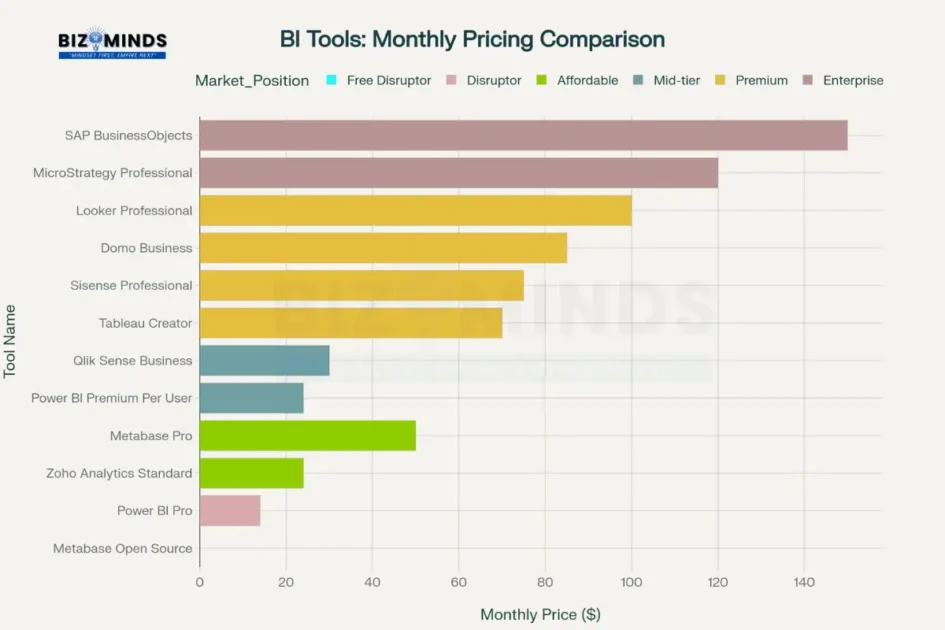
Monthly pricing comparison of popular business intelligence tools, highlighting the significant cost advantages of disruptive affordable solutions
The Great Business Intelligence Tools Disruption: Market Transformation
Traditional Enterprise Stranglehold Crumbles
The business intelligence tools market, valued at $31.98 billion in 2024 and projected to reach $63.20 billion by 2029, has experienced unprecedented disruption from affordable alternatives. Traditional enterprise solutions like Tableau Creator ($70/month), SAP BusinessObjects ($150/month), and MicroStrategy Professional ($120/month) maintained market dominance through feature complexity and integration capabilities, creating significant barriers to entry for small and medium businesses.
However, the emergence of strategically priced solutions has fundamentally altered competitive dynamics. Microsoft Power Business Intelligence Tools Pro, initially launched at $10 per user monthly and recently increased to $14 monthly, has captured 24.5% market share by delivering enterprise-grade functionality at dramatically reduced costs. This pricing strategy enabled organizations to deploy comprehensive business intelligence capabilities without the substantial capital investments traditionally required for Business Intelligence Tools implementations.
Affordable Solutions Drive Market Share Gains
The affordable Business Intelligence Tools segment, including open-source and budget-friendly commercial solutions, has captured approximately 35.2% adoption rate as of 2024, with projections indicating growth to 55% by 2029. This remarkable expansion reflects fundamental shifts in organizational attitudes toward data analytics accessibility and cost-effectiveness considerations.
Metabase, available as a completely free open-source solution, has gained traction among over 80,000 companies worldwide by eliminating licensing barriers entirely. The platform’s hosted Pro version, starting at $500 monthly for up to 10 users, provides enterprise features while maintaining significant cost advantages over traditional alternatives. Similarly, Zoho Analytics has positioned itself as an affordable alternative starting at $24 per user monthly, offering comprehensive BI capabilities with transparent pricing structures.

Business intelligence tools market share in 2024, highlighting the significant 15.2% capture by affordable and open-source solutions, alongside Microsoft’s dominant position
Cost Analysis: The Financial Revolution of Business Intelligence Tools
Dramatic Savings Across Organization Sizes
Financial analysis reveals staggering cost differentials between traditional and affordable Business Intelligence Tools solutions across various organizational scales. Small businesses with 5-25 users can reduce annual Business Intelligence Tools expenditures from $21,000 with traditional solutions to $7,200 with affordable alternatives, representing 66% cost savings. Medium-sized organizations managing 50-100 users achieve similar savings ratios, reducing costs from $84,000 to $28,800 annually.
Enterprise-level organizations demonstrate the most significant absolute savings potential. Companies deploying Business Intelligence Tools solutions for 1,000+ users can reduce annual costs from $840,000 with premium solutions like Tableau Creator to $168,000 with Power BI Pro, generating $672,000 in annual savings. These financial advantages enable organizations to reallocate substantial resources toward strategic initiatives while maintaining comprehensive analytics capabilities.
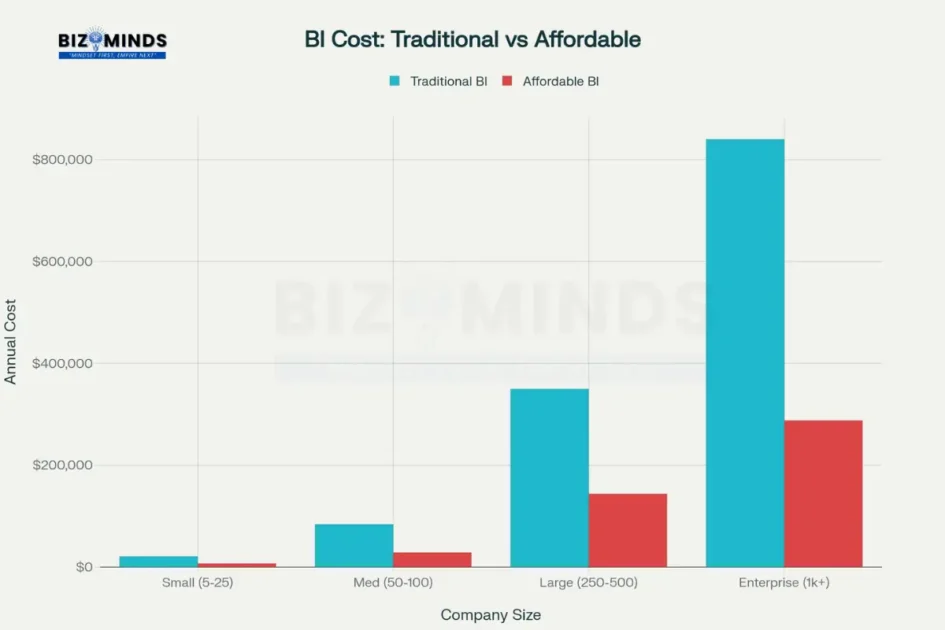
Cost comparison showing how affordable business intelligence tools deliver substantial savings across all company sizes, from small businesses to large enterprises
Return on Investment Acceleration
Research from Nucleus Research indicates organizations implementing business intelligence solutions achieve average returns of $13.01 for every dollar invested, with ROI figures increasing 20% compared to previous assessments. Affordable Business Intelligence Tools amplify these returns by reducing initial investment requirements while maintaining comparable analytical capabilities.
Case studies demonstrate measurable operational improvements following affordable Business Intelligence Tools implementations. New York Shipping Exchange tripled shipping volume after implementing cost-effective Business Intelligence Tools solutions that centralized data access and eliminated manual reporting processes. Similarly, organizations leveraging Power Business Intelligence Tools report 30% faster report generation, 20% cost reductions, and doubled data flow speeds compared to previous traditional BI implementations.
Feature Parity: Challenging Premium Assumptions
Comprehensive Capability Comparison
Detailed feature analysis reveals affordable Business Intelligence Tools achieve near-parity with premium alternatives across critical functionality domains. Power BI scores consistently high across data visualization (9/10), real-time analytics (9/10), and cloud deployment (10/10) capabilities, matching or exceeding premium competitor performance in most categories.
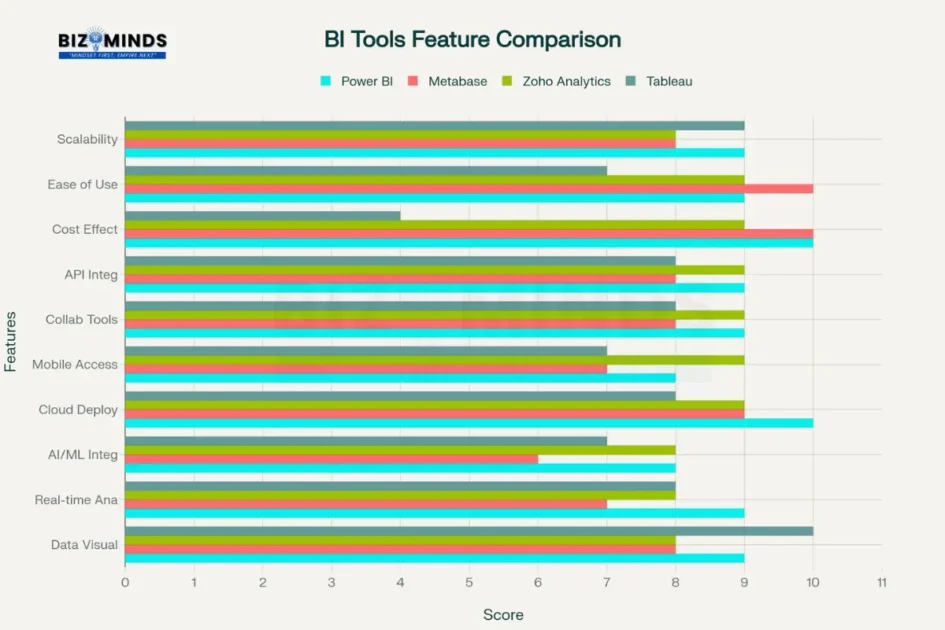
Comprehensive feature comparison showing how affordable BI tools like Power BI compete effectively with premium solutions across key capabilities
Metabase, despite its free pricing model, delivers strong performance in ease of use (10/10) and cost effectiveness (10/10) while maintaining acceptable scores across technical capabilities. The platform’s open-source architecture enables extensive customization possibilities, often exceeding proprietary solution flexibility while eliminating licensing restrictions entirely.
Advanced Analytics Democratization
Affordable solutions have successfully democratized advanced analytics capabilities previously restricted to enterprise budgets. Power BI incorporates artificial intelligence-powered insights, natural language querying through Copilot functionality, and machine learning integration at standard pricing tiers. These capabilities rival premium offerings while remaining accessible to organizations with limited budgets.
Zoho Analytics provides AI-powered insights through its Zia assistant, enabling natural language queries and automated trend detection at competitive pricing points. This democratization represents a fundamental shift in analytics accessibility, enabling data-driven decision-making across organizational hierarchies regardless of technical expertise levels.
Real-World Success Stories: Proof of Performance
Manufacturing Sector Transformation
Manufacturing organizations have achieved significant operational improvements through affordable BI implementations. A leading beverage manufacturer reduced reporting time by 30% and achieved 20% cost reductions following Power BI migration from traditional enterprise solutions. The implementation enabled real-time production monitoring, inventory optimization, and quality control improvements while eliminating expensive licensing fees.
Walmart’s finance organization standardized on Power BI for reporting and analytics, creating scalable and cost-effective solutions across their global operations. The implementation provided dynamic inventory adjustment capabilities, reducing carrying costs while minimizing stockout incidents through predictive analytics integration.
Healthcare and Service Industries
Healthcare providers
Healthcare providers have leveraged affordable BI solutions to revolutionize patient care analytics and operational efficiency. A leading healthcare provider transitioned from Tableau to Power BI, achieving cost savings through eliminated licenses while improving integration with existing Microsoft ecosystem tools. The migration enabled faster insights generation and simplified decision-making processes across clinical and administrative functions.
Service-based organizations
Service-based organizations like Starbucks utilize business intelligence tools to predict customer purchases and customize promotional offers, achieving 7% increases in comparable global store sales through personalized recommendation systems. These implementations demonstrate affordable BI tools’ capability to deliver sophisticated customer analytics at manageable cost structures.
Financial Services Innovation
Investment banking organizations have achieved remarkable returns through affordable BI implementations. One global investment bank reported 641% ROI with Oracle Fusion Data Intelligence Platform, generating $1.12 million in annual cost savings and 50% reductions in ServiceNow ticket volumes. While not specifically affordable BI, this demonstrates the ROI potential that budget-conscious solutions can similarly achieve.
Dollar Shave Club leveraged business intelligence to optimize marketing strategies and customer acquisition processes, ultimately achieving a $1 billion acquisition valuation through data-driven growth strategies. Their success illustrates how affordable BI tools can provide strategic advantages leading to substantial business outcomes.
Market Impact and Competitive Response
Pricing Pressure Across Industry
The success of affordable Business Intelligence Tools solutions has created industry-wide pricing pressure, forcing traditional vendors to reconsider their pricing strategies. Even Microsoft, despite its market-leading position, implemented the first Power BI price increase in nearly 10 years, raising Pro licensing from $10 to $14 monthly starting April 2025. This adjustment reflects ongoing development costs while maintaining competitive positioning against enterprise alternatives.
Traditional enterprise vendors have responded through feature differentiation and value-added services rather than direct price competition. Tableau emphasizes advanced visualization capabilities and storytelling tools, while SAP BusinessObjects focuses on enterprise integration and governance features. However, feature gaps continue narrowing as affordable solutions enhance their capabilities through regular updates and community-driven development.
Open-Source Acceleration
Open-source Business Intelligence Tools solutions have gained significant momentum as organizations seek cost-effective alternatives without vendor lock-in concerns. Metabase’s completely free core offering has attracted widespread adoption among startups and cost-conscious organizations, while Apache Superset and other open-source alternatives provide enterprise-grade capabilities without licensing restrictions.
This open-source acceleration creates additional competitive pressure on commercial vendors, forcing continuous innovation and pricing optimization to maintain market relevance. The trend toward open-source adoption particularly appeals to technically sophisticated organizations capable of managing self-hosted deployments while avoiding recurring licensing costs.
Strategic Implementation Considerations
Total Cost of Ownership Analysis
When assessing Business Intelligence Tools, organizations must look beyond sticker price to the full cost of ownership, which includes integration, training, and support. Affordable solutions distinguish themselves with transparent subscription or perpetual licensing models that avoid hidden fees.
Key factors to evaluate include:
- Licensing and subscription tiers (per user vs. capacity-based)
- Data integration and ETL tool costs
- Training time and enablement resources
- Ongoing maintenance and support fees
By choosing platforms with clear pricing—such as flat-rate monthly plans or open-source options—companies can accurately forecast budgets and avoid surprise expenditures that erode ROI.
Power BI’s seamless integration with Microsoft ecosystem tools reduces implementation complexity and training requirements for organizations already utilizing Office 365, Azure, or other Microsoft platforms. This integration advantage provides additional cost savings through reduced consulting fees and accelerated deployment timelines.
Dynamics benefit from:
- Prebuilt connectors to core Microsoft services
- Single sign-on (SSO) and unified identity management
- Shared governance and compliance controls
- Reduced need for third-party middleware
This tight integration minimizes consulting engagements and accelerates time-to-insight, ensuring projects stay on schedule and budget.
Scalability and Growth Planning
Scalable Business Intelligence Tools accommodate evolving data volumes and user counts without necessitating costly hardware upgrades. Cloud-native architectures enable on-demand resource allocation—compute and storage scale automatically as workloads increase.
Critical scalability considerations include:
- Auto-scaling compute clusters for peak reporting periods
- Elastic storage tiers to manage growing data lakes
- Multi-tenant vs. dedicated deployment options
- Performance monitoring and capacity alerts
This flexibility prevents over-provisioning while guaranteeing consistent performance under variable loads.
Zoho Analytics provides flexible deployment options including cloud, on-premises, and hybrid configurations, enabling organizations to optimize their implementation approach based on security requirements and cost considerations. This flexibility supports long-term growth planning while maintaining cost predictability.
Deployment flexibility supports:
- Data residency and sovereignty requirements
- Phased migrations from legacy on-premises systems
- Tailored network and access-control configurations
- Optimized total cost of ownership through selective cloud usage
By aligning deployment strategy to organizational priorities, businesses ensure long-term growth pathways remain both agile and cost-effective.
Future Business Intelligence Tools Market Trajectory
Continued Disruption Acceleration
Market projections indicate continued acceleration of affordable Business Intelligence Tools adoption, with the segment expected to capture a majority market share by 2029. As organizations prioritize lean operations, decision-makers increasingly favor platforms that deliver core analytics and visualization capabilities at minimal cost. This shift is driven by:
Key Elements of Business Intelligence Tools Adoption
- Transparent, subscription-based pricing models
- Cloud-native deployments eliminating infrastructure investment
- Rapid onboarding with prebuilt connectors to popular data sources
- Community-driven extensions and marketplace integrations
Artificial intelligence integration across affordable Business Intelligence Tools platforms will further enhance their competitive positioning. Vendors are embedding AI-driven recommendations, anomaly detection, and natural language query interfaces directly into standard offerings. For example:
Key AI Features
- Automated insight generation highlighting emergent trends
- Predictive forecasting models accessible through drag-and-drop modules
- Conversational querying powered by large language model backends
- Smart data preparation with AI-assisted data cleaning and enrichment
Innovation Through Competition
Competitive pressure from affordable Business Intelligence Tools solutions drives continued innovation across the entire BI market. Premium vendors are responding by investing heavily in advanced capabilities, ensuring their offerings remain differentiated on value-added services:
Key Innovation Areas
- Enhanced user experience with customizable, pixel-perfect dashboard design
- Deep learning and real-time streaming analytics pipelines
- Unified metadata layers for secure data governance and lineage tracking
- Embedded analytics SDKs for seamless integration into proprietary applications
This innovation cycle benefits all market participants, as affordable platforms adopt premium-level features while established vendors enhance value propositions through specialized enterprise-grade support services and industry-specific templates. Organizations can therefore choose solutions aligned precisely with their budgets, technical requirements, and domain needs, making data-driven decision-making ubiquitous across the global economy.
Conclusion
The democratization of Business Intelligence Tools has fundamentally altered the competitive landscape, enabling organizations of all sizes to harness data-driven insights with minimal financial risk. What once required substantial capital investments in enterprise-grade platforms is now accessible through subscription-based and open-source solutions, shifting decision-makers’ focus from budget constraints to strategic innovation.
As adoption of Business Intelligence Tools continues to grow, the industry’s emphasis has moved from purely expanding feature sets to enhancing user experience and accelerating time-to-value. Intuitive interfaces, prebuilt integrations, and AI-driven automation empower business users to self-serve analytics without relying on IT, driving greater operational agility and fostering a culture of continuous improvement.
The competitive response from traditional vendors has spurred an innovation renaissance across the BI ecosystem. Business Intelligence Tools developed by established providers now offer granular governance controls, advanced machine-learning pipelines, and real-time streaming analytics, ensuring that organizations can select solutions tailored to their unique requirements—whether the priority is cost, scale, or specialized capabilities.
Looking ahead, the evolution of Business Intelligence Tools will be defined by seamless AI integration, deeper cloud-native optimization, and expanded industry-specific templates. These advancements promise to further lower barriers to entry, enabling every department—from marketing to finance—to leverage data insights as a core driver of business growth and resilience.
Frequently Asked Questions / People Also Ask
What makes affordable Business Intelligence Tools competitive with enterprise solutions?
Affordable Business Intelligence Tools achieve competitiveness through cloud-native architectures, automated deployment capabilities, and focus on core analytics functionality rather than extensive enterprise features. Modern solutions like Power BI and Zoho Analytics provide comprehensive data visualization, real-time analytics, and AI integration at fraction of traditional costs while maintaining professional-grade security and scalability.
How do organizations calculate ROI for BI implementations?
BI ROI calculations should include direct cost savings from automated reporting, improved decision-making speed, reduced data analysis time, and operational efficiency gains. Research indicates average returns of $13.01 per dollar invested, with affordable solutions amplifying returns through reduced initial investments while delivering comparable analytical capabilities and business outcomes.
What are the primary risks of switching from expensive to affordable BI tools?
Primary risks include potential feature gaps in specialized enterprise functions, migration complexity for existing implementations, and reduced vendor support levels. However, modern affordable solutions increasingly match enterprise feature sets while providing community support, extensive documentation, and professional services options to mitigate implementation risks.
Which industries benefit most from affordable BI disruption?
Small to medium businesses across all industries benefit significantly, particularly retail, manufacturing, healthcare, and professional services organizations. These sectors often lacked access to sophisticated analytics due to cost barriers, but affordable solutions enable data-driven decision making previously limited to large enterprises with substantial BI budgets.
How do open-source BI tools compare to commercial affordable options?
Open-source tools like Metabase provide maximum cost advantages with complete feature access but require technical expertise for deployment and maintenance. Commercial affordable options offer professional support, hosted services, and easier implementation at modest cost premiums, making them suitable for organizations preferring vendor-managed solutions over self-hosted deployments.
What future developments will impact the affordable BI market?
Expected developments include increased AI/ML integration, enhanced mobile capabilities, improved natural language processing, and continued cloud-native optimization. These advances will further democratize advanced analytics while maintaining cost advantages, potentially accelerating enterprise vendor price pressure and market share shifts toward affordable alternatives.
Citations
- https://infomineo.com/blog/the-best-business-intelligence-bi-software-in-2025/
- https://www.ideas2it.com/blogs/tableau-to-power-bi
- https://solutionsreview.com/business-intelligence/whats-changed-2024-gartner-magic-quadrant-for-analytics-and-business-intelligence-platforms/
- https://powerbi.microsoft.com/en-us/blog/important-update-to-microsoft-power-bi-pricing/
- https://scoop.market.us/business-intelligence-statistics/
- https://www.metabase.com/lp/business-intelligence-demo
- https://embeddable.com/blog/metabase-vs-power-bi
- https://www.zoho.com/analytics/insightshq/power-bi-alternatives.html
- https://www.zoho.com/analytics/insightshq/best-self-service-bi-tools.html
- https://www.metabase.com
- https://webdashboard.com/power-bi-price-increases/
- https://www.yellowfinbi.com/blog/bi-and-analytics-delivering-over-1300-roi-according-to-nucleus-research-do-you-b
- https://www.atlassian.com/data/business-intelligence/7-real-world-use-cases
- https://croclub.com/data-reporting/business-intelligence-examples/
- https://www.winwire.com/blog/tableau-to-power-bi-migration-case-studies/
- https://multishoring.com/blog/enterprise-business-intelligence/
- https://valiotti.com/blog/metabase-review/
- https://www.microsoft.com/en-us/power-platform/products/power-bi/enterprise
- https://www.zoho.com/analytics/
- https://datasemantics.co/power-bi-migration-success-story/
- https://www.microsoft.com/en/customers/story/1557385809666881648-walmart-retailer-power-bi
- https://nucleusresearch.com/research/single/oracle-fusion-data-intelligence-platform-roi-case-study-investment-bank/
- https://www.binarysemantics.com/blogs/business-intelligence-for-small-businesses/
- https://www.holistics.io/bi-tools/self-service/
- https://www.zoho.com/analytics/business-intelligence-bi-software.html
- https://www.appsruntheworld.com/top-10-analytics-and-bi-software-vendors-and-market-forecast/
- https://www.domo.com/learn/article/business-intelligence-tools
- https://www.domo.com/learn/article/open-source-bi-tools
- https://www.openpr.com/news/4139074/business-intelligence-tools-market-hits-new-high-microsoft
- https://www.uneecops.com/blog/best-business-intelligence-tools-comparison-for-2024/
- https://zapier.com/blog/business-intelligence-software/
- https://www.thoughtspot.com/data-trends/business-intelligence/business-intelligence-tools
- https://www.integrate.io/blog/top-business-intelligence-tools/
- https://www.holistics.io/blog/bi-tools-comparison-matrix/
- https://www.fortunebusinessinsights.com/business-intelligence-bi-market-103742
- https://www.netguru.com/blog/open-source-bi-tools
- https://www.reddit.com/r/BusinessIntelligence/comments/1coccmm/seeking_recommendations_for_affordableopensource/
- https://estuary.dev/blog/business-intelligence-tools/
- https://mopinion.com/business-intelligence-bi-tools-overview/
- https://www.analytics8.com/blog/bi-tool-comparison-choosing-the-best-analytics-tool-for-business/
- https://www.sigmacomputing.com/resources/announcements/business-intelligence-is-at-a-breaking-point-new-report-finds
- https://ajelix.com/bi/self-service-business-intelligence-tools/
- https://www.passionned.com/business-intelligence/tools/
- https://www.grow.com/blog/are-business-intelligence-tools-still-relevant
- https://www.spec-india.com/blog/business-intelligence-tools
- https://www.gooddata.com/resources/comparing-best-business-intelligence-tools/
- https://www.netsuite.com/portal/resource/articles/business-strategy/business-intelligence-examples.shtml
- https://www.helicalinsight.com/top-10-bi-tools-for-2025/
- https://competitiveanalytics.com/case-studies-index
- https://www.veritis.com/blog/from-data-to-decisions-the-best-business-intelligence-tools/
- https://www.coursera.org/articles/bi-software
- https://www.grow.com/blog/are-expensive-analytics-tools-worth-it-cutting-costs-with-effective-bi-solutions
- https://www.impactmybiz.com/blog/5-must-read-business-intelligence-case-studies/
- https://cobit-solutions.com/en/15-power-bi-success-stories/
- https://www.interviewquery.com/p/business-intelligence-case-studies
- https://vidi-corp.com/business-intelligence-case-studies/
- https://www.cloudzero.com/blog/cloud-business-intelligence-tools/
- https://www.scnsoft.com/case-studies/business-intelligence
- https://www.intelligentaudit.com/blog/business-intelligence-in-2024-actionable-strategies-toward-efficiency
- https://www.aufaitux.com/blog/power-bi-vs-other-bi-tools/
- https://www.reddit.com/r/BusinessIntelligence/comments/181l4jt/opinions_on_power_bi_compared_to_other_bi_tools/
- https://www.zoho.com/analytics/insightshq/power-bi-limitations.html
- https://www.forbes.com/sites/markminevich/2023/12/14/the-dawn-of-ai-disruption-how-2024-marks-a-new-era-in-innovation/
- https://www.dynamicssquare.com/blog/power-bi-pricing-and-licensing-free-vs-pro-vs-premium/
- https://learn.microsoft.com/en-us/power-bi/guidance/powerbi-implementation-planning-usage-scenario-enterprise-bi
- https://sranalytics.io/blog/top-bi-tools/
- https://datafortune.com/top-business-intelligence-tools-in-2025/
- https://www.technavio.com/report/business-intelligence-market-industry-analysis
- https://www.microsoft.com/en-us/power-platform/products/power-bi/pricing
- https://www.itmagination.com/blog/power-bi-solutions-in-modern-enterprises
- https://github.com/metabase/metabase
- https://jaipuriamba.edu.in/business-intelligence-tools-for-decision-making/
- https://www.linkedin.com/pulse/business-intelligence-tools-market-regional-analysis-xugfc
- https://www.acceldata.io/blog/open-source-reporting-smarter-insights-zero-costs
- https://www.metabase.com/pricing/
- https://www.dchbi.com/post/top-business-intelligence-tools-for-small-businesses-in-2024
- https://www.clariontech.com/blog/top-10-power-bi-dashboard-use-cases-for-fortune-500
- https://www.domo.com/learn/article/small-business-business-intelligence
- https://www.beyondkey.com/casestudy/manufacturing-power-bi
- https://www.ifourtechnolab.com/blog/power-bi-use-cases
- https://digitaldefynd.com/IQ/business-analytics-case-studies/
- https://10senses.com/blog/what-is-the-roi-of-business-intelligence/
- https://www.qlik.com/us/business-intelligence-tools
- https://www.kmworld.com/WhitePapers/KMWhitePaper/9713-4-Case-Studies-in-Market-Intelligence-ROI.htm