

7 Essential Data Backup Recovery Solutions for 2025
In an era where digital transformation drives business success, data backup recovery solutions have evolved from optional safety nets to mission-critical infrastructure that determines organizational survival. The devastating impact of data loss continues to escalate, with organizations facing average recovery costs of $1.53 million per ransomware incident and experiencing downtime that can destroy 93% of companies within a year. Modern enterprises cannot afford to treat backup recovery solution implementation as an afterthought—the stakes are simply too high in today’s interconnected business landscape.
The enterprise backup and recovery market has experienced remarkable expansion, growing from $25.8 billion in 2025 to a projected $54.6 billion by 2030. This explosive growth reflects not merely increased spending but a fundamental shift in how organizations perceive data backup recovery—transforming from reactive disaster recovery to proactive business continuity enablement. US companies are particularly driving this transformation, with 88% of enterprises now viewing comprehensive data backup recovery solution strategies as essential competitive differentiators rather than operational overhead.
The urgency for robust protection has never been more pronounced, particularly as ransomware attacks have become increasingly sophisticated and financially devastating. In 2025, only 54% of organizations successfully restored data using backups after ransomware attacks, representing a six-year low in backup effectiveness. This alarming statistic underscores the critical gap between having basic data backup recovery systems and achieving reliable recovery outcomes when organizations face their darkest moments.
As we advance through 2025, the convergence of escalating cyber threats, stringent regulatory requirements, and hybrid cloud complexities demands a new generation of data backup recovery solution approaches. Organizations must navigate an increasingly perilous digital environment where traditional protection methods prove inadequate against modern threats, while simultaneously delivering measurable return on investment and supporting ambitious digital transformation initiatives that drive business growth and innovation.

Enterprise backup and recovery market showing steady growth from $12.5B in 2020 to projected $54.6B in 2030
The Critical State of Data Backup Recovery in 2025
Escalating Threat Landscape
The ransomware epidemic has fundamentally altered the data backup recovery solution landscape. In 2025, only 54% of organizations successfully restored data using backups after ransomware attacks, representing a six-year low in backup effectiveness. This alarming statistic underscores a critical gap between having backup systems and achieving reliable recovery outcomes. Meanwhile, average ransom demands have surged to $1.13 million, with 74% of attacks now employing double extortion tactics that steal data before encryption.
The statistics paint a sobering picture for US enterprises. Healthcare organizations alone experienced 720 data breach incidents in 2024, compromising 186 million records and reinforcing the sector’s position as the most expensive for data breach recovery at $9.77 million per incident. These figures highlight the inadequacy of traditional backup approaches in confronting sophisticated modern threats.
Infrastructure Vulnerabilities
Despite technological advances, backup failure rates remain troublingly high. Current data reveals that 58% of backup attempts fail during recovery due to outdated technology, inadequate testing, and configuration errors. Hardware failures account for 28% of backup system failures, followed by software issues at 24% and human error at 21%. These vulnerabilities create dangerous gaps in data protection strategies, leaving organizations exposed when they most need reliable recovery capabilities.
Backup Failure Analysis
| Failure Type | Percentage | Average Recovery Time Hours |
| Hardware Failure | 28 | 48 |
| Software Issues | 24 | 36 |
| Human Error | 21 | 72 |
| Network Problems | 15 | 24 |
| Configuration Errors | 12 | 18 |
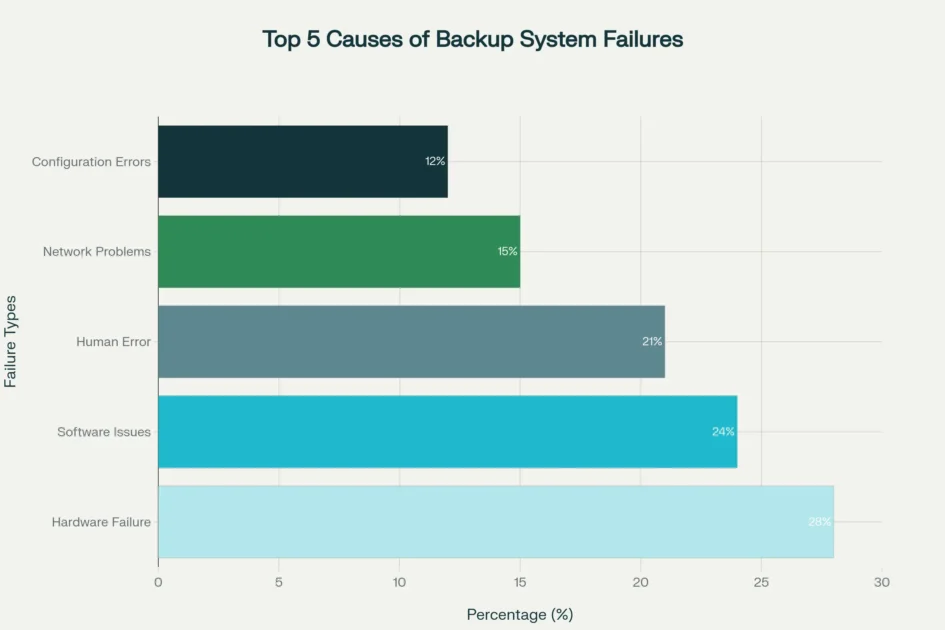
Horizontal bar chart displaying the primary causes of backup system failures, with hardware failure being the leading cause at 28%
The complexity of modern IT environments compounds these challenges. Organizations operating hybrid cloud infrastructures struggle with fragmented backup policies, inconsistent data governance, and limited visibility across distributed systems. Only 5% of organizations report fully automated cloud backup posture management, despite 79% investing in backup improvements. This automation gap creates operational inefficiencies and increases the likelihood of human error during critical recovery operations.
Solution 1: Veeam Backup & Replication – The VMware Virtualization Leader
Veeam Backup & Replication continues to dominate the virtualized environment protection market, offering unparalleled VM recovery capabilities with sub-15-minute recovery time objectives (RTO). The platform’s strength lies in its comprehensive virtualization support, extending beyond traditional VMware environments to encompass Hyper-V, AWS, Azure, and Google Cloud platforms.
Key Differentiators
Veeam’s instant VM recovery feature enables organizations to power on virtual machines directly from backup storage, eliminating lengthy restoration processes during critical downtime events. The platform’s built-in WAN acceleration optimizes data transfer across distributed locations, while advanced monitoring provides real-time visibility into backup job status and storage utilization.
The solution’s ransomware protection capabilities include immutable backup repositories and automated malware scanning during backup operations. These features proved invaluable for a major US logistics company that successfully restored operations within two hours following a ransomware attack, avoiding the $900,000 in potential revenue losses.
Investment Considerations
Starting at $899 annually, Veeam delivers exceptional value for organizations with substantial virtual machine deployments. The platform’s hybrid cloud architecture supports both on-premises and cloud storage targets, enabling flexible data placement strategies that balance cost optimization with recovery performance requirements.
Backup Solutions Comparison
| Solution | Deployment Model | Target Market | Key Strength | RTO Minutes | RPO Minutes | Starting Price Annual | Ransomware Protection |
| Veeam Backup & Replication | Hybrid Cloud | SMB to Enterprise | VM Recovery Speed | < 15 | 15-60 | $899 | Advanced |
| Commvault Complete Data Protection | Multi-Cloud | Enterprise | Global Deduplication | < 30 | 30-120 | $2,500 | Enterprise |
| Acronis Cyber Protect | Hybrid Cloud | SMB to Mid-Market | Integrated Security | < 20 | 15-90 | $599 | Integrated |
| Rubrik Cloud Data Management | Cloud-Native | Enterprise | Policy Automation | < 10 | 5-30 | $1,800 | AI-Powered |
| N2WS (AWS/Azure Native) | Cloud-Native | Cloud-First Organizations | AWS/Azure Integration | < 5 | 1-15 | $500 | Immutable Storage |
| Cohesity DataHawk | Software-Defined | Large Enterprise | Data Management | < 25 | 30-180 | $3,200 | Cyber Vaulting |
| Veritas NetBackup | Enterprise On-Premises | Large Enterprise | Enterprise Scale | < 45 | 60-240 | $1,200 | Traditional |
Solution 2: Commvault Complete Data Protection – Enterprise Data Backup Recovery Solution with Global Deduplication
Commvault represents the gold standard for large enterprise data backup recovery implementations, offering sophisticated global deduplication capabilities that can reduce storage requirements by up to 70%. The platform’s software-defined architecture provides comprehensive workload protection across physical, virtual, cloud, and SaaS environments through a unified management interface.
Advanced Data Management in Enterprise Data Backup Recovery Solutions
Commvault’s intelligent data classification and automated lifecycle management policies ensure that data backup recovery processes align with business requirements and regulatory mandates. The platform’s global deduplication technology operates across multiple sites, dramatically reducing storage costs and bandwidth requirements for geographically distributed organizations.
Real-world implementation at Atresmedia demonstrated Commvault’s enterprise capabilities, achieving 40% improvements in both RTO and recovery point objectives (RPO) while enabling critical data recovery within two-hour thresholds. This performance proved essential for maintaining broadcast operations during infrastructure incidents.
Enterprise Investment Profile
With annual licensing starting at $2,500, Commvault targets large enterprises requiring comprehensive data management capabilities. The platform’s total cost of ownership benefits emerge through reduced storage infrastructure requirements and operational efficiency gains from centralized data management.
Solution 3: Acronis Cyber Protect – Integrated Security-First Approach
Acronis Cyber Protect distinguishes itself by integrating cybersecurity directly into data backup recovery solution architecture, providing unified protection against modern threats. The platform combines traditional backup capabilities with advanced threat detection, vulnerability assessments, and endpoint protection in a single solution.
Cybersecurity Integration in Data Backup Recovery Solutions
The platform’s behavioral analysis engine continuously monitors backup data for ransomware indicators, automatically quarantining suspicious activities before they can compromise recovery capabilities. This proactive approach proved critical during Hurricane Sandy, where an Acronis customer-maintained operations throughout a three-day power outage, generating $900,000 in avoided losses against a $50,000 annual investment—delivering an impressive 1,700% ROI.
Acronis’ blockchain-based data authentication ensures backup integrity by creating immutable records of all backup operations. This technology provides cryptographic proof of data authenticity, essential for regulatory compliance and forensic investigations.
Mid-Market Positioning
Priced at $599 annually, Acronis targets small to mid-market organizations seeking comprehensive protection without enterprise complexity. The solution’s rapid deployment capability enables protection within 20 minutes of installation, making it ideal for organizations with limited IT resources.

Dual chart showing inverse relationship between increasing ransom payments and decreasing data backup recovery success rates from 2020-2025
Solution 4: Rubrik Cloud Data Management – AI-Powered Policy Automation
Rubrik revolutionizes traditional data backup recovery approaches through artificial intelligence and machine learning integration. The platform’s policy-driven automation eliminates manual backup management tasks while providing predictive analytics for capacity planning and performance optimization.
Intelligent Automation
Rubrik’s AI-powered threat detection analyzes backup data patterns to identify anomalies that may indicate security compromises or data corruption. The system automatically adjusts backup frequencies and retention policies based on data importance scoring and access patterns, optimizing storage utilization without compromising recovery capabilities.
The platform’s instant recovery architecture enables application restoration within 10 minutes, supported by sophisticated deduplication algorithms that reduce storage footprints by up to 95%. This performance proves essential for mission-critical applications that cannot tolerate extended downtime periods.
Innovation Investment
At $1,800 annually, Rubrik represents a premium investment in next-generation data backup recovery solution technology. The platform’s cloud-native architecture eliminates traditional infrastructure constraints while providing unlimited scalability for growing data volumes.
Solution 5: N2WS (AWS/Azure Native) – Cloud-First Optimization
N2WS delivers purpose-built data backup recovery solutions for cloud-native organizations operating primarily within AWS and Azure ecosystems. The platform’s deep cloud integration provides features unavailable through generic backup solutions, including cross-region replication, automated disaster recovery testing, and granular cost optimization.
Cloud-Native Advantages
N2WS leverages native cloud services to achieve recovery time objectives under 5 minutes through instant volume snapshots and automated infrastructure provisioning. The platform’s immutable storage integration using services like Amazon S3 Glacier provides ransomware-resistant protection at significantly lower costs than traditional backup infrastructure.
Skechers successfully implemented N2WS across their complex multi-cloud environment, achieving standardized backup policies while reducing operational overhead by 92% through intelligent lifecycle management. The retailer’s implementation demonstrates the platform’s ability to manage enterprise-scale deployments while maintaining cost efficiency.
Cost-Effective Cloud Protection
Starting at $500 annually, N2WS provides exceptional value for cloud-centric organizations. The platform’s usage-based pricing model scales automatically with infrastructure growth, eliminating capacity planning complexities and overprovisioning costs.
Solution 6: Cohesity DataHawk – Software-Defined Data Management Platform
Cohesity transforms traditional backup approaches by creating a comprehensive data management platform that combines backup, archival, analytics, and compliance capabilities. The platform’s software-defined architecture eliminates infrastructure silos while providing global search and instant recovery at scale.
Unified Data Platform
Cohesity’s Helios AI-driven interface provides centralized visibility and control across distributed data centers and cloud environments. The platform’s global search capabilities enable rapid data location and recovery, while SLA-based backup policies ensure consistent protection across diverse workloads.
The solution’s cyber vaulting capabilities create air-gapped recovery environments that remain isolated from production networks during normal operations. This architecture proved essential for a major financial services firm that successfully recovered from a sophisticated ransomware attack without paying ransom demands or experiencing extended service disruptions.
Enterprise Platform Investment
At $3,200 annually, Cohesity targets large enterprises requiring comprehensive data management capabilities beyond traditional backup functionality. The platform’s unified architecture reduces management complexity while providing advanced analytics and compliance reporting capabilities.
Solution 7: Veritas NetBackup – Traditional Enterprise Reliability
Veritas NetBackup maintains its position as the trusted choice for large enterprises with complex, heterogeneous IT environments. The platform’s mature architecture supports virtually every storage system, application, and operating system combination, making it ideal for organizations with extensive legacy infrastructure investments.
Comprehensive Platform Support
NetBackup’s extensive compatibility matrix encompasses mainframe systems, legacy Unix platforms, and modern cloud services through a single management interface. The platform’s proven scalability supports petabyte-scale deployments while maintaining consistent performance and reliability standards.
The solution’s advanced deduplication technology operates across storage targets and geographic locations, optimizing bandwidth utilization and reducing storage costs. NetBackup’s automated disaster recovery capabilities include site failover orchestration and application-specific recovery procedures for complex enterprise applications.
Enterprise Heritage Investment
Starting at $1,200 annually, NetBackup represents a substantial investment in proven enterprise data backup recovery solution technology. The platform’s extensive feature set and professional services ecosystem provide comprehensive support for mission-critical implementations.
Implementation Strategy and Best Practices
Assessment and Planning Framework
Successful data backup recovery implementation begins with comprehensive risk assessment and business impact analysis. Organizations must evaluate their current data protection gaps, identify critical business applications, and establish realistic recovery objectives based on business requirements rather than technical convenience.
The assessment process should quantify potential data loss impacts in financial terms, considering not only direct recovery costs but also business interruption, regulatory penalties, and reputational damage. This analysis provides the foundation for ROI calculations that justify investment in robust data backup recovery solutions.

Industry-specific Recovery Time Objectives showing Financial Services requiring fastest recovery at 5 minutes
Automation and Testing Imperatives
Modern data backup recovery strategies must prioritize automation to eliminate human error and ensure consistent protection. Automated backup validation, recovery testing, and capacity management reduce operational overhead while improving reliability. Only 37% of organizations currently ensure their backups remain clean before restoration, highlighting the critical need for automated integrity verification.
Regular disaster recovery testing validates backup effectiveness and identifies potential recovery obstacles before actual incidents occur. Organizations should conduct quarterly recovery drills that simulate realistic failure scenarios, measuring actual recovery times against established objectives.
Hybrid Architecture Optimization
The future of data backup recovery lies in hybrid architectures that combine on-premises performance with cloud economics and scalability. Organizations should design backup strategies that leverage local storage for rapid recovery while utilizing cloud storage for long-term retention and geographic distribution.
This approach balances cost optimization with performance requirements, enabling organizations to achieve aggressive recovery objectives without prohibitive infrastructure investments. Cloud storage costs have decreased to $0.01-$0.05 per GB monthly for archival tiers, making long-term retention economically viable.

Stacked area chart showing the shift from on-premises to cloud backup solutions, with cloud adoption reaching 68% in 2025
Emerging Technologies and Future Trends
Artificial Intelligence Integration
AI and machine learning technologies are transforming data backup recovery solution capabilities through predictive analytics, automated threat detection, and intelligent data classification. These technologies enable proactive identification of potential failures, optimization of backup schedules based on data usage patterns, and automated response to security incidents.
Machine learning algorithms analyze historical backup patterns to predict optimal backup windows, reducing impact on production systems while ensuring comprehensive protection. AI-powered anomaly detection identifies potential ransomware activities before encryption occurs, enabling rapid response and containment.
Quantum-Resistant Security
As quantum computing advances threaten current cryptographic standards, data backup recovery solutions must evolve to incorporate quantum-resistant encryption algorithms. Organizations should evaluate backup solutions for their cryptographic agility and ability to migrate to post-quantum cryptography standards as they become available.
This preparation ensures long-term data protection investments remain viable as security technologies evolve. Early adoption of quantum-resistant backup solutions provides competitive advantages and regulatory compliance as new standards emerge.
Regulatory Compliance and Risk Management for Data Backup Recovery Solutions
Evolving Compliance Landscape
US organizations face increasingly stringent data protection regulations across federal, state, and industry-specific requirements. Data backup recovery solutions must provide comprehensive audit trails, data residency controls, and automated compliance reporting to meet evolving regulatory mandates.
The cost of non-compliance continues to escalate, with 32% of data breaches resulting in regulatory fines exceeding $100,000. Modern backup solutions must integrate compliance management capabilities that simplify regulatory reporting while ensuring data protection practices meet current requirements.
Risk-Based Protection Strategies
Effective data backup recovery programs implement risk-based approaches that prioritize protection investments based on business impact analysis. Organizations should classify data assets according to their business criticality, regulatory requirements, and recovery urgency to optimize protection strategies and resource allocation.
This approach ensures mission-critical systems receive appropriate protection levels while avoiding over-investment in low-risk data categories. Risk-based strategies typically reduce overall backup costs by 30-40% while improving recovery capabilities for critical business functions.
Cost Optimization and ROI Analysis for Data Backup Recovery Solutions
Total Cost of Ownership Modeling
Data backup recovery solution investments require comprehensive total cost of ownership analysis that encompasses licensing, infrastructure, operational, and opportunity costs. Organizations must evaluate not only initial implementation expenses but also ongoing maintenance, training, and upgrade requirements.
Effective TCO modeling includes quantification of avoided losses through improved recovery capabilities. A typical enterprise backup solution with $200,000 five-year TCO can deliver 100% ROI through prevention of a single major data loss incident. This analysis provides compelling justification for investment in robust protection capabilities.
Cloud Economics Optimization for Data Backup Recovery Solutions
Cloud-based data backup recovery solutions offer flexible cost structures that align expenses with actual resource consumption. Organizations can optimize costs through intelligent data tiering, automated lifecycle management, and usage-based pricing models that eliminate overprovisioning.
Successful cloud backup implementations typically achieve 40-60% cost reductions compared to traditional on-premises solutions while improving recovery capabilities and operational flexibility. These savings result from elimination of hardware refresh cycles, reduced facility requirements, and operational efficiency gains.
Conclusion
In 2025, the imperative for robust data backup recovery strategies has never been clearer. Organizations face escalating cyber threats and increasingly stringent regulations that demand proactive, resilient protection measures. By investing in comprehensive backup recovery solutions, businesses not only safeguard critical assets but also reinforce customer trust and brand reputation in an era where data integrity underpins competitive advantage.
Selecting the right backup recovery solution requires a tailored approach that aligns with specific operational needs, budget constraints, and growth objectives. Whether leveraging hybrid cloud architectures for rapid recovery or adopting cloud-native platforms for scalable protection, decision-makers must balance performance, cost, and complexity. A well-defined risk assessment and business impact analysis guide this process, ensuring investments in data backup recovery deliver measurable ROI and operational resilience.
Looking ahead, emerging technologies such as AI-driven automation and quantum-resistant encryption will reshape backup recovery solutions, enabling predictive failure detection and future-proof data security. Integrating intelligent analytics into backup workflows enhances recovery reliability, while preparing for post-quantum cryptography ensures long-term protection. Organizations that embrace these innovations will stay ahead of evolving threats and regulatory demands in the rapidly changing data protection landscape.
Ultimately, robust data backup recovery practices are not merely an IT safeguard but a strategic enabler of business continuity and innovation. By prioritizing reliable recovery objectives, continuous testing, and adaptive technologies, enterprises can transform backup from a compliance checkbox into a catalyst for operational excellence. In doing so, they secure their digital future and empower growth in an increasingly data-driven world.
Citations
- https://www.brightdefense.com/resources/ransomware-statistics/
- https://ontech.com/data-backup-statistics/
- https://www.datainsightsmarket.com/reports/enterprise-backup-and-recovery-solutions-526964
- https://cyberfortress.com/blog/record-ransomware-payouts-in-q2-2025-underscore-need-for-resilience/
- https://www.infrascale.com/data-loss-statistics-usa/
- https://invenioit.com/continuity/disaster-recovery-statistics/
- https://info.cloudcarib.com/blog/backup-failures
- https://www.eon.io/blog/2025-state-cloud-backup
- https://v2cloud.com/blog/backup-and-recovery-solutions
- https://dl.acronis.com/u/rc/WP_ROI_of_Disaster_Recovery_EN-US_200910.pdf
- https://buzzclan.com/managed-it/data-backup-and-recovery/
- https://www.datamation.com/big-data/data-recovery-use-cases/
- https://storware.eu/blog/5-enterprise-backup-solutions-to-consider-in-2025/
- https://n2ws.com/blog/cloud-backup-solutions
- https://n2ws.com/solutions/case-studies
- https://www.calamu.com/blog/top-10-cyber-recovery-stats-you-cant-ignore
- https://www.pulseway.com/blog/backup-pricing
- https://www.brightdefense.com/resources/data-breach-statistics/
- https://www.futuremarketinsights.com/reports/cloud-based-backup-services-market
- https://www.dell.com/en-us/lp/enterprise-backup-solutions
- https://www.unitrends.com/solutions/enterprise-backup-solutions/
- https://www.grandviewresearch.com/horizon/outlook/cloud-backup-market/india
- https://www.salesforce.com/in/platform/data-backup-recovery/
- https://infodot.co.in/blog/top-10-enterprise-cloud-backup-services-to-know/
- https://expertinsights.com/backup-and-recovery/cloud-backup-stats
- https://www.cohesity.com/solutions/backup-and-recovery/
- https://www.hycu.com/blog/12-best-enterprise-data-backup-recovery-solutions-right-now
- https://www.eon.io/state-cloud-backup-report
- https://www.rubrik.com/lp/analyst-reports/gartner-mq
- https://www.baculasystems.com/blog/best-enterprise-backup-solutions/
- https://n2ws.com/blog/cloud-computing-statistics
- https://www.commvault.com/platform/backup-and-recovery
- https://www.redstor.com/resource-hub/top-10-enterprise-backup-solutions/
- https://www.serverion.com/uncategorized/top-5-backup-performance-metrics-to-track/
- https://deepstrike.io/blog/ransomware-payout-statistics-2025
- https://www.hipaajournal.com/healthcare-data-breach-statistics/
- https://www.sophos.com/en-us/content/state-of-ransomware
- https://www.ibm.com/reports/data-breach
- https://www.exabeam.com/explainers/information-security/top-ransomware-statistics-and-recent-ransomware-attacks-2025/
- https://www.upguard.com/blog/biggest-data-breaches-us
- https://n2ws.com/blog/ransomware-statistics
- https://www.verizon.com/business/resources/reports/dbir/
- https://www.veeam.com/blog/state-of-data-backup.html
- https://www.fortinet.com/resources/cyberglossary/ransomware-statistics
- https://informationisbeautiful.net/visualizations/worlds-biggest-data-breaches-hacks/
- https://www.werecoverdata.com/clients/recovery-case-studies
- https://www.flatworldsolutions.com/insurance/case-studies/business-continuity.php
- https://nextperimeter.com/it-blog/backup-system-immediate-roi/
- https://www.betsol.com/case-study/delivered-seamless-backup-and-disaster-recovery/
- https://www.edstellar.com/blog/business-continuity-case-studies
- https://www.unitrends.com/blog/how-to-prove-the-roi-of-your-backup-investment/
- https://axcient.com/case-studies/
- https://intervision.com/blog-real-world-examples-of-disaster-recovery-using-aws/
- https://www.meegle.com/en_us/topics/cloud-backup/cloud-backup-roi-analysis
- https://biztechmagazine.com/article/2019/03/world-backup-day-3-backup-and-recovery-success-stories
- https://hoop.dev/blog/8-real-life-stories-of-disaster-recovery-success-in-difficult-situations/
- https://www.keepit.com/blog/the-roi-of-cloud-backup/
- https://www.optimum-web.com/disaster-recovery-and-backup-plan-case-study/
- https://www.csharptek.com/casestudy/azure-disaster-recovery-saved-client
- https://www.spanning.com/resources/roi-microsoft-office-365-backup/
- https://www.ontrack.com/en-us/case-studies
- http://www.sifytechnologies.com/europe/blog/heres-enterprise-disaster-recovery-system/
- https://www.marketresearchfuture.com/reports/data-recovery-software-market-5739
- https://learn.microsoft.com/en-us/microsoft-365/backup/backup-pricing?view=o365-worldwide
- https://aws.amazon.com/backup/pricing/
- https://www.openpr.com/news/4209270/professional-data-recovery-software-market-to-reach-usd-3-2
- https://cloud.google.com/backup-disaster-recovery/pricing
- https://www.researchandmarkets.com/report/global-data-recovery-service-market
- https://www.novabackup.com/blog/data-protection-trends-in-2025
- https://www.verifiedmarketresearch.com/product/data-recovery-software-market/
- https://gogeekz.com/data-backup-disaster-recovery-trends-2025/
- https://learn.microsoft.com/en-us/azure/backup/azure-backup-pricing
- https://www.grandviewresearch.com/industry-analysis/data-protection-recovery-solutions-market
- https://www.unitrends.com/media/downloads/resources/The-State-of-Backup-and-Recovery-Report-2025.pdf
- https://www.dataarchiva.com/detailed-analysis-of-salesforce-data-backup-cost/
- https://www.verifiedmarketreports.com/product/data-recovery-service-market/
- https://www.infrascale.com/data-backup-solutions-statistics-usa/
- https://www.dbta.com/Columns/Next-Gen-Data-Management/The-Cost-Benefit-Analysis-of-Database-Backup-Strategies-153236.aspx