
9 Top Career Assessment Tools for Confident Job Decisions
Career assessment tools have revolutionized the modern American workplace, serving as sophisticated instruments that transform how professionals navigate their career trajectories and make strategic job decisions. These comprehensive evaluation systems have become essential resources in an employment environment where 42% of job seekers actively considered changing positions in the past year, while 94% of employers now recognize that skills-based hiring approaches provide superior job performance predictions compared to traditional recruitment methods. The strategic implementation of career assessment tools bridges the critical gap between individual potential and sustainable career success, offering data-driven insights that support both personal fulfillment and organizational effectiveness.
The widespread adoption of career assessment tools reflects a fundamental paradigm shift in how Americans approach professional development and career planning strategies. Contemporary research demonstrates that organizations utilizing pre-employment assessments experience remarkable outcomes, including 39% lower employee turnover rates and 23% higher employee engagement levels when implementing strengths-based development programs. These compelling statistics underscore the tangible value proposition that quality career assessment tools provide to individuals seeking career clarity and organizations committed to optimal talent placement and retention strategies.
The evolution of career assessment tools has accelerated dramatically within the past decade, with 81% of American companies now employing sophisticated skills-based hiring approaches—representing a significant increase from 73% adoption rates in 2023. This upward trend reflects broader recognition among human resources professionals and career development specialists that effective career matching requires more than traditional resume screening protocols. Modern career assessment tools demand sophisticated psychological evaluations, aptitude measurements, and values alignment analyses that can accurately predict long-term job satisfaction, performance outcomes, and career advancement potential across diverse industries and professional environments.
Contemporary career assessment tools employ diverse theoretical frameworks ranging from the scientifically validated Holland RIASEC model to cutting-edge machine learning algorithms that adapt to individual response patterns. The most effective assessment platforms combine multiple evaluation dimensions including personality traits analysis, vocational interest identification, cognitive abilities measurement, and personal values alignment. This comprehensive multi-faceted approach ensures that career guidance addresses both innate individual characteristics and environmental preferences, creating holistic career recommendations that support sustained professional success. Research published in peer-reviewed psychological journals consistently confirms that individuals whose interests align strategically with their chosen careers experience significantly higher job satisfaction levels, improved performance metrics, and enhanced career longevity compared to those in mismatched professional environments.
The Strategic Importance of Career Assessment Tools for Confident Career Decisions
The utilization of career assessment tools represents a fundamental shift in how Americans approach career planning and professional development. Research demonstrates that organizations using pre-employment assessments experience 39% lower employee turnover rates, while companies implementing strengths-based development report 23% higher employee engagement levels. These statistics underscore the tangible value these tools provide to both individuals seeking career clarity and organizations striving for optimal talent placement.

Career Assessment Tools Usage Statistics in US Companies 2024-2025
Career Assessment Tools Model
The model of career assessment tools has undergone a revolutionary transformation in recent years, with 81% of American companies now implementing comprehensive skills-based hiring methodologies—representing a substantial progression from the 73% adoption rate documented in 2023. This dramatic shift signifies more than a mere statistical increase; it represents a fundamental reconceptualization of how organizations evaluate talent potential and predict workplace success.
The accelerated adoption reflects growing recognition among Fortune 500 companies and emerging businesses alike that traditional hiring practices often fail to identify candidates who will thrive in specific roles, leading to costly turnover and suboptimal team performance. Modern employers increasingly understand that resume credentials and interview impressions provide limited insight into an individual’s actual capacity for sustained professional excellence and cultural integration.
This transformative trend reflects a broader organizational recognition that effective career matching transcends traditional resume screening protocols and demands sophisticated psychological evaluations combined with comprehensive aptitude assessments. Contemporary research validates that meaningful career assessment tools must incorporate multiple analytical dimensions, including cognitive ability measurements, personality trait evaluations, and behavioral tendency predictions that collectively forecast long-term job satisfaction and performance outcomes.
Leading organizations have discovered that candidates who demonstrate strong technical qualifications on paper may struggle significantly in roles that conflict with their intrinsic motivational drivers, work style preferences, or values alignment. Consequently, progressive employers invest substantially in validated assessment platforms that reveal these deeper compatibility factors before making critical hiring decisions.
The evolution toward comprehensive skills-based evaluation represents a strategic response to mounting evidence that traditional hiring approaches generate substantial hidden costs through employee turnover, reduced productivity, and workplace dysfunction. Research demonstrates that organizations utilizing scientifically validated career assessment tools achieve 39% lower turnover rates while simultaneously experiencing 23% improvements in employee engagement metrics. These compelling outcomes have prompted human resources leaders to embrace assessment methodologies that predict not merely whether candidates can perform job functions, but whether they will find sustained satisfaction and motivation within specific organizational contexts. The resulting alignment between individual capabilities and role requirements creates synergistic relationships that benefit both employee career advancement and organizational performance optimization.
Understanding Career Assessment Tools Methodology
Modern career assessment tools employ diverse theoretical frameworks, ranging from the well-established Holland RIASEC model to advanced machine learning algorithms. The most effective assessments combine multiple evaluation dimensions: personality traits, vocational interests, cognitive abilities, and values alignment. This multi-faceted approach ensures comprehensive career guidance that considers both innate characteristics and environmental preferences.
Research published in peer-reviewed journals confirms that individuals whose interests align with their chosen careers experience significantly higher job satisfaction, improved performance, and enhanced career longevity. The correlation between proper career-interest matching and professional success has made these tools essential components of modern career planning strategies.
1. CareerFitter Insights: Career Assessment Tools for Personality Analysis
CareerFitter represents one of the most established online career assessment platforms, operating for over 25 years with university approval and extensive validation research. The assessment utilizes a dual-evaluation approach, combining work personality analysis with aptitude assessment to generate highly personalized career recommendations.
Key Features and Methodology of Career Assessment Tools
The CareerFitter assessment consists of 60 strategically designed questions requiring 17-30 minutes to complete. The platform employs proprietary FIT Score technology that compares individual responses against over 1,000 career profiles, providing quantified compatibility ratings for each profession. This comprehensive approach includes personality strengths analysis, leadership style identification, and optimal work environment preferences.
Pricing and Accessibility of Career Assessment Tools
CareerFitter offers a freemium model with basic results provided at no cost and premium insights available for $19.95—a one-time payment with no recurring subscription fees. The premium package includes detailed career matching, integrated job search functionality, and professional branding tools for LinkedIn and other platforms.
Effectiveness and User Outcomes
Users report high satisfaction with CareerFitter’s practical applicability, particularly appreciating the integrated job search feature that connects assessment results directly to current employment opportunities. The platform’s strength lies in its actionable career guidance, providing not just personality insights but concrete steps toward career transition and professional development.
2. Strong Interest Inventory: Career Assessment Tools Gold Standard
The Strong Interest Inventory maintains its position as one of the world’s most respected career planning tools, utilized by 100% of the top 100 U.S. colleges according to U.S. News & World Report. Developed through extensive empirical research and continuously updated to reflect contemporary workplace realities, the Strong assessment provides unparalleled depth in career exploration.
Scientific Foundation and Validation
The Strong Interest Inventory is grounded in Holland’s RIASEC framework while incorporating advanced statistical methodologies to ensure predictive accuracy. The assessment features 291 carefully constructed items that evaluate interests across multiple dimensions, requiring 30-50 minutes for completion. Regular updates ensure alignment with evolving career education and emerging professions.
Comprehensive Career Exploration
The Strong assessment generates detailed occupational scales that compare individual interests with those of satisfied professionals across numerous career fields. Results include specific job recommendations, educational pathway guidance, and personal style preferences that inform workplace behavior and team dynamics.
Investment and ROI
Pricing for the Strong Interest Inventory typically ranges from $50-75 depending on the provider, representing a significant but worthwhile investment in career planning. The assessment’s comprehensive nature and professional validation justify the cost for individuals seeking thorough career exploration and strategic planning support.

ROI and Business Impact of Career Assessment Tools
3. Myers-Briggs Type Indicator (MBTI): Personality-Driven Career Assessment Tools Insights
The Myers-Briggs Type Indicator remains one of the most widely recognized personality assessments in professional settings, with 76% of organizations employing more than 100 people utilizing MBTI for hiring and development purposes. Based on Jungian personality theory, MBTI provides insights into individual preferences that significantly influence career satisfaction and workplace performance.
Theoretical Framework and Application of Career Assessment Tools
MBTI categorizes individuals into 16 distinct personality types based on four key dimensions: Extraversion/Introversion, Sensing/Intuition, Thinking/Feeling, and Judging/Perceiving. Each type corresponds to specific career inclinations, with research demonstrating that certain personality types gravitate toward particular professional fields and work environments.
Career Planning Integration
While MBTI is not designed as a direct career selection tool, it provides valuable insights into work styles, communication preferences, and environmental needs that significantly impact job satisfaction. Career counselors frequently combine MBTI results with other assessments to create comprehensive career planning strategies.
Professional Usage and Limitations of Career Assessment Tools
Despite widespread adoption, MBTI faces criticism regarding predictive validity for job performance, with studies indicating modest correlations between type and career success. However, its value in self-awareness and team development remains substantial, particularly when used as part of broader career exploration processes rather than definitive career selection.
4. O*NET Interest Profiler: Government-Backed Career Assessment Tools Exploration
The O*NET Interest Profiler serves as the U.S. Department of Labor’s official career assessment tool, providing free access to comprehensive occupational information covering over 900 career paths. This government-backed assessment offers unparalleled breadth in career exploration while maintaining scientific rigor and regular updates based on current labor market data.
Comprehensive Occupational Database
The O*NET Interest Profiler connects individual interests to detailed occupational information, including job duties, required education, salary ranges, and growth projections. The assessment utilizes the Holland RIASEC framework to categorize interests and match them with corresponding career families and specific occupations.
Accessibility and Public Service Mission of Career Assessment Tools
As a free public service, the ONET Interest Profiler democratizes access to professional-grade career assessment, requiring 20-60 minutes to complete 180 interest-based items. The assessment’s integration with the broader ONET database provides users with immediate access to current labor market information and career pathway guidance.
Research Applications and Validation
The ONET Interest Profiler undergoes continuous research and validation, with studies demonstrating strong correlations between interest-occupation matching and career satisfaction outcomes. Academic institutions and career counselors frequently incorporate ONET results into comprehensive career planning programs.

Top 9 Career Assessment Tools – Pricing vs Features Comparison
5. CliftonStrengths: Career Assessment Tools Strengths-Based Professional Development
CliftonStrengths (formerly StrengthsFinder) represents a paradigm shift toward strengths-based career development, utilized by 90% of Fortune 500 companies and completed by over 34 million individuals worldwide. Rather than focusing on deficiency remediation, CliftonStrengths identifies and develops individual talents that correlate with exceptional performance.
Strengths-Based Psychology Foundation
The assessment measures 34 distinct talent themes across four domains: Strategic Thinking, Relationship Building, Influencing, and Executing. Participants receive their top five strengths along with detailed development resources and strategies for leveraging these talents in professional contexts.
Workplace Application and ROI
Organizations implementing CliftonStrengths report significant improvements in employee engagement, with research indicating that employees who use their strengths are six times more likely to be engaged at work and three times more likely to report excellent quality of life. These outcomes translate into measurable business benefits, including reduced turnover and improved productivity.
Professional Development Integration in Career Assessment Tools
CliftonStrengths assessment costs $49.99 for individual use, providing lifetime access to results and development resources. The assessment’s focus on talent development rather than career selection makes it particularly valuable for professionals seeking to maximize their potential within existing roles or career trajectories.
6. Truity Career Personality Profiler: Career Assessment Tools for Scientific Career Matching
Truity combines Big Five personality research with Holland Code theory to provide scientifically grounded career recommendations. The assessment’s 94-question format requires 30-45 minutes to complete and offers both free basic results and comprehensive premium insights.
Dual-Theory Integration in Career Assessment Tools
Truity’s unique approach integrates established psychological frameworks to provide multidimensional career guidance. The assessment evaluates personality traits, work preferences, and motivational drivers to generate personalized career recommendations across various industries and education levels.
Accessibility and Value Proposition
Basic Truity results are available free of charge, with premium reports costing $19-29. This tiered approach allows users to evaluate the assessment’s relevance before investing in comprehensive results, making it accessible to diverse populations regardless of financial resources.
User Experience and Limitations
While Truity provides valuable insights for career exploration, users report that free results can be limited compared to premium alternatives. The assessment’s strength lies in its scientific foundation, though it may lack the comprehensive career integration features found in more expensive platforms.
7. Career Explorer: AI-Enhanced Career Assessment Tools for Career Matching
Career Explorer leverages machine learning algorithms and real-time data updates to provide dynamic career recommendations. The assessment’s technology-driven approach represents a modern evolution in career assessment methodology, appealing particularly to tech-savvy professionals.
Machine Learning Integration in Career Assessment Tools
The platform’s proprietary algorithms analyze user responses against extensive career databases, updating recommendations in real-time as users provide additional information. This dynamic approach ensures that career suggestions remain current and relevant throughout the assessment process.
Subscription Model and Features
Career Explorer offers basic results free of charge with premium memberships available for $48 annually. Premium features include detailed personality reports, comprehensive career matching across 800+ occupations, and access to career coaching sessions.
Technology-Forward Approach
While Career Explorer’s technological sophistication appeals to modern users, some career counselors express their concerns about the validity of algorithm-based recommendations without extensive psychological validation. The platform serves best as a supplementary tool within broader career exploration processes.
8. 123Test: Accessible Basic Assessment
123Test provides free, basic career assessment based on Holland Code theory, requiring 20-30 minutes to complete. While less comprehensive than premium alternatives, 123Test offers valuable entry-level career guidance for individuals beginning their career exploration journey.
Holland Code Foundation in Career Assessment Tools
The assessment utilizes established Holland RIASEC principles to categorize interests and match them with compatible career fields. Results include basic personality type identification and general career recommendations without extensive detail or integration features.
Free Access and Limitations
As a completely free platform, 123Test democratizes access to career assessment while maintaining basic scientific validity. However, users seeking comprehensive career guidance may find the results insufficient for detailed career planning purposes.
9. Princeton Review Career Quiz: Quick Career Assessment Tools Overview
The Princeton Review Career Quiz provides rapid career exploration through 24 questions requiring less than five minutes to complete. While not suitable for comprehensive career planning, the quiz serves as an effective introduction to career assessment concepts.
Rapid Career Assessment Tools Format
The quiz’s “would you rather” format simplifies career exploration into digestible comparisons, making it accessible to high school students and adults seeking quick career insights. Results include basic career recommendations with educational requirements and job outlook information.
Educational Integration in Career Assessment Tools
As part of Princeton Review’s broader educational services, the career quiz integrates with college planning resources. However, career counselors note that the brief format limits the depth and accuracy of results compared to more comprehensive assessments.
Career Assessment Tools Comparison
| Assessment Tool | Pricing | Duration | Question Count | Theoretical Foundation | Key Features | Best For | Accuracy Rating | Usage Statistics |
| CareerFitter | Free + $19.95 Premium | 17-30 minutes | 60 questions | Work Personality + Aptitude | FIT scores, job search integration, branding tools | Comprehensive career planning | 8.5/10 | 25+ years online, university approved |
| Strong Interest Inventory | $50-75 (varies by provider) | 30-50 minutes | 291 questions | Holland RIASEC Model | Occupational scales, personal style preferences | Academic/career counseling | 9/10 | 100% of top 100 US colleges |
| Myers-Briggs Type Indicator (MBTI) | $60-150 (varies by provider) | 20-30 minutes | 93 questions | Jungian Personality Theory | 16 personality types, career suggestions | Team building, self-awareness | 7.5/10 | 76% of organizations 100+ employees |
| O*NET Interest Profiler | Free (US Dept of Labor) | 20-60 minutes | 180 items | Holland RIASEC Model | 900+ occupations, government-backed data | Career exploration, students | 8/10 | US Department of Labor standard |
| CliftonStrengths (StrengthsFinder) | $49.99 (one-time) | 30-45 minutes | 177 statements | Strengths-Based Psychology | 34 strength themes, development tools | Professional development | 8.5/10 | 90% of Fortune 500 companies |
| Truity Career Personality Profiler | Free + $19-29 Premium | 30-45 minutes | 94 questions | Big Five + Holland Code | Personality insights, growth advice | Self-discovery, career change | 7/10 | Popular among career changers |
| Career Explorer | Free + $48/year Premium | 20-30 minutes | 60 questions | Machine Learning Algorithms | Real-time updates, machine learning | Tech-savvy individuals | 6.5/10 | Modern, algorithm-based approach |
| 123Test Career Test | Free | 20-30 minutes | 60 questions | Holland Code | Personality type, basic career matches | Basic career guidance | 6/10 | Basic assessment tool |
| Princeton Review Career Quiz | Free | Under 5 minutes | 24 questions | Interest-Based Matching | Quick career overview, education requirements | Quick career overview | 5/10 | Educational supplement only |
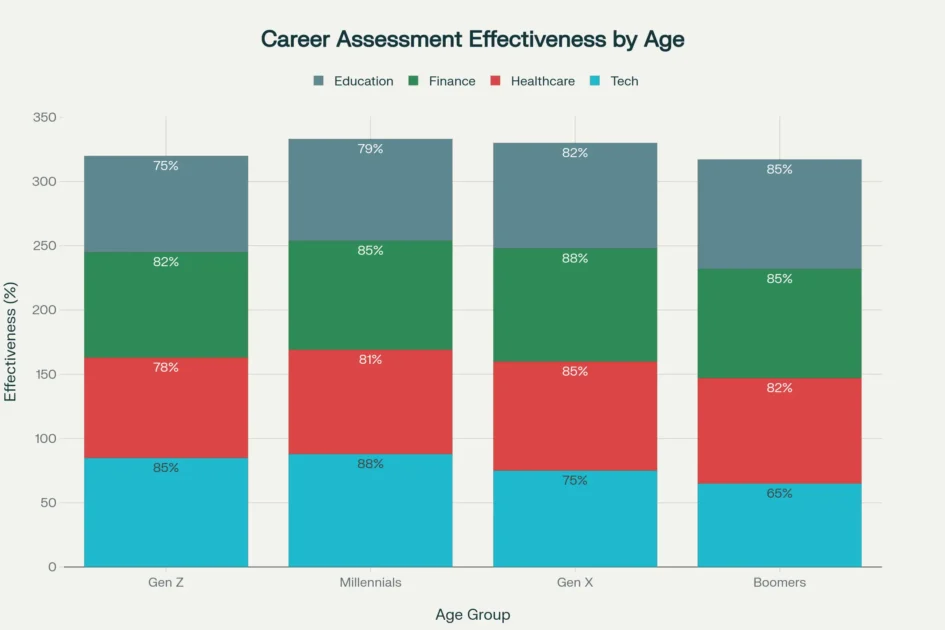
Career Assessment Effectiveness by Age Group and Industry in the US
Strategic Implementation and ROI Considerations of Career Assessment Tools
Organizations and individuals implementing career assessment tools report substantial returns on investment across multiple metrics. Companies utilizing pre-employment assessments achieve 36% higher satisfaction with hiring decisions, while employees receiving strengths-based development demonstrate 23% increased engagement levels. These outcomes translate into reduced turnover costs, improved productivity, and enhanced organizational performance.
Measuring Assessment Effectiveness
The effectiveness of career assessment tools varies significantly based on implementation strategy and individual circumstances. Research indicates that assessments perform optimally when combined with professional guidance, ongoing development support, and integration with broader career planning initiatives. Organizations achieving maximum ROI typically invest in comprehensive assessment programs rather than isolated testing protocols.
Industry-Specific Considerations
Different industries demonstrate varying levels of assessment effectiveness, with technology and healthcare sectors showing particularly strong correlations between assessment results and career satisfaction. Financial services and education also demonstrate high assessment utility, while traditional manufacturing industries show more modest benefits.
Future Trends and Technological Evolution
The career assessment industry continues evolving at an unprecedented pace, with artificial intelligence and machine learning technologies assuming increasingly prominent roles in transforming how professionals discover optimal career paths. Current market analysis reveals accelerating integration between sophisticated assessment platforms and comprehensive professional development resources, creating interconnected career management ecosystems that support sustained long-term professional growth across diverse industries. These technological advancements represent a fundamental shift from static evaluation methods toward dynamic, adaptive systems that continuously refine recommendations based on emerging workplace trends, evolving job market demands, and individual professional development trajectories.
AI Integration and Personalization Revolution
Advanced algorithmic frameworks now enable real-time assessment adaptation and highly personalized result generation, significantly improving accuracy and relevance for diverse user populations across various demographic and professional segments. These cutting-edge technological advances promise increasingly sophisticated career assessment tools while maintaining the rigorous psychological validity that forms the foundational backbone of effective evaluation instruments. Machine learning capabilities allow platforms to analyze vast datasets of successful career transitions, identifying patterns and correlations that human analysts might overlook, thereby enhancing predictive accuracy and career matching precision.
Key AI-Powered Features Transforming Career Assessment:
- Adaptive Questioning Algorithms: Dynamic question selection based on real-time response analysis, reducing assessment time while increasing accuracy
- Predictive Career Modeling: Machine learning systems that forecast career satisfaction based on historical data from millions of professionals
- Personalized Development Pathways: AI-generated skill development recommendations tailored to individual career objectives and current competency levels
- Real-Time Market Integration: Continuous updates incorporating current job market trends, salary data, and emerging profession requirements
- Cross-Platform Data Synthesis: Integration of assessment results with professional networking profiles, educational backgrounds, and work history analysis
Emerging Technological Capabilities:
- Natural Language Processing: Advanced interpretation of open-ended responses to capture nuanced career preferences and motivational factors
- Behavioral Pattern Recognition: Sophisticated analysis of response patterns to identify subconscious career inclinations and potential blind spots
- Virtual Reality Career Simulations: Immersive experiences allowing users to explore potential career environments before making commitments
- Blockchain Credential Verification: Secure, tamper-proof storage and verification of assessment results and professional certifications
Comprehensive Workplace Integration Strategies
Modern organizations increasingly integrate sophisticated career assessment tools into broader talent management strategies, utilizing comprehensive results for strategic team formation, targeted leadership development programs, and systematic succession planning initiatives. This holistic integration approach maximizes assessment value while simultaneously supporting organizational objectives and individual career aspirations through coordinated development pathways. Progressive companies recognize that effective talent management requires continuous assessment and development rather than isolated evaluation events.
Strategic Implementation Framework:
- Multi-Level Assessment Integration: Deployment across hiring, onboarding, performance reviews, and promotion decisions
- Team Composition Optimization: Scientific matching of personality types and skill sets for enhanced collaborative effectiveness
- Leadership Pipeline Development: Identification and cultivation of high-potential employees based on assessment-revealed capabilities
- Succession Planning Enhancement: Data-driven identification of internal candidates for critical organizational roles
- Cultural Alignment Measurement: Assessment of individual values compatibility with organizational culture and mission
Organizational Benefits and ROI Metrics:
- Employee Retention Improvement: Organizations report 25-40% reduction in turnover when implementing comprehensive assessment programs
- Productivity Enhancement: Teams formed using assessment data demonstrate 15-30% higher performance metrics
- Training Cost Optimization: Targeted development programs based on assessment results reduce training expenses by up to 50%
- Leadership Effectiveness: Assessment-based leadership development programs show 35% improvement in management satisfaction scores
- Cultural Cohesion: Companies using values-based assessments report 20% improvement in employee engagement surveys
Data Analytics and Predictive Modeling
Contemporary career assessment tools increasingly leverage sophisticated data analytics and predictive modeling capabilities to provide unprecedented insights into career trajectories and professional development opportunities. These advanced analytical frameworks process millions of data points from successful professionals, identifying subtle patterns that correlate with long-term career satisfaction and achievement. The integration of big data analytics enables assessment platforms to offer increasingly precise recommendations while continuously improving their predictive accuracy through machine learning feedback loops.
Advanced Analytics Components:
- Longitudinal Career Tracking: Analysis of career progression patterns across decades of professional development
- Industry-Specific Modeling: Tailored predictions based on sector-specific success factors and advancement pathways
- Economic Impact Integration: Correlation of career choices with economic trends, salary projections, and market stability
- Geographic Optimization: Location-based career recommendations considering regional job markets and cost-of-living factors
- Skills Gap Analysis: Identification of emerging skill requirements and recommendations for proactive professional development
Conclusion and Strategic Recommendations
Career assessment tools represent transformative resources for navigating today’s increasingly complex professional environment, providing scientifically validated insights that empower individuals to make confident job decisions and develop comprehensive strategic career planning frameworks. The nine assessment platforms examined throughout this analysis demonstrate diverse methodological approaches to career exploration, ranging from comprehensive personality evaluation systems like the Myers-Briggs Type Indicator to specialized strengths identification frameworks such as CliftonStrengths, and cutting-edge AI-enhanced matching algorithms exemplified by Career Explorer.
For professionals seeking meaningful career guidance, the optimal strategy involves carefully selecting career assessment tools that align precisely with specific career planning objectives, available financial resources, and desired depth of psychological insight, while recognizing that no single assessment can provide complete career direction without additional exploration and professional consultation.
Organizations implementing comprehensive career assessment tools achieve maximum strategic value through thoughtful integration with broader talent management initiatives, including leadership development programs, strategic team formation protocols, and employee engagement enhancement strategies. The substantial return on investment demonstrated across multiple performance metrics—including 39% reductions in employee turnover, 36% improvements in hiring decision satisfaction, and 23% increases in employee engagement levels—clearly justifies organizational investment in quality assessment platforms combined with professional implementation support and ongoing development resources.
Progressive companies recognize that effective talent optimization requires systematic assessment integration rather than isolated testing events, creating sustainable competitive advantages through enhanced employee-role alignment and improved organizational culture cohesion.The American workplace continues experiencing rapid transformation driven by technological advancement, generational shifts, and evolving professional expectations, ensuring that career assessment tools will remain essential resources for both individual career success and organizational performance optimization.
Emerging trends including artificial intelligence integration, real-time adaptive questioning, and predictive career modeling promise increasingly sophisticated assessment capabilities while maintaining the psychological validity and scientific rigor that form the foundation of effective evaluation instruments. As these technological enhancements mature, career assessment tools will provide even more precise career matching, personalized development recommendations, and strategic planning support that adapts continuously to changing market conditions and individual professional growth trajectories.
The key to maximizing career assessment tools value lies in understanding their distinct capabilities, inherent limitations, and optimal implementation strategies within comprehensive career development frameworks that combine multiple evaluation approaches with practical exploration activities and professional guidance.
Successful career planning requires viewing assessments as powerful starting points rather than definitive answers, utilizing their insights to inform broader career exploration processes that include informational interviews, job shadowing experiences, skills development initiatives, and strategic networking activities. Whether individuals seek career transitions, professional advancement, or initial career selection, the strategic application of validated assessment instruments provides the foundational insights necessary for confident decision-making and sustained professional fulfillment in an increasingly competitive and dynamic employment marketplace.
Citations
- https://www.selectsoftwarereviews.com/blog/recruiting-statistics
- https://www.criteriacorp.com/research/2024-2025-hiring-benchmark-report
- https://www.uschamber.com/co/grow/thrive/cliftonstrengths-assessment
- https://accendotechnologies.com/blog/talent-assessment-tools/
- https://pmc.ncbi.nlm.nih.gov/articles/PMC9395809/
- https://pmc.ncbi.nlm.nih.gov/articles/PMC9819525/
- https://pmc.ncbi.nlm.nih.gov/articles/PMC10295380/
- https://www.careerfitter.com/career-advice/top-career-assessment-reviews
- https://www.careerfitter.com/free_test/careerbuilder/test
- https://asia.themyersbriggs.com/instruments/sii/
- https://www.prnewswire.com/news-releases/cpp-inc-revitalizes-the-strong-interest-inventory-assessment-for-a-new-generation-of-professionals-147569435.html
- https://www.ebsco.com/research-starters/health-and-medicine/strong-interest-inventory-sii
- https://careers.washu.edu/resources/strong-interest-inventory/
- https://www.indeed.com/career-advice/finding-a-job/strong-interest-inventory-assessment
- https://en.wikipedia.org/wiki/Myers%E2%80%93Briggs_Type_Indicator
- https://hbr.org/2015/07/ace-the-assessment
- https://files.eric.ed.gov/fulltext/ED579286.pdf
- https://www.myersbriggs.org/type-in-my-life/personality-type-and-careers/
- https://journals.sagepub.com/doi/10.1177/106907279500300208
- https://www.themyersbriggs.com/en-US/Support/MBTI-Facts
- https://www.simplypsychology.org/the-myers-briggs-type-indicator.html
- https://www.theswaddle.com/myers-briggs-test-has-been-debunked-time-and-again-why-do-companies-still-use-it
- https://www.onetcenter.org/dl_files/IP_Manual.pdf
- https://www.govinfo.gov/content/pkg/GOVPUB-L37-PURL-LPS12364/pdf/GOVPUB-L37-PURL-LPS12364.pdf
- https://www.onetcenter.org/IP.html
- https://career-advising.ndsu.edu/blog/2023/12/08/tools-for-exploration-onet-interest-profiler/
- https://www.ischool.berkeley.edu/careers/students/cliftonstrengths
- https://www.gallup.com/cliftonstrengths/en/249455/specific-career-best-match-top-cliftonstrengths.aspx
- https://novoresume.com/career-blog/career-aptitude-test
- https://in.indeed.com/career-advice/career-development/aptitude-test-for-career
- https://www.imocha.io/blog/employee-career-development-tools
- https://www.123test.com/career-test/
- https://www.princetonreview.com/quiz/career-quiz
- https://www.aihr.com/blog/training-roi/
- https://yaksha.com/resources/blogs/skill-assessment-tests-statistics-you-should-know/
- https://www.onetcenter.org/dl_files/proTestAsse.pdf
- https://roiinstitute.net/roi-methodology/
- https://high5test.com/employee-satisfaction-statistics/
- https://learning.linkedin.com/content/dam/me/business/en-us/amp/learning-solutions/images/wlr-2024/LinkedIn-Workplace-Learning-Report-2024.pdf
- https://www.harrisonassessments.com/success-stories.html
- https://www.act.org/content/act/en/workforce-solutions/resources/success-stories.html
- https://pmc.ncbi.nlm.nih.gov/articles/PMC8211878/
- https://sherpact.com/career-assessment-tools/
- https://futuremug.com/blog/top-skill-assessment-tools-and-platforms-for-2025/
- https://www.coursera.org/resources/career-quiz
- https://www.journals.scholarpublishing.org/index.php/ABR/article/view/11299
- https://testlify.com/best-talent-assessment-tools/
- https://capd.mit.edu/resources/free-career-aptitude-tests/
- https://www.mindgroom.com/blog/importance-of-career-assessment-test-in-career-counselling-and-effectiveness/
- https://www.bestcareertest.org
- https://www.brainwonders.in/blog/career-assessment-test-its-importance-and-effectivness
- https://www.edumilestones.com/best-career-counselling-platforms-in-india
- https://journals.sagepub.com/home/jca
- https://metana.io/blog/career-quiz/
- https://www.jobbank.gc.ca/career-planning/quizzes
- https://files.eric.ed.gov/fulltext/EJ1327135.pdf
- https://www.careerkey.org/fit/personality/holland-code-assessment-riasec
- https://journal2.iicet.org/index.php/ijtih/article/download/72/49
- https://www.gallup.com/cliftonstrengths/en/254033/strengthsfinder.aspx
- https://www.ncda.org/aws/NCDA/pt/sd/news_article/554248/_PARENT/CC_layout_details/false
- https://www.gallup.com/cliftonstrengths/en/252137/home.aspx
- https://www.ncbi.nlm.nih.gov/books/NBK554596/
- https://mgesjournals.com/hssr/article/download/hssr.2021.939/3450/15602
- https://www.linkedin.com/posts/ruhi-banerjee-15985313a_ruhibanerjee-careercoaching-mentoring-activity-7361623801899462656-QrmH
- https://www.diva-portal.org/smash/get/diva2:1566717/FULLTEXT01.pdf
- https://strengthscape.com/ai-career-accelerator-roi-india/
- https://pmc.ncbi.nlm.nih.gov/articles/PMC6480750/
- https://blogs.psico-smart.com/blog-the-impact-of-personality-assessments-on-career-choices-and-job-satisfaction-178348
- https://www.sciencedirect.com/science/article/abs/pii/S0191886923002118
- https://mpowerminds.com/blog/impact-and-roi-of-employee-training-on-business
- https://iaap-journals.onlinelibrary.wiley.com/doi/10.1111/apps.12174
- https://www.frontiersin.org/journals/psychology/articles/10.3389/fpsyg.2025.1583454/full
- https://global.wilsonlearning.com/challenges/measure-business-impact-and-roi/
- https://www.dol.gov/sites/dolgov/files/ETA/advisories/TEN/2007/TEN21-07a1.pdf
- https://ink.library.smu.edu.sg/cgi/viewcontent.cgi?article=2025&context=lkcsb_research
- https://www.reddit.com/r/mbti/comments/xpz81g/unpopular_opinion_the_16personalities_test_is/
- https://www.youtube.com/watch?v=vjtM4cmulZU
- https://www.onetonline.org
- https://www.vedatma.com/career-kaleidoscope-shifting-perspectives-with-strong-interest-inventory/
- https://pmc.ncbi.nlm.nih.gov/articles/PMC10017728/
- https://career.colostate.edu/resources/interest-profiler-onet/
- https://www.statisticssolutions.com/free-resources/directory-of-survey-instruments/career-assessment-inventory-cai/
- https://www.medicalnewstoday.com/articles/myers-briggs-16-personality-types
- https://www.themyersbriggs.com/en-US/Explore-Solutions/Strong
- https://www.16personalities.com/articles/our-theory
- https://blog.xoxoday.com/empuls/measuring-employee-experience/
- https://bright-journal.org/Journal/index.php/JADS/article/download/172/150
- https://www.culturemonkey.io/employee-engagement/employee-experience-roi/
- https://www.linkedin.com/pulse/state-us-recruiting-20242025-key-hiring-metrics-pharma-alex-benjamin-neuje
- https://www.formpl.us/blog/analyzing-success-rates-a-comprehensive-guide-to-15-job-application-metrics
- https://bucketlistrewards.com/blog/employee-recognition-stats/
- https://www.gmac.com/market-intelligence-and-research/research-library/employment-outlook/2024-corporate-recruiters-survey-infographic
- https://www.aihr.com/blog/top-pre-employment-assessment-tools/
- https://www.1e.com/blogs/employee-experience-roi-how-to-calculate-and-measure-return-on-experience-rox/
- https://gohire.io/blog/hiring-statistics
- https://www.applauz.me/en/employee-engagement-roi
- https://blog.hiringthing.com/job-application-statistics
- https://365talents.com/en/resources/7-ways-measure-roi-skills-strategy/
- https://www.mercer.com/insights/people-strategy/future-of-work/global-talent-trends/
- https://www.wecreateproblems.com/blog/recruitment-statistics
- https://www.aihr.com/blog/employee-engagement-roi/
- https://testlify.com/case-studies-of-companies-that-successfully-used-skill-assessments/
- https://www.youtube.com/watch?v=uSI9A6z-WnA
- https://www.apa.org/pubs/reports/work-in-america/2024/2024-work-in-america-report.pdf
- https://www.themyersbriggs.com
- https://www.ajg.com/2024-us-workforce-trends-report-career-wellbeing/
- https://thrivemap.io/high-volume-hiring-case-studies/
- https://merittrac.com/case-studies/
- https://fortune.com/2023/09/12/personality-test-ceos-fortune-500-leadership-style-assessment/
- https://mhanational.org/2024-workplace-wellness-research/
- https://www.randstadusa.com/business/business-insights/case-studies-success-stories/
- http://jlh.temp.bluecentral.com/research-white-papers.aspx
- https://www.apa.org/pubs/reports/work-in-america/2024
- https://hmscareercoaching.com/about-us/case-studies/
- https://www.psychometrics.com/assessments/strong-interest-inventory-myers-briggs-type-indicator-career-report/