


Why “Hustle Culture” is Hurting Productivity (And What Works Instead)
The relentless pursuit of success through endless hours and constant grinding has become the defining characteristic of modern American work culture. Hustle culture, once celebrated as the pathway to achievement, is now revealing itself as a productivity killer that’s devastating both businesses and workers across the United States. Recent research paints a startling picture: 66% of American employees are experiencing burnout at record levels, while productivity paradoxically declines as working hours increase.
The promise of this culture was simple, work harder, longer, and more intensely than everyone else, and success will follow. Yet mounting evidence from Stanford University, major corporations, and mental health researchers tells a different story. Companies embracing alternative approaches like four-day workweeks are seeing productivity increases of 91%, while those clinging to this culture face staggering costs of $322 billion annually in lost productivity.
This comprehensive examination reveals why hustle culture is failing American workers and what evidence-based alternatives are delivering superior results for both employees and employers.
The Rise and Toxic Nature of Hustle Culture
Hustle culture emerged from the entrepreneurial spirit that built Silicon Valley and spread across American workplaces like wildfire. The culture promotes the idea that continuous work, sacrificing personal time, and pushing beyond physical and mental limits are necessary for success. Social media amplified this message, with influencers and executives glorifying 80-hour work weeks and celebrating exhaustion as a badge of honor.
The concept of hustle culture involves much more than sheer hard work—it centers on constantly striving for achievement and self-improvement. Research identifies it as “an unspoken agreement between supervisors and employees concerning a designated workplace commitment compliance” that creates toxic productivity expectations. This culture manifests in several devastating ways:
- Glorification of overwork – Employees feel pressured to work beyond capacity without rest or recovery
- Fear-based motivation – Workers fear being perceived as lazy or uncommitted if they maintain boundaries
- Always-on expectations – Technology enables 24/7 accessibility, blurring work-life boundaries completely
- Success mythology – The belief that only those willing to sacrifice everything will achieve greatness
The psychological toll is immense. Studies show that this culture leads to chronic stress, anxiety, depression, and a cascade of mental health issues. Workers caught in this cycle often experience emotional exhaustion, reduced performance, and detachment from their work—the opposite of what this culture promises to deliver.
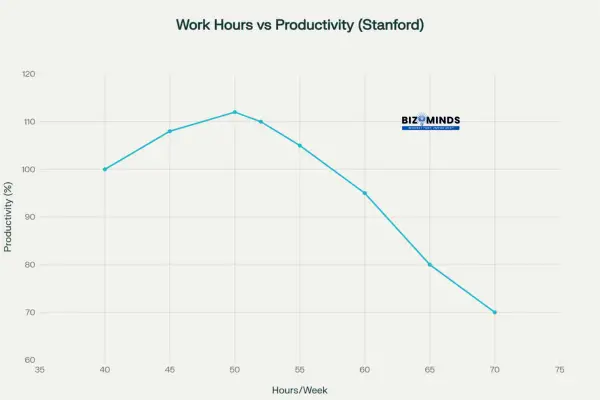
Stanford Research: Productivity Decline After 50 Hours Per Week
The USA Hustle Culture Epidemic
The United States has become ground zero for this culture proliferation. Unlike European countries with strong labor protections, American workers face minimal legal safeguards against excessive working hours. The result is a workforce pushed to breaking points:
Startling Statistics:
- 47% of full-time American workers actually work 47 hours per week, not the standard 40
- Nearly 40% of Americans report working more than 50 hours per week
- Only 44% of American employees report having work-life balance, despite 94% believing it’s important
- Americans take far fewer vacation days compared to their European counterparts, with 26% using only five days or less each year
The hustle culture mentality has become so embedded that 33% of Americans feel guilty about taking time off, compared to just 18% of Europeans. This guilt-driven approach to work creates a vicious cycle where rest is viewed as weakness rather than necessity for optimal performance.
Silicon Valley’s Dark Influence
Silicon Valley, the supposed pinnacle of innovation and progressive workplace culture, has become a cautionary tale about this culture’s destructive potential. Research reveals that prestigious tech companies harbor some of the highest burnout rates in America:
Tech Company Burnout Rates:
- Credit Karma: 70.73% of employees reporting burnout
- Twitch: 68.75%
- Amazon: 59.53%
- Snapchat: 60.40%
- Apple, Google, and Facebook each face burnout rates exceeding 48% among their employees
Recent developments show Silicon Valley startups embracing even more extreme versions of this culture. Certain companies now openly promote the “996” work schedule, requiring employees to work from 9 AM to 9 PM, six days a week, resulting in a total of 72 hours of work weekly. This approach, outlawed in China for its health dangers, is being voluntarily adopted by American workers desperate to compete in the AI race.
The human cost is devastating. Ethnographic research from Silicon Valley describes employees suffering from “burnout, alcoholism, insomnia, mental and physical illness” and even suicide. Workers become so psychologically broken by this culture that they’re permanently unable to find meaningful employment or lead fulfilling lives.

Employee Burnout Rates by Industry in the USA (2025)
The Science Behind Why Hustle Culture Fails
The fundamental premise of this culture—that more hours equal more output—has been thoroughly debunked by scientific research. Stanford University economist John Pencavel conducted groundbreaking studies revealing the productivity cliff that occurs when working hours exceed optimal levels.
The Stanford Productivity Research
Pencavel’s research reveals that employee productivity drops significantly after surpassing a 50-hour workweek and declines steeply beyond 55 hours. The most striking finding: at 70 hours per week, the extra 15 hours beyond 55 yield “little or no result”. This means workers pushing themselves through this culture extremes are essentially working for free while destroying their health.
The productivity decline isn’t gradual, it’s precipitous. Workers become substantially less productive at all hours of the workday due to stress, fatigue, and cognitive overload. This culture creates a false economy where apparent dedication masks actual inefficiency.
The Neurological Impact of Overwork
Recent neuroscience research provides disturbing evidence about this culture’s impact on brain structure and function. Preliminary studies show that overwork is associated with structural brain changes, particularly in regions linked to cognition and emotion. This suggests hustle culture may cause permanent neurological damage.
Sleep deprivation, a hallmark of this culture, compounds these effects. The National Sleep Foundation reports that 60% of adults experience negative effects from inadequate sleep, with 70% reporting direct impairment of work productivity. Hustle culture workers averaging just 6.5 hours of sleep face severe cognitive consequences:
Sleep Deprivation Effects on Work Performance:
- 55% struggle to work required hours
- 69% experience impaired clear thinking
- 58% have trouble performing work carefully
- 47% face challenges interacting with colleagues
- 48% have difficulty controlling temper at work
The productivity losses from sleep deprivation alone cost businesses $1,967 per employee annually. When multiplied across the American workforce, hustle culture’s sleep sacrifice costs the economy approximately $300 billion yearly in reduced performance.
The Psychological Destruction of Overwork
This culture creates a perfect storm for psychological distress. Research published in Nature Human Behaviour reveals that overwork leads to:
- Chronic workplace stress impacts 79% of employees, emerging as a significant issue for overall well-being
- Work-family conflict that exhausts psychological resources and triggers emotional exhaustion
- Burnout cascade effects including anxiety, depression, anger, and avoidance behaviors
For women, this culture proves especially destructive. Research indicates that 42% of women in Corporate America report experiencing burnout, compared to 35% of men, with the gender disparity having more than doubled since 2019. Women face the additional burden of emotional labor and caregiving responsibilities that hustle culture ignores completely.
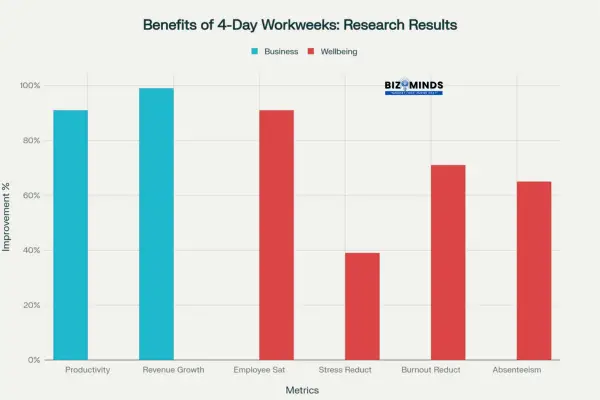
Benefits of 4-Day Workweeks: Research Results from Various Studies
The Economic Devastation of Hustle Culture
The financial costs of this culture extend far beyond individual suffering to represent a massive economic drain on American businesses and society. The numbers are staggering and growing worse each year.
The Billion-Dollar Burnout Crisis
Burnout, as the inevitable consequence of this culture, costs American businesses approximately $322 billion each year due to lost productivity. This figure represents more than the GDP of many entire countries, highlighting the massive scale of hustle culture’s economic destruction. Additional costs include:
Healthcare System Impact:
- $125-190 billion annually in healthcare costs related to workplace burnout
- For every physician lost to burnout: $500,000 to $1 million in replacement costs
- $4.6 billion annual cost to the U.S. healthcare system from physician burnout alone
Workforce Disruption:
- 70% of burnt-out employees would leave their current jobs
- 89% of employees experienced burnout in the past year
- 2.6 times more likely for burned-out employees to actively seek new employment
The turnover costs alone are crushing. When hustle culture burns out valuable employees, companies face recruitment, training, and knowledge transfer expenses that can exceed an entire year’s salary per departure.
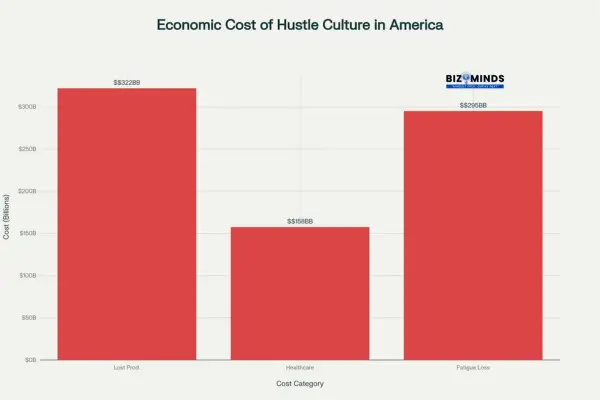
The Economic Cost of Hustle Culture in America (Billions USD Annually)
The Hidden Costs of Presenteeism
Hustle culture doesn’t just create absenteeism—it creates “presenteeism,” where exhausted employees show up but perform poorly. Research reveals that workers experiencing daytime fatigue from this culture demands report:
- 2.4% average productivity loss compared to well-rested colleagues
- 13% higher scores for reduced work effectiveness
- Significantly impaired abilities in time management, attention, decision-making, memory, and motivation
These seemingly small percentages compound across millions of workers. A 2.4% productivity loss across America’s 150 million workforce represents billions in economic value destroyed by this culture each year.
The Competitive Disadvantage
Ironically, hustle culture creates competitive disadvantages for the very companies that embrace it most aggressively. While these organizations appear more dedicated and intensive, they’re actually:
- Less innovative due to exhausted, stressed workers who can’t think creatively
- Less adaptive because burned-out employees resist change and avoid risk-taking
- Less attractive to top talent who increasingly prioritize work-life balance
- More vulnerable to disruption from competitors using smarter, more sustainable approaches
Companies clinging to this culture find themselves trapped in a death spiral of declining performance, increasing costs, and talent exodus—all while believing they’re working harder than ever toward success.
What Actually Works: Evidence-Based Alternatives to Hustle Culture
While this culture destroys productivity and people, alternative approaches deliver superior results for both businesses and employees. The evidence is overwhelming: working smarter, not harder, produces better outcomes across every meaningful metric.
The Four-Day Workweek Revolution
The most compelling alternative to this culture is the four-day workweek, which has produced remarkable results in comprehensive trials across six countries involving 2,896 employees at 141 companies. The results shattered hustle culture assumptions:
Four-Day Workweek Results:
- 90% of participating companies chose to continue the shorter schedule permanently
- Productivity either maintained or actually improved in most cases
- Significant reductions in burnout, stress, and anxiety
- Improved mental health scores by up to 38%
- Sleep problems reduced by 40%
The research showed that employees did not rush frantically to fit five days’ worth of work into a compressed four-day schedule. Instead, they eliminated inefficiencies, reduced unnecessary meetings, and focused on high-impact activities. Hustle culture’s assumption that more time equals more output proved completely false.
American Companies Leading the Change
Progressive American companies are abandoning this culture for evidence-based approaches with remarkable success:
Buffer’s Transformation:
Buffer, the social media management company, implemented a permanent 32-hour, four-day workweek after pandemic-related trials. Results included:
- 91% of employees reporting increased happiness and productivity
- Sustained revenue growth despite reduced hours
- Dramatic improvement in employee retention and satisfaction
Kickstarter’s Success:
The crowdfunding platform adopted a four-day workweek in 2022, reducing to 32 hours without pay cuts. Employees report the shortened schedule “has enabled us all to live brighter, fuller lives and has allowed us to return to work refreshed”.
The Wanderlust Group’s Growth:
This outdoor tech company saw extraordinary business results after implementing a four-day workweek:
- 99% growth in Annual Recurring Revenue year-over-year
- 120% growth in nights booked through their marketplace
- Net Promoter Score of 75 on more than 60,000 responses
These results directly contradict this culture’s core premise that success requires endless hours and constant sacrifice.
Flexible Work Arrangements That Defeat Hustle Culture
Beyond four-day workweeks, several flexible work models are proving superior to this culture approaches:
Results-Only Work Environment (ROWE):
ROWE focuses on outcomes rather than hours worked, completely eliminating hustle culture’s time-obsessed mentality. Canada Mortgage and Housing Corporation implemented ROWE and found:
- Increased employee morale and engagement
- Decreased stress associated with work-life balance
- Improved productivity through autonomous decision-making
Compressed Workweeks:
Companies offering compressed schedules allow employees to work longer days for additional time off. Benefits include:
- Improved work-life balance through extended weekends
- Reduced commuting time and costs
- Higher employee satisfaction and retention rates
Hybrid Work Models:
Major corporations are discovering that hybrid arrangements outperform hustle culture’s office-obsessed approach:
- Dell: 60% of employees work flexibly with 20% higher Net Promoter Scores and $12 million annual savings since 2014
- Humana: Nearly half the workforce works remotely with improved talent attraction and reduced facility costs
- Cisco: Estimated $500 million savings over five years while accessing broader talent pools
The Power of Prioritization over Hustle
The most successful alternatives to this culture emphasize strategic prioritization rather than brute-force effort. Research from Atlassian reveals that 78% of people attend so many meetings they can’t accomplish their actual work. Companies rejecting hustle culture instead focus on:
Elimination Strategies:
- Reducing or eliminating non-essential meetings
- Automating repetitive, low-value tasks
- Streamlining communication processes
- Focusing on high-impact activities only
Efficiency Improvements:
- Using technology to reduce manual work
- Implementing better project management systems
- Training employees in time management and prioritization
- Creating clear boundaries between work and personal time
These approaches consistently outperform this culture because they address root causes of inefficiency rather than simply demanding more hours from exhausted workers.
The Mental Health Crisis behind Hustle Culture
The human cost of this culture extends far beyond productivity metrics to encompass a genuine mental health crisis affecting millions of American workers. The psychological damage inflicted by hustle culture creates long-term consequences that destroy lives and devastate families.
The Anxiety and Depression Epidemic
Hustle culture creates perfect conditions for anxiety and depression to flourish. The constant pressure to produce, compete, and sacrifice creates chronic stress that fundamentally alters brain chemistry. Research reveals that poor work-life balance significantly increases risks of:
- Anxiety disorders affecting 33% of workers in high-stress environments
- Depression linked directly to overwork and chronic fatigue
- Sleep disorders affecting 40% of overworked employees
- Substance abuse as workers seek escape from relentless pressure
- Relationship breakdown due to work-life conflict and emotional unavailability
The psychological distress created by this culture doesn’t remain confined to work hours. Workers carry stress, anxiety, and exhaustion into their personal lives, affecting marriages, parenting, and friendships. The ripple effects touch entire families and communities.
The Burnout Progression
Hustle culture follows a predictable path toward complete burnout that researchers have mapped extensively. The progression typically includes:
Stage 1: Honeymoon Phase
Workers initially embrace hustle culture enthusiasm, believing hard work will lead to success. Energy levels remain high, but sustainable practices aren’t established.
Stage 2: Stagnation
The initial excitement fades as workers realize the demands are unsustainable. Productivity begins declining despite increased effort. Personal relationships start showing strain.
Stage 3: Frustration
Workers become angry and resentful about unrealistic expectations. Performance issues emerge, leading to more pressure and longer hours in a vicious cycle.
Stage 4: Apathy
Emotional exhaustion sets in completely. Employees often experience a sense of disconnection from their jobs and coworkers, leading to reduced engagement and productivity. Mental health issues often emerge or worsen significantly.
Stage 5: Complete Burnout
Workers experience total physical, emotional, and mental exhaustion. Many require extended leave or complete career changes to recover. Some employees never fully regain their previous levels of productivity and functionality after experiencing burnout.
Gender-Specific Impacts of Hustle Culture
Hustle culture affects women disproportionately, creating additional layers of psychological distress. Research shows that women face unique challenges within hustle culture environments:
The Double Burden:
Working women often carry primary responsibility for childcare and household management while facing identical hustle culture workplace demands. This creates:
- Chronic work-family conflict affecting 54% of career women
- Higher rates of emotional exhaustion and anxiety
- Greater difficulty accessing recovery time and self-care
- Increased likelihood of leaving the workforce entirely
Undervalued Emotional Labor:
Hustle culture typically ignores or undervalues the emotional work that women disproportionately perform in workplaces, including:
- Supporting colleague well-being and team morale
- Managing diversity, equity, and inclusion initiatives
- Providing unofficial mentorship and guidance
- Handling conflict resolution and interpersonal issues
This additional labor remains largely unrewarded in hustle culture environments that focus solely on visible, measurable outputs.
The Generational Impact
Young Americans entering the workforce face particular vulnerability to hustle culture messaging. Research reveals disturbing trends among high school and college students:
- 64% of students report having no leisure time due to multiple activities and pressure to build impressive profiles
- Peak burnout now occurs at age 25 rather than the traditional mid-career crisis around age 42
- 48% of students engage in activities primarily because peers do the same, creating competitive pressure cycles
- 26% report parental pressure to excel in multiple areas simultaneously
This culture is stealing youth and vitality from an entire generation, replacing natural development with artificial pressure to constantly achieve and produce. The long-term psychological consequences remain largely unknown but deeply concerning.
Building Sustainable Work Cultures
Creating alternatives to hustle culture requires intentional, systematic changes that prioritize human well-being alongside business success. The most successful organizations are discovering that sustainable practices actually enhance rather than diminish performance.
Principles of Sustainable Work Culture
Organizations moving beyond this culture embrace several core principles that create healthier, more productive environments:
Human-Centered Design:
- Acknowledging employees as whole individuals with needs that extend beyond their professional roles is essential for fostering genuine well-being and engagement
- Designing policies that support physical, mental, and emotional well-being
- Creating psychological safety where people can express concerns and limitations
- Promoting rest and recovery as essential business investments
Results-Focused Accountability:
- Measuring outcomes rather than hours worked or perceived effort
- Setting clear, achievable goals with reasonable timelines
- Providing resources and support needed for success
- Promoting efficiency and smart working techniques takes precedence over relying solely on sheer effort and hard labor
Sustainable Growth Models:
- Planning expansion that considers human capacity limitations
- Investing in systems and technology that reduce manual workload
- Building redundancy so individual employees aren’t single points of failure
- Prioritizing long-term sustainability over short-term gains
Leadership Transformation
Moving away from this culture requires fundamental changes in leadership philosophy and behavior. The most effective leaders demonstrate:
Boundary Modeling:
Leaders who reject hustle culture actively model healthy boundaries by:
- Taking regular vacations and disconnecting from work completely
- Respecting after-hours boundaries and avoiding non-urgent communications
- Discussing the importance of rest and recovery openly
- Sharing their own struggles with work-life balance authentically
Vulnerability and Authenticity:
Hustle culture promotes perfectionism and invincibility myths. Sustainable leaders instead:
- Acknowledge mistakes and learning opportunities
- Discuss mental health challenges and coping strategies
- Ask for help when needed and encourage others to do the same
- Admit when workloads are unsustainable and make adjustments
Systems Thinking:
Rather than hustle culture’s individual-focused approach, sustainable leaders think systematically:
- Identifying root causes of inefficiency rather than demanding more effort
- Investing in training, tools, and processes that support employee success
- Creating feedback loops that prevent problems from escalating
- Building organizational resilience that doesn’t depend on individual heroics
Implementation Strategies for Change
Organizations seeking to eliminate this culture and implement sustainable alternatives can follow proven strategies:
Assessment and Awareness:
- Conduct anonymous surveys to understand current burnout levels and cultural issues
- Identify specific hustle culture behaviors and expectations that need changing
- Measure baseline productivity, turnover, and satisfaction metrics
- Create awareness campaigns about the true costs of overwork
Pilot Programs:
- Test four-day workweeks or flexible arrangements with volunteer teams
- Implement “meeting-free” days or hours to reduce interruptions
- Create quiet spaces and policies that support focus and recovery
- Experiment with results-only work environments for appropriate roles
Policy Changes:
- Establish clear boundaries around after-hours communication
- Require minimum vacation time usage and disconnect policies
- Limit meeting lengths and frequencies to protect productive time
- Create explicit expectations about sustainable work practices
Cultural Reinforcement:
- Celebrate employees who maintain healthy boundaries
- Share success stories about productivity improvements from sustainable practices
- Train managers in recognizing and preventing burnout
- Make well-being metrics part of leadership performance evaluations
The transition away from this culture requires patience and persistence, but organizations making this shift consistently report improved results across all meaningful measures of success.
Conclusion:
The evidence is overwhelming and undeniable: hustle culture is not just failing to deliver on its promises—it’s actively destroying the productivity, creativity, and humanity it claims to enhance. Across industries, companies, and individuals, the data tells the same story: sustainable work practices outperform this culture approaches in every meaningful metric while preserving the mental, physical, and emotional well-being of the workforce.
The path forward requires courage to reject decades of ingrained assumptions about work and success. It demands that leaders, employees, and organizations embrace evidence over mythology, prioritizing human flourishing alongside business results. The companies and countries leading this transformation—from Buffer’s 91% productivity increase to Iceland’s comprehensive four-day workweek success—are proving that there is indeed a better way.
Hustle culture’s reign of terror over American workplaces is ending not through regulation or mandate, but through the simple recognition that it doesn’t work. As more organizations discover the competitive advantages of sustainable practices, this culture will become not just morally questionable but economically obsolete.
The future of work lies not in grinding harder, but in working with wisdom, intention, and respect for human limitations. That future is not just possible—it’s already beginning, one recovered employee and one enlightened organization at a time.
FAQs: Understanding Hustle Culture and Better Alternatives
1. What exactly is hustle culture and how did it become so prevalent?
Hustle culture is the workplace mentality that glorifies constant work, long hours, and sacrificing personal life for professional success. It became prevalent through Silicon Valley startup culture, social media glamorization of overwork, and American entrepreneurial values that equate busyness with worthiness. This culture promotes the false belief that only those willing to work 60-80 hours weekly deserve success, creating toxic productivity expectations that harm both individuals and businesses.
2. Does working longer hours actually increase productivity?
No, research consistently shows that working longer hours decreases productivity. Stanford University studies reveal that productivity peaks around 50 hours per week and declines dramatically afterward. At 70 hours weekly, workers produce essentially no additional output compared to 55 hours. Hustle culture’s assumption that more time equals more results is scientifically false and economically destructive.
3. What are the main health consequences of hustle culture?
Hustle culture creates severe physical and mental health consequences including chronic stress, anxiety, depression, sleep disorders, cardiovascular disease, and increased stroke risk. Workers experience emotional exhaustion, relationship problems, substance abuse issues, and in extreme cases, complete psychological breakdown requiring professional treatment. The health impacts often persist long after leaving this culture environments.
4. How much does hustle culture cost American businesses?
Hustle culture costs American businesses approximately $322 billion annually in lost productivity from burnout, plus $125-190 billion in healthcare costs related to workplace stressAdditional costs also arise from employee turnover, absenteeism, presenteeism, and a decline in innovation within the organization. The total economic impact likely exceeds $500 billion yearly across the U.S. economy.
5. What is a four-day workweek and does it really work?
A four-day workweek typically involves working 32 hours over four days with full pay, or compressing 40 hours into four longer days. Research involving 2,896 employees across six countries found that 90% of companies continued four-day schedules permanently due to maintained or improved productivity, reduced burnout, and higher employee satisfaction. Companies like Buffer, Kickstarter, and Basecamp report excellent results.
6. Can flexible work arrangements compete with hustle culture intensity?
Yes, flexible arrangements consistently outperform this culture approaches. Companies using hybrid work, results-only environments, and flexible scheduling report higher productivity, better talent retention, and lower costs than hustle culture organizations. Dell saved $12 million annually while improving employee satisfaction through flexible work policies.
7. How can managers identify if their team is suffering from hustle culture?
Warning signs include: employees consistently working excessive hours, high turnover rates, increased sick days, declining work quality despite long hours, employee complaints about work-life balance, signs of stress or burnout, and defensive attitudes about overwork. Managers should watch for physical symptoms like exhaustion, irritability, and decreased creativity that indicate hustle culture damage.
8. What industries are most affected by hustle culture burnout?
According to 2025 data, the industries with highest burnout rates are services/tourism/restaurants (82%), construction/real estate (77%), legal (73%), and technology (38-70% depending on company). Healthcare, despite high-stress environments, shows more moderate burnout rates around 48%, possibly due to better awareness of mental health issues.
9. How do you transition away from hustle culture without losing competitiveness?
Companies transition successfully by focusing on efficiency rather than hours worked, implementing systems that reduce wasted time, prioritizing high-impact activities, and measuring results rather than effort. Microsoft Japan boosted its productivity by 40% by implementing a four-day workweek, demonstrating the effectiveness of reduced work hours. The key is working smarter, not longer, while maintaining clear performance standards.
10. What role does technology play in perpetuating hustle culture?
Technology enables hustle culture by creating 24/7 accessibility expectations through smartphones, email, and messaging apps. However, technology can also solve hustle culture problems through automation, better project management systems, and tools that improve efficiency. The key is using technology to reduce workload rather than extend working hours.
11. Are there legal protections against hustle culture in the United States?
The U.S. has minimal legal protections against this culture compared to European countries. The Fair Labor Standards Act requires overtime pay for non-exempt employees working over 40 hours, but many hustle culture workers are exempt professionals. Some states are considering “right to disconnect” laws that would limit after-hours work communications, but federal protections remain limited.
12. How can individuals protect themselves while working in hustle culture environments?
Individuals can protect themselves by setting personal boundaries, refusing non-urgent after-hours communications, prioritizing sleep and self-care, documenting excessive work demands, seeking mental health support when needed, and ultimately considering employment changes if this culture demands become unsustainable. Building financial reserves provides more options for refusing unreasonable work expectations.
Citations
- https://www.hono.ai/blog/toxic-productivity-and-hustle-culture
- https://blog.theinterviewguys.com/workplace-burnout-in-2025-research-report/
- https://timesofindia.indiatimes.com/education/news/hybrid-work-surges-in-the-us-83-workers-say-work-life-balance-matters-more-than-the-paycheck/articleshow/123135257.cms
- https://www.ijhssi.org/papers/vol13(7)/1307127132.pdf
- https://hubstaff.com/blog/burnout-statistics-workplace/
- https://worldatwork.org/publications/workspan-daily/work-life-balance-is-the-american-model-getting-a-bad-reputation
- https://www.atlantis-press.com/article/125986422.pdf
- https://thehill.com/lobbying/5325471-burnout-erupts-among-professionals/
- https://www.atoss.com/en/insights/blog/work-life-balance
- https://www.flame.edu.in/in-the-media/toxic-productivity-is-hustle-culture-ruining-your-productivity
- https://www.visier.com/blog/new-survey-70-percent-burnt-out-employees-would-leave-current-job/
- https://www.linkedin.com/pulse/work-life-balance-statistics-2025-global-trends-clockify-lrxvc
- https://www.rockethealth.app/blog/the-impact-of-hustle-culture-on-work-life-balance-and-relationships
- https://www.forbes.com/sites/bryanrobinson/2025/02/08/job-burnout-at-66-in-2025-new-study-shows/
- https://lifehackmethod.com/blog/work-life-balance-statistics/
- https://extension.ucr.edu/features/hustleculture
- https://www2.deloitte.com/us/en/pages/about-deloitte/articles/burnout-survey.html
- https://4dayweek.io/work-life-balance/statistics
- https://academicworks.cuny.edu/bb_etds/101/
- https://www.shrm.org/topics-tools/news/inclusion-diversity/burnout-shrm-research-2024
- https://www.intoo.com/us/blog/work-long-hours-your-workforce-may-be-less-productive/
- https://www.activtrak.com/blog/flexible-work-arrangement-examples/
- https://timesofindia.indiatimes.com/education/news/how-a-4-day-workweek-boosts-productivity-and-cuts-burnout-global-study-reveals/articleshow/122827421.cms
- https://routine.co/blog/posts/how-productive-is-an-80-hour-week
- https://deliberatedirections.com/beyond-the-40-hour-workweek-alternative-work-models/
- https://www.nature.com/articles/d41586-025-02295-2
- https://cs.stanford.edu/people/eroberts/cs181/projects/crunchmode/econ-hours-productivity.html
- https://www.airswift.com/blog/flexible-work-model
- https://www.bamboohr.com/blog/real-results-the-pros-cons-of-a-4-day-workweek
- https://www.bbc.com/worklife/article/20210819-the-case-for-a-shorter-workweek
- https://apploye.com/blog/hybrid-working-model-examples/
- https://www.investopedia.com/four-daywork-week-study-success-11777896
- https://siepr.stanford.edu/publications/policy-brief/future-hours-work
- https://www.prodoscore.com/blog/beyond-the-office-embracing-alternative-work-models-for-work-life-harmony/
- https://www.sap.com/norway/insights/viewpoints/the-four-day-workweek-paradox.html
- https://www.inc.com/minda-zetlin/if-you-work-more-than-48-hours-a-week-you-may-be-wasting-your-time-according-to-a-stanford-professor.html
- https://www.sciencedirect.com/science/article/pii/S2405844023091077
- https://www.apa.org/monitor/2025/01/rise-of-4-day-workweek
- https://www.cnbc.com/2019/03/20/stanford-study-longer-hours-doesnt-make-you-more-productive-heres-how-to-get-more-done-by-doing-less.html
- https://mooreks.co.uk/insights/alternative-work-models/
- https://trial.medpath.com/news/f9296b424dade871/poor-sleep-quality-significantly-impacts-workplace-productivity-new-research-reveals
- https://www.frontiersin.org/journals/public-health/articles/10.3389/fpubh.2025.1483746/full
- https://www.scirp.org/journal/paperinformation?paperid=138637
- https://www.hult.edu/blog/how-sleep-deprivation-affects-work-and-performance/
- https://imperfect.co.in/employee-mental-health/
- https://ijip.in/articles/work-life-balance-on-stress/
- https://www.truworthwellness.com/blog/impact-of-sleep-deprivation-on-employee-productivity/
- https://www.passporthealthusa.com/employer-solutions/blog/2019-2-overworking-affect-physical-and-mental-health/
- https://pmc.ncbi.nlm.nih.gov/articles/PMC9819779/
- https://arno.uvt.nl/show.cgi?fid=156608
- https://pmc.ncbi.nlm.nih.gov/articles/PMC6617405/
- https://www.frontiersin.org/journals/psychology/articles/10.3389/fpsyg.2024.1472885/full
- https://pmc.ncbi.nlm.nih.gov/articles/PMC9911531/
- https://pmc.ncbi.nlm.nih.gov/articles/PMC5819024/
- https://pmc.ncbi.nlm.nih.gov/articles/PMC11788319/
- https://pmc.ncbi.nlm.nih.gov/articles/PMC8462448/
- https://oem.bmj.com/content/82/3/105
- https://www.frontiersin.org/journals/psychology/articles/10.3389/fpsyg.2022.906876/full
- https://www.sleepfoundation.org/sleep-hygiene/good-sleep-and-job-performance
- https://www.sciencedirect.com/science/article/pii/S0277953619307695
- https://preply.com/en/blog/b2b-companies-with-4-day-work-week/
- https://www.linkedin.com/business/talent/blog/talent-engagement/companies-are-embracing-flexible-work
- https://www.businessinsider.com/employee-burnout-tech-companies-silicon-valley-blind-survey-2018-5
- https://builtin.com/company-culture/companies-with-4-day-work-weeks
- https://work.iwgplc.com/MediaCentre/Article/hybrid-success-stories-3-businesses-leading-the-way
- https://fortune.com/2025/08/01/ai-startups-996-china-working-model-silicon-valley/
- https://www.barraiser.com/blogs/companies-with-4-day-work-weeks
- https://www.officernd.com/blog/hybrid-work-success-stories/
- https://www.linkedin.com/pulse/silicon-valley-style-culture-killing-us-dr-richard-claydon
- https://4dayweek.io/companies
- https://www.allstatecorporation.com/stories/future-of-flexible-work.aspx
- https://qz.com/work/1260607/what-silicon-valley-gets-wrong-and-right-about-culture
- https://www.indeed.com/career-advice/finding-a-job/four-day-workweek
- https://hr.ucdavis.edu/departments/worklife-wellness/flexiblework/success-stories
- https://blog.stackademic.com/silicon-valleys-996-explosion-work-72-hours-double-your-pay-or-get-out-0281e41c1a6f
- http://hrdailyadvisor.com/2025/02/27/which-companies-have-embraced-the-4-day-work-week/
- https://www.forbes.com/sites/kalinabryant/2024/03/27/the-impact-of-flexible-work-and-the-importance-of-adapting-to-change/
- https://www.bbc.com/worklife/article/20230417-hustle-culture-is-this-the-end-of-rise-and-grind
- https://www.flexjobs.com/blog/post/remote-flexible-companies-with-4-day-workweek
- https://blog.radancy.com/2025/02/06/the-rise-of-hybrid-work-redesigning-work-life-balance/