

How to Adjust Your Budget When Income Fluctuates : A Strategic Plan
In today’s evolving economic setting, millions of Americans face the challenge of managing finances with unpredictable earnings. Whether you’re a freelancer navigating project-based work, a seasonal employee in agriculture or construction, or someone whose regular salary includes variable commissions and bonuses, learning to adjust your budget effectively is crucial for financial stability. Research from Bankrate reveals that only 46% of Americans have enough emergency savings to cover three months of expenses, while 24% have no emergency savings at all. This financial vulnerability becomes even more pronounced when income fluctuates, making strategic budget adjustments not just helpful but essential for long-term financial health.
The art to adjust your budget during income volatility requires more than simple expense cutting, it demands a comprehensive understanding of your financial patterns, strategic planning tools, and practical implementation techniques that can weather both feast and famine periods. This guide provides detailed, expert-tested strategies that have helped thousands of Americans maintain financial stability despite unpredictable earnings, supported by real-world case studies and actionable frameworks you can implement immediately.
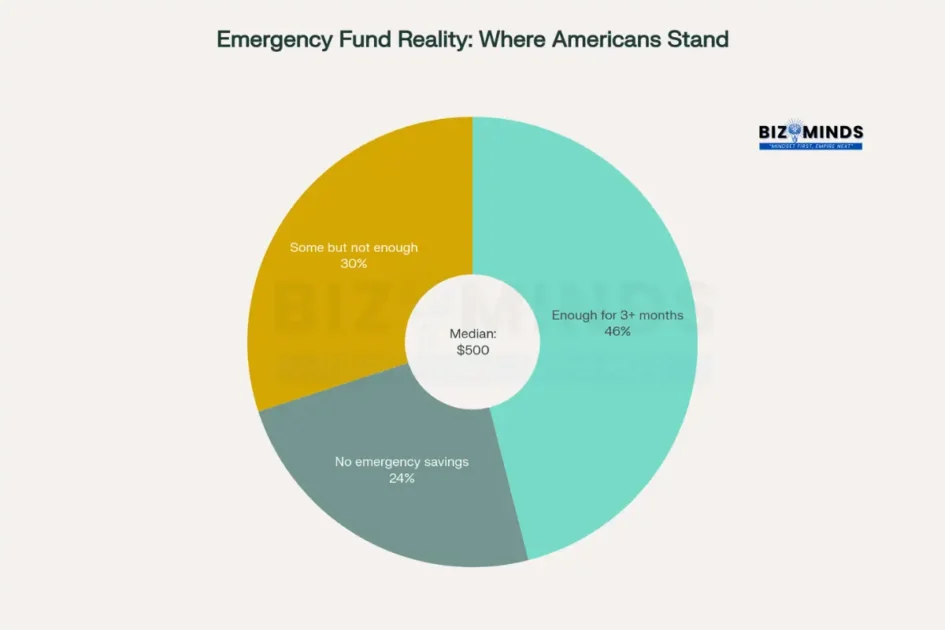
Emergency fund statistics: Why you need to adjust your budget for adequate savings
Understanding When You Need to Adjust Your Budget with Variable Income
How Income Fluctuation Signals the Need to Adjust Your Budget
Variable income affects a broader segment of the American workforce than many realize. Beyond traditional seasonal industries like agriculture and construction, the gig economy has expanded to encompass millions of workers across diverse sectors. Data from recent financial planning studies shows that approximately 30% of the workers experience some form of income variability. This includes not only freelancers and contractors but also commission-based sales professionals, service industry workers dependent on tips, and even salaried employees whose hours or overtime opportunities fluctuate.
The financial stress associated with income volatility extends beyond immediate cash flow concerns. Research conducted by Dutch financial institutions found that income volatility can increase psychological stress, particularly for households earning below $63,000 annually. This stress threshold provides important context for understanding when and how to adjust your budget most effectively.
Seasonal Patterns That Require You to Adjust Your Budget
Different industries experience predictable patterns of income fluctuation that require tailored budgeting approaches. Agricultural workers typically see peak earnings during harvest seasons, with significant downturns during off-season months. Construction workers often experience increased activity during warmer months, while tourism and hospitality professionals may see spikes during holiday seasons and summer travel periods.
Tax preparation professionals represent an excellent case study in extreme seasonal income variation. Many earn 70-80% of their annual income between January and April, requiring sophisticated financial planning to sustain themselves through the remaining eight months. Successful professionals in this field typically adjust their budget by setting aside 60-70% of peak-season earnings in dedicated accounts for off-season expenses.
Psychological Impact and Financial Behavior That Help You Adjust Your Budget Effectively
The psychological toll of income uncertainty can significantly impact financial decision-making. Studies show that people experiencing income volatility often make suboptimal financial choices during both high and low earning periods. During peak earnings, there’s a tendency toward lifestyle inflation and reduced savings rates. Conversely, during lean periods, individuals may make overly conservative decisions that limit their earning potential or delay necessary investments in their skills or equipment.
Understanding these behavioral patterns is crucial when learning to adjust your budget effectively. Successful variable income earners develop systems that account for both the mathematical and emotional aspects of financial planning.
Foundation Steps to Adjust Your Budget: Analysis and Assessment
Recognizing Income Patterns Before You Adjust Your Budget
The first step in mastering to adjust your budget involves thoroughly analyzing your income history. Unlike traditional budgeting advice that relies on stable monthly figures, variable income budgeting requires a minimum of 12-18 months of data to identify meaningful patterns. Start by collecting every pay stub, invoice, and payment record from the past two years. Organize this information by month and identify your highest, lowest, and median monthly earnings.
For comprehensive analysis, calculate both your annual average monthly income and your quarterly averages. Many seasonal workers find that their income follows predictable quarterly patterns that annual averages alone don’t capture. For example, a landscaping business owner might see 40% of annual income in Q2 and Q3, with significantly reduced earnings in Q1 and Q4.
Consider the experience of Maria, a freelance graphic designer from Denver. After tracking her income for 18 months, she discovered that her earnings averaged $4,200 monthly but ranged from $1,800 to $7,500. More importantly, she identified that her income typically dropped 30-40% in January and February as clients reduced marketing spend post-holidays. This pattern recognition allowed her to adjust her budget proactively, setting aside additional funds in November and December for the predictable winter downturn.
Expense Categorization and Prioritization When You Adjust Your Budget
Variable income budgeting requires more sophisticated expense categorization than traditional fixed-income budgeting. Create four distinct categories: non-negotiable fixed expenses (rent, insurance, minimum debt payments), variable necessities (groceries, utilities that fluctuate seasonally), important but flexible expenses (cell phone plans, subscriptions, discretionary transportation), and purely discretionary spending (entertainment, dining out, non-essential purchases).
This categorization becomes essential when your income drops and you need to adjust your budget quickly. Non-negotiable expenses must be covered first, followed by variable necessities. The flexible and discretionary categories serve as your adjustment mechanisms—areas where spending can be reduced or eliminated without compromising your essential needs or long-term financial goals.
Research from financial planning professionals indicates that individuals who proactively categorize expenses are 60% more likely to successfully navigate income downturns without accumulating debt. This preparation allows for quick decision-making during stressful periods when income drops unexpectedly.
Emergency Fund Strategies When You Adjust Your Budget for Variable Income
Traditional financial advice suggests maintaining 3-6 months of expenses in emergency funds, but variable income earners require more substantial reserves. Financial experts recommend 6-12 months of expenses for freelancers and seasonal workers. This extended timeline accounts for both the unpredictability of income recovery and the potential for multiple consecutive low-income months.
The median emergency fund for Americans is only $500, insufficient for handling even minor financial disruptions. For variable income earners, this inadequacy becomes particularly problematic. Consider implementing a tiered emergency fund approach: maintain 3 months of essential expenses in highly liquid savings, followed by an additional 3-6 months in slightly less liquid but higher-yield accounts.
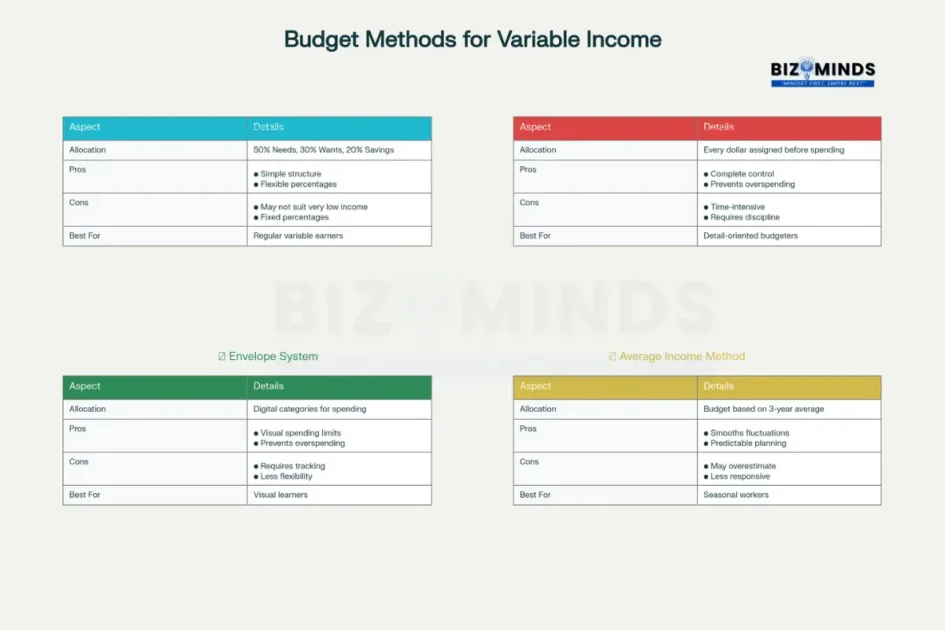
Four proven methods to adjust your budget for variable income success
Strategic Methods to Adjust Your Budget for Fluctuating Income
Average Income Method: How to Adjust Your Budget Consistently
The average income method provides stability by using historical earnings data to create predictable monthly budgets. Calculate your average monthly income over the past 2-3 years, then build your budget around this figure. During months when earnings exceed the average, surplus funds flow into designated savings accounts. When earnings fall below average, you draw from these reserves to maintain consistent spending patterns.
This approach works exceptionally well for individuals with predictable seasonal patterns. John, a tax preparer from Minnesota, implemented this system after struggling with boom-bust spending cycles. By calculating his three-year average monthly income at $3,800 and budgeting accordingly year-round, he eliminated the financial stress of his off-season months. During his busy season (January-April), earnings averaging $8,000 monthly flow into designated accounts that fund his May-December expenses.
To implement the average income method effectively to adjust your budget, establish separate accounts for different purposes: monthly operating expenses, taxes, business expenses, and longer-term savings goals. Automate transfers during high-earning months to reduce the temptation to overspend. Many successful practitioners report that this “pay yourself a salary” approach provides the psychological benefits of regular employment while maintaining the flexibility of variable income work.
Zero-Based Budgeting: Precision Ways to Adjust Your Budget
Zero-based budgeting requires allocating every dollar of income to specific purposes, ensuring that income minus allocated expenses equals zero. For variable income earners, this method provides exceptional control and flexibility, allowing budget adjustments that respond directly to earnings changes.
The key to successful zero-based budgeting with variable income lies in monthly recalibration. At the beginning of each month, assess your projected income and allocate funds accordingly. If your income increases, additional funds can be directed toward accelerated debt payments, increased savings, or previously deferred purchases. When income decreases, you can systematically reduce allocations while protecting essential expenses.
Sarah, a freelance marketing consultant from Austin, mastered the ability to adjust your budget for casual income and uses zero-based budgeting to manage income that ranges from $3,000 to $12,000 monthly. Each month, she allocates funds in order of priority: essential expenses first, minimum savings contributions second, then discretionary spending based on remaining available funds. This systematic approach eliminated the anxiety she previously experienced during low-income months, as she always knows exactly how much money is available for each category.
Digital Envelope Budgeting Systems to Help Adjust Your Budget
The envelope budgeting system, updated for the digital age, provides visual spending controls that many variable income earners find particularly effective. Digital envelope apps like YNAB, Goodbudget, and newer platforms create virtual spending categories with predetermined limits, preventing overspending in any single area.
For variable income earners, digital envelopes offer flexibility that physical cash envelopes cannot match. You can quickly reallocate funds between categories when income changes, and many apps provide spending analytics that help identify patterns and opportunities for optimization. The visual nature of envelope budgeting also provides immediate feedback about spending decisions, which can be particularly valuable during high-income months when overspending temptation increases.
The most successful envelope budgeters create categories that align with their income patterns. During peak earning months, they fund multiple envelopes simultaneously. During lean months, they focus on essential envelopes while leaving discretionary envelopes empty. This approach maintains spending discipline while providing flexibility to adjust your budget based on current income reality.
The 50/30/20 Rule Adaptation
The traditional 50/30/20 budgeting rule (50% needs, 30% wants, 20% savings) requires modification for variable income earners but can provide valuable structure. Instead of applying percentages to actual monthly income, apply them to your baseline income figure, either your average monthly income or your lowest reliable monthly income.
This modification creates several advantages. During high-income months, excess earnings beyond your baseline can be allocated to accelerated savings, debt payments, or investments. During low-income months, your essential needs remain covered because they’re based on conservative income estimates. The flexibility lies in adjusting the “wants” category, which can expand during good months and contract during difficult ones.
Consider the approach used by David, a commission-based insurance agent whose monthly income varies from $2,500 to $8,500. He applies the 50/30/20 rule to his baseline income of $3,000, allocating $1,500 for needs, $900 for wants, and $600 for savings. When his income exceeds $3,000, the excess goes entirely to additional savings and debt payments. When his income falls below $3,000, he reduces or eliminates the “wants” category while maintaining his essential needs and minimum savings commitments.
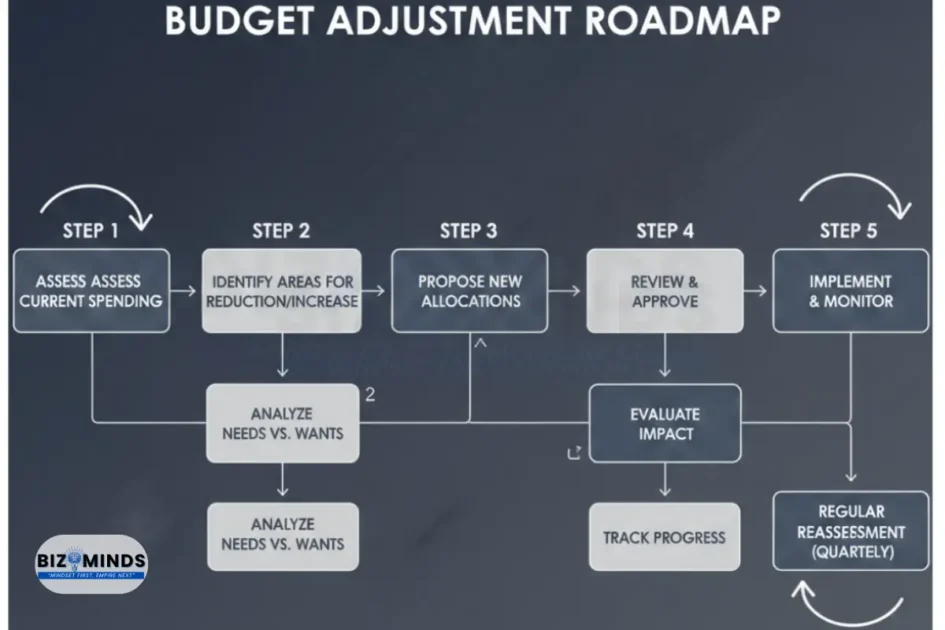
Step-by-step guide: How to adjust your budget when income changes
Practical Ways to Adjust Your Budget: Implementation Strategies
Creating Income Smoothing Systems to Adjust Your Budget
Income smoothing involves creating financial mechanisms that reduce the impact of income volatility on your monthly cash flow. The most effective approach involves establishing multiple dedicated accounts that serve specific functions in your financial ecosystem. Create separate accounts for monthly expenses, taxes, emergency reserves, and longer-term savings goals.
Automate fund transfers during high-income periods to reduce emotional spending decisions. Many banks now offer automatic savings programs that can be customized for variable income patterns. Set up percentage-based transfers that move funds immediately when income deposits exceed predetermined thresholds. This automation helps prevent lifestyle inflation during peak earning periods while ensuring adequate reserves for lean months.
Professional services providers often implement income smoothing through client retainer arrangements. Instead of accepting large project payments that create income spikes, negotiate monthly retainer fees that provide predictable cash flow. While this approach may not be suitable for all variable income situations, it demonstrates the value of creating systems that naturally smooth income fluctuations.
Tax Planning and Quarterly Obligations
Variable income earners face unique tax planning challenges that require proactive management. Unlike employees with automatic tax withholding, freelancers and contractors must estimate and pay quarterly taxes to avoid penalties. The IRS expects quarterly payments when annual tax liability exceeds $1,000, and late payments can result in significant penalties and interest charges.
Establish a dedicated tax savings account and immediately transfer 25-30% of all earnings into this account. This percentage should account for federal income tax, state income tax, Social Security, and Medicare taxes. During high-income months, consider transferring slightly higher percentages to account for progressive tax rates that increase with higher earnings.
Successful variable income earners often work with tax professionals who specialize in self-employment situations. These professionals can provide guidance on legitimate business deductions, optimal quarterly payment strategies, and retirement planning options that reduce current tax obligations while building long-term wealth.
Debt Management to Adjust Your Budget with Variable Income
Managing debt payments when income fluctuates requires strategic approaches that balance financial obligations with cash flow realities. Traditional debt repayment strategies assume consistent monthly payments, which may not be realistic for variable income earners during low-earning periods.
Consider implementing a tiered debt payment strategy. Establish minimum payments for all debts that can be sustained during your lowest-income months. During higher-income months, apply additional payments to high-interest debt using either debt avalanche (highest interest first) or debt snowball (smallest balance first) methods. This approach maintains good standing with all creditors while accelerating debt elimination when possible.
Many variable income earners benefit from consolidating high-interest debt into lower-interest options that provide more manageable payment structures. However, be cautious about extending repayment periods, as this increases total interest costs over time. Focus on debt consolidation options that reduce monthly payment obligations without significantly extending repayment timeframes.
Building Multiple Income Streams
Diversifying income sources can significantly reduce the impact of fluctuations in any single income stream. While building multiple income streams requires time and effort, it provides long-term stability that makes budget adjustment less frequent and less stressful. Consider both active and passive income opportunities that complement your primary skills and interests.
Active income diversification might include offering complementary services to existing clients, developing partnerships with other professionals, or creating service offerings that generate income during your traditional off-seasons. Passive income development could involve creating digital products, investing in dividend-paying stocks, or developing rental property income.
The key to successful income diversification lies in choosing opportunities that leverage existing skills and relationships rather than requiring completely new expertise. A freelance writer might develop passive income through affiliate marketing or creating online courses about writing, both of which utilize existing knowledge and professional networks.
Technology Tools to Help You Adjust Your Budget Efficiently
Best Apps to Help You Adjust Your Budget for Variable Income
Popular Budgeting Apps
Modern budgeting apps offer features specifically designed for variable income management that can significantly simplify the process to adjust your budget. YNAB (You Need a Budget) provides zero-based budgeting tools with income forecasting features that help variable income earners plan for upcoming expenses. The app’s “age of money” metric helps users understand how well their current system smooths income fluctuations.
Essential Features When You Adjust Your Budget with Apps
Goodbudget offers envelope-style budgeting that works well for users who prefer manual transaction entry over automatic bank account syncing. This approach provides greater privacy and forces users to actively engage with their spending decisions. The app’s sharing features also support couples or families managing variable income together.
App Comparison: Which Helps You Adjust Your Budget Best
Monarch Money provides comprehensive financial management that combines budgeting with investment tracking, making it valuable for variable income earners who want to coordinate short-term cash flow management with long-term wealth building. The app’s cash flow forecasting helps users anticipate future financial needs based on income patterns and planned expenses.
Automation and Financial Systems That Simplify How You Adjust Your Budget
Automated Transfers That Help You Adjust Your Budget
Automated financial systems can reduce the emotional stress associated with variable income management while ensuring consistent progress toward financial goals when you adjust your budget. Set up automatic transfers that move predetermined percentages of income into savings accounts whenever deposits exceed specific thresholds. This automation prevents the common mistake of treating high-income months as permission for increased lifestyle spending.
Bill Payment Automation When You Adjust Your Budget
Consider using automatic bill payment systems for fixed expenses while maintaining manual control over variable expenses. This approach ensures that essential obligations are met consistently while preserving flexibility to adjust your budget based on current income levels. Many banks offer alerts and notifications that can help you monitor account balances and spending patterns without requiring constant manual oversight.
Investment Automation to Reduce Budget Adjustments
Investment automation can be particularly valuable for variable income earners who struggle with consistent investment contributions. Apps like M1 Finance allow users to set up automatic investments triggered by account balance thresholds rather than scheduled dates. This approach ensures continued investment progress while accommodating income fluctuations and reduces the need to frequently adjust your budget for investment goals.
Tracking Tools for When You Need to Adjust Your Budget
Spreadsheet Solutions to Track and Adjust Your Budget
Effective variable income management requires robust tracking systems that provide insights into both income patterns and spending behaviors, helping you determine when and how to adjust your budget. Spreadsheet-based tracking remains popular among detail-oriented users who want complete control over their data analysis. Create monthly tracking sheets that capture income sources, timing, and associated expenses to identify patterns that can inform when you need to adjust your budget.
Cloud-Based Tools That Help You Adjust Your Budget
Cloud-based tracking tools offer the advantage of accessibility across multiple devices while providing automatic backup and sharing capabilities. Tools like Tiller integrate bank account data with customizable spreadsheet formats, combining automation with analytical flexibility. These systems can generate reports that help identify seasonal patterns, expense trends, and opportunities to adjust your budget for better financial outcomes.
Analytics Features That Signal When to Adjust Your Budget
Consider implementing time-based tracking for income-generating activities to understand the relationship between effort and earnings. Many variable income earners discover that small changes in their work patterns or client relationships can significantly impact their income stability. This data can inform strategic decisions about business development and client management, reducing how often you need to adjust your budget reactively.
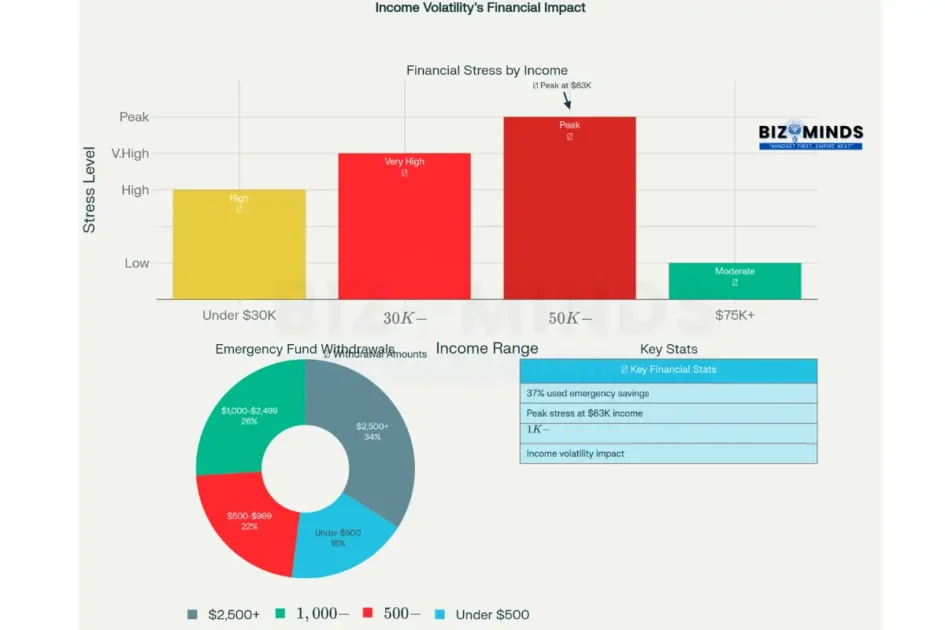
Financial stress patterns: When you must adjust your budget for income volatility
Common Challenges and Solutions to Adjust your Budget
Overcoming Income Peaks and Valleys
The feast-or-famine cycle represents one of the most significant challenges for variable income earners. During high-earning months, there’s natural tendency to increase spending, which can create financial stress when income inevitably decreases. Successful variable income management requires disciplined systems that prevent lifestyle inflation during peak earnings while maintaining adequate quality of life during lean periods.
Implement a “peak month protocol” that automatically directs excess earnings toward predetermined goals rather than increased discretionary spending. This might involve automatic transfers to emergency funds, debt payments, or investment accounts that activate when monthly income exceeds your baseline budget. The key lies in treating peak earnings as temporary windfalls rather than sustainable income increases.
During valley periods, focus on maintaining essential expenses while temporarily reducing or eliminating discretionary spending. Create detailed lists of expenses that can be quickly eliminated or reduced during low-income months. This preparation reduces decision-making stress during difficult periods and helps maintain focus on income generation rather than financial anxiety.
Managing Client Payment Delays
Variable income earners often face additional complexity from irregular payment schedules that don’t align with their expense obligations. Late client payments can create cash flow crises even when overall income remains adequate. Successful professionals develop systems that minimize the impact of payment delays on their personal finances.
Consider implementing invoice terms that encourage prompt payment through early payment discounts and late payment penalties. Many freelancers find that requiring partial payment upfront reduces both payment delays and the risk of non-payment. For larger projects, negotiate milestone-based payment schedules that provide regular cash flow rather than single large payments upon completion.
Develop relationships with clients who consistently pay promptly, and prioritize these relationships when workload management requires choices between opportunities. While payment reliability shouldn’t be the only factor in client selection, it deserves significant weight when evaluating long-term business relationships.
Seasonal Business Expansion Strategies
Many variable income earners can reduce income volatility through strategic business development that creates revenue streams during traditionally slow periods. This requires analyzing your current income patterns to identify specific months or seasons when earnings consistently decline, then developing services or products that can generate income during these periods.
A landscaping business owner might develop snow removal services, holiday decoration installation, or indoor plant maintenance services to generate winter income. A wedding photographer could offer portrait sessions, corporate events, or photography workshops during the traditionally slow winter months. The key lies in leveraging existing skills and equipment while serving different market needs.
Consider partnership opportunities with businesses that have complementary seasonal patterns. A tax preparer might partner with a bookkeeper to offer year-round financial services to clients, creating referral income during the off-season while providing additional value to clients during peak season.
Psychological Aspects of Variable Income
The emotional stress associated with income uncertainty can significantly impact both financial decision-making and overall well-being. Successful variable income earners develop psychological strategies that reduce anxiety while maintaining motivation during challenging periods. This often involves reframing variable income as an opportunity for flexibility and control rather than a source of financial instability.
Create visual representations of your financial progress that extend beyond monthly income figures. Track annual earnings, net worth growth, and goal achievement to maintain perspective during temporary low-income periods. Many variable income earners find that monthly income fluctuations become less stressful when viewed within the context of annual financial progress.
Develop systems that provide psychological security during uncertain periods. This might involve maintaining larger emergency funds than traditionally recommended, creating detailed backup plans for various income scenarios, or building professional networks that can provide support during challenging periods. The investment in psychological security often pays dividends through improved decision-making and reduced stress-related health issues.
Long-term Financial Planning to Adjust your Budget with Variable Income
Retirement Planning Strategies
Variable income earners face unique challenges when planning for retirement, as traditional advice assumes consistent earnings and employer-sponsored retirement benefits. Without access to employer 401(k) plans, many variable income earners must create their own retirement savings systems using individual retirement accounts (IRAs) and taxable investment accounts.
Consider maximizing contributions to SEP-IRAs or Solo 401(k) plans, which allow much higher contribution limits than traditional IRAs for self-employed individuals. These accounts provide immediate tax deductions that can be particularly valuable during high-income years while building long-term retirement security. The flexibility to vary contribution amounts based on income makes these accounts ideal for variable income situations.
Develop retirement contribution strategies that account for income variability. During high-income months, maximize retirement contributions to take advantage of tax deductions and compound growth. During low-income months, focus on meeting minimum contribution requirements or temporarily suspend contributions if necessary. The key lies in maintaining long-term perspective while accommodating short-term cash flow realities.
Investment Approaches for Fluctuating Income
Traditional investment advice often assumes consistent monthly contributions, which may not be realistic for variable income earners. Instead, consider investment strategies that accommodate irregular contribution schedules while maintaining progress toward long-term wealth building goals.
Implement a tiered investment approach that allocates funds based on income levels and financial stability. Maintain conservative investments (emergency funds, stable value accounts) as your foundation, then add more aggressive growth investments as income and emergency reserves increase. This approach ensures financial security while providing opportunities for wealth building during prosperous periods.
Consider automatic investment plans that activate when account balances reach predetermined thresholds rather than scheduled monthly contributions. This approach ensures consistent investment progress while accommodating income fluctuations. Many variable income earners find that this method results in higher overall investment levels than attempting to maintain consistent monthly contributions.
Insurance and Risk Management
Variable income earners often have greater insurance needs due to reduced access to employer-sponsored benefits and increased financial vulnerability during low-income periods. Comprehensive risk management becomes essential for protecting both current financial stability and long-term wealth building progress.
Disability insurance deserves particular attention for variable income earners, as the loss of earning capacity can be financially devastating. Look for policies that account for variable income patterns and provide adequate coverage based on average earnings rather than minimum earnings. Some policies offer increasing benefit options that adjust coverage as income grows over time.
Health insurance requires careful consideration of both cost and coverage needs. Variable income earners may qualify for subsidized marketplace plans during low-income periods but must plan for potential changes in eligibility as income fluctuates. Consider health savings accounts (HSAs) that provide tax advantages while building reserves for future medical expenses.
Case Studies and Real-World Applications
Case Study: Seasonal Construction Manager
Robert manages construction crews in Minnesota, earning roughly 75% of his annual income between April and October. His annual income averages $85,000, but monthly earnings range from zero in January to $18,000 in peak summer months. After several years of financial stress during winter months, Robert implemented a comprehensive budget adjustment system.
Robert’s strategy centers on treating his high-earning months as intensive savings periods rather than opportunities for increased spending. He maintains a baseline monthly budget of $4,200 based on essential expenses and minimum savings goals. During peak season, all earnings above $4,200 flow into designated accounts: 40% to emergency funds, 30% to tax obligations, 20% to retirement savings, and 10% to equipment and professional development.
This approach eliminated Robert’s previous pattern of accumulating credit card debt during winter months while enabling him to invest in equipment upgrades that increased his earning potential. His emergency fund now covers eight months of expenses, providing security during extended winter periods and unexpected project delays.
Case Study: Freelance Marketing Consultant
Most successful freelancers adjust your budget monthly, not annually. Therefore, Lisa operates a freelance marketing consultancy serving small businesses, with monthly income ranging from $3,500 to $15,000 depending on client project timing and seasonal business cycles. Her income peaks during Q4 as clients prepare for holiday marketing campaigns and drops significantly in January and February as businesses reduce marketing spend.
Lisa implemented a client retainer system that converts project-based payments into more predictable monthly income. She negotiates annual contracts with core clients, receiving monthly payments instead of project-completion payments. This approach reduced her income volatility by approximately 40% while providing clients with better budget predictability.
For remaining project-based work, Lisa maintains separate business and personal checking accounts with automated transfer systems. When project payments arrive, 30% immediately transfers to tax savings, 25% to emergency reserves, and 15% to business development funds. The remaining 30% flows to personal expenses and discretionary spending, preventing project windfall spending that previously created budget stress.
Case Study: Agricultural Producer
The Johnson family operates a 500-acre corn and soybean farm in Iowa, with income concentrated during harvest months and significant expenses distributed throughout the growing season. Their annual income averages $120,000 but arrives in two major payments: corn harvest in October and soybean harvest in November.
The Johnsons use a comprehensive cash flow budgeting system that coordinates income timing with expense obligations. They maintain operating lines of credit to fund spring planting expenses, which are repaid during harvest. A separate equipment reserve fund, funded during profitable years, provides flexibility for machinery purchases and repairs without disrupting operating cash flow.
Their personal budgeting follows a similar pattern, with harvest income allocated immediately to accounts supporting different family needs throughout the year. They pay themselves a monthly “salary” of $6,000 from designated accounts, treating harvest payments as business revenue rather than personal income windfalls. This approach has eliminated the feast-or-famine spending cycles that previously created family financial stress.
Conclusion
Learning to adjust your budget effectively when income fluctuates represents a crucial skill in today’s dynamic economy, where traditional employment models continue to evolve and millions of Americans embrace variable income opportunities. The comprehensive strategies outlined in this guide—from understanding income patterns and implementing appropriate budgeting methods to leveraging technology and building robust emergency reserves—provide the foundation for achieving financial stability despite earnings volatility.
Whether you’re a freelancer managing project-based income, a seasonal worker navigating predictable fluctuations, or a commission-based professional dealing with monthly variations, the ability to adjust your budget strategically separates successful variable income earners from those who struggle with financial uncertainty.
The key to long-term success lies in treating variable income as an opportunity for strategic financial management rather than a limitation that constrains your financial potential. By implementing systems that smooth income fluctuations, building adequate emergency reserves, and maintaining disciplined spending during both peak and valley periods, you can achieve greater financial security than many traditional employees with steady paychecks.
The proactive approach to adjust your budget based on income reality—rather than wishful thinking—creates a sustainable foundation for wealth building that actually benefits from income variability. When you master the skill to adjust your budget efficiently, high-income months become opportunities for accelerated savings and debt reduction, while low-income months become manageable challenges rather than financial crises.
Remember that mastering variable income budgeting is a gradual process that improves with experience and consistent application of proven principles. Start with the foundational strategies that align best with your specific income patterns and personal financial goals, then gradually incorporate more sophisticated techniques as your comfort and expertise develop.
The most successful variable income earners understand that the need to adjust your budget regularly isn’t a sign of financial failure—it’s evidence of responsive, intelligent money management. As you implement these strategies, you’ll discover that the flexibility to adjust your budget based on changing circumstances becomes one of your greatest financial advantages.
The investment in learning these essential budgeting skills will pay substantial dividends through reduced financial stress, improved long-term wealth building, and greater confidence in your financial future regardless of economic conditions. Your ability to adjust your budget effectively transforms income volatility from a source of anxiety into a strategic advantage that provides opportunities unavailable to those with fixed incomes.
As you continue to refine your approach and build experience with these proven strategies, you’ll join the ranks of financially successful variable income earners who have discovered that the freedom to adjust your budget dynamically creates more financial security, not less. The journey toward financial mastery begins with the first step—start implementing these strategies today, and experience the peace of mind that comes from knowing you can confidently navigate any income fluctuation that comes your way.
Frequently Asked Questions
How often should I adjust my budget when income fluctuates?
The frequency of budget adjustments depends on your income pattern predictability. If you have relatively predictable seasonal variations, quarterly adjustments may be sufficient. However, if your income changes monthly or unpredictably, monthly budget reviews are essential. The key is establishing a baseline budget that covers essential expenses during low-income periods, then creating adjustment protocols for when income exceeds or falls below expectations. Most successful variable income earners review their budgets monthly but only make major adjustments when income changes persist for more than two consecutive months.
What percentage of income should go to emergency funds for someone with variable income?
Variable income earners should maintain larger emergency reserves than traditional advice suggests. While standard guidance recommends 3-6 months of expenses, variable income earners benefit from 6-12 months of essential expenses in emergency funds. During high-income months, consider allocating 20-30% of earnings to emergency reserves until you reach your target. Once your emergency fund is established, you can reduce this percentage to 10-15% for maintenance. The larger reserve accounts for both income unpredictability and the potential for extended low-income periods that are common with variable income patterns.
Should I pay off debt or build savings first with irregular income?
For variable income earners, building a solid emergency fund should take priority over accelerated debt payments, with one important exception: high-interest debt above 15-20% interest rates. Start by establishing a $1,000-2,000 starter emergency fund, then focus on eliminating high-interest debt while simultaneously building your emergency reserve. Once you have 3-6 months of expenses saved and high-interest debt eliminated, you can focus on accelerated debt payments during high-income months while maintaining minimum payments during low-income periods. This approach provides security while making steady debt progress.
How do I handle taxes when my income varies significantly month to month?
Variable income earners must be proactive about tax planning since there’s no automatic withholding system. Immediately set aside 25-30% of all earnings in a dedicated tax account, adjusting this percentage based on your expected annual tax rate. Make quarterly estimated tax payments to avoid penalties, using Form 1040-ES to calculate required payments. During high-income months, consider setting aside slightly higher percentages to account for progressive tax rates. Work with a tax professional who understands variable income situations to optimize deductions and ensure compliance with quarterly payment requirements.
What budgeting method works best for seasonal workers?
The average income method typically works best for seasonal workers with predictable patterns. Calculate your average monthly income over 2-3 years and budget based on this figure year-round. During peak seasons, excess earnings flow into designated accounts that fund off-season expenses. This approach provides stability and prevents the boom-bust spending cycles common among seasonal workers. Supplement this with the envelope method for discretionary spending categories, allowing flexibility during peak earning periods while maintaining discipline during off-seasons.
How can I avoid overspending during high-income months?
Implement automatic systems that remove temptation from high-income months. Set up automatic transfers that immediately move predetermined percentages of income above your baseline budget into savings, debt payments, or investment accounts. Treat high-income months as opportunities to secure your financial future rather than increase current lifestyle expenses. Create a “celebration budget” that allows modest lifestyle upgrades during peak months without derailing long-term financial goals. Many successful variable income earners follow the rule of directing at least 70% of above-baseline earnings toward financial goals rather than increased spending.