

7 Best Professional Development Courses to Advance Your Career
The American workforce is experiencing unprecedented transformation, with rapidly evolving technologies, shifting market demands, and changing organizational structures creating both challenges and opportunities for career advancement. In this dynamic landscape, professional development has become not merely an option but a strategic necessity for career growth and long-term success.
Recent data from LinkedIn Learning reveals that nearly half of learning and talent development professionals see a skills crisis, with 49% agreeing that executives are concerned employees lack the right skills to execute business strategy. This skills gap presents a significant challenge, but also an extraordinary opportunity for professionals who invest in the right Professional Development Courses to distinguish themselves in competitive job markets.
The financial impact of strategic professional development cannot be overstated. Companies that prioritize employee training report 24% higher profit margins compared to those that neglect workforce development, while organizations with comprehensive training programs see 218% higher income per employee. For individual professionals, the return on investment is equally compelling.
According to Project Management Institute research, certified professionals earn 33% more than their non-certified counterparts, while 75% of Google Career Certificate graduates report positive career outcomes within six months of completion. These statistics underscore a fundamental truth: in today’s knowledge-driven economy, continuous learning through Professional Development Courses has become the most reliable pathway to career advancement and financial growth.
The US professional development market reflects this growing demand, with projections showing growth from $98 billion in 2024 to an estimated $146.9 billion by 2030, representing a compound annual growth rate of 6.9%. This expansion is driven by multiple factors, including digital transformation initiatives, the integration of artificial intelligence across industries, and the growing recognition that employee development directly correlates with organizational success.
Organizations from Fortune 500 companies to emerging startups are investing heavily in Professional Development Courses, with 71% of US organizations offering leadership training and 60% prioritizing technical skills development. The message is clear: companies understand that their competitive advantage lies not in static resources, but in the continuous development of human capital through strategic learning initiatives.
For professionals navigating this aspect, the challenge lies not in recognizing the importance of professional development, but in selecting the most impactful Professional Development Courses that align with career objectives and market demands. The following comprehensive analysis examines seven of the most effective professional development programs available to US professionals, each chosen based on measurable career outcomes, salary advancement potential, and alignment with current and projected market needs.
These courses represent diverse pathways to career advancement, from technical certifications that unlock high-paying specialized roles to leadership programs that prepare professionals for executive responsibilities. By understanding the unique benefits, requirements, and career trajectories associated with each program, professionals can make informed decisions about their professional development investments and create strategic learning pathways that accelerate career growth in an increasingly competitive marketplace.
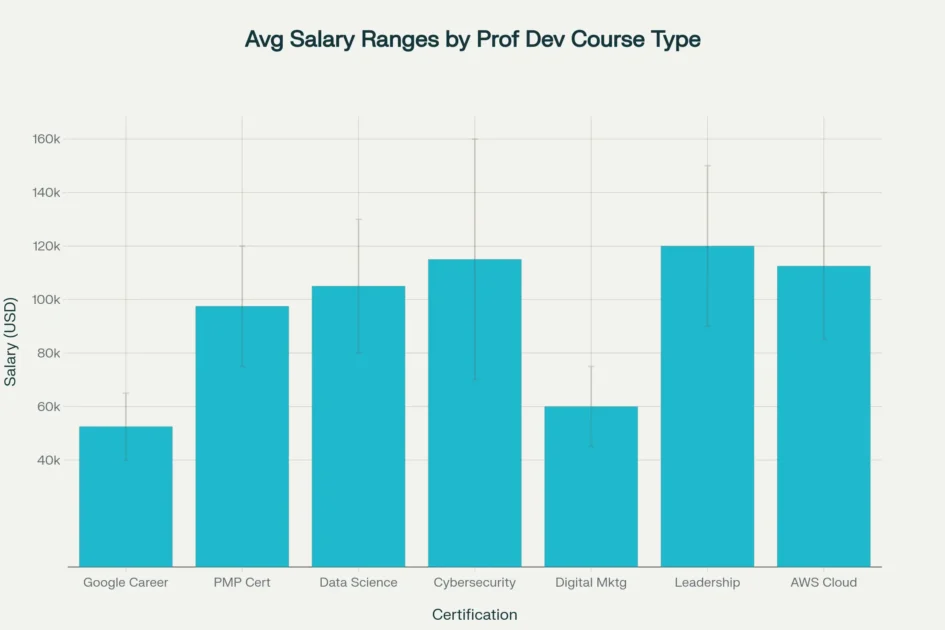
Average salary ranges for professionals with different types of professional development courses, showing strong ROI across all certification types
Project Management Professional (PMP) Certification
The Project Management Professional certification stands as the gold standard in project management credentials, representing one of the most globally recognized and career-transformative Professional Development Courses available to US professionals. Administered by the Project Management Institute, the PMP certification validates a professional’s ability to manage complex projects, lead diverse teams, and deliver results within scope, time, and budget constraints. With over 22 million new project management jobs expected to be created globally by 2027, the demand for PMP-certified professionals continues to surge across industries ranging from construction and healthcare to information technology and financial services.
The certification requirements reflect the program’s commitment to developing seasoned professionals. Candidates must demonstrate either 4,500 hours of project management experience with a four-year degree, or 7,500 hours with an associate’s degree, plus 35 hours of dedicated project management education. This rigorous prerequisite ensures that PMP candidates possess substantial real-world experience before pursuing certification, making the credential particularly valuable to employers seeking proven project leadership capabilities.
The career impact of PMP certification
The career impact of PMP certification is substantial and well-documented. According to PMI’s salary survey, 66% of PMP-certified professionals report increases in total compensation, with certified project managers earning an average of 33% more than their non-certified counterparts. In the United States, PMP-certified professionals typically command salaries ranging from $75,000 for entry-level positions to $120,000 for senior roles, with program managers and portfolio managers often exceeding $150,000 annually. Beyond immediate salary benefits, PMP certification opens pathways to senior leadership positions, with many certified professionals advancing to roles such as program directors, operations managers, and chief executive officers.
Real-world success stories from American companies demonstrate the transformative power of PMP certification. AT&T, which invested $1 billion in employee training initiatives, reported a 10% increase in productivity and significant reduction in turnover among employees who completed project management training. Similarly, companies like Microsoft, IBM, and General Electric actively seek PMP-certified professionals for leadership roles, recognizing that certified project managers bring standardized methodologies, risk management expertise, and proven ability to deliver complex initiatives.
The PMP curriculum encompasses five process groups and ten knowledge areas that form the foundation of effective project management. These include project integration management, scope management, time management, cost management, quality management, human resource management, communications management, risk management, procurement management, and stakeholder management. This comprehensive framework ensures that certified professionals can handle diverse project challenges across various industries and organizational contexts.
Google Career Certificates
Google Career Certificates represent a revolutionary approach to Professional Development Courses, designed to bridge the gap between traditional education and industry-ready skills for high-growth technology careers. Launched as part of Google’s Grow with Google initiative, these programs address a critical challenge in the American job market: while nearly 74% of job postings require a college degree, less than 40% of Americans possess one, leaving 70 million Americans without access to well-paying career opportunities. Google Career Certificates provide an alternative pathway to high-demand careers in technology, with programs covering areas such as data analytics, cybersecurity, user experience design, project management, and digital marketing.
The accessibility and effectiveness of Google Career Certificates have made them among the most impactful Professional Development Courses in the current market. At $49 per month through Coursera, with most programs completed in 3-6 months, the total investment of approximately $294 represents exceptional value compared to traditional degree programs. The program’s commitment to accessibility is further demonstrated through the Google Career Certificates Fund, which provides financing options for learners who can repay costs in small monthly installments only after securing employment with a minimum salary of $40,000 per year.
Career outcomes for Google Certificate graduates
Career outcomes for Google Certificate graduates are impressive and well-documented. Seventy-five percent of program graduates report positive career outcomes, including new jobs, promotions, or salary increases within six months of completion. The program has reached one million graduates globally, with success stories spanning diverse backgrounds and career transitions. Ray Bryant, an IT Support Certificate graduate, increased his annual salary by $20,000 after completing the program and securing a position as a data center technician at Google. James Bingham, a Project Management Certificate graduate and military veteran, successfully transitioned from military service to civilian project management roles.
The program’s employer consortium includes over 150 national employers, including Deloitte, Verizon, Ford, Wells Fargo, and Target, who actively recruit Google Certificate graduates for entry-level positions. This extensive employer network demonstrates industry recognition of the program’s quality and relevance to current business needs. Additionally, all Google Career Certificates are recognized by the American Center of Education, allowing graduates to earn college credits that can be applied toward bachelor’s degree programs.
The curriculum design reflects Google’s understanding of current industry needs and emerging technology trends. The Google Data Analytics Certificate, for example, covers essential tools including Python, SQL, R, and Tableau, with hands-on projects using real-world datasets. The Cybersecurity Certificate addresses the growing demand for security professionals, with employment in cybersecurity projected to grow 35% over the next decade. The User Experience Design Certificate prepares students for creative technology roles with median salaries exceeding $75,000 annually.
Google’s investment in ongoing program development ensures that Professional Development Courses remain current with industry trends and employer needs. Recent additions include advanced data analytics programs, artificial intelligence fundamentals, and specialized tracks for emerging technologies. This commitment to continuous improvement, combined with the program’s proven track record of career advancement, positions Google Career Certificates as essential Professional Development Courses for professionals seeking entry into high-growth technology fields.
Data Science Certification Programs
Data Science certification programs have emerged as among the most valuable Professional Development Courses for career advancement in the digital economy, with the Bureau of Labor Statistics projecting 36% growth in data science employment from 2023 to 2033—a rate much faster than the average for all occupations. This explosive growth reflects the increasing importance of data-driven decision making across industries, from financial services and healthcare to retail and manufacturing. For professionals seeking to capitalize on this trend, data science certifications provide structured pathways to develop essential skills in statistics, programming, machine learning, and data visualization.
The salary potential for certified data science professionals
The salary potential for certified data science professionals is exceptional, making these among the highest-return Professional Development Courses available. Entry-level data scientists typically earn between $80,000 and $100,000 annually, while experienced professionals with advanced certifications command salaries exceeding $130,000. Specialized roles such as machine learning engineers, AI architects, and data science managers can earn $150,000 to $200,000 or more, particularly in major metropolitan areas and technology companies. Research by EY India indicates that 66% of Chief Audit Executives are willing to pay higher salaries for data analytics skills, while KDNuggets found that professionals with big data certifications earn 14.3% higher salaries than their non-certified counterparts.
Leading data science certification programs offer diverse pathways tailored to different career goals and experience levels. The IBM Data Science Professional Certificate, available through Coursera, provides comprehensive training in data science tools and methodologies, including Python, R, SQL, machine learning, and data visualization. This 12-course program emphasizes hands-on learning through real-world projects and provides access to IBM’s Talent Network for job opportunities. Microsoft’s Azure Data Scientist certification focuses on cloud-based data science solutions, while SAS offers specialized certifications for advanced analytics and statistical modeling.
The curriculum structure of data science Professional Development Courses
The curriculum structure of data science Professional Development Courses typically progresses from foundational concepts to advanced applications. Students begin with statistical analysis and data manipulation, advance through programming languages such as Python and R, explore machine learning algorithms and predictive modeling, and culminate with capstone projects that demonstrate real-world problem-solving capabilities. This progression ensures that graduates can immediately contribute value to organizations seeking data-driven insights and solutions.
Real-world applications of data science certification
Real-world applications of data science certification extend across virtually every industry sector. In healthcare, certified data scientists develop predictive models for patient outcomes and optimize treatment protocols. Financial services firms employ data science professionals to detect fraud, assess credit risk, and develop algorithmic trading strategies. Retail companies use data science to optimize inventory management, personalize customer experiences, and improve supply chain efficiency. Technology companies rely on data scientists to enhance product recommendations, optimize user experiences, and develop artificial intelligence capabilities.
The continuous evolution of data science technologies requires ongoing professional development even after initial certification. Leading programs incorporate emerging trends such as machine learning operations, quantum machine learning, and augmented analytics into their curricula. This commitment to staying current with technological advances ensures that Professional Development Courses in data science provide long-term career value and maintain relevance in rapidly evolving technology landscapes.
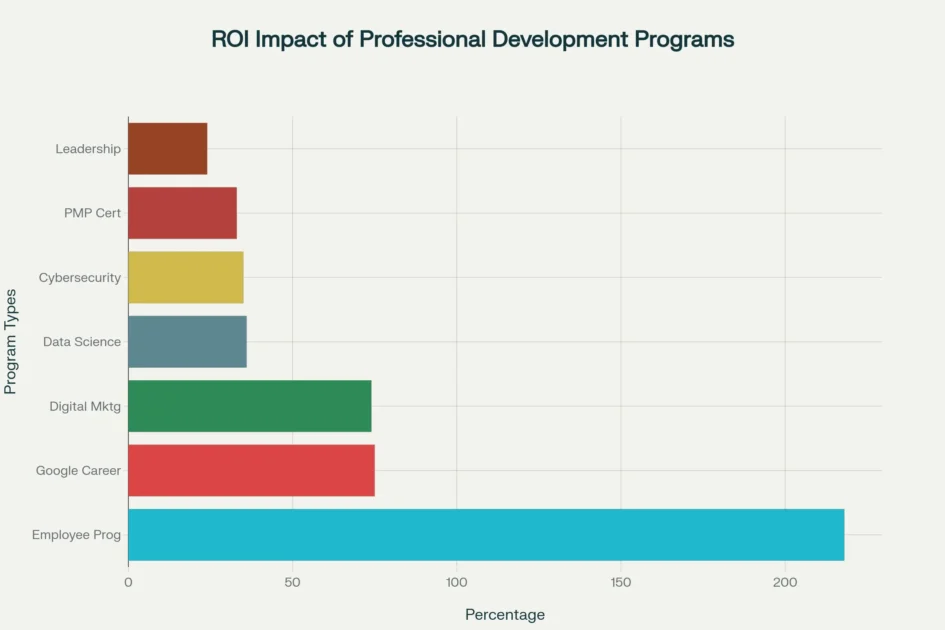
Return on Investment (ROI) statistics demonstrating the significant career and financial benefits of professional development programs across multiple disciplines
Cybersecurity Professional Certifications
Cybersecurity certifications represent some of the most strategically important Professional Development Courses in today’s threat landscape, with the US Bureau of Labor Statistics projecting 35% growth in cybersecurity employment over the next decade. This unprecedented growth rate reflects the escalating sophistication of cyber threats and the corresponding demand for skilled security professionals across all industries. From entry-level positions starting at $70,000 to senior roles exceeding $200,000, cybersecurity offers some of the most competitive salaries in the technology sector, making these Professional Development Courses particularly attractive for career advancement.
The cybersecurity certification
The cybersecurity certification background encompasses multiple specialized tracks, allowing professionals to develop expertise in areas such as ethical hacking, incident response, cloud security, and security architecture. Leading certifications include the Certified Ethical Hacker, which focuses on penetration testing and vulnerability assessment, and the Certified Information Security Officer certification for executive-level security leadership. The Certified Cybersecurity Technician provides entry-level professionals with foundational security skills, while advanced programs such as the Certified Penetration Testing Professional target senior technical specialists.
Salary progression in cybersecurity careers demonstrates the exceptional return on investment of these Professional Development Courses. Entry-level security analysts typically earn $75,000 to $105,000, while specialized roles such as penetration testers command $90,000 to $130,000 annually. Senior positions offer even greater financial rewards, with security consultants earning $110,000 to $150,000, cloud security engineers commanding $120,000 to $160,000, and Chief Information Security Officers earning $160,000 to $250,000 or more. These salary ranges reflect the critical importance organizations place on protecting their digital assets and maintaining regulatory compliance.
The practical applications of cybersecurity
The practical applications of cybersecurity Professional Development Courses extend across every sector of the American economy. Government agencies require certified professionals to protect critical infrastructure and sensitive national security information. Healthcare organizations need cybersecurity experts to safeguard patient data and ensure HIPAA compliance. Financial institutions employ security professionals to prevent fraud, protect customer information, and meet regulatory requirements. Technology companies rely on cybersecurity specialists to secure cloud platforms, protect intellectual property, and maintain customer trust.
Real-world demand for cybersecurity professionals is evidenced by the extensive job opportunities available to certified practitioners. Major employers including Lockheed Martin, JPMorgan Chase, Microsoft, and the Department of Defense actively recruit certified cybersecurity professionals. The skills shortage in cybersecurity has created a highly competitive job market, with companies offering premium compensation packages, flexible work arrangements, and comprehensive benefits to attract qualified candidates.
The curriculum design of cybersecurity
The curriculum design of cybersecurity Professional Development Courses reflects the multifaceted nature of modern security challenges. Programs typically cover network security, risk assessment, incident response, forensic investigation, compliance management, and emerging technologies such as artificial intelligence and Internet of Things security. Hands-on laboratories and simulation exercises provide practical experience with security tools and techniques, ensuring that graduates can immediately contribute to organizational security objectives.
Professional development in cybersecurity
Professional development in cybersecurity requires ongoing education due to the constantly evolving threat landscape. Leading certification programs include continuing education requirements and provide access to threat intelligence updates, security research, and industry best practices. This commitment to continuous learning ensures that certified professionals maintain current knowledge of emerging threats and defensive technologies, making cybersecurity Professional Development Courses valuable long-term career investments.
Leadership Development Programs
Leadership development programs represent the pinnacle of Professional Development Courses for career advancement, with organizations worldwide investing an estimated $370 billion annually in leadership training initiatives. These comprehensive programs focus on developing the soft skills, strategic thinking, and emotional intelligence necessary for executive success, making them essential for professionals aspiring to senior management and C-suite positions. Research consistently demonstrates that effective leadership development delivers measurable business outcomes, including improved team performance, higher employee retention, and increased organizational profitability.
The return on investment for leadership Professional Development Courses
The return on investment for leadership Professional Development Courses is substantial and well-documented. Companies with strong leadership development programs report 24% higher profit margins and significantly improved employee engagement scores. Individual participants in leadership development programs typically see career advancement opportunities, with many progressing to senior management roles within 12-24 months of program completion. The financial impact extends beyond immediate salary increases, as leadership-trained professionals develop the skills necessary to drive organizational growth, manage complex initiatives, and inspire high-performance teams.
Comprehensive leadership development programs
Comprehensive leadership development programs address multiple competency areas essential for modern executive success. Core curriculum components include strategic planning and vision development, team building and conflict resolution, change management and organizational transformation, communication and presentation skills, financial management and business acumen, and ethical decision-making and corporate governance. These programs often incorporate experiential learning methodologies, including executive coaching, 360-degree feedback assessments, case study analysis, and capstone projects that allow participants to apply learning to real organizational challenges.
Leading organizations have developed exemplary leadership development programs that serve as models for Professional Development Courses in this category. General Electric’s renowned leadership development program has produced numerous Fortune 500 CEOs and is credited with establishing many modern leadership development practices. McKinsey & Company’s leadership institute provides advanced training for senior consultants and partners, focusing on client relationship management and strategic advisory skills. Harvard Business School’s executive education programs offer intensive leadership development opportunities for experienced professionals seeking to advance to C-suite positions.
The practical applications of leadership development training
The practical applications of leadership development training demonstrate immediate workplace relevance. Participants learn to manage cross-functional teams in matrix organizations, navigate complex stakeholder relationships, and drive strategic initiatives across diverse business units. Leadership-trained professionals develop the ability to communicate effectively with board members, investors, and external partners, while building organizational cultures that attract and retain top talent. These skills become increasingly critical as professionals advance to positions with broader organizational responsibilities and greater impact on business outcomes.
Industry-specific leadership development programs provide specialized training for unique sectoral challenges. Healthcare leadership programs focus on patient care quality, regulatory compliance, and interdisciplinary team management. Financial services leadership training emphasizes risk management, regulatory oversight, and stakeholder communication. Technology sector programs address rapid innovation cycles, product development challenges, and global team management. This specialization ensures that leadership Professional Development Courses provide immediately applicable skills for specific industry contexts.
The measurable outcomes of leadership development programs
The measurable outcomes of leadership development programs validate their effectiveness as Professional Development Courses for career advancement. Organizations with comprehensive leadership development programs report 12% higher employee engagement, 18% better business performance, and 25% lower leadership turnover rates. Individual participants demonstrate improved decision-making capabilities, enhanced communication skills, and greater confidence in managing organizational challenges. These outcomes translate directly into career advancement opportunities, with leadership-trained professionals more likely to receive promotions, salary increases, and expanded responsibilities within their organizations.
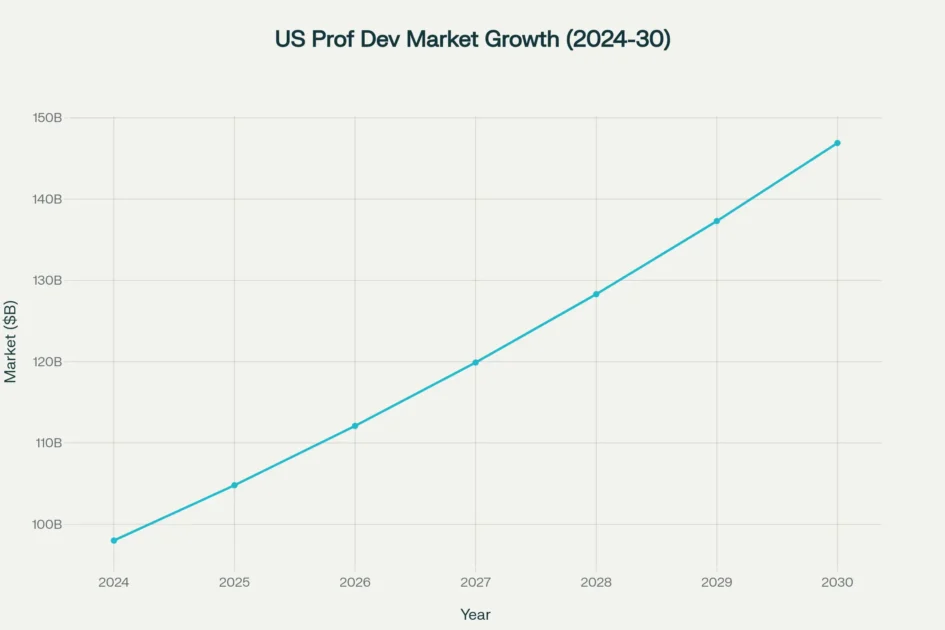
US Professional Development Courses Market projected to reach $146.9 billion by 2030, demonstrating strong growth in the professional learning sector
Digital Marketing Certifications
Digital marketing certifications have become essential Professional Development Courses as businesses increasingly shift advertising budgets from traditional media to digital channels, with digital marketing spending projected to reach $786 billion globally by 2026. These comprehensive programs equip professionals with skills in search engine optimization, social media marketing, content strategy, email marketing, analytics, and paid advertising across multiple platforms. The accessibility and immediate applicability of digital marketing skills make these certifications particularly valuable for career changers, entrepreneurs, and marketing professionals seeking to enhance their expertise in rapidly evolving digital landscapes.
The career impact of digital marketing Professional Development Courses is significant, with 74% of certified professionals reporting salary increases following program completion. Entry-level digital marketing specialists typically earn $45,000 to $60,000 annually, while experienced professionals with advanced certifications command salaries ranging from $65,000 to $100,000 or more. Specialized roles such as marketing automation managers, performance marketing specialists, and digital marketing directors can earn $100,000 to $150,000, particularly in major metropolitan areas and technology-focused companies.
Leading digital marketing certification programs
Leading digital marketing certification programs provide comprehensive training across multiple disciplines and platforms. The Digital Marketing Institute’s Professional Diploma in Digital Marketing offers globally recognized certification covering digital strategy, social media, artificial intelligence applications, pay-per-click advertising, and email marketing. Google’s Digital Marketing & eCommerce Certificate provides practical training in Google Analytics, Google Ads, and e-commerce platforms, with direct pathways to employment opportunities at Google and partner companies. HubSpot Academy offers free certification programs in inbound marketing, content marketing, and sales enablement, with over 7 million professionals having completed HubSpot courses.
The curriculum structure of digital marketing courses
The curriculum structure of digital marketing Professional Development Courses reflects the integrated nature of modern marketing strategies. Programs typically begin with foundational concepts including consumer behavior analysis and market research methodologies, progress through channel-specific training in search engine optimization, social media marketing, and content creation, advance to analytical and measurement techniques using platforms such as Google Analytics and social media insights tools, and culminate with strategic planning and campaign management projects. This comprehensive approach ensures that graduates can develop, implement, and optimize integrated marketing campaigns across multiple channels.
Real-world applications of digital marketing certification extend across virtually every industry sector and business size. E-commerce companies rely on certified digital marketers to drive online sales through search engine optimization, paid advertising, and conversion rate optimization. B2B organizations employ digital marketing professionals to generate leads through content marketing, social media engagement, and marketing automation platforms. Small businesses and startups particularly value certified digital marketers who can manage multiple marketing functions and deliver measurable results with limited budgets.
The return on investment for digital marketing Professional Development Courses is enhanced by the measurable nature of digital marketing activities. Unlike traditional marketing channels, digital marketing provides detailed analytics and performance metrics that allow professionals to demonstrate direct correlation between marketing activities and business outcomes. This capability to prove marketing ROI makes certified digital marketing professionals particularly valuable to organizations seeking accountability and optimization in their marketing investments.
Industry recognition and employer demand for digital marketing certifications
Industry recognition and employer demand for digital marketing certifications continue to grow as businesses prioritize digital transformation initiatives. Major corporations including Amazon, Facebook, Google, and Microsoft actively recruit certified digital marketing professionals for roles ranging from campaign management to strategic marketing leadership. The employer consortium supporting digital marketing certification programs includes companies across diverse sectors, demonstrating the universal applicability of digital marketing skills in modern business environments.
AWS Cloud Computing Certifications
Amazon Web Services certifications represent some of the most valuable and in-demand Professional Development Courses in the technology sector, with AWS commanding over 30% of the global cloud computing market and demand for AWS-certified professionals increasing 65% in the past year. These comprehensive certification programs validate expertise in cloud architecture, security, development, and operations, positioning certified professionals for high-paying roles in organizations undergoing digital transformation initiatives. With the cloud computing market projected to reach $832.1 billion by 2025 and 15% job growth anticipated through 2031, AWS certifications provide exceptional career advancement opportunities.
The salary potential for AWS-certified professionals
The salary potential for AWS-certified professionals demonstrates the exceptional return on investment of these Professional Development Courses. AWS Solutions Architect Associates typically earn $85,000 to $120,000 annually, while AWS Solutions Architect Professionals command $120,000 to $160,000. Specialized certifications such as AWS DevOps Engineer and AWS Security Specialist can lead to salaries exceeding $150,000, particularly in major metropolitan areas and at technology companies implementing large-scale cloud infrastructure. Senior cloud architects and cloud platform managers often earn $175,000 to $250,000 or more, reflecting the critical importance of cloud expertise in modern enterprise technology strategies.
AWS certification pathways are structured to accommodate different experience levels and career objectives. Foundational certifications such as AWS Cloud Practitioner provide entry-level professionals with basic cloud concepts and AWS service fundamentals. Associate-level certifications including Solutions Architect Associate, Developer Associate, and SysOps Administrator Associate target professionals with one to two years of hands-on AWS experience. Professional-level certifications such as Solutions Architect Professional and DevOps Engineer Professional require advanced expertise and are designed for senior technical professionals leading complex cloud implementations.
The practical applications of AWS
The practical applications of AWS Professional Development Courses extend across virtually every industry sector as organizations migrate from on-premises infrastructure to cloud-based solutions. Healthcare organizations use AWS services to securely store and process patient data while maintaining HIPAA compliance. Financial services firms rely on AWS infrastructure for high-frequency trading, risk analysis, and regulatory reporting applications. Media and entertainment companies leverage AWS for content distribution, video streaming, and digital asset management. Government agencies utilize AWS GovCloud for sensitive workloads requiring enhanced security and compliance capabilities.
Real-world demand for AWS-certified professionals is evidenced by the extensive job opportunities available across diverse industries and company sizes. Major technology companies including Netflix, Airbnb, and Pinterest built their entire platforms on AWS infrastructure and actively recruit certified professionals. Traditional enterprises undergoing digital transformation initiatives, such as Capital One, GE, and Johnson & Johnson, seek AWS expertise to modernize legacy systems and implement cloud-native applications. Consulting firms including Accenture, Deloitte, and IBM hire AWS-certified professionals to lead client cloud migration and optimization projects.
The comprehensive curriculum of AWS Professional Development Courses addresses the multifaceted nature of modern cloud computing. Training programs cover cloud architecture and design patterns, security and compliance frameworks, cost optimization and resource management, automation and infrastructure-as-code, monitoring and performance optimization, and disaster recovery and business continuity planning. Hands-on laboratories and real-world scenarios provide practical experience with AWS services, ensuring that certified professionals can immediately contribute to organizational cloud initiatives.
The continuous evolution of cloud technologies requires ongoing professional development even after initial AWS certification. Amazon regularly introduces new services and capabilities, updates existing features, and enhances security and compliance frameworks. Leading AWS Professional Development Courses provide access to continuous learning resources, industry updates, and recertification programs that ensure certified professionals maintain current knowledge of cloud best practices and emerging technologies. This commitment to ongoing education makes AWS certifications valuable long-term career investments that adapt to evolving technology world.
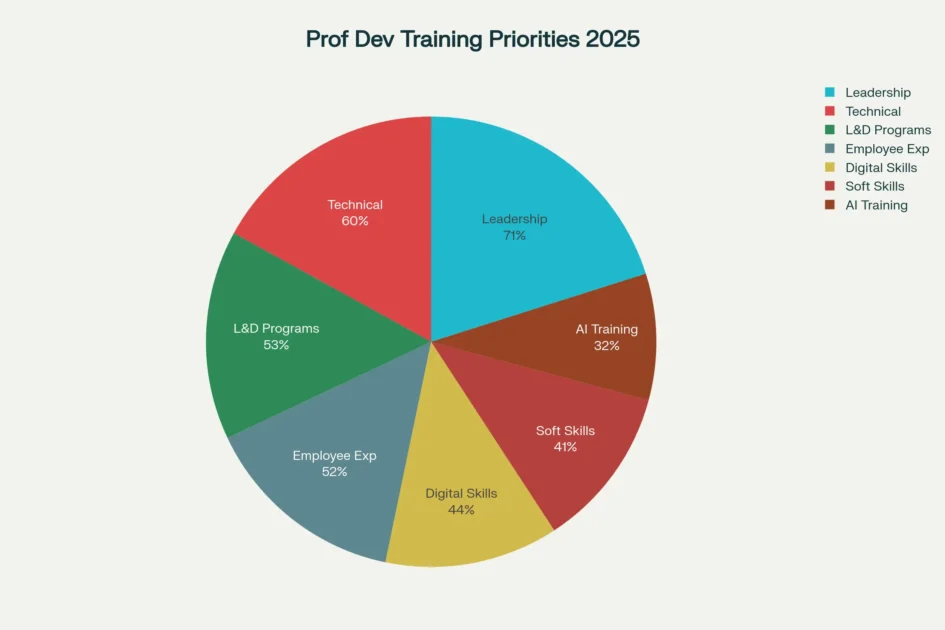
Organizations’ top professional development training priorities for 2025, with leadership development leading at 71% of companies offering such programs
Comparative Analysis and Selection Framework
Selecting the most appropriate Professional Development Courses requires careful analysis of individual career objectives, current skill levels, industry trends, and return on investment potential. Each of the seven professional development programs examined offers distinct advantages and career pathways, making the selection process crucial for maximizing professional growth and financial returns. Understanding the comparative benefits, requirements, and outcomes of these programs enables professionals to make informed decisions about their educational investments and career advancement strategies.
The financial return on investment
The financial return on investment varies significantly among Professional Development Courses, with some programs offering immediate salary increases while others provide long-term career advancement opportunities. Leadership development programs typically require the highest initial investment, ranging from $2,000 to $10,000, but offer substantial long-term returns through access to executive positions and senior management roles. Google Career Certificates provide exceptional value at $294 total cost, with 75% of graduates reporting positive career outcomes within six months. AWS and cybersecurity certifications offer strong salary increases of 25-35%, while PMP certification delivers consistent 33% salary premiums across industries.
Duration and time commitment
Duration and time commitment considerations significantly impact the feasibility of different Professional Development Courses for working professionals. Google Career Certificates and AWS certifications can typically be completed in 3-6 months with part-time study, making them accessible for professionals with demanding work schedules. Data science programs require 6-12 months for comprehensive skill development, while leadership development programs may extend 6-18 months to include experiential learning and coaching components. PMP certification preparation typically requires 3-6 months of intensive study, depending on prior project management experience.
Industry applicability and transferability across sectors vary among Professional Development Courses, influencing their long-term career value. Leadership development programs offer universal applicability across all industries and organizational types, making them particularly valuable for professionals uncertain about long-term industry commitments. Cybersecurity and data science certifications provide broad industry applicability due to universal security and analytics needs. Digital marketing certifications are particularly relevant for consumer-facing industries, while AWS certifications are most valuable in technology-focused organizations.
Geographic and remote work considerations
Geographic and remote work considerations increasingly influence Professional Development Courses selection as workplace flexibility becomes more important to career satisfaction. Cloud computing and cybersecurity certifications align well with remote work trends, as these roles often support distributed teams and cloud-based infrastructure. Digital marketing certifications enable location-independent career opportunities through freelancing, consulting, or remote employment arrangements. Traditional project management and leadership development programs may require more in-person collaboration, though virtual delivery models have expanded during recent years.
Career stage alignment
Career stage alignment ensures that Professional Development Courses match individual professional development needs and experience levels. Entry-level professionals benefit most from Google Career Certificates and foundational cybersecurity programs that provide pathways into high-growth technology careers. Mid-career professionals seeking advancement should consider PMP certification, AWS certifications, or specialized data science programs that build upon existing experience. Senior professionals aspiring to executive roles should prioritize leadership development programs that focus on strategic thinking and organizational management.
The selection framework should also consider emerging technology trends and future skill demands to ensure Professional Development Courses remain relevant throughout career progression. Artificial intelligence integration across industries suggests that data science and advanced analytics skills will become increasingly valuable. Cloud-first organizational strategies indicate continued growth in demand for AWS and cloud security expertise. The emphasis on employee experience and organizational culture highlights the ongoing importance of leadership development and emotional intelligence training.
Implementation Strategies and Success Factors
Successfully completing Professional Development Courses requires strategic planning, disciplined execution, and systematic application of acquired knowledge to career advancement activities. The most effective approach involves developing a comprehensive professional development plan that aligns educational investments with specific career objectives, timelines, and performance metrics. This strategic approach maximizes the return on investment for Professional Development Courses while ensuring that learning activities support broader career advancement goals.
Preparation strategies significantly influence success rates and learning outcomes for Professional Development Courses across all program types. Foundational skill assessment helps identify knowledge gaps and prerequisite learning needs before beginning formal certification programs. Time management and study schedule development ensures consistent progress while balancing work, family, and educational commitments. Resource allocation planning addresses financial costs, technology requirements, and support system needs for successful program completion.
The learning methodology varies among Professional Development Courses, requiring adaptation of study approaches to match program delivery formats and assessment requirements. Self-paced online programs such as Google Career Certificates and AWS certifications benefit from structured study schedules and regular progress checkpoints. Instructor-led programs including leadership development and specialized data science courses require active participation, peer collaboration, and application of concepts to workplace scenarios. Hybrid programs combining online learning with practical exercises need balanced attention to both theoretical knowledge and hands-on skill development.
Practical application of knowledge during Professional Development Courses
Practical application of knowledge during Professional Development Courses accelerates learning retention and demonstrates value to current employers. Project-based assignments provide opportunities to apply new skills to workplace challenges, creating immediate value while building portfolio evidence of capabilities. Volunteer opportunities and pro bono projects enable skill practice in low-risk environments while building professional networks and references. Cross-functional collaboration within current roles demonstrates newly acquired skills and positions professionals for expanded responsibilities.
Networking and professional community engagement amplify the career benefits of Professional Development Courses beyond knowledge acquisition alone. Industry conferences, professional associations, and certification alumni networks provide access to job opportunities, mentorship relationships, and industry insights. Online communities and forums enable knowledge sharing, problem-solving collaboration, and relationship building with professionals worldwide. Local meetups and professional groups offer face-to-face networking opportunities and potential partnership development.
Performance measurement and career milestone tracking ensure that Professional Development Courses deliver expected outcomes and inform future educational investments. Salary progression monitoring provides quantitative evidence of certification value and informs salary negotiation strategies. Responsibility expansion and role advancement demonstrate professional growth and validate educational investment decisions. Skill application metrics track the practical utilization of acquired knowledge and identify areas for continued development.
Long-term career planning
Long-term career planning integrates Professional Development Courses into broader career advancement strategies and succession planning activities. Multiple certification pathways provide continuous learning opportunities and prevent skill obsolescence in rapidly evolving industries. Specialization development enables experts to command premium compensation and access niche opportunities within chosen fields. Leadership preparation through progressive skill development positions professionals for executive advancement and organizational leadership responsibilities.
Conclusion
The landscape of professional advancement in America has fundamentally transformed, with traditional career progression models giving way to skills-based advancement and continuous learning paradigms. The seven Professional Development Courses examined in this comprehensive analysis—Project Management Professional certification, Google Career Certificates, Data Science programs, Cybersecurity certifications, Leadership Development programs, Digital Marketing certifications, and AWS Cloud Computing certifications—represent the most strategic investments professionals can make in their career advancement. Each program offers distinct pathways to increased earning potential, expanded career opportunities, and enhanced professional recognition, with documented success stories demonstrating measurable returns on educational investments.
The financial impact of these Professional Development Courses extends far beyond immediate salary increases, creating compound benefits that accelerate throughout professional careers. Organizations increasingly recognize certified professionals as valuable assets who can drive business outcomes, manage complex initiatives, and adapt to rapidly changing market conditions. This recognition translates into premium compensation packages, accelerated promotion opportunities, and access to leadership roles that might otherwise require decades of experience to achieve. The data consistently shows that professionals who invest in strategic Professional Development Courses position themselves for sustained career growth and financial prosperity in an increasingly competitive marketplace.
Looking toward 2025 and beyond, the importance of continuous professional development will only intensify as technological advancement, artificial intelligence integration, and market disruption continue to reshape industries and job requirements. The most successful professionals will be those who embrace lifelong learning through carefully selected Professional Development Courses that align with emerging trends and organizational needs. The programs highlighted in this analysis provide foundational skills and advanced competencies that remain valuable across industry transitions and economic cycles, making them sound investments for long-term career security and advancement.
The key to maximizing the career impact of Professional Development Courses lies in strategic selection, disciplined execution, and systematic application of acquired knowledge to workplace challenges. Professionals must assess their current capabilities, identify market opportunities, and select certification programs that bridge skill gaps while positioning them for future growth. Success requires commitment to continuous learning, active networking within professional communities, and consistent demonstration of newly acquired capabilities through expanded responsibilities and leadership opportunities. By approaching professional development as a strategic career investment rather than a one-time educational activity, American professionals can create sustainable competitive advantages that drive lifelong career success and financial prosperity.
Citations
- https://learning.linkedin.com/resources/workplace-learning-report
- https://high5test.com/employee-training-statistics/
- https://www.devlinpeck.com/content/employee-training-statistics
- https://blogs.psico-smart.com/blog-case-studies-companies-successfully-demonstrating-roi-from-training-investments-167740
- https://www.linkedin.com/pulse/roi-employee-training-why-investing-your-workforce-pays-elmaghawry-xe6hc
- https://www.reliablesoft.net/best-google-career-certificates/
- https://www.novelvista.com/blogs/project-management/pmp-certification-uses-career-growth
- https://www.technavio.com/report/professional-development-market-industry-in-the-us-analysis
- https://www.mordorintelligence.com/industry-reports/professional-development-market
- https://high5test.com/leadership-training-statistics/
- https://www.technavio.com/report/professional-development-market-analysis
- https://peoplemanagingpeople.com/topics/career-development/best-career-development-courses/
- https://www.indeed.com/career-advice/career-development/certifications-in-demand
- https://www.imd.org/blog/learning-and-development/high-income-skills/
- https://www.verifyed.io/blog/best-professional-certifications-2025
- https://instituteprojectmanagement.com/blog/future-proof-your-career-with-a-pmi-certification/
- https://www.simplilearn.com/can-i-get-job-with-pmp-certification-article
- https://staragile.com/info/project-management/pmp-career-path
- https://techcanvass.com/blogs/what-after-pmp-certification.aspx
- https://anexas.net/12-reasons-why-pmp-certification-is-worth-it/
- https://www.coursera.org/professional-certificates/google-it-support
- https://blog.google/outreach-initiatives/grow-with-google/google-career-certificate-graduates-reach-1-million/
- https://socialfinance.org/work/google/
- https://grow.google/certificates/data-analytics/
- https://www.eccouncil.org/cybersecurity-salary/
- https://grow.google/intl/ssa-en/courses-and-tools/
- https://www.dasca.org/newsroom/the-role-of-data-science-certifications-in-shaping-your-career
- https://www.coursera.org/professional-certificates/ibm-data-science
- https://www.refontelearning.com/blog/best-data-science-certifications-for-career-growth-in-2025
- https://www.gsdcouncil.org/blogs/data-science-professional-skills-career-growth
- https://www.upgrad.com/data-science-course/
- https://www.sas.com/cs_cz/certification/credentials/advanced-analytics/data-scientist.html
- https://www.testleaf.com/blog/cybersecurity-salary-in-india-2025/
- https://www.simplilearn.com/tutorials/cyber-security-tutorial/cyber-security-jobs
- https://www.upgrad.com/blog/cyber-security-salary-in-india/
- https://skillup.online/blog/top-cybersecurity-certifications-for-salary-growth/
- https://futurense.com/blog/what-is-the-cybersecurity-average-salary-in-india
- https://www.ddi.com/blog/roi-of-leadership-development
- https://pmc.ncbi.nlm.nih.gov/articles/PMC11505461/
- https://economictimes.com/jobs/mid-career/unlocking-the-value-measuring-the-roi-of-leadership-training/articleshow/103358075.cms
- https://www.indeed.com/career-advice/career-development/best-training-programs-companies
- https://managementconsulted.com/leadership-training-roi/
- https://digitalmarketinginstitute.com/students/courses/professional-diploma-in-digital-marketing
- https://academy.hubspot.com/courses/digital-marketing
- https://www.coursera.org/specializations/roi-drivendigitalmarketinganalytics
- https://thecmo.com/career/best-digital-marketing-courses/
- https://www.niit.com/india/course/digital-marketing-program/
- https://cxl.com/institute/
- https://online.hbs.edu/blog/post/professional-development-opportunities
- https://6-pence.com/professional-development-opportunities/
- https://archieapp.co/blog/workplace-statistics/
- https://www.deel.com/blog/employee-development-statistics/
- https://www.marketresearchfuture.com/reports/professional-development-market-27792
- https://www.sganalytics.com/blog/10-most-high-demand-skills-for-the-future/
- https://www.coursera.org/courses?query=professional+development
- https://www.edstellar.com/blog/corporate-training-companies-usa
- https://www.coursera.org/courses?query=statistics+for+data+science
- https://inomics.com/top/professional-training-courses
- https://www.togetherplatform.com/blog/best-training-and-development-programs
- https://grow.google/certificates/
- https://www.coursera.org/courses?query=data+analytics
- https://www.edstellar.com/blog/professional-development-training-topics
- https://careers.augustana.edu/blog/2023/06/27/30-companies-that-offer-exceptional-professional-development-programs-for-entry-level-employees/
- https://ignouiop.samarth.edu.in/index.php/site/programme-detail?id=5e5212395196738427372255ac9cd9f9fcd4ad96f7f4eb9f4118de5da50270371789
- https://peoplemanagingpeople.com/learning-development/learning-development-certifications/
- https://www.greatplacetowork.com/resources/blog/examples-of-development-programs-for-employees-from-award-winning-companies
- https://www.vectorsolutions.com/resources/blogs/10-professional-development-courses-to-empower-your-workforce-in-2025/
- https://builtin.com/articles/companies-with-leadership-development-programs
- https://career247.com/job-assisted-programs/data-science
- https://www.coursera.org/courses?query=free
- https://compt.io/blog/10-examples-of-professional-development-programs-for-employees/
- https://www.gallup.com/workplace/349484/state-of-the-global-workplace.aspx
- https://www.shrm.org/labs/resources/measuring-the-roi-of-your-training-initiatives
- https://www.shrm.org/content/dam/en/shrm/topics-tools/research/2025-shrm-state-of-the-workplace-research-report.pdf
- https://www.tekstac.com/employee-training-programs-roi-measurement/
- https://www.researchandmarkets.com/report/united-states-professional-development-market
- https://hbr.org/2023/10/evaluating-roi-on-your-companys-learning-and-development-initiatives
- https://www.grandviewresearch.com/industry-analysis/personal-development-market
- https://thegrowthfaculty.com/articles/TheGoodNewsstaffbenefitgivesyou353ROIforevery1spent
- https://www.coursera.org/in/articles/high-income-skills
- https://www.reworked.co/learning-development/5-learning-and-development-certifications-for-the-workplace/
- https://www.projectboldlife.com/career/top-7-best-professional-development-courses-career-growth/
- https://www.aboutamazon.com/news/workplace/our-upskilling-2025-programs
- https://www.21kschool.com/in/blog/online-courses-for-professional-development/
- https://sageuniversity.edu.in/blogs/top-10-most-demanded-courses-in-india-future-proof-your-career
- https://www.linkedin.com/learning/topics/professional-certificates
- https://aisect.org/top-10-job-oriented-courses-offered-by-aisect-academies-you-shouldnt-miss-in-2025/
- https://www.shrm.org/topics-tools/news/hr-magazine/how-to-measure-roi-leadership-development
- https://grow.google/intl/ssa-en/google-career-certificates/
- https://www.forbes.com/sites/rachelwells/2025/10/10/17-free-google-career-certificates-for-100000-jobs-in-2026/
- https://www.ccl.org/categories/roi-value/
- https://learn.microsoft.com/en-us/training/career-paths/data-scientist
- https://www.coursera.org/in/articles/cybersecurity-salary