

9 Best Time Management Tools for Busy Entrepreneurs
The entrepreneurial journey demands more than ambition and innovation—it requires mastery over the most finite resource available: time. Recent research reveals that 63% of business owners in the United States work more than 50 hours weekly, yet report feeling they should only work 41.7 hours to maintain optimal productivity and well-being.
This paradox reflects a deeper crisis in how entrepreneurs allocate their hours and attention. For startups operating on razor-thin margins and established businesses navigating competitive markets, the difference between entrepreneurs who thrive and those who merely survive often comes down to structured time management tools. Without systematic approaches to organizing work, entrepreneurs find themselves trapped in cycles of reactive crisis management where urgent matters consume hours that should be dedicated to strategic growth.
The modern business demands practical, technology-enabled solutions that transform time from a constant constraint into a manageable asset. The nine time management tools profiled throughout this guide represent proven methodologies that leading entrepreneurs use to reclaim control over their schedules, eliminate productivity leaks, and build sustainable businesses that support rather than consume their lives.
The mental and physical toll of unmanaged time consumption has reached crisis proportions across the entrepreneurial community. A staggering 72% of entrepreneurs suffer from burnout at some point in their entrepreneurial journey, while 87.7% struggle with active mental health challenges directly attributable to work-related stress and insufficient rest.
Sleep disturbances affect 55% of entrepreneurs, physical exhaustion plagues 38%, and 70% of small business owners report that burnout has negatively impacted their personal relationships. These statistics transcend productivity metrics—they reflect a genuine health emergency among America’s business builders. The root cause proves remarkably consistent: entrepreneurs lack structured systems for managing their time, leading to endless work expansion where tasks multiply to fill available hours without generating proportional value increases. Beyond personal health impacts, this time management crisis costs American businesses substantially.
Research indicates that small businesses operate at only 47% of the productivity level achieved by large enterprises, representing approximately 5.4% of US GDP in unrealized economic potential. Yet this massive opportunity gap becomes surmountable through adoption of effective time management tools that enforce boundaries, eliminate distractions, automate routine tasks, and create accountability mechanisms ensuring work remains aligned with strategic objectives.
The productivity challenges facing entrepreneurs manifest in specific, quantifiable ways that quality time management tools directly address. Email management alone consumes 33% of entrepreneurs’ time, making it the single largest productivity drain across modern businesses. Administrative tasks consume an additional 24%, social media distractions steal 20%, context switching between applications drains 17%, and unnecessary meetings waste 16%—together these activities represent 110% of observable time waste, reflecting how entrepreneurs simultaneously struggle with multiple efficiency drains.
The average worker remains productively focused for merely 2 hours and 53 minutes daily despite spending substantially more time at their desks, with each interruption requiring approximately 25 minutes for full focus recovery. These figures underscore why 82% of people lack time management systems—the complexity feels overwhelming, implementation appears time-consuming, and results seem uncertain.
Yet entrepreneurs who implement systematic approaches through modern time management tools experience transformative improvements: 80% reductions in productivity leaks, 61% revenue increases from more efficient time allocation, and dramatic improvements in personal well-being as structured work hours prevent the endless expansion that characterizes typical entrepreneurial existence.
Understanding the specific capabilities of modern time management tools empowers entrepreneurs to make informed decisions aligned with their particular business needs and growth stages. The marketplace offers diverse solutions addressing distinct productivity dimensions: comprehensive project management platforms consolidating multiple business functions, specialized time tracking applications providing granular visibility into daily activity patterns, visual task management systems emphasizing simplicity and rapid adoption, knowledge management platforms facilitating documentation and team collaboration, and workflow automation engines eliminating manual repetitive work.
For entrepreneurs already stretched thin managing multiple responsibilities, selecting appropriate time management tools represents one of the highest-ROI decisions available—implementation costs typically range from free to modest monthly subscriptions while potential benefits include recovering hours daily, preventing burnout-driven health crises, enabling sustainable revenue growth, and building organizational infrastructure capable of scaling without proportional increases in personal work demands.
This comprehensive guide examines nine proven time management solutions specifically designed for American entrepreneurs, providing detailed analysis of features, pricing, real-world applications, and implementation guidance. Whether managing a solo venture or leading growing teams, the tools presented here offer pathways toward reclaiming time from chaos, building resilient business systems, and creating sustainable entrepreneurial lives that support both professional ambitions and personal well-being.
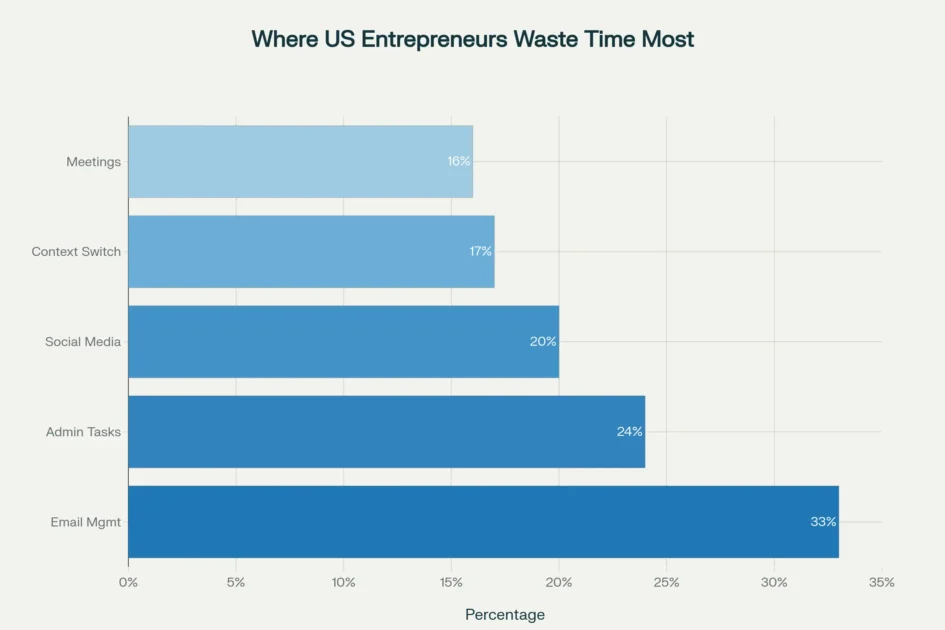
Horizontal bar chart displaying the top five time-wasting activities for US entrepreneurs based on recent productivity research
The Time Management Crisis Facing American Entrepreneurs
Understanding the Productivity Gap
The productivity gap for American entrepreneurs presents alarming statistics that demand immediate attention and strategic intervention through proper time management tools. According to comprehensive research spanning 2024 and 2025, business owners spend a staggering 36% of their work weeks on administrative tasks—routine activities like invoicing, email management, payroll processing, and office supply ordering that don’t directly contribute to revenue generation or strategic growth.
This translates to roughly 14 hours per week dedicated to tasks that could potentially be automated, delegated, or streamlined through appropriate time management tools. For entrepreneurs earning $150,000 annually, this represents approximately $53,460 in annual salary cost devoted to non-revenue-generating administrative work. The situation becomes even more concerning when examining daily productivity patterns. Research indicates that the average worker remains productive for merely 2 hours and 53 minutes each day, despite spending significantly more time at their desks and reporting feeling perpetually behind.
Knowledge workers in the United States spend approximately 4 hours per week simply reorienting themselves after switching between applications—nearly 5 working weeks annually or roughly 9% of total work time lost to context switching rather than productive effort. These figures underscore why structured time management tools represent not luxury items but essential business infrastructure for entrepreneurs competing in increasingly complex markets.
The mental and emotional toll of unmanaged productivity challenges extends far beyond operational metrics to create a genuine health crisis among American entrepreneurs. A groundbreaking study found that 87.7% of small business owners struggle with active mental health challenges, with 34.4% reporting burnout symptoms directly attributed to excessive work hours and relentless operational focus. Sleep disturbances affect 82% of entrepreneurs, causing them to lose sleep specifically due to work-related concerns, while physical exhaustion plagues 38%, and 70% report that burnout has negatively impacted their personal relationships and quality of life.
The average entrepreneur faces approximately 60 interruptions daily, with each disruption requiring an average of 23 minutes to 30 minutes for full focus recovery—meaning frequent interruptions can consume 14 to 23 hours weekly simply regaining concentration after being pulled away from focused work.
These mental health consequences prove devastating not merely from personal welfare perspectives but from business performance perspectives: entrepreneurs reporting burnout show decreased decision-making quality, reduced strategic thinking capacity, increased mistakes and rework, and diminished ability to lead teams effectively. Implementing effective time management tools that create structured workflows, eliminate distracting interruptions, and enforce sustainable work boundaries directly addresses these psychological and physiological challenges while simultaneously improving business outcomes.
Context switching and multitasking represent perhaps the most insidious productivity drains affecting modern entrepreneurs, with costs so substantial that they warrant dedicated examination. Research from the Software Engineering Institute at Carnegie Mellon University demonstrates that when workers juggle five projects simultaneously, they expend only 20% of their cognitive energy on actual work, with the remaining 80% dissipating through context switching overhead. The financial implications prove staggering: multitasking reduces productivity by as much as 40%, and lost productivity due to context switching costs the global economy an estimated $450 billion annually, with proportional damage affecting individual businesses of all sizes.
The average digital worker toggles between applications and websites nearly 1,200 times daily and uses approximately 10 different applications per day, switching between them roughly 25 times on average. This fragmented workflow creates cascading problems: researchers found that six out of ten workers report difficulty tracking information flowing through different apps, and employees spend an average of 59 minutes daily simply searching for information across disconnected tools rather than performing actual work.
The quality consequences prove equally concerning—when forced to context switch between complex tasks, workers make significantly more errors, demonstrate reduced attention to detail, and produce inferior work compared to focused single-task performance. Entrepreneurs who implement comprehensive time management tools that consolidate fragmented workflows, reduce app switching, and protect focus time can recover an estimated 40% of lost productivity while simultaneously improving work quality and employee satisfaction.
The entrepreneurial work pattern particularly exacerbates these productivity challenges, as business owners often work 50-60 hours weekly, with many founders exceeding 60-100 hours, yet producing diminishing returns as hours increase. Stanford economist John Pencavel’s comprehensive research demonstrates that productivity per hour declines sharply beyond 50 hours weekly, and after 55 hours productivity deteriorates so dramatically that additional hours produce virtually no additional output—workers putting in 70 hours weekly accomplish essentially the same work as those working 55 hours.
This paradox reflects fundamental neuroscience: human brains require adequate sleep, meals, relaxation, and genuine recovery time to function optimally, particularly for high-concentration work like strategic planning, financial analysis, and complex problem-solving that define entrepreneurial success. Yet 59% of entrepreneurs and 82% of surveyed solopreneurs report that their work-life balance needs improvement, and nearly half find it difficult to disconnect during time off due to constant work demands and connectivity.
The Adobe research on work-life balance paradoxically reveals that entrepreneurs using time management tools strategically, including AI-powered automation and intelligent prioritization, save an average of six hours weekly—equivalent to 26 hours monthly or 310 hours annually—demonstrating that tool adoption directly enables reduced work hours without corresponding productivity decreases.
Furthermore, entrepreneurs implementing robust time management tools that systematically eliminate time waste, enforce boundaries, and automate repetitive work report improved job satisfaction, stronger personal relationships, better strategic decision-making, and sustainable business growth that doesn’t require personal sacrifice of physical and mental health.
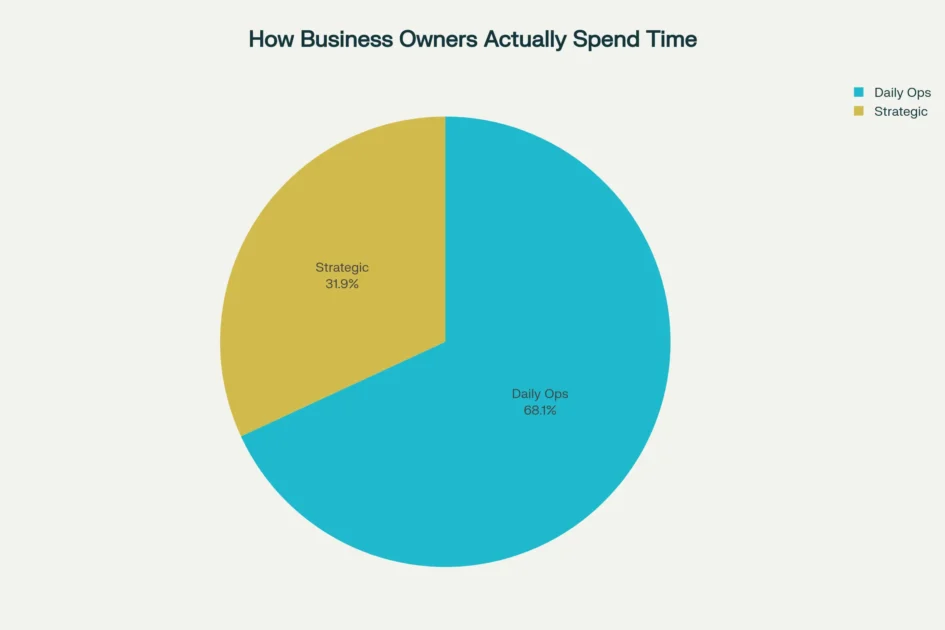
Pie chart illustrating how business owners divide their time between daily operational tasks and strategic planning activities
The Hidden Cost of Poor Time Management
Beyond productivity metrics, poor time management exacts substantial financial and opportunity costs. Time management research reveals that business owners waste approximately seven hours weekly on low-value activities that deliver minimal return on investment. Email management alone consumes 33% of entrepreneurs’ time, making it the single largest time drain in modern business operations. Administrative tasks account for an additional 24% of wasted time, followed by social media distractions at 20%, context switching between applications at 17%, and unnecessary meetings at 16%.
Small businesses experience downtime costs ranging from $137 to $427 per minute, with large enterprises facing losses up to $9,000 per unplanned outage. These figures underscore the critical importance of implementing robust time management systems that prevent costly disruptions and inefficiencies.
The productivity gap extends beyond individual entrepreneurs to impact entire organizations. Research from McKinsey Global Institute demonstrates that US small and medium-sized enterprises operate at only 47% of the productivity level of large companies, compared to a 60% average across ten advanced economies studied. This productivity deficit represents approximately 5.4% of US GDP—a staggering economic opportunity that remains untapped due to inefficient time management practices, limited technology adoption, and inadequate systems for tracking and optimizing work.
For entrepreneurs, this data point reveals both a challenge and an opportunity: those who successfully implement effective time management tools can gain significant competitive advantages over peers who continue operating without structured systems. The choice facing modern entrepreneurs isn’t whether to adopt time management tools, but rather which tools align best with their specific business needs, team structures, and growth objectives.

Column chart displaying the five most pressing productivity challenges faced by US entrepreneurs with corresponding statistics
Essential Features to Consider in Time Management Tools
Core Functionality Requirements
When evaluating time management tools, entrepreneurs should prioritize several essential features that directly impact productivity and business outcomes. Automated time tracking represents perhaps the most critical functionality, as manual time entry systems suffer from inaccuracy, incompleteness, and user resistance. Modern time management tools employ sophisticated algorithms that automatically monitor computer and mobile device activity, categorizing time spent across applications, websites, and specific projects without requiring constant user input.
This automation eliminates the cognitive burden of remembering to start and stop timers while providing accurate data for billing, productivity analysis, and resource allocation decisions. Research indicates that effective employee time tracking can reduce productivity leaks by 80% and boost revenue by 61% when properly implemented.
Task and project management capabilities form another cornerstone of effective time management tools. Entrepreneurs need systems that support hierarchical task structures with projects, tasks, and subtasks; enable clear assignment of responsibilities with due dates and priority levels; and provide multiple viewing options including list, board, calendar, and timeline perspectives. The most effective tools allow entrepreneurs to break down complex initiatives into manageable components while maintaining visibility into overall progress and dependencies.
Integration capabilities deserve careful consideration, as the average small business owner juggles four different digital tools daily, with nearly a third using five or more applications. Time management tools that seamlessly connect with existing email systems, calendar applications, communication platforms, and project management software reduce context switching—which accounts for 17% of wasted time according to recent research.
Advanced Features for Entrepreneur Success
Beyond core functionality, several advanced features significantly enhance time management effectiveness for busy entrepreneurs. Productivity reporting and analytics transform raw time data into actionable insights that drive continuous improvement. Quality time management tools generate detailed reports showing productivity trends, time allocation across projects and clients, identification of peak performance hours, and comparison of estimated versus actual time requirements for various activities.
These analytics empower entrepreneurs to make data-driven decisions about delegation, pricing, resource allocation, and process optimization. A study by Microsoft found that 57% of employee time goes toward communication activities—emails, chats, and meetings—rather than focused work execution. Comprehensive reporting helps entrepreneurs identify and address such imbalances before they undermine business performance.
Automation and workflow capabilities represent another crucial differentiator among time management tools. Modern platforms incorporate sophisticated automation features that handle repetitive tasks without human intervention: automatically moving tasks between workflow stages when specified conditions occur, sending reminder notifications as deadlines approach, updating project statuses based on task completion rates, and generating recurring tasks for regular activities. These automation features can save entrepreneurs hours each week by eliminating mundane manual work.
Butler automation in Trello, for example, allows users to create complex multi-step workflows using simple if-then logic, while Asana’s AI-powered workflow builder suggests optimizations based on team usage patterns. Research shows that 79% of employees report improved productivity after implementing automation technology in their workflows.
Collaboration and communication features have become increasingly important as remote and hybrid work models proliferate. Effective time management tools provide built-in capabilities for team communication, file sharing, comment threads on specific tasks, real-time notifications of project updates, and clear visibility into team member workloads and availability. These features reduce the need for separate communication tools while ensuring all project-related discussions remain contextually attached to relevant tasks and deliverables.
The Alternative Board research found that 68% of business owners identify “holding employees accountable to actual results” as a top priority for improving time management. Tools with robust collaboration features make this accountability both visible and measurable without creating oppressive micromanagement environments.
The 9 Best Time Management Tools for Entrepreneurs
1. Asana: Comprehensive Goal Setting and Team Collaboration
Asana has established itself as a leading time management tool for entrepreneurs who prioritize strategic goal alignment and cross-functional team collaboration. The platform excels at connecting individual tasks to broader company objectives, ensuring every team member understands how their daily work contributes to organizational success.
Asana’s hierarchical structure allows entrepreneurs to organize work across multiple dimensions: workspaces house teams, which contain projects, which break down into tasks and subtasks with granular detail including assignees, due dates, dependencies, custom fields, and attached files. This flexibility accommodates diverse workflows without forcing teams into rigid templates that don’t match their actual work patterns.
The platform offers multiple project views that cater to different cognitive preferences and use cases. List view provides simple task organization ideal for straightforward workflows; Board view delivers Kanban-style visual management perfect for tracking work through defined stages; Timeline view creates Gantt-style visualization showing task dependencies and critical path analysis; Calendar view displays upcoming deadlines in traditional date format; and Dashboard view generates real-time reporting with customizable charts tracking project health metrics.
Research shows that this flexibility significantly impacts user adoption and satisfaction, as team members can work within interfaces that match their natural thinking patterns rather than adapting to tool constraints.
Asana’s 2025 introduction of AI-powered features represents a significant advancement for busy entrepreneurs. Asana AI automates workflow suggestions based on project patterns, generates task summaries to accelerate status updates, predicts potential delays before they impact deliverables, and prioritizes tasks intelligently based on urgency and importance.
These AI capabilities address one of entrepreneurs’ most persistent challenges: maintaining strategic focus amidst operational chaos. With pricing starting at $10.99 per user monthly for the Starter plan and advancing to $24.99 monthly for the Advanced tier, Asana positions itself as a mid-range option that delivers enterprise-level capabilities accessible to growing businesses.
The platform maintains a strong 4.6 out of 5 rating on G2, with users particularly praising its goal-tracking functionality and portfolio management features that provide executives with high-level visibility across multiple initiatives.
2. Trello: Intuitive Visual Task Management
Trello has earned widespread adoption among entrepreneurs who value visual simplicity and rapid implementation over complex feature sets. The platform’s card-and-board metaphor provides an immediately intuitive interface that requires minimal training: boards represent projects or workflows, lists define stages within those workflows, and cards embody individual tasks that move through stages via drag-and-drop manipulation.
This straightforward approach allows entrepreneurs to begin organizing work within minutes rather than hours or days spent on tool configuration, making it particularly valuable for those seeking practical time management tools that deliver immediate usability without extensive onboarding requirements. Trello’s unlimited cards and generous free plan make it particularly attractive for solo entrepreneurs and small teams testing project management approaches before committing to paid solutions, with research showing that 78% of users feel more accountable for their tasks due to visual tracking while 72% of teams acknowledge reduced stress levels associated with project management.
The platform’s Butler automation tool dramatically enhances Trello’s utility beyond simple task lists and transforms it into a sophisticated productivity engine. Butler allows entrepreneurs to create sophisticated workflow automation using natural language commands or visual rule builders: automatically assigning tasks to team members when cards enter specific lists, sending reminder notifications at predetermined intervals before due dates, creating recurring tasks for regular business activities, and updating card properties based on checklist completion or other triggers.
These automation capabilities help entrepreneurs escape the tyranny of manual task updating while ensuring nothing falls through organizational cracks, with advanced features including command chaining where one automation can trigger multiple subsequent actions for complex workflow scenarios. G2 reviews consistently highlight Butler as Trello’s most valuable feature for busy professionals who need to maximize time management tools effectiveness without constant system maintenance, particularly when implementing no-code automation that delivers 30% productivity improvements within six months of deployment.
Trello’s extensive Power-Up ecosystem addresses the platform’s main limitation by expanding functionality into areas like time tracking, calendar synchronization, advanced reporting, voting mechanisms, and integration with hundreds of external tools including Slack, Google Drive, Salesforce, and Jira.
This modular approach allows entrepreneurs to build customized time management tools systems that include only needed features rather than paying for comprehensive platforms with unused capabilities. Successful organizations report 40% reductions in status meeting time through streamlined communication, 25% improvements in task completion rates, 15% increases in employee satisfaction, and 20% faster decision-making speed regarding project adjustments.
With pricing starting at just $5 per user monthly for the Standard plan—significantly below competitors offering similar feature breadth—Trello delivers exceptional value for entrepreneurs prioritizing visual task management and workflow flexibility. The platform maintains a 4.4 out of 5 G2 rating, with users consistently praising its ease of use while noting limitations in advanced reporting and native time tracking functionality.
3. RescueTime: Automatic Time Tracking and Focus Management
RescueTime distinguishes itself through completely automated time tracking that requires no manual input or timer management from users, addressing one of the most persistent obstacles preventing adoption of productivity tracking time management tools.
The platform’s desktop and mobile applications run silently in the background, recording time spent across applications, websites, documents, and activities throughout each workday. This passive tracking approach eliminates the accuracy problems inherent in manual time entry systems while providing entrepreneurs with comprehensive data about their actual work patterns rather than idealized versions they might report when manually logging time.
RescueTime automatically categorizes tracked activities into productivity ratings ranging from “very productive” to “very distracting,” generating a daily Productivity Pulse score that quantifies overall work effectiveness through a 0-100 scale. Research from RescueTime’s user base demonstrates that the typical entrepreneur discovers they waste approximately 4-6 hours weekly through distraction and context switching, with immediate improvements possible through visibility-driven behavioral change.
The platform’s focus time capabilities address one of entrepreneurs’ most significant challenges: maintaining concentration amidst constant digital distractions that interrupt work approximately 60 times daily. RescueTime allows users to block distracting websites and applications for specified periods, creating protected focus sessions where deep work can occur without interruption.
Users can schedule recurring focus time blocks aligned with their peak performance hours or initiate ad-hoc sessions when tackling particularly demanding projects, with three blocking intensity levels—Normal, Intermediate, and Strict—providing granular control over restriction levels. Research demonstrates that even brief interruptions can require 25 minutes for full focus recovery, making these distraction-blocking features particularly valuable for entrepreneurs working on complex strategic initiatives requiring sustained concentration.
The platform also provides customizable alerts that notify users when they’ve spent specified amounts of time on particular applications or categories, helping maintain awareness of time allocation patterns throughout the day while enabling immediate course correction when noticing unproductive patterns emerging.
RescueTime’s reporting dashboard transforms raw activity data into actionable insights that drive time management tools effectiveness and continuous productivity improvements. Entrepreneurs can view detailed breakdowns of time allocation across categories, applications, and specific websites; identify daily and weekly patterns revealing peak productivity hours; track progress toward custom goals for time spent on important work categories; and compare current performance against historical baselines to measure improvement over time.
The platform integrates with popular tools including Google Calendar, Slack, Asana, and GitHub, automatically incorporating scheduled meetings and completed tasks into timeline visualizations that provide comprehensive context for time utilization. With pricing at $12 monthly for the premium individual plan—among the most affordable productivity platforms available—RescueTime offers accessible yet sophisticated time tracking capabilities for entrepreneurs committed to data-driven productivity enhancement.
Notable customer testimonials include a father who gained four additional hours weekly with family through RescueTime-driven productivity improvements, demonstrating the personal impact beyond business metrics. The platform maintains a 4.5 out of 5 rating on review sites, with users particularly appreciating the automatic tracking and focus features while noting that team-level functionality remains somewhat limited compared to enterprise time tracking solutions.
4. Monday.com: Visual Workflow Automation Powerhouse
Monday.com has emerged as a comprehensive work operating system that extends beyond traditional time management tools into full-scale business process automation and intelligent execution. The platform’s visual workflow builder allows entrepreneurs to create sophisticated operational processes without coding knowledge: defining task progression through customized pipeline stages, establishing automation rules that trigger actions based on status changes or deadline proximity, and building interconnected workflows that span multiple teams and departments.
This capability proves particularly valuable for entrepreneurs scaling their operations, as it enables standardization of previously ad-hoc processes while maintaining the flexibility to adapt workflows as business needs evolve. Monday.com’s color-coded boards and status columns provide at-a-glance visibility into project health, team workload distribution, and bottleneck identification. Real-world implementations demonstrate companies automating over 40,000 human actions annually, saving approximately 390 hours yearly and increasing project capacity substantially through systematic workflow optimization.
The platform’s integration of customer relationship management functionality within its project management framework represents a unique value proposition for entrepreneurs managing sales pipelines alongside operational workflows, transforming Monday.com into a true platform for time management tools and business acceleration.
Monday Sales CRM allows business owners to track leads, opportunities, and customer interactions within the same environment used for project delivery, eliminating data silos and context switching between separate systems. This integrated approach ensures sales and delivery teams maintain alignment throughout the customer lifecycle while reducing the hours spent switching between disconnected applications.
The platform supports advanced reporting capabilities including customizable dashboards that aggregate data across multiple boards, real-time charts tracking key performance indicators, and automated status updates that keep stakeholders informed without requiring manual report generation. Organizations implementing monday.com automation have achieved a 346% return on investment over three years, with productivity gains worth $121,000 and administrative cost savings of $123,000, while teams report 40% faster production times and threefold increases in creative output.
One of the powerful time management tools, a Monday.com’s artificial intelligence features introduced and continuously enhanced throughout 2024 and 2025 represent significant advancements for busy entrepreneurs managing complex operations. Monday Sidekick operates as a context-aware AI assistant understanding user roles, company structures, and work styles to proactively offer help and anticipate needed actions.
The platform’s natural language automation allows entrepreneurs to describe workflows conversationally—”Notify me when high-priority tasks stay in ‘In Progress’ for more than two days”—with AI translating descriptions into functional automation recipes. Additionally, Monday Magic enables rapid workflow construction and Monday Expert provides autonomous assistance for task execution, with all users receiving 500 free AI credits monthly enabling experimentation at no additional cost.
With pricing structured at $12 per user monthly for the Standard plan with 250 automation actions and advancing to $19 monthly for the Pro tier with enhanced automation limits and time tracking capabilities, monday.com provides accessible enterprise-grade functionality for growing businesses seeking comprehensive time management tools solutions. The platform maintains a 4.7 out of 5 G2 rating, with users particularly praising its visual customization and automation capabilities while noting that the learning curve can be steep for teams new to structured project management practices.
5. ClickUp: All-in-One Project Management Ecosystem
ClickUp positions itself as “the everything app” for work management, offering an extraordinarily comprehensive feature set that consolidates functionality typically requiring multiple separate tools and represents one of the most advanced time management tools available today. The platform integrates task management, document collaboration, goal tracking, time tracking, resource management, and team communication within a unified workspace accessible via web, desktop, and mobile applications.
This consolidation addresses a critical pain point identified in recent research: the average small business owner wastes 96 minutes daily switching between applications and searching for information across disconnected systems, with ClickUp’s unified interface eliminating approximately 20 hours monthly of context-switching overhead.
ClickUp’s Everything view provides entrepreneurs with a centralized dashboard displaying all tasks, documents, and goals across projects, eliminating the need to navigate between separate tools for comprehensive work visibility. The platform currently serves over 2 million teams including companies like Booking.com, Netflix, Uber, and Spotify, with customers reporting dramatic productivity improvements.
ClickUp Brain represents a significant differentiator among modern time management tools, functioning as a comprehensive AI assistant integrated throughout the platform rather than an afterthought feature. The AI assistant can generate entire project plans from brief descriptions, automatically create task lists with reasonable time estimates, draft project briefs and documentation with professional quality, summarize lengthy documents and meeting transcripts, generate translations across multiple languages, and provide intelligent answers to questions about work contained within the ClickUp workspace.
These capabilities save entrepreneurs hours weekly on administrative work while ensuring consistent documentation standards across projects. ClickUp reports that customers achieve a 37% productivity increase through AI utilization, with teams saving an average of 10+ hours weekly. The platform includes ClickUp AI Agents that autonomously handle task assignment, progress tracking, and prioritization, with AI syncups that automatically capture meeting notes, generate task lists, and notify relevant team members of action items.
Among the best time management tools, a ClickUp’s native time tracking integration eliminates the need for separate time tracking add-ons, allowing users to start timers directly from tasks, manually log time for activities not captured by timers, and generate detailed reports showing time allocation across projects, clients, and team members. This integrated approach ensures time data remains contextually connected to specific deliverables, enabling sophisticated analysis of project profitability, time accuracy in estimates, and resource allocation optimization.
With pricing starting at $7 per user monthly for the Unlimited plan—significantly below competitors offering similar feature breadth—ClickUp delivers exceptional value for entrepreneurs seeking comprehensive time management tools functionality without enterprise-level costs. The platform maintains a 4.7 out of 5 G2 rating, with customer success stories documenting 33% overhead reductions, $120,000 savings per project, and 4 months ahead-of-schedule project delivery. Users consistently praise the extensive feature set and customization options while noting that the abundance of capabilities can initially overwhelm new users unfamiliar with advanced project management concepts.
6. Notion: Knowledge Management and Documentation Hub
Notion has revolutionized how entrepreneurs manage organizational knowledge by providing an infinitely flexible workspace combining note-taking, documentation, database management, project tracking, and team collaboration—making it an exceptional time management tools platform for knowledge-intensive work. Unlike traditional project management tools that organize work around tasks and timelines, Notion structures information around interconnected pages that can contain any combination of text, images, tables, databases, embedded files, and linked references to other pages.
This flexibility allows entrepreneurs to build customized knowledge management systems tailored precisely to their business needs: creating client portals with project documentation and status updates, maintaining product wikis with technical specifications and user guides, organizing meeting notes with automatic task extraction, and developing strategic planning documents with embedded goal tracking. The platform’s unified approach reduces information fragmentation while creating a central brain containing all organizational knowledge accessible via search and cross-referenced relationships.
Notion’s database functionality provides entrepreneurs with powerful tools for managing structured information without requiring traditional database expertise, representing perhaps the most intuitive time management tools approach to data management available.
Users can create databases of any information type—clients, projects, tasks, contacts, inventory, or custom entities—and view that data through multiple perspectives including table, board, calendar, gallery, and timeline layouts. Notion AI can generate entire databases from conversational descriptions, automatically creating structured systems with appropriate properties, relationships, and views within seconds rather than hours of manual configuration.
Database properties support various field types including text, numbers, dates, checkboxes, formulas, relations between databases, and rollup calculations that aggregate related information, enabling sophisticated business tracking: maintaining customer databases with relationship history and project status, tracking content calendars with publication dates and performance metrics, managing hiring pipelines with candidate evaluation scorecards, and monitoring financial data with automated calculations. With over 99 database templates available through Notion’s template gallery, entrepreneurs can launch comprehensive tracking systems within minutes rather than building from scratch.
An effective example of time management tools, a Notion AI and database automations transform static documentation into intelligent, self-updating systems that reduce manual administrative work while maintaining accuracy. Automations execute predetermined actions when database entries change—creating tasks when new projects begin, notifying team members of status changes, sending Slack alerts for critical events, and executing multi-step workflows spanning multiple databases without manual intervention.
Notion AI can generate content outlines and first drafts from brief prompts, summarize lengthy documents into key points and action items, answer questions by searching across the entire workspace, translate content between languages, and extract tasks from meeting notes converting them into trackable items. With pricing at $10 per seat monthly for team plans and a generous free tier for individual use, Notion offers accessible entry points for entrepreneurs at any business stage.
The platform maintains a 4.7 out of 5 rating across app stores and review sites, with users particularly appreciating its flexibility and AI capabilities while noting that unlimited customization options can initially overwhelm users accustomed to more structured time management tools with predetermined workflows.
7. Toggl Track: Streamlined Time Tracking Simplicity
Toggl Track has earned a reputation as one of the most user-friendly time tracking solutions available, prioritizing ease of use and quick implementation over complex feature sets—a critical advantage among time management tools in a market where adoption friction represents the primary barrier to productivity gains. The platform’s one-click timer interface allows entrepreneurs to begin tracking time on any task with a single button press, eliminating friction that typically undermines time tracking adoption.
Users can organize tracked time using flexible tagging systems with projects, clients, and custom tags; add descriptive notes providing context for time entries; and switch between tasks seamlessly as work patterns shift throughout the day. This simplicity proves particularly valuable for entrepreneurs who resist time tracking systems perceived as burdensome or time-consuming to maintain, with adoption research indicating that 82% of people lack time management systems largely because available tools feel too complicated or require excessive overhead.
The platform’s reporting capabilities transform tracked time into actionable business intelligence that drives strategic decision-making for growing enterprises. Toggl Track generates detailed reports showing time allocation across projects, clients, and team members; identifies billable versus non-billable hours for accurate client invoicing; reveals productivity patterns including peak performance hours and common distraction periods; and provides project profitability analysis comparing time invested against revenue generated—critical functionality for entrepreneurs seeking to optimize time management tools effectiveness.
The profitability analysis feature recently expanded to enable multi-level analysis across team members, projects, clients, and tasks, with visual presentations showing revenue versus cost versus profit comparisons facilitating data-driven pricing and staffing decisions. Case study evidence demonstrates real-world impact: a Sacramento software consultancy grew tenfold by using Toggl Track reports to differentiate from competitors, win Fortune 500 clients, and demonstrate hour-by-hour transparency in developer billing. A lean five-person marketing team discovered scope creep consuming several hours monthly through Toggl Track analysis, enabling them to take on additional business without quality compromises.
One of the effective time management tools a Toggl Track’s integration ecosystem connects the platform with hundreds of popular business tools including Asana, Trello, Monday.com, Google Calendar, Slack, and GitHub, allowing time tracking to occur directly within existing workflows rather than requiring separate timer management. The platform offers native applications for Windows, Mac, Linux, iOS, and Android, plus browser extensions for Chrome, Firefox, and Edge, ensuring time tracking remains accessible regardless of device or location.
With pricing starting at $10 per user monthly for the Starter plan and a functional free tier supporting unlimited tracking with limited reporting, Toggl Track provides accessible time tracking for entrepreneurs at any budget level. The platform maintains a 4.7 out of 5 G2 rating, with users consistently praising its intuitive interface, exceptional reporting capabilities, and real-world business impact while noting that advanced project management features require integration with complementary time management tools rather than existing within Toggl itself.
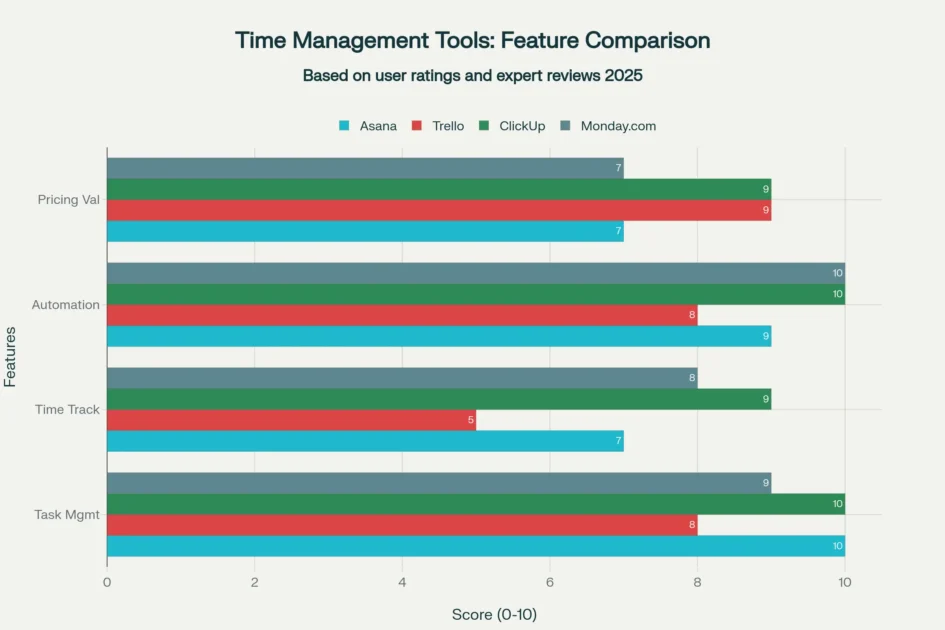
Grouped horizontal bar chart comparing four popular time management tools across key features
8. Clockify: Feature-Rich Free Time Tracking
Clockify has disrupted the time tracking market by offering genuinely unlimited functionality in its free tier, making professional-grade time tracking accessible to entrepreneurs regardless of budget constraints. Unlike competitors that impose user limits, feature restrictions, or time caps on free plans, Clockify provides unlimited users, projects, and tracked time at zero cost.
This democratization of time tracking technology proves particularly valuable for bootstrapped startups and early-stage entrepreneurs who need robust productivity tools before revenue supports paid software subscriptions.
The free plan includes core functionality that many competitors reserve for paid tiers: manual time entry and stopwatch timers, project and task organization, detailed reporting with filterable views, team dashboard showing real-time activity, and timesheet functionality for approval workflows.
The platform’s paid tiers, starting at an economical $3.99 per user monthly, introduce advanced features that support growing businesses: GPS tracking for field teams requiring location verification, time audit logs preventing unauthorized entry manipulation, scheduling functionality for workforce planning, billable rates and labor costs for profitability analysis, and enhanced reporting with custom fields and advanced filters.
These capabilities enable Clockify to scale alongside business growth, supporting simple time tracking needs for solopreneurs while accommodating complex requirements as teams expand. The platform’s timesheet approval system proves particularly valuable for entrepreneurs managing contractors or remote teams, providing workflow processes where team members submit tracked time for manager review and approval before incorporation into payroll or client billing.
Among the best time management tools, Clockify’s integration library includes connections to over 80 popular web applications spanning project management, communication, accounting, and development tools. The platform offers native applications for all major operating systems and mobile platforms, plus browser extensions that enable time tracking directly from within web-based tools without switching contexts.
A unique Kiosk mode allows shared device time tracking in retail, manufacturing, or service environments where employees lack individual computers or smartphones. With over 3 million users globally and consistent 4.7 out of 5 ratings across review platforms, Clockify has established itself as the premier free time tracking solution for entrepreneurs seeking professional capabilities without financial barriers. Users particularly appreciate the platform’s generous free tier and straightforward interface while noting that customer support response times can lag compared to premium-priced competitors.
9. Todoist: Task Prioritization and Personal Productivity
Todoist has evolved into a sophisticated yet accessible task management platform that excels at helping entrepreneurs capture, organize, and prioritize the multitude of tasks competing for their attention daily, making it one of the most effective time management tools for personal productivity.
The platform’s natural language input allows users to create tasks by typing phrases like “Team meeting tomorrow at 2pm” or “Review proposal next Monday,” with Todoist automatically parsing dates, times, and recurrence patterns without requiring navigation through form fields. This intelligent input system reduces task capture friction, encouraging comprehensive documentation of commitments rather than selective recording of only major items.
Research demonstrates that incomplete task lists contribute significantly to stress and forgotten obligations, with entrepreneurs reporting that the mental burden of remembering tasks consumes cognitive resources better directed toward strategic thinking. Todoist’s natural language processing capability enables entrepreneurs to utilize time management tools intuitively, typing complex recurring patterns like “every first Wednesday of the month” or “every other Tuesday starting March 3,” ensuring sophisticated scheduling occurs without requiring manual date calculations.
The platform’s priority system helps entrepreneurs distinguish truly important work from merely urgent distractions, transforming time management tools into strategic business drivers. Todoist supports four priority levels with color coding for visual differentiation: P1 for critical tasks requiring immediate attention, P2 for important tasks with some flexibility, P3 for tasks that should be completed but aren’t time-sensitive, and P4 for low-priority items that can be addressed when capacity allows.
This hierarchical structure encourages regular evaluation of task importance rather than defaulting to chronological or reactive work patterns. The platform’s Productivity features generate metrics tracking task completion streaks, total accomplished tasks, and productivity trends over time through its gamified Karma system that has proven extraordinarily effective in motivating consistent action. Research indicates that gamification increases motivation and task completion rates for many users by 50-70% by providing tangible evidence of accomplishment that combats the amorphous nature of knowledge work.
Among the best time management tools, Todoist’s Karma system assigns points for completing tasks with varying complexity and priority levels, creates daily streaks rewarding consistent productivity, and establishes progression levels from Beginner through Enlightened, with users reporting significantly enhanced motivation through time management tools featuring this achievement-oriented design.
Todoist’s collaboration capabilities support team task management and cross-functional work coordination without the complexity of full project management platforms, positioning it as an accessible time management tools solution for growing businesses. Entrepreneurs can share projects with team members or external collaborators, assign tasks to specific individuals, comment on tasks to provide clarification or request updates, and receive notifications when assigned tasks are completed.
Team Workspaces introduced in recent platform updates enable centralized project-related information sharing, ensuring team members maintain alignment throughout project lifecycles. The platform supports hierarchical project structures with sub-projects for sophisticated task organization, enabling entrepreneurs to scale their personal productivity time management tools approach to team operations.
For teams managing 1-250 people, Todoist accommodates expansion without fundamental workflow changes, with shared projects supporting up to five collaborators and team projects handling significantly larger groups across multiple departments.
Todoist’s integration ecosystem connects the platform with over 90 popular business tools, transforming it into a central hub within broader productivity workflows rather than isolated time management tools. Email integrations with Gmail and Outlook allow entrepreneurs to convert important emails directly into actionable tasks, calendar integrations with Google Calendar and Apple Calendar ensure deadline visibility, and communication tool integrations with Slack and Microsoft Teams streamline team collaboration.
The platform integrates seamlessly with automation services like Zapier, enabling entrepreneurs to create sophisticated workflows: automatically generating Todoist tasks from Trello cards, syncing Asana status updates directly to Todoist, creating tasks from specific Slack message reactions, or generating recurring reminders from calendar events. With pricing at just $4 monthly for the Pro plan—among the most affordable paid options in the productivity tool market—Todoist delivers exceptional value for entrepreneurs prioritizing task management and personal productivity over comprehensive project planning.
The platform has reached extraordinary adoption milestones with 30 million users globally and 2+ billion tasks completed, demonstrating that time management tools featuring intuitive natural language processing, gamification, and smart prioritization resonate strongly with entrepreneurs seeking to reclaim control over their work. The platform maintains a 4.6 out of 5 rating across review sites, with users particularly appreciating its simplicity, natural language processing, and cross-platform synchronization while noting that it lacks advanced features like time tracking and financial management found in more comprehensive time management tools ecosystems.
Implementing Time Management Tools Successfully
Strategic Tool Selection and Deployment
Successful time management tools implementation requires thoughtful evaluation of business needs, team dynamics, and workflow requirements rather than defaulting to popular options or comprehensive platforms that may not align with specific organizational contexts. Entrepreneurs should begin by documenting current pain points using time management tools selection criteria: Are tasks falling through cracks due to lack of tracking systems? Does the team struggle with communication and context sharing? Do billing inaccuracies stem from poor time tracking? Is strategic work perpetually postponed due to operational chaos?
Research demonstrates that 74% of teams abandon newly implemented time management tools within the first month, with the primary cause being poor matching between tool capabilities and actual business needs rather than insufficient tool quality. These specific challenges should drive tool selection rather than aspirational features that may never see actual use. Organizations successfully adopting productivity software establish clear business goals and measurable KPIs before tool selection, ensuring selected solutions directly address documented pain points while delivering quantifiable improvements.
The platform evaluation process should include testing trials with actual work rather than theoretical scenarios, requiring hands-on experimentation with time management tools under realistic conditions. Most quality productivity platforms offer free tiers or trial periods ranging from 14 days to indefinite free plans with feature limitations.
Entrepreneurs should leverage these opportunities to assess whether time management tools integrate smoothly with existing workflows, meet actual team needs versus marketed capabilities, feel intuitive enough for consistent adoption, and deliver measurable improvements in targeted pain points. Successful implementation typically requires starting with core features and gradually expanding time management tools usage rather than attempting to activate all functionality immediately.
This phased approach prevents overwhelm while building team confidence and competence, with research showing that organizations implementing tools in phases achieve 40% higher user adoption rates compared to big-bang implementations where all features launch simultaneously. Documentation of baseline metrics before implementation proves essential for measuring ROI and justifying technology investments: total hours worked weekly, percentage of time allocated to strategic versus operational activities, number of missed deadlines, revenue per hour worked, and subjective stress assessments.
Leadership commitment and clear communication represent critical success factors often overlooked in time management tools deployment strategies. Research demonstrates that technology adoption succeeds primarily when organizational leadership actively promotes and models time management tools usage, with subordinates significantly more likely to adopt when they observe leaders using systems consistently.
Organizations implementing new productivity solutions must establish kick-off meetings setting clear expectations, communicate specific timeline information, and explain how time management tools adoption aligns with individual and team-level goals rather than presenting changes as abrupt impositions. The Alternative Board research found that 77% of business owners identify spending time on truly urgent tasks as their priority, yet only 19% operate from formal strategic plans defining urgency criteria—implementing appropriate time management tools directly enables this distinction between urgent and important.
Pre-launch communication addressing team concerns, explaining expected workflow changes, and positioning time management tools as enablers of better work rather than surveillance mechanisms proves critical for securing buy-in and preventing the resistance that causes premature abandonment.
Building Sustainable Time Management Habits
Technology alone cannot solve time management challenges without corresponding behavioral changes and organizational commitment, requiring time management tools to integrate with deliberate habit formation and workflow redesign. Entrepreneurs must establish clear expectations and accountability mechanisms ensuring time management tools become integral to daily operations rather than optional systems used inconsistently by some team members.
Effective implementation strategies include scheduling regular review sessions where teams collectively examine productivity data, identify improvement opportunities, and celebrate progress toward goals; creating standardized operating procedures incorporating time management tools into core business processes; and designating tool champions who maintain expertise, provide peer training, and advocate for consistent usage patterns.
Organizations implementing productivity software discover that insufficient training represents one of the primary adoption barriers, with research showing that comprehensive training delivered before tool launch significantly impacts long-term utilization and user satisfaction. Role-based training approaches recognize that different team members require different time management tools guidance—sales representatives need distinct workflows compared to administrative staff or project managers—ensuring training addresses specific job responsibilities rather than delivering generic instruction.
Ongoing optimization and continuous improvement mindset represent final phases of successful time management tools implementation that organizations often neglect. Entrepreneurs should regularly evaluate whether selected productivity tools continue meeting evolving business needs, gather team feedback about friction points and enhancement requests, and explore additional features or integration opportunities that could further streamline workflows with time management tools.
Research demonstrates that effective time management systems evolve alongside business growth rather than remaining static after initial deployment, with companies treating productivity software as dynamic systems requiring ongoing refinement achieving substantially better results than those viewing implementation as one-time projects. Organizations should establish feedback loops spanning organizational layers to detect hidden issues and opportunities for enhanced time management tools utilization, recognizing that team members interacting daily with systems often identify optimization opportunities that executives miss.
Monthly or quarterly reviews examining productivity metrics, user engagement patterns, and emerging workflow needs ensure time management tools investments continue delivering value as business requirements evolve. Furthermore, leaders should address adoption roadblocks proactively when they emerge, providing additional training, adjusting workflows to match system capabilities, or potentially switching platforms if fundamental misalignment becomes apparent rather than allowing organizations to silently revert to previous methods.
Maximizing Return on Investment from Time Management Tools
Measuring Productivity Improvements
Quantifying the impact of time management tools provides essential feedback for investment decisions and continuous improvement efforts that drive business success. Entrepreneurs should establish baseline metrics before time management tools implementation, then track changes over subsequent weeks and months: total hours worked weekly, percentage of time allocated to strategic versus operational activities, number of missed deadlines or deliverables, revenue per hour worked, and subjective stress and work-life balance assessments.
These measurements enable data-driven evaluation of whether selected tools actually improve productivity or merely add complexity without corresponding benefits. Research indicates that effective time management tools can reduce productivity leaks by 80% and boost revenue by 61%, representing substantial returns on relatively modest tool investments. Organizations implementing time tracking software experience 5% improvements in billable hours utilization, equivalent to $15,000 per employee annually—a finding validated across multiple studies and business contexts.
Key performance indicators specifically designed for time management tools evaluation should encompass financial metrics, operational efficiency, and employee well-being dimensions. Entrepreneurs should track cost savings through reduced administrative overhead, labor efficiency gains from automation and streamlined workflows, improvements in project delivery timelines and accuracy, and reductions in employee turnover driven by improved work-life balance.
The ROI formula for time management tools investment calculates: (Time Saved × Hourly Wage) + Cost Savings – Tool Cost ÷ Tool Cost × 100%. If calculated ROI exceeds 100%, the tool investment proves cost-effective and value-creating. Beyond quantitative metrics, qualitative indicators provide important context about time management tools effectiveness: whether team members feel more organized and in control of their work, whether communication has improved with reduced confusion about responsibilities and deadlines, whether quality of strategic thinking has increased due to protected time for deep work, and whether businesses scale more smoothly due to documented processes.
Case study evidence demonstrates real-world impact: Afton Manufacturing, a small manufacturer, implemented time tracking software and discovered 10 minutes daily per employee lost to administrative inefficiencies, translating to $6,000+ annual savings and complete tool cost recovery within two months.
Advanced Strategies for Busy Entrepreneurs
Sophisticated entrepreneurs leverage time management tools not merely for tracking and organization but as strategic business intelligence systems that inform major decisions and drive competitive advantage. Advanced applications include analyzing historical project data to improve future estimates and proposals, identifying profitable versus unprofitable client types based on time-to-revenue ratios calculated through time management tools analytics, determining optimal team size and structure based on workload patterns and capacity analysis, and evaluating which business activities generate highest returns relative to time invested.
These strategic applications transform time management from administrative overhead into competitive advantage. The McKinsey research demonstrating that US small businesses operate at only 47% of large company productivity levels suggests that entrepreneurs mastering time management tools and productivity analysis achieve significant market differentiation.
Organizations implementing comprehensive time tracking report 40% reductions in project delivery timelines, 33% decreases in administrative overhead, and $120,000+ cost savings per project through optimization visibility. For professionals in service-based businesses, increasing billable time from 70% to 75% through better time management tools utilization generates equivalent to $15,000 annual revenue per employee—a massive opportunity most entrepreneurs remain unaware of.
The integration of artificial intelligence into time management tools represents the frontier of productivity enhancement, offering capabilities that extend beyond simple automation to provide predictive insights about project risks.
Modern AI-enhanced time management tools provide intelligent task prioritization analyzing due dates, dependencies, and urgency; predictive project risk identification preventing costly delays; automated documentation generation from meeting transcripts and discussions; personalized productivity recommendations based on individual work patterns; and smart scheduling that prevents meeting conflicts while optimizing focus time.
Entrepreneurs who embrace these AI-enhanced time management tools position themselves at the leading edge of productivity innovation, gaining advantages that compound over time as AI systems learn from organizational data. Research indicates that 73% of businesses report improved work quality and 79% cite enhanced productivity from automation technology implementation, with these benefits accelerating as AI systems mature.
For time-starved entrepreneurs, AI-powered time management tools may represent breakthrough technology enabling sustainable growth without corresponding increases in work hours or stress levels. The intelligent task prioritization feature proves particularly valuable, analyzing factors like due dates, task dependencies, and team workloads to recommend optimal task sequence, enabling teams to focus immediately on highest-impact activities.
Conclusion
The time management crisis facing American entrepreneurs demands urgent attention and strategic intervention. With 63% of business owners working more than 50 hours weekly yet feeling perpetually behind, 87.7% struggling with mental health challenges, and 82% lacking structured time management systems, the status quo proves unsustainable for individual wellbeing and business success.
The nine time management tools profiled in this guide—Asana, Trello, RescueTime, Monday.com, ClickUp, Notion, Toggl Track, Clockify, and Todoist—represent proven solutions that address distinct entrepreneur needs across the productivity spectrum. From comprehensive project management ecosystems to focused time tracking applications, these platforms provide the technological foundation for reclaiming control over the entrepreneur’s most precious resource: time.
Success requires moving beyond tool selection to actual implementation, consistent usage, and continuous optimization. Entrepreneurs must recognize that time management tools deliver value proportional to the commitment invested in their deployment and integration into daily business operations. The research is unambiguous: structured time management systems can recover up to 20% of working time, reduce productivity leaks by 80%, and boost revenue by 61%.
These improvements don’t materialize automatically upon software purchase but emerge through deliberate practice, behavioral change, and organizational commitment. For entrepreneurs ready to escape the tyranny of reactive work patterns and build businesses that support rather than consume their lives, effective time management tools offer a proven pathway forward.
The competitive landscape continues evolving, with artificial intelligence introducing capabilities that seemed science fiction mere years ago. Entrepreneurs who embrace these technologies while maintaining focus on core business objectives position themselves for sustainable success in increasingly complex markets.
The choice facing today’s busy entrepreneur isn’t whether to implement time management tools—the productivity crisis makes that decision obvious—but rather which tools align best with specific business needs and how quickly implementation can occur. Every day without structured time management systems represents lost productivity, missed opportunities, and unnecessary stress. The tools exist, the research validates their effectiveness, and the path forward is clear. The question remaining is simply: when will you begin?
Citations
- https://clockify.me/time-management-statistics
- https://www.agilitypr.com/pr-news/uncategorized/time-management-new-survey-reveals-biz-owners-spending-time-theyd-rather-spend/
- https://lifehackmethod.com/blog/time-management-statistics/
- https://www.flowlu.com/blog/productivity/productivity-time-managment-statistics/
- https://www.runn.io/blog/time-management-statistics
- https://www.mckinsey.com/mgi/our-research/americas-small-businesses-time-to-think-big
- https://flowace.ai/blog/12-time-management-tools/
- https://myhours.com/best-time-tracking-apps
- https://plaky.com/blog/best-productivity-apps/
- https://www.salesforce.com/news/stories/small-business-productivity-trends-2024/
- https://firebearstudio.com/blog/what-is-asana.html
- https://www.proprofsproject.com/blog/best-time-management-software/
- https://www.appypieautomate.ai/blog/reviews/trello-review
- https://www.smartsuite.com/blog/trello-review
- https://clariti.app/blog/best-productivity-apps/
- https://asana.com/features
- https://connecteam.com/reviews/asana/
- https://asana.com/product
- https://www.uctoday.com/collaboration/trello-review-the-ultimate-kanban-project-management-app/
- https://thedigitalprojectmanager.com/tools/trello-software-review/
- https://apploye.com/rescuetime-review
- https://connecteam.com/reviews/rescuetime/
- https://www.youtube.com/watch?v=p_MhCRDu7e4
- https://www.smartsuite.com/blog/monday-review
- https://connecteam.com/reviews/monday/
- https://www.kdnuggets.com/review/monday-com-crm-review-2024-features-pricing-pros-cons
- https://thedigitalprojectmanager.com/tools/monday-review/
- https://monday.com/pricing
- https://clickup.com/general-resources/project-management
- https://clickup.com/blog/how-to-use-project-management-software/
- https://clickup.com/teams/project-management
- https://www.simplilearn.com/what-is-clickup-project-management-tool-article
- https://tech.co/project-management-software/clickup-review
- https://apps.apple.com/us/app/notion-notes-tasks-ai/id1232780281
- https://www.notion.com
- https://play.google.com/store/apps/details?id=notion.id&hl=en_IN
- https://www.notioneverything.com/blog/free-notion-templates
- https://ryanzofay.com/life-changing-time-management-tools/
- https://smallbusinessxchange.com/news/10-productivity-apps-for-entrepreneurs/130182/
- https://flowace.ai/time-tracking-software-for-small-businesses/
- https://www.saner.ai/blogs/best-apps-for-entrepreneurs
- https://apploye.com/best-employee-time-tracking-software
- https://lifehackmethod.com/blog/productivity-tools-for-entrepreneurs/
- https://www.paymoapp.com/blog/best-time-tracking-software/
- https://www.simplilearn.com/top-time-management-tools-article
- https://www.wordstream.com/blog/ws/2021/03/30/productivity-tools
- https://quickbooks.intuit.com/time-tracking/small-businesses/
- https://brainhub.eu/library/best-productivity-apps
- https://www.1stadvantagebank.com/2025/01/10/top-8-productivity-tools-for-small-business-owners/
- https://tasktracker.in
- https://zapier.com/blog/best-time-tracking-apps/
- https://zapier.com/blog/best-productivity-apps/
- https://cake.com/empowered-team/small-business-statistics/
- https://ro.uow.edu.au/articles/thesis/An_exploration_of_the_time-management_behaviours_of_small-business_owner-managers/27661158
- https://www.forbes.com/advisor/business/small-business-statistics/
- https://www.uschamber.com/small-business/small-business-data-center
- https://www.apollotechnical.com/time-management-statistics-every-business-should-know/
- https://www.kaplancollectionagency.com/business-advice/68-entrepreneurship-statistics-for-2025/
- https://www.goldmansachs.com/pressroom/press-releases/2025/small-business-owners-plan-to-grow
- https://myhours.com/articles/the-importance-of-time-management
- https://ff.co/startup-statistics-guide/
- https://www.bls.gov/productivity/
- https://www.business.com/articles/time-management-tips-for-small-business-owners/
- https://www.hostinger.com/tutorials/entrepreneurship-statistics
- https://www.sellerscommerce.com/blog/small-business-statistics/
- https://everhour.com/blog/asana-time-tracking/
- https://www.rescuetime.com
- https://www.xda-developers.com/trello-personal-productivity/
- https://play.google.com/store/apps/details?id=com.rescuetime.android&hl=en_IN
- https://asana.com/resources/time-management-tips
- https://www.reddit.com/r/trello/comments/yhw6k7/what_is_everyones_opinion_about_trello/
- https://www.helloleads.io/blog/stats-facts/rescuetime-20-amazing-stats-facts/
- https://asana.com/resources/time-management-templates
- https://www.linkedin.com/pulse/project-management-software-review-trello-v-asana-allen-baird-phd
- https://www.youtube.com/watch?v=Ns_cfhMWpg4
- https://clickup.com/teams/design
- https://www.forbes.com/advisor/in/business/software/mondaycom-review/
- https://www.notion.com/desktop
- https://www.capterra.in/software/147657/monday-com
- https://www.notion.com/templates/productivity-planner-2025