

9 Essential Business Strategy Development Steps
Developing an effective business strategy is no longer optional in today’s competitive environment—it’s the foundation that determines whether your organization thrives or merely survives. Business Strategy Development Steps represent a systematic approach to transforming your vision into measurable outcomes that drive sustainable growth.
For business leaders navigating the complex terrain of strategic planning, understanding these essential steps can mean the difference between achieving remarkable success and watching opportunities slip away. This comprehensive guide explores the nine critical Business Strategy Development that leading American companies use to maintain their competitive edge, backed by research, real-world examples, and actionable insights that you can implement immediately.
The strategic planning process has evolved significantly over the past decade, with 78% of US companies now incorporating SWOT analysis as their primary framework, while 52% rely on balanced scorecards to measure progress. What makes Business Strategy Development Steps particularly crucial in 2024 is that 74% of organizations struggle to execute their strategies effectively, often due to misalignment between planning and implementation.
This gap between strategy formulation and execution costs American businesses billions annually in lost opportunities and wasted resources. Understanding and properly executing each of the Business Strategy Development enables organizations to bridge this gap, transforming strategic intent into concrete business results that shareholders, employees, and customers can see and measure.
Throughout this article, we’ll examine each of the nine essential Business Strategy Development Steps in detail, providing frameworks, methodologies, and case studies from successful US companies like Amazon, Apple, Walmart, and Starbucks. You’ll learn how to conduct comprehensive market analysis, establish meaningful objectives, allocate resources effectively, and monitor progress using key performance indicators. Whether leading a startup seeking market entry or managing an established corporation pursuing transformation, these Business Strategy Development offer a proven roadmap for strategic success.
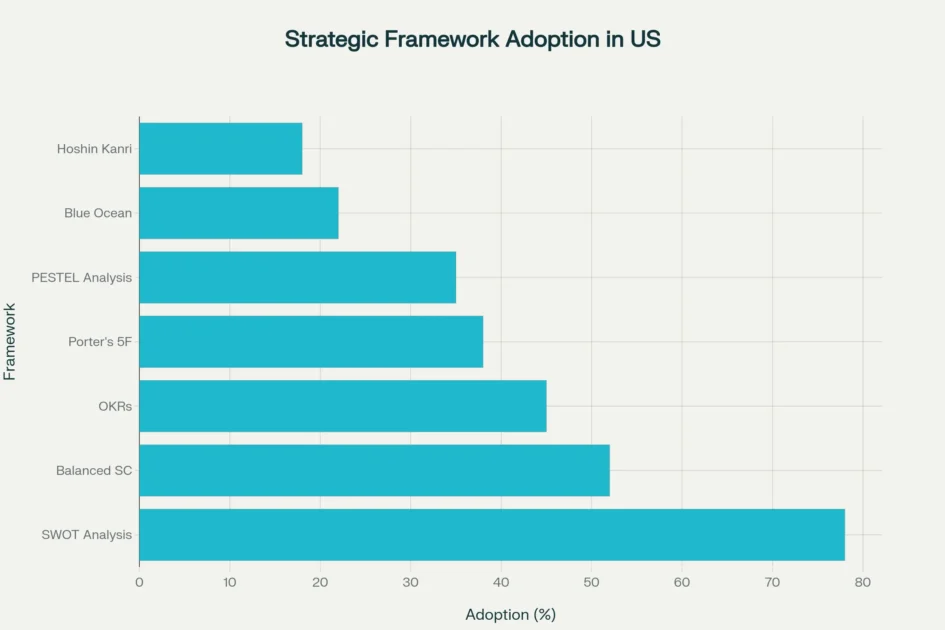
Strategic Planning Framework Adoption Among US Companies – showing SWOT Analysis as the most widely adopted framework at 78%, followed by Balanced Scorecard at 52%
Understanding the Foundation of Business Strategy Development Steps
Business Strategy Development Steps form the systematic framework that guides organizations from initial conception to successful execution of their strategic objectives. At its core, these steps represent more than just planning exercises—they constitute a comprehensive methodology for aligning your organization’s resources, capabilities, and aspirations with market opportunities and competitive realities. Research from the International Institute for Management Development indicates that organizations following structured Business Strategy Development are 67% more likely to achieve their strategic objectives compared to those using informal approaches.
The importance of Business Strategy Development Steps extends beyond mere planning. These steps create organizational alignment, ensuring everyone from frontline employees to C-suite executives understands not only what the company aims to achieve but also how their individual contributions support those goals.
When Walmart implemented structured Business Strategy Development for its supply chain optimization, the company reduced out-of-stock occurrences by 16% while simultaneously improving vendor relationships and lowering inventory management costs. This example demonstrates how properly executed Business Strategy Development translate abstract strategic goals into tangible operational improvements.
Understanding Business Strategy Development Steps requires recognizing that strategy exists at multiple organizational levels. Corporate-level strategy addresses overall portfolio management and resource allocation across business units, while business-level strategy focuses on competitive positioning within specific markets. Functional strategies then cascade from these higher levels, defining how departments like marketing, operations, and finance will support broader objectives. The interconnection between these levels makes following comprehensive Business Strategy Development essential—without this structured approach, organizations risk creating disconnected initiatives that consume resources without advancing strategic goals.
The evolution of Business Strategy Development reflects changing business environments. McKinsey research from the 1970s identified four stages of strategic planning sophistication, with the highest level—strategic management—characterized by widespread strategic thinking and well-defined frameworks. Today’s Business Strategy Development Steps incorporate lessons from decades of strategic management theory while addressing contemporary challenges like digital transformation, sustainability requirements, and rapidly shifting competitive dynamics. Companies that master these steps gain what researchers call “strategic agility”—the ability to adapt quickly to market changes while maintaining focus on long-term objectives.
Step 1: Conducting Comprehensive Environmental Scanning and Market Research
The first of the essential Business Strategy Development Steps involves conducting thorough environmental scanning and market research to understand the competitive terrain where your strategy will unfold. This foundational step requires gathering and analyzing data about market trends, customer needs, competitor activities, and broader economic, technological, political, and social factors that could impact your strategic success. According to a 2024 study, 92% of successful strategic initiatives begin with comprehensive market research that informs every subsequent decision in the Business Strategy Development.
Environmental scanning within Business Strategy Development Steps employs several analytical frameworks. PESTEL analysis examines Political, Economic, Social, Technological, Environmental, and Legal factors affecting your industry, helping identify both threats and opportunities that might not be immediately apparent.
For instance, when Chipotle recognized changing consumer preferences toward health-conscious dining and convenience in 2020, the company’s environmental scanning revealed an opportunity to invest in “Chipotlanes”—drive-through lanes specifically for mobile pickup orders. This strategic move, informed by thorough market research, contributed to the company opening 500 Chipotlanes and planning 250 additional restaurant locations.
Market research within Business Strategy Development Steps extends beyond simple data collection to include competitive intelligence gathering. Porter’s Five Forces framework helps assess industry attractiveness by analyzing supplier bargaining power, buyer bargaining power, threat of substitutes, threat of new entrants, and competitive rivalry.
Amazon’s market research revealed that B2B wholesale markets valued between $7.2 and $8.2 trillion offered massive growth potential, leading to the creation of Amazon Business. This platform now serves professional buyers with over 250 million products, demonstrating how comprehensive market research in Business Strategy Development can reveal transformative opportunities.
Effective environmental scanning in Business Strategy Development Steps also requires understanding your total addressable market (TAM), serviceable available market (SAM), and serviceable obtainable market (SOM). These frameworks help validate market opportunities before committing resources. Research shows that organizations conducting rigorous market sizing as part of their Business Strategy Development make more realistic projections and avoid costly over-investment in underperforming initiatives.
Dollar General’s success illustrates this principle—rather than competing directly with Walmart’s ubiquitous presence, the company’s market research identified underserved rural consumers, leading to a focused strategy of opening small, cost-efficient stores in areas where big-box retailers didn’t operate. This targeted approach, grounded in solid market research, enabled Dollar General to capture a profitable niche while maintaining low overhead costs.
Step 2: Performing In-Depth SWOT Analysis
The second critical component of Business Strategy Development Steps involves conducting a comprehensive SWOT analysis—systematically evaluating your organization’s internal Strengths and Weaknesses alongside external Opportunities and Threats. This analytical framework serves as the cornerstone of effective Business Strategy Development, providing the factual foundation upon which all subsequent strategic decisions should rest.
Research indicates that organizations incorporating rigorous SWOT analysis into their Business Strategy Development make decisions based on evidence rather than assumptions, significantly improving strategic outcomes.
Internal assessment within Business Strategy Development Steps requires honest evaluation of your organization’s capabilities and limitations. Apple’s strength in design excellence and ecosystem integration represents a competitive advantage that informs its differentiation strategy. The company’s SWOT analysis reveals strengths in brand loyalty, innovation capacity, and premium pricing power, while acknowledging weaknesses such as high price points that limit market penetration in price-sensitive segments.
This self-awareness, gained through thorough SWOT analysis in Business Strategy Development, enables Apple to focus resources on areas where it maintains competitive advantages rather than engaging in unprofitable price competition.
External analysis in Business Strategy Development Steps examines marketplace opportunities and threats beyond your organization’s control. Coca-Cola’s SWOT analysis identified social media as both an opportunity for enhanced customer engagement and a threat through potential negative publicity. The company’s strategic response included sophisticated social media analytics, leading to successful campaigns like “Share a Coke,” which personalized bottles with popular names and generated a 7% sales increase and 870% surge in Facebook traffic. This example illustrates how SWOT analysis within Business Strategy Development translates environmental awareness into actionable strategic initiatives.
Best practices for SWOT analysis in Business Strategy Development Steps include engaging diverse stakeholders to gain multiple perspectives. Research shows that SWOT analyses conducted by cross-functional teams identify 43% more strategic issues than those completed by single departments.
American Express demonstrates this collaborative approach—when the company reinvented itself from express mail services to credit cards in the mid-1900s, its SWOT analysis involved extensive stakeholder input that revealed both the declining viability of traditional services and the emerging opportunity in consumer credit. Today, with more than 133 million credit cards in use, this strategic pivot exemplifies how thorough SWOT analysis in Business Strategy Development can identify transformation opportunities that redefine entire organizations.
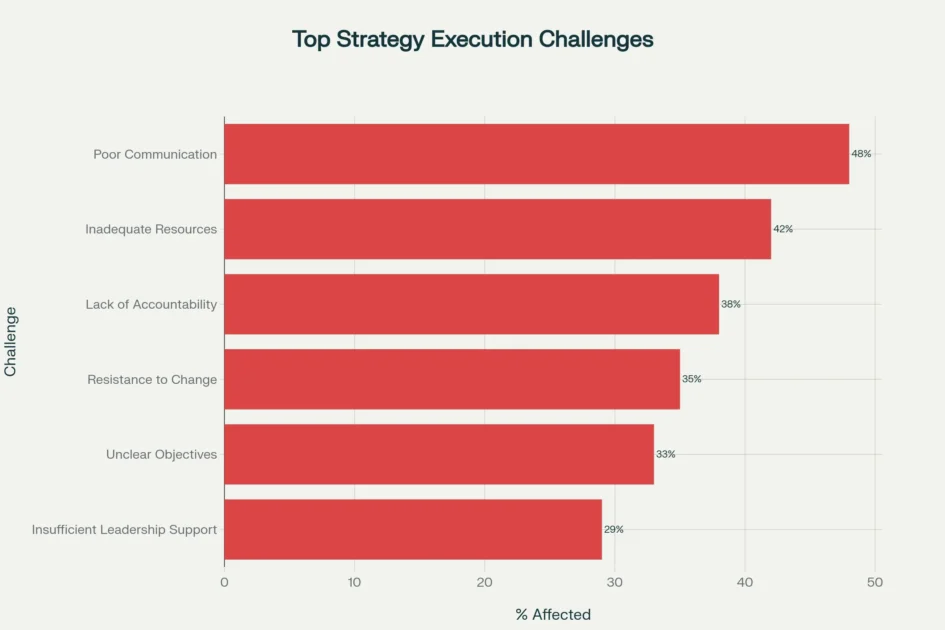
Top Strategy Execution Challenges – Poor Communication leads at 48%, followed by Inadequate Resources at 42%, highlighting common barriers to successful strategy implementation
Step 3: Establishing Clear Vision, Mission, and Strategic Objectives
The third essential element of Business Strategy Development Steps involves articulating a compelling vision, defining your mission, and establishing specific strategic objectives that translate aspirations into measurable targets. This step provides the directional framework that guides all subsequent Business Strategy Development, ensuring organizational alignment and creating shared purpose among employees. According to strategy execution research, organizations with clearly defined visions and objectives achieve their goals 3.5 times more frequently than those with ambiguous direction.
Vision statements within Business Strategy Development Steps describe your organization’s aspirational future state—where you want to be in three to five years. Starbucks’ vision of creating a “third place” between work and home where customers could relax and enjoy premium coffee exemplifies how powerful visions in Business Strategy Development shape strategic direction.
This clear vision guided decisions about store design, product offerings, and customer service standards, ultimately building a brand that generated billions in revenue and transformed coffee consumption culture. Research indicates that effective visions within Business Strategy Development share common characteristics: they’re inspirational yet achievable, specific enough to guide decision-making, and memorable enough that employees can articulate them without reference materials.
Strategic objectives in Business Strategy Development Steps must follow the SMART framework—Specific, Measurable, Achievable, Relevant, and Time-bound. Instead of vague aspirations like “improve customer satisfaction,” effective Business Strategy Development requires precise objectives such as “increase customer satisfaction scores from 65 to 85 by the end of 2026”.
This specificity enables progress tracking and accountability. Research from Asana indicates that organizations using SMART objectives in their Business Strategy Development complete projects 28% faster than those with imprecise goals. The balanced scorecard approach helps organizations develop strategic objectives across four critical perspectives: financial performance, customer satisfaction, internal processes, and organizational learning and growth.
Goal-setting within Business Strategy Development Steps also requires careful attention to avoid conflicting objectives. Organizations sometimes create tensions between short-term profits and long-term growth, or between sales volume and profitability. Effective Business Strategy Development includes mechanisms for identifying and resolving these conflicts before implementation begins.
Nike demonstrates this principle through its strategic objectives that balance innovation (Nike+ technology for personalized training) with brand loyalty and premium positioning. The company’s clear objectives in these Business Strategy Development enable teams across product development, marketing, and retail to make aligned decisions that reinforce rather than undermine each other. When strategic objectives emerge from rigorous analysis and stakeholder engagement, they create the organizational clarity essential for successful strategy execution.
Step 4: Formulating Strategic Approaches and Competitive Positioning
The fourth step in Business Strategy Development Steps involves selecting the strategic approach your organization will pursue and defining your competitive positioning within the marketplace. This critical phase of Business Strategy Development determines how you’ll compete—whether through cost leadership, differentiation, market focus, or innovative value creation. Research from Harvard Business School professor Michael Porter indicates that organizations must make clear strategic choices; attempting to pursue multiple conflicting approaches simultaneously often results in mediocre performance across all dimensions.
Cost leadership strategy within Business Strategy Development Steps focuses on becoming the lowest-cost producer in your industry while maintaining acceptable quality standards. Walmart exemplifies this approach through massive scale, efficient logistics, and aggressive supplier negotiations that enable consistently lower prices than competitors.
The company’s Business Strategy Development includes sophisticated supply chain optimization, cross-docking inventory strategies that eliminate warehouse storage, and strategic vendor partnerships promising increased purchases in exchange for the lowest possible pricing. This integrated approach to Business Strategy Development has made Walmart the world’s largest retailer, demonstrating that properly executed cost leadership can deliver sustained competitive advantages.
Differentiation strategy in Business Strategy Development Steps emphasizes creating unique value propositions that justify premium pricing. Apple’s Business Strategy Development focuses on sleek design, intuitive user interfaces, and seamless ecosystem integration that differentiates its products from competitors. This differentiation enables Apple to maintain higher profit margins despite lower unit volumes compared to cost-focused competitors.
Research indicates that successful differentiation strategies in Business Strategy Development require continuous innovation to prevent competitors from replicating unique features. Lush Cosmetics demonstrates differentiation through ethical sourcing and corporate social responsibility, while Tesla differentiates through electric vehicle technology and autonomous driving capabilities.
Market focus strategy within Business Strategy Development Steps targets specific customer segments with tailored offerings. REI’s Business Strategy Development concentrates on outdoor enthusiasts willing to pay premium prices for quality equipment and expertise, supported by the company’s bold decision to close stores on Black Friday—the busiest shopping day—encouraging employees and customers to spend time outdoors instead. This focused approach in Business Strategy Development builds intense customer loyalty within a defined segment rather than attempting to serve all consumers.
Blue Ocean Strategy represents another powerful approach within Business Strategy Development, creating uncontested market space through value innovation. Netflix’s transformation from DVD rentals to streaming entertainment exemplifies this approach, making traditional video rental competitors obsolete rather than competing directly with them. Organizations following comprehensive Business Strategy Development must carefully evaluate which strategic approach aligns with their capabilities, market conditions, and competitive environment before committing resources to implementation.
Step 5: Developing Implementation Plans and Resource Allocation Strategies
The fifth critical element of Business Strategy Development Steps involves translating strategic objectives into detailed implementation plans with clear resource allocation strategies. This phase bridges the gap between strategy formulation and execution—a gap where many organizations stumble despite having excellent strategic intentions. According to research, 67% of well-formulated strategies fail during implementation due to inadequate planning and resource allocation within Business Strategy Development.
Resource allocation in Business Strategy Development Steps requires determining how financial, human, and technological resources will be distributed across strategic initiatives. Effective resource allocation begins by establishing project priorities based on strategic significance and revenue impact. Organizations must conduct comprehensive assessments identifying critical projects and ranking them according to factors like deadlines, client needs, and organizational objectives.
Amazon’s resource allocation within its Business Strategy Development demonstrates this principle—the company strategically invests in its extensive warehouse network (more than 185 fulfillment centers worldwide, including over 75 facilities in North America alone) and advanced robotics technology that accelerates operations beyond human capacity. This strategic resource allocation enables Amazon to maintain competitive advantages in delivery speed and cost efficiency.
Implementation planning within Business Strategy Development includes developing Work Breakdown Structures (WBS) that decompose strategic objectives into manageable tasks and subtasks. Project managers must identify necessary skills, expertise, qualifications, and technology needed for each task, then determine resource engagement timelines to prevent capacity shortages or excess. Research indicates that organizations using structured implementation planning in their Business Strategy Development Steps complete projects 31% more efficiently than those with informal approaches.
Simon-Kucher’s work with a leading global bank illustrates effective implementation planning—the firm supported cross-selling of high-value financial products through data-driven market tests, sales process audits, and psychological barrier identification, ultimately achieving a 50% increase in conversion rates through optimized sales processes.
Resource allocation strategies in Business Strategy Development must also address organizational structure alignment. Effective implementation may require restructuring, creating new roles, or redefining existing positions to support strategic objectives. Leadership and culture play critical roles—leaders must communicate strategy clearly, motivate employees, and foster cultures supporting strategic initiatives. Danfoss demonstrates this principle through its sustainable manufacturing initiatives, which required significant resource reallocation toward decarbonizing supply chains and manufacturing processes without compromising operational efficiency.
The company’s comprehensive approach to resource allocation within Business Strategy Development Steps addressed both the technical challenges of implementing sustainable practices and the organizational culture changes necessary for successful adoption. Organizations following effective Business Strategy Development recognize that resource allocation isn’t a one-time decision but rather an ongoing process requiring regular review and adjustment as circumstances change.
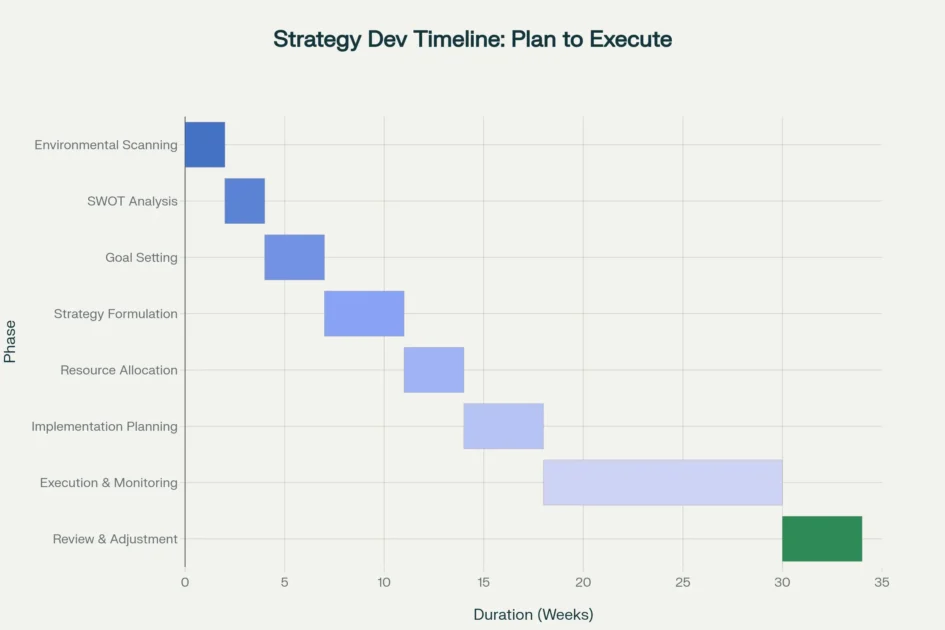
Business Strategy Development Timeline showing eight critical phases spanning 34 weeks (8.5 months), with Execution & Monitoring being the longest phase at 12 weeks
Step 6: Establishing Key Performance Indicators and Measurement Systems
The sixth essential component of Business Strategy Development Steps involves establishing comprehensive key performance indicators (KPIs) and measurement systems that enable progress tracking and accountability. Without robust measurement frameworks within Business Strategy Development, organizations cannot determine whether their strategies are succeeding or need adjustment. Research indicates that companies with well-defined KPI systems in their Business Strategy Development achieve strategic objectives 2.7 times more frequently than those relying on informal assessment methods.
KPI selection within Business Strategy Development Steps requires aligning metrics with strategic objectives across multiple business dimensions. Financial performance metrics—including revenue growth, profit margins, return on investment, and cash flow—provide fundamental indicators of strategic success. Customer-focused KPIs measure satisfaction scores, retention rates, lifetime value, and Net Promoter Scores, reflecting how well strategies meet market needs.
Operational efficiency indicators track order fulfillment time, resource utilization, inventory turnover, and quality metrics. For example, organizations implementing Business Strategy Development focused on operational excellence might establish KPIs such as “average three days maximum order fill time” or “achieve minimum inventory turnover ratio of 5-6 annually”.
The balanced scorecard framework within Business Strategy Development Steps provides a comprehensive approach to measurement by examining performance across four critical perspectives: financial capacity, customer perception, internal processes, and organizational learning and growth. This multidimensional view prevents organizations from over-emphasizing easily measured financial metrics at the expense of equally important strategic factors.
Leading organizations following comprehensive Business Strategy Development typically track 5-10 carefully selected KPIs per strategic objective—enough to provide comprehensive insights without overwhelming decision-makers with excessive data. Research shows that KPI dashboards optimally display this number of indicators, balancing comprehensiveness with clarity and enabling leaders to focus on the most critical performance indicators aligned with strategic goals.
Modern Business Strategy Development increasingly leverage technology platforms for automated KPI tracking and real-time reporting. Organizations using automated systems report 40% time savings in data collection and 28% improvement in data accuracy compared to manual tracking methods. These platforms enable leaders to make decisions faster—companies with real-time KPI visibility make strategic adjustments within days rather than the weeks or months required by traditional reporting approaches.
Strategic risk assessment forms another critical measurement dimension within Business Strategy Development. Organizations must continuously evaluate strategic risks—threats to achieving long-term objectives—and monitor key risk indicators alongside performance metrics. By establishing comprehensive measurement systems early in Business Strategy Development Steps, organizations create the visibility necessary for adaptive strategy management, enabling quick responses to market changes while maintaining focus on long-term objectives.
Step 7: Executing Strategy Through Organizational Alignment and Cultural Integration
The seventh critical step in Business Strategy Development Steps focuses on executing strategy through organizational alignment and cultural integration—ensuring that your organization’s structure, processes, and culture actively support strategic objectives. This execution phase represents where strategic plans transform into tangible results, yet research shows 83% of executives identify strategy execution as increasingly important while only 30% express confidence in bridging the formulation-execution gap. Effective Business Strategy Development addresses this challenge through systematic approaches to cultural alignment and organizational change management.
Cultural alignment within Business Strategy Development requires ensuring that organizational values, beliefs, and behaviors support strategic direction. When culture aligns with strategy, employees enthusiastically embrace and execute strategic objectives; when disconnects exist, implementation becomes an uphill battle yielding suboptimal results. For instance, strategies focused on innovation and agility thrive in cultures valuing creativity and experimentation, while bureaucratic, risk-averse cultures naturally resist rapid decision-making requirements.
Research indicates that 67% of strategy execution failures stem from cultural misalignment rather than flawed strategic logic. Allianz demonstrates effective cultural integration within Business Strategy Development Steps—the German insurance provider didn’t simply aim to regain market share but rather reset competitive standards entirely through cultural transformation supporting execution excellence.
Leadership plays a pivotal role in Business Strategy Development execution. Leaders must communicate strategy clearly, model desired behaviors, and foster accountability throughout the organization. Harvard Business School research emphasizes that only 18% of frontline employees consider strategy weekly compared to 63% of organizational leaders—creating a dangerous gap in strategic awareness. Organizations following effective Business Strategy Development Steps close this gap through consistent communication ensuring everyone understands both the overall strategy and their specific role in achieving it.
ContractorNerd CEO John Hughes emphasizes this connection: “At ContractorNerd, we’ve learned that aligning our culture with our strategic objectives is key to long-term success. When employees believe in the company’s mission and values, they’re more likely to contribute meaningfully to its growth”.
Strategic alignment in Business Strategy Development Steps extends beyond communication to include accountability mechanisms, resource allocation, and organizational structure. Creating accountability cultures means demonstrating to team members that their contributions matter to broader organizational success—tapping into employees’ inherent pride around their work through both external recognition and intrinsic motivation.
Emirates Global Aluminium illustrates comprehensive alignment within Business Strategy Development through its AI-driven transformation, which required not only technology implementation but also organizational capability building and culture change to scale impact across operations. Organizations must also balance innovation and control within Business Strategy Development —encouraging creative problem-solving while maintaining strategic boundaries that prevent pursuit of opportunities inconsistent with core objectives.
By systematically addressing cultural alignment, leadership behaviors, accountability systems, and organizational structures, Business Strategy Development Steps enable the execution excellence that transforms strategic plans into competitive advantages.
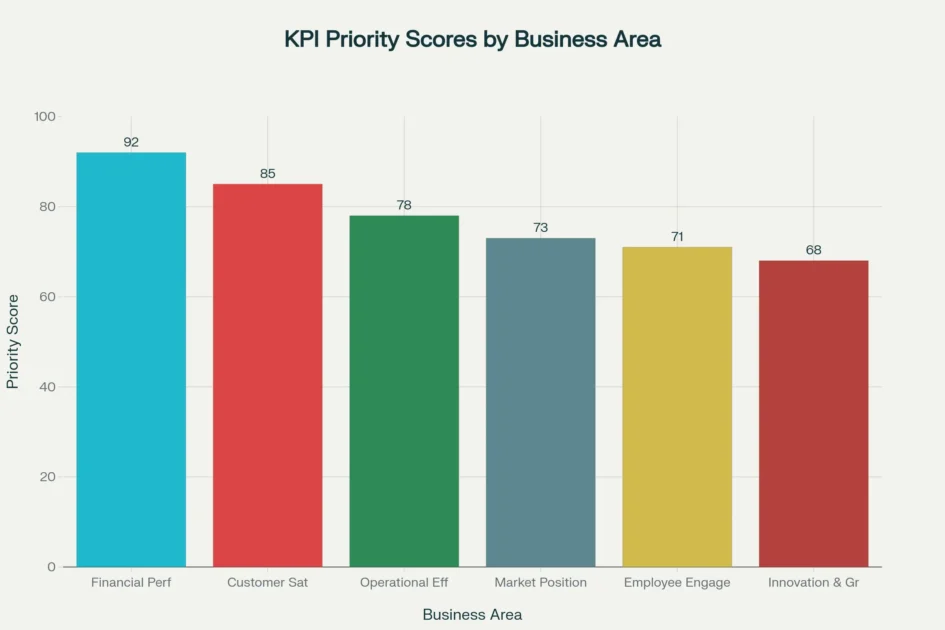
KPI Priority Scores across six business areas – Financial Performance ranks highest at 92/100, followed by Customer Satisfaction at 85/100
Step 8: Monitoring Progress and Implementing Continuous Improvement Processes
The eighth essential element of Business Strategy Development Steps involves establishing robust monitoring systems and continuous improvement processes that enable adaptive strategy management. Effective Business Strategy Development recognizes that strategic execution isn’t a linear process but rather requires ongoing evaluation, learning, and adjustment based on performance data and changing circumstances. Research indicates organizations with systematic monitoring processes embedded in their Business Strategy Development identify performance issues 42% faster and implement corrective actions 35% more quickly than those relying on periodic reviews.
Progress monitoring within Business Strategy Development requires establishing regular review cadences at multiple organizational levels. Strategic dashboards provide real-time visibility into KPI performance, enabling leaders to spot trends and anomalies requiring attention. These dashboards optimally display 5-10 critical metrics with visual indicators showing performance relative to targets—green for on-track, yellow for at-risk, and red for off-target initiatives.
Research shows that organizations using strategic dashboards make more informed decisions and achieve objectives 1.8 times more frequently than those without structured monitoring tools. Monthly operational reviews examine tactical execution, quarterly strategic reviews assess progress toward annual objectives, and annual planning sessions evaluate overall strategic direction and make necessary course corrections.
Continuous improvement methodologies within Business Strategy Development Steps include both incremental optimization and transformative innovation. The Hoshin Kanri framework, used in advanced Business Strategy Development, emphasizes continuous improvement by aligning long-term vision with annual goals cascaded across organizational teams. This approach ensures all organizational levels contribute to strategic objectives while maintaining flexibility to adjust based on performance feedback.
Coca-Cola demonstrates continuous improvement within Business Strategy Development through its social media analytics capabilities—the company continuously monitors customer sentiment, engagement patterns, and campaign performance, enabling rapid adjustments that optimize marketing effectiveness. This real-time learning capability, embedded in Business Strategy Development Steps, enabled successful campaigns like “Share a Coke” while also preventing potential negative publicity through early detection of emerging issues.
Adaptive strategy management within Business Strategy Development Steps requires building flexibility into strategic plans while maintaining focus on core objectives. Market conditions, competitive dynamics, technological innovations, and regulatory changes may necessitate strategic adjustments even when initial plans were well-conceived.
Organizations following effective Business Strategy Development establish “early warning systems” that detect emerging risks and opportunities before they become critical. Scenario planning and stress testing help organizations understand how different risks might impact business and prepare contingency responses. For example, strategic risk assessments within Business Strategy Development Steps evaluate both internal capability gaps and external threats like market disruption, regulatory changes, or competitive moves.
By continuously monitoring performance, learning from both successes and failures, and maintaining strategic flexibility, organizations ensure their Business Strategy Development remains relevant and effective despite dynamic environments. Research confirms that companies with strong continuous improvement cultures embedded in their Business Strategy Development achieve 23% higher profitability and 19% faster growth compared to industry peers.
Step 9: Reviewing, Adjusting, and Sustaining Strategic Momentum
The ninth and final step in Business Strategy Development Steps focuses on comprehensive strategic review, adjustment, and sustaining momentum over time—recognizing that strategy development is cyclical rather than linear. This concluding phase of Business Strategy Development evaluates overall strategic performance, captures organizational learning, and establishes the foundation for subsequent strategic planning cycles. Research indicates that organizations conducting rigorous strategic reviews achieve 2.3 times higher returns on strategic investments compared to those treating strategy as a one-time planning exercise.
Strategic review processes within Business Strategy Development assess multiple dimensions of performance and learning. Performance evaluation examines whether strategic objectives were achieved, analyzing both quantitative KPI results and qualitative factors like cultural transformation or capability development.
Root cause analysis investigates why certain initiatives succeeded while others fell short, identifying systemic issues requiring attention in future Business Strategy Development Steps. For instance, when strategic initiatives underperform, effective reviews determine whether the strategy itself was flawed, implementation was inadequate, external circumstances changed unexpectedly, or insufficient resources were allocated. This diagnostic capability within Business Strategy Development enables organizational learning that improves subsequent strategic planning quality.
Strategic adjustments within Business Strategy Development Steps may range from minor tactical modifications to fundamental strategic pivots depending on review findings. Incremental adjustments fine-tune execution approaches—perhaps reallocating resources among initiatives, modifying timelines, or enhancing communication strategies.
More substantial strategic pivots may be necessary when environmental scanning reveals fundamental market shifts or competitive threats. American Express exemplifies major strategic adjustment within Business Strategy Development —the company pivoted from express mail and money orders to credit cards when reviewing its strategic position revealed declining viability in traditional services and emerging opportunities in consumer credit. This willingness to make bold strategic adjustments, informed by rigorous Business Strategy Development, enabled American Express to remain relevant and profitable for over 170 years.
Sustaining strategic momentum within Business Strategy Development requires institutionalizing strategic thinking throughout the organization. Companies reaching the highest level of strategic management sophistication—what McKinsey calls “Stage 4″—integrate widespread strategic thinking and well-defined frameworks into regular organizational rhythms. This means strategy isn’t confined to annual planning sessions but rather informs daily decisions at all organizational levels.
Organizations sustaining momentum through effective Business Strategy Development celebrate strategic wins to reinforce desired behaviors, share lessons learned to build organizational capabilities, and maintain visible leadership commitment to strategic priorities. Research confirms that companies with strong strategy execution cultures—where frontline employees regularly consider strategic implications of their work—achieve 47% higher productivity and 34% better customer satisfaction compared to organizations where strategy remains confined to senior leadership.
By completing comprehensive strategic reviews, making necessary adjustments, and sustaining strategic focus over time, organizations ensure their Business Strategy Development Steps deliver lasting competitive advantages rather than temporary improvements.
Implementing Business Strategy Development Steps: Best Practices and Success Factors
Successfully implementing Business Strategy Development Steps requires attention to several critical success factors and best practices that differentiate high-performing organizations from those struggling with execution. Research consistently shows that technical excellence in strategy formulation matters less than organizational capability to execute—making these implementation best practices essential components of effective Business Strategy Development. Studies indicate that organizations following structured best practices in their Business Strategy Development achieve strategic objectives 3.2 times more frequently while requiring 28% fewer resources than those using informal approaches.
Stakeholder engagement represents a foundational best practice within Business Strategy Development Steps. Involving leaders, managers, and frontline employees from the start builds strategies reflecting diverse perspectives while fostering buy-in essential for execution success. Research shows that SWOT analyses and strategic planning sessions conducted by cross-functional teams identify 43% more strategic issues and opportunities than those completed by isolated departments.
Regular stakeholder check-ins throughout Business Strategy Development maintain alignment and keep participants invested in strategy success. Data-driven decision-making forms another critical success factor—basing strategic choices on centralized, current data rather than assumptions or outdated information. Organizations using data analytics tools to monitor key performance metrics, identify trends, and adjust strategies as new information emerges strengthen their Business Strategy Development Steps’ foundations and reduce reliance on guesswork.
Communication excellence throughout Business Strategy Development ensures everyone understands both the overall strategy and their specific role in achieving it. Clear communication breaks down strategy into actionable steps with progress updates regularly shared across teams. When employees at all organizational levels understand how their contributions matter, motivation and alignment improve dramatically. Flexibility and adaptability represent essential characteristics of effective Business Strategy Development Steps in dynamic business environments.
Building strategic flexibility allows adjustments as conditions change—whether due to market shifts, new technologies, or other external factors—without losing sight of core objectives. Organizations following best practices in Business Strategy Development balance maintaining strategic focus with remaining responsive to emerging challenges and opportunities.
Leadership commitment and role modeling form the final critical success factor in Business Strategy Development Steps. Leaders must actively champion strategic behaviors, communicate strategy persistently, and demonstrate through their actions that strategic priorities genuinely drive decisions and resource allocation. When leadership commitment wavers, employees quickly conclude that strategy is merely rhetoric rather than genuine organizational priority—undermining execution efforts regardless of technical planning quality. ContractorNerd CEO John Hughes captures this imperative: “Culture isn’t just about creating a great workplace—it’s about driving the strategy forward”.
Organizations embedding these best practices throughout their Business Strategy Development Steps create the organizational capabilities and cultural foundations that transform strategic plans from documents gathering dust into competitive advantages delivering measurable business results. By focusing on stakeholder engagement, data-driven decision-making, communication excellence, strategic flexibility, and visible leadership commitment, organizations maximize the probability that their Business Strategy Development Steps will generate the intended strategic outcomes and sustainable competitive advantages.
Conclusion
Business Strategy Development Steps provide the essential framework that transforms organizational aspirations into competitive realities, offering a systematic approach to navigating today’s complex business environment.
Throughout this comprehensive exploration, we’ve examined the nine critical Business Strategy Development Steps that leading American companies employ to maintain strategic advantages: conducting environmental scanning and market research, performing SWOT analysis, establishing vision and objectives, formulating strategic approaches, developing implementation plans, establishing KPIs, executing through cultural alignment, monitoring progress continuously, and reviewing and sustaining strategic momentum.
Research consistently demonstrates that organizations following structured Business Strategy Development Steps achieve strategic objectives 3.2 times more frequently than those using informal approaches, while simultaneously requiring fewer resources and adapting more quickly to market changes.
The practical application of Business Strategy Development Steps requires more than theoretical understanding—it demands organizational commitment to systematic planning, rigorous analysis, transparent communication, and adaptive execution.
Companies like Amazon, Apple, Walmart, and Starbucks demonstrate that sustainable competitive advantages emerge not from isolated brilliant strategies but rather from disciplined execution of comprehensive Business Strategy Development Steps that align resources, capabilities, and culture with strategic intent.
The data reveals compelling evidence: 78% of US companies now incorporate SWOT analysis as their primary strategic framework, 52% utilize balanced scorecards for measurement, and organizations with clearly defined strategic objectives achieve goals 3.5 times more frequently than those with ambiguous direction.
These statistics underscore that Business Strategy Development Steps have evolved from optional planning exercises into essential management capabilities separating high-performing organizations from struggling competitors.
Looking forward, Business Strategy Development Steps will continue evolving to address emerging challenges including digital transformation, sustainability imperatives, artificial intelligence integration, and increasingly dynamic competitive environments.
Organizations that master these Business Strategy Development while maintaining flexibility to adapt frameworks as circumstances change will be best positioned for long-term success. The evidence is clear: whether you’re leading a startup seeking market entry, managing a mid-sized company pursuing growth, or directing an established corporation through transformation, systematic application of Business Strategy Development Steps dramatically improves your probability of strategic success.
The question isn’t whether to follow structured Business Strategy Development Steps but rather how quickly your organization can develop the capabilities and disciplines necessary to execute them effectively.
Take action today by conducting an honest assessment of your current strategic planning process against the nine Business Strategy Development Steps outlined in this guide. Identify gaps where your organization lacks structure, rigor, or alignment, then prioritize addressing the most critical weaknesses first.
Engage stakeholders across your organization in developing comprehensive Business Strategy Development tailored to your specific context, industry, and competitive position. Remember that strategic excellence is a journey rather than a destination—continuous improvement in how you execute Business Strategy Development will compound over time, creating sustainable competitive advantages that deliver lasting value to shareholders, employees, and customers alike.
The organizations that will thrive in the coming decade are those beginning today to strengthen their Business Strategy Development Steps, building the strategic capabilities that transform vision into measurable business results.
Citations
- https://creately.com/guides/strategic-planning-frameworks/
- https://quantive.com/resources/articles/top-strategic-frameworks
- https://www.imd.org/blog/strategy/business-strategy/
- https://okrinternational.com/how-to-formulate-a-successful-business-strategy/
- https://www.vistage.com/research-center/business-leadership/strategic-planning/20181105-10-steps-building-best-business-strategies/
- https://onstrategyhq.com/resources/strategic-planning-process-basics/
- https://www.cascade.app/strategy-factory-report/56-strategy-examples
- https://www.spiderstrategies.com/blog/strategy-formulation/
- https://dspmuranchi.ac.in/pdf/Blog/Strategy%20Formulation%20and%20Implementation.doc
- https://www.alliant.edu/blog/business-strategy-development
- https://www.spiderstrategies.com/blog/business-strategy-examples/
- https://en.wikipedia.org/wiki/Strategic_planning
- https://whatfix.com/blog/digital-transformation-examples/
- https://www.spiderstrategies.com/blog/strategic-planning-tools/
- https://www.mckinsey.com/about-us/case-studies
- https://www.investopedia.com/articles/personal-finance/090815/basics-business-development.asp
- https://razorpay.com/learn/business-development/
- https://brand24.com/blog/business-performance-metrics/
- https://www.uschamber.com/co/good-company/growth-studio/successful-companies-that-reinvented-their-business
- https://www.stratnavapp.com/Articles/strategic-planning-tools
- https://www.ibm.com/think/topics/business-strategy-use-cases
- https://www.simon-kucher.com/en/insights/resource-allocation-boost-efficiency-and-achieve-growth
- https://www.kineticcs.com/wp-content/uploads/2016/06/Strategy-formulation-best-practices_Kinetic_Consulting.pdf
- https://www.brown.edu/Departments/Engineering/Courses/En9/spring/handouts/StrategyGoalsandStrategyFormulation.doc
- https://easy-feedback.com/blog/competitive-analysis/competitive-analysis-methods/
- https://www.poppulo.com/blog/corporate-strategies-examples
- https://consultport.com/business-excellence/5-business-strategies-that-generated-billions-with-examples/
- https://digitaldefynd.com/IQ/business-analysis-case-studies/
- https://balancedscorecard.org/blog/five-essential-elements-for-building-a-strong-strategy-execution-culture/
- https://businessmap.io/blog/culture-and-strategy
- https://www.linkedin.com/pulse/role-culture-effective-strategy-execution-emergent-africa-ftskf
- https://www.flowlu.com/blog/productivity/business-plan/
- https://thethrivingsmallbusiness.com/strategic-planning-process/
- https://www.spiderstrategies.com/blog/business-objectives/
- https://www.thrivesparrow.com/blog/strategic-goals
- https://www.plerdy.com/blog/business-strategy-examples/
- https://asana.com/resources/strategic-goals-objectives
- https://www.mural.co/blog/strategic-planning-tools
- https://www.atlassian.com/blog/productivity/how-to-write-smart-goals
- https://mailchimp.com/resources/competitive-positioning/
- https://www.productleadership.com/resources/guides/competitive-analysis-and-positioning/
- https://bestrategicplanning.com/resource-allocation-in-strategy-implementation/
- https://www.runn.io/blog/resource-allocation-strategy
- https://www.spiderstrategies.com/blog/strategy-implementation/
- https://www.saviom.com/blog/what-is-resource-allocation-and-why-is-it-important/
- https://asana.com/resources/strategy-implementation
- https://www.kpifire.com/blog/creating-a-culture-of-strategy-execution/
- https://onstrategyhq.com/resources/27-examples-of-key-performance-indicators/
- https://www.spiderstrategies.com/blog/kpi-business-growth/
- https://asana.com/resources/success-metrics-examples
- https://www.ifcbeyondthebalancesheet.org/about-the-toolkit/strategy/strategic-objectives-and-kpis
- https://www.fathomhq.com/blog/11-financial-kpis-you-should-be-tracking-in-2024
- https://www.oracle.com/in/erp/cfo/cfo-kpis/
- https://www.simplekpi.com/Blog/KPI-Dashboards-a-comprehensive-guide
- https://www.onboardmeetings.com/blog/understanding-strategic-risk-assessment/
- https://www.metricstream.com/learn/strategic-risk-management.html
- https://www.thestrategyinstitute.org/insights/implementing-a-long-term-strategic-risk-management-strategy
- https://online.hbs.edu/blog/post/creating-a-culture-of-strategy-execution
- https://www.achieveit.com/resources/blog/drive-plan-execution-alignment/
- https://hive.com/blog/strategic-objectives/
- https://triskellsoftware.com/blog/strategic-planning-models/
- https://www.bdo.in/getmedia/77f11e86-5698-44a8-8b54-e43016bbd247/Strategic-and-Operational-Risk-Assessment_POV.pdf.aspx?ext=.pdf&disposition=attachment
- https://auditboard.com/blog/strategic-risk-assessment-template-examples-checklist
- https://hyperisland.com/en/blog/hyper-insights/top-7-strategic-frameworks-every-leader-should-know
- https://www.smestrategy.net/blog/strategic-plan-examples-case-studies-and-free-strategic-planning-template
- https://www.mystudies.com/en-us/business-accountability-management/business-strategy/case-study/
- https://www.cascade.app/blog/best-strategy-frameworks
- https://store.hbr.org/case-studies/
- https://www.achieveit.com/resources/blog/write-powerful-precise-strategic-objectives/
- https://inductusgroup.com/competitive-analysis-how-to-identify-your-true-market-position/
- https://nationalpublicresearch.com/survey-types/competitive-analysis-and-market-positioning/
- https://www.breakcold.com/whats-the-difference/competitive-positioning-market-positioning
- https://www.iosrjournals.org/iosr-jbm/papers/Vol26-issue8/Ser-11/C2608112335.pdf
- https://www.linkedin.com/pulse/get-employee-buy-in-build-exceptional-culture-dr-gonzalo-shoobridge
- https://iriscarbon.com/aligning-risk-management-strategy-with-organizational-objectives-a-strategic-approach/